


Supreme Court Voting Rights Fallout: A Historic Reversal
By Darius Spearman (africanelements)
Support African Elements at patreon.com/africanelements and hear recent news in a single playlist. Additionally, you can gain early access to ad-free video content.
The Callais Shockwave Across the South
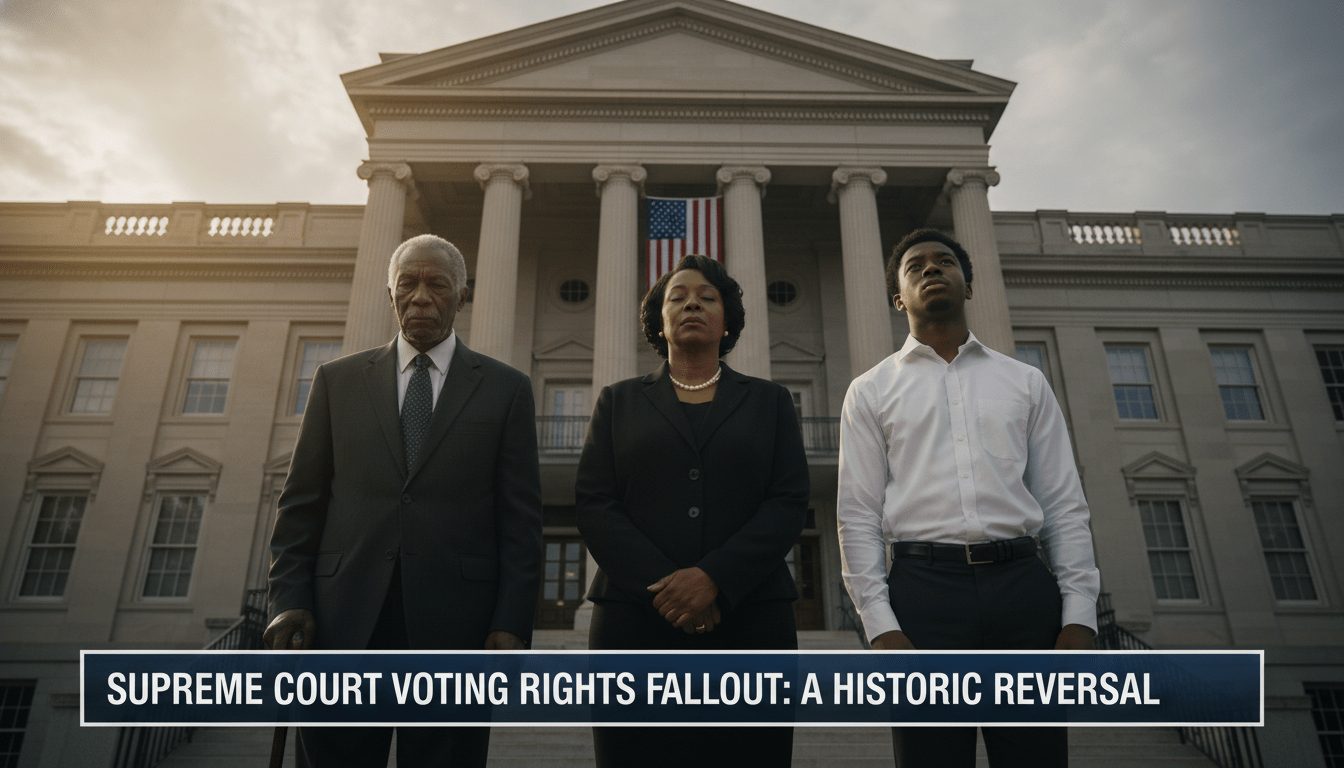
The United States Supreme Court delivered a historic decision on April 29, 2026. The 6-3 ruling in Callais v. Louisiana shocked the political world entirely. This monumental decision effectively rewrote decades of established voting rights law. The justices labeled Louisiana’s second majority-Black district an unconstitutional racial gerrymander. Consequently, this sudden move created an immediate crisis for civil rights organizations. The Congressional Black Caucus held emergency briefings within twenty-four hours. Leaders expressed deep fears about the upcoming elections under current President Donald Trump. They warned that the ruling serves as a permanent death certificate for the Voting Rights Act. Similar districts across the Southern states now face immediate and severe jeopardy. Many political experts firmly believe these maps will be dismantled before the 2028 elections (apnews.com).
The fallout from this judicial decision extends far beyond Louisiana borders. An initial analysis reveals a highly grim outlook for minority representation nationwide. Between fifteen and twenty congressional seats held by Black representatives are now at risk. These deeply vulnerable districts spread across Alabama, Georgia, and North Carolina. State legislatures are currently planning special sessions to review their own maps. Republican lawmakers explicitly aim to correct these boundaries toward strong partisan advantages. Civil rights groups argue this action will reverse decades of hard-fought progress. The nation is currently witnessing a profound shift in American electoral politics. The essential legal tools used to ensure fair representation are systematically fading away (theguardian.com).
Understanding Redistricting and Representation
Redistricting remains a fundamental constitutional requirement in the United States government. The complex process follows the decennial U.S. Census every ten years. Article I of the Constitution strictly mandates this national population count. States must redraw their legislative boundaries to ensure equal population across all districts. This specific process honors the important legal principle of one person, one vote. Population equality prevents some privileged citizens from holding more political power than others. State legislatures generally hold the exclusive authority to draw these actual lines. However, the political party in power frequently manipulates this process for gain. They utilize specific tactics to systematically dilute the voting strength of opposing groups (ballotpedia.org).
Politicians frequently employ two primary manipulative methods known as packing and cracking. Packing involves concentrating many voters of a disfavored group into a single district. This aggressive tactic wastes their excess votes and strictly limits their broader influence. Cracking purposefully splits a concentrated group of voters across several different districts. Therefore, these displaced voters can never form a political majority in any single area. These calculated strategies entirely neutralize the political power of specific demographic communities. When mapmakers weaponize these techniques against racial groups, it constitutes illegal racial gerrymandering. Majority-minority districts were specifically created to counter these highly discriminatory tactics. These unique districts allow minority groups a fair opportunity to elect preferred candidates (campaignlegal.org).
The Voting Rights Act Under Siege
The Voting Rights Act of 1965 stands as a monumental civil rights achievement. This historic piece of legislation sought to enforce the promises of the Fifteenth Amendment. The federal law explicitly prohibited denying the right to vote based on race. However, early enforcement faced significant legal hurdles in conservative federal courts. Plaintiffs originally had to definitively prove that lawmakers acted with discriminatory intent. Proving the deeply hidden motives of evasive politicians proved to be notoriously difficult. Congress eventually recognized this severe and limiting flaw in the legal framework. Lawmakers amended Section 2 of the Voting Rights Act during 1982. This crucial legislative update established a powerful new legal standard called the results test (brennancenter.org).
The new results test changed the entire landscape of American voting rights. Federal courts could finally strike down electoral maps that diluted minority voting power. The actual hidden motives behind the mapmaking process simply no longer mattered. The Supreme Court established strict, manageable guidelines in the 1986 Thornburg v. Gingles case. The Gingles preconditions strictly determined when states must draw majority-minority districts. First, a minority group needed to be large and geographically compact. Second, they also had to demonstrate strong political cohesion within their community. Finally, plaintiffs had to prove that the white majority voted as a restrictive bloc. This specific legal framework protected minority political power successfully for nearly forty years (brennancenter.org).
The Paradox of Race and the Law
The Supreme Court began complicating redistricting laws significantly during the 1990s. The controversial 1993 case of Shaw v. Reno created a massive legal contradiction. The Court ruled that states must actively consider race to satisfy the Voting Rights Act. However, the Fourteenth Amendment strictly prohibited race from being the predominant mapmaking factor. This equal protection clause prevents the federal government from classifying citizens by race. Mapmakers suddenly found themselves trapped in an incredibly confusing legal paradox. They faced federal lawsuits if they ignored race entirely during the redistricting process. Conversely, they also faced conservative lawsuits if they focused on race too heavily (wikipedia.org).
This intense legal tension perfectly mirrors the complexities of affirmative action in modern education. Conservative legal scholars consistently advocate for a completely colorblind interpretation of the Constitution. They passionately argue that any race-conscious remedy violates the strict Fourteenth Amendment. The current Supreme Court majority strongly supports this rigid colorblind approach. The Callais v. Louisiana ruling heavily favored this specific constitutional interpretation over historical context. The judicial decision essentially declared that constitutional prohibitions override remedial voting laws entirely. This ruling severely restricts the federal government from protecting minority voters nationwide. State legislatures now possess immense, unchecked power to draw maps without federal interference (lls.edu).
The Partisan Loophole in the South
A deeply historical correlation exists between race and political affiliation in the South. Black voters overwhelmingly support candidates from the national Democratic Party. Conversely, White voters largely support candidates representing the national Republican Party. This clear statistical pattern is widely known as racially polarized voting. Targeting regional voters based on political party achieves the exact same numerical result as targeting by race. This political reality created a massive legal loophole for state legislatures to exploit. The Supreme Court previously ruled that extreme partisan gerrymandering remains perfectly legal. Federal courts currently consider partisan mapmaking an entirely non-justiciable political question (bipartisanpolicy.org).
State mapmakers deliberately use this partisan loophole to shield themselves from discrimination lawsuits. They openly and confidently admit to drawing lines to secure a partisan advantage. They argue their political actions target Democrats rather than Black citizens specifically. This legal defense makes challenging discriminatory maps incredibly difficult for civil rights groups. The Callais ruling firmly affirmed this highly controversial legal strategy. The conservative justices accepted the argument that Louisiana moved voters strictly for partisan reasons. The Court declared this practice a standard, acceptable part of aggressive partisan politics. Federal judges will no longer actively police maps based on these specific demographic claims. This decision hands a highly powerful weapon to politicians seeking to maintain control (apnews.com).
The Return of Discriminatory Intent
The Callais decision fundamentally alters how federal courts evaluate voting rights cases. Plaintiffs can no longer safely rely on the highly effective 1982 results test. They must now explicitly prove that mapmakers harbored specific, purposeful discriminatory intent. This incredibly high legal hurdle aggressively returns the country to a pre-1982 standard. Justice Elena Kagan wrote a blistering, historically significant dissent against the majority opinion. She strongly noted that this new standard renders Section 2 practically useless. Legal critics frequently refer to the severely weakened law as a dead letter. Proving purposeful discrimination requires incredibly deep investigations into private legislative actions (brennancenter.org).
Federal courts use specific judicial criteria called the Arlington Heights factors to find intent. Judges must thoroughly examine the historical background of the controversial state decision. They carefully look for long-standing patterns of discriminatory actions by local lawmakers. They also heavily scrutinize the exact sequence of events during the redistricting process. Rushing a map through a special session with limited public input naturally raises suspicions. Substantive departures from traditional districting principles also serve as crucial circumstantial evidence. However, uncovering outright, documented legislative bias remains an incredibly difficult task for legal teams. Modern mapmakers rarely leave written evidence of their deep-seated discriminatory motives (lls.edu).
A Second Redemption in Modern Times
Historians draw very clear parallels between current political events and the late nineteenth century. Many prominent legal scholars describe the current era as the Second Redemption. The original First Redemption occurred after the historical period of Reconstruction ended. White Southern Democrats forcefully regained control of state governments during that turbulent time. They rapidly implemented harsh Jim Crow laws to strictly eliminate Black political participation. This devastating era highlights the troubling history of black voter disenfranchisement in America. Significant advancements in civil rights frequently face intense legal and political backlash (eji.org).
The modern Second Redemption officially began with the Shelby County v. Holder decision in 2013. The Supreme Court effectively removed federal preclearance oversight for states with known discriminatory histories. The recent Callais ruling rapidly accelerates this systematic dismantling of legal protections. These judicial decisions reflect a much broader shift in the political narrative across America. Periods of significant democratic expansion almost always trigger aggressive efforts to restrict voting access. The systematic removal of voting protections leaves minority communities highly vulnerable today. State legislatures act with increasing confidence in their ability to suppress diverse voices. The heavy emotional weight of these repeated historical cycles burdens civil rights advocates heavily (splcenter.org).
Non-Black Voters and the Callais Case
The major lawsuit against Louisiana was brought by a very specific group of citizens. Twelve white Louisianians formally sued to block the finalized 2024 congressional map. These individuals specifically identified themselves as non-Black voters in formal legal documents. They strongly argued the state created an unconstitutional racial quota for congressional representation. Prominent conservative legal organizations heavily backed and fully funded this controversial lawsuit. Their primary legal argument focused completely on the disruption of traditional districting principles. They claimed the new district boundaries ignored geographical compactness and localized communities of interest. Ultimately, the lawsuit successfully convinced the Supreme Court to strike down the finalized map (theguardian.com).
The unexpected creation of the second majority-Black district had heavily impacted incumbent politicians. Republican Representative Garret Graves immediately announced he would decline to seek reelection. The new legislative district stretched dramatically from Shreveport to the city of Baton Rouge. This unusual layout made the geographic area politically unfavorable for any conservative incumbent. Graves publicly stated that running for Congress simply did not make sense anymore. The district essentially transformed into an open political seat for the upcoming election. The recent Supreme Court ruling completely changes this complex political dynamic once again. Graves will finish his current term, but the specific district will eventually vanish (forbes.com).
The Fight for the John Lewis Act
Civil rights organizations absolutely refuse to accept these heavy judicial defeats without a struggle. The Congressional Black Caucus demands immediate federal action to firmly protect voters. They are aggressively pushing for the passage of the John Lewis Voting Rights Advancement Act. This highly anticipated proposed federal bill aims to fully restore the original 1965 legislation. The act would introduce a brand new, highly modernized preclearance formula for problem states. Jurisdictions with recent, documented histories of discrimination would absolutely require federal approval for changes. This legislation targets specific practices frequently used to suppress minority voter turnout (house.gov).
The proposed federal legislation directly counters recent Supreme Court rulings like the Brnovich decision. It strictly requires public notice for any changes to voting laws before a major election. This high level of transparency strictly prevents state lawmakers from quietly altering polling place access. It also restricts states from shifting highly diverse areas into at-large election systems. Passing this crucial legislation remains highly uncertain in the deeply polarized current political climate. The current administration and heavily divided Congress present significant hurdles for leading civil rights advocates. However, legal experts maintain that federal legislation remains the absolute only viable path forward. State courts alone simply cannot guarantee the robust protection of fundamental constitutional rights (rockthevote.org).
The Future of Black Political Power
The ultimate future of multiracial representation hangs very delicately in the balance today. The Callais v. Louisiana decision definitively marks a dangerous pivot point for American democracy. Decades of steady political progress currently face an unprecedented and highly organized legal threat. Black elected officials impressively grew from barely a thousand in 1970 to over ten thousand today. The influential Congressional Black Caucus actively expanded from thirteen members to sixty-five members. These incredibly historic gains are now at immediate, terrifying risk of severe reversal. Southern states will undoubtedly use this new ruling to actively redesign their political landscapes (apnews.com).
Dedicated advocates must firmly prepare for grueling, expensive legal battles leading up to 2028. State legislatures currently hold the ultimate, unchecked power to dictate minority political influence. The conservative Supreme Court effectively handed the legislative keys back to local politicians entirely. Concerned citizens must swiftly turn their strict attention toward state courts and intense grassroots organizing. Combating extreme partisan gerrymandering strictly requires massive voter turnout and absolute community solidarity. The ongoing fight for voting rights remains a continuous, generational struggle for total equality. Marginalized communities must remain highly vigilant against every single attempt to silence their collective voices (democraticredistricting.com).
About the Author
Darius Spearman is a professor of Black Studies at San Diego City College, where he has been teaching for over 20 years. He is the founder of African Elements, a media platform dedicated to providing educational resources on the history and culture of the African diaspora. Through his work, Spearman aims to empower and educate by bringing historical context to contemporary issues affecting the Black community.
