



/
RSS Feed
Tennessee NAACP Redistricting Petition Demands Fair Voting Rights
By Darius Spearman (africanelements)
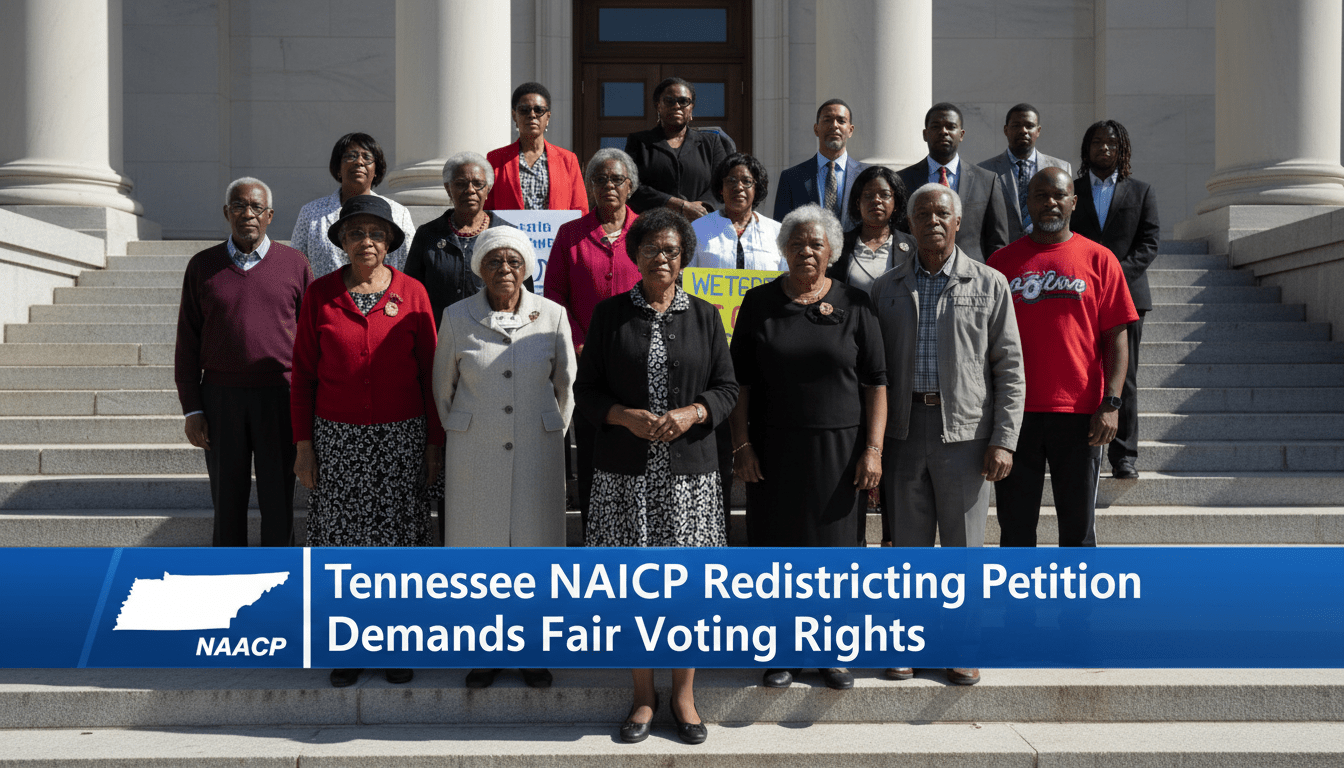
The Tennessee NAACP has launched an urgent legal battle. They filed an emergency court petition to block new congressional maps. Advocates argue the redrawing is an unconstitutional racial gerrymander. The maps dismantle the only majority-Black district in the state. This calculated move aims to cement partisan advantage for the ruling party. The current controversy is simply the latest chapter in history. It represents a century-long struggle over Black political representation in the American South. State leaders have historically targeted African American voters through strategic district lines.Support African Elements at patreon.com/africanelements and hear recent news in a single playlist. Additionally, you can gain early access to ad-free video content.
A Century of Struggle for Black Representation
The fight for voting rights in Tennessee runs extremely deep. The state witnessed a brief surge in Black political participation during the Reconstruction Era. Black men gained the right to vote through the 15th Amendment in 1870. Voters sent several Black representatives to the state legislature. However, this progress faced a violent and immediate backlash. Tennessee was the birthplace of the Ku Klux Klan in 1865. The state later implemented harsh Jim Crow measures to maintain white supremacy. Leaders instituted poll taxes and literacy tests to disenfranchise Black voters. Newly emancipated individuals continued to face involuntary servitude long after the Civil War ended. The Ku Klux Klan used organized terror to suppress the Black vote. They targeted individuals who attempted to exercise their constitutional rights. Local governments actively ignored these blatant acts of racial violence. White supremacist groups operated with complete impunity for many decades. The federal government eventually intervened to protect minority voters. The Voting Rights Act of 1965 fundamentally changed the political landscape. Section 2 of the Act became the crown jewel of the movement. It prohibited any practice resulting in the denial of voting rights based on race. The law forced states to create districts where Black voters could elect preferred candidates (constitutioncenter.org). Civil rights leaders fought tirelessly to secure these critical legal protections. The recent redistricting efforts threaten to undo decades of this hard-won progress.The Impact of a Recent Supreme Court Ruling
The current crisis traces back to a landmark Supreme Court decision. In April 2026, the Court ruled on the Louisiana v. Callais case. The conservative majority delivered a significant blow to the Voting Rights Act. They ruled 6-3 that Louisiana created an unconstitutional racial gerrymander (supremecourt.gov). Louisiana had drawn a second majority-Black congressional district following a lower court order. The Supreme Court claimed the state prioritized race over traditional districting principles. Justice Samuel Alito led the logic for the majority opinion. He stated that mere disproportionate representation does not prove an unequal opportunity. The ruling determined that Louisiana failed to disentangle race from politics. The Court concluded that compliance with a lower court finding does not justify race-based redistricting. This decision severely weakened Section 2 of the Voting Rights Act. The ruling overturned years of established legal precedent regarding minority representation. Justice Alito argued that traditional districting must take absolute priority. He insisted that race cannot be the predominant factor in map drawing. This interpretation ignores the reality of racially polarized voting in the South. It places a massive burden on civil rights organizations moving forward. They must now prove intentional discrimination to strike down unfair maps. Disproportionate representation is no longer enough to trigger federal intervention. The ruling gave Southern states a clear green light to alter maps. They now have legal cover to dismantle majority-minority districts.Dismantling the Memphis Bastion of Black Power
Memphis has served as a critical stronghold for Black voters. The 9th Congressional District is the only majority-minority district in Tennessee. Since the 1970s, the district has elected candidates preferred by Black constituents. The Ford family dynasty represented the area for 32 years. Steve Cohen, a white Democrat, won the seat in 2006. Cohen remained the candidate of choice for the majority-Black constituency (wikipedia.org). The new 2026 maps completely shatter this unified voting bloc. The redrawn boundaries crack the 9th District into three separate pieces. Memphis has a population that is over 60 percent Black. The new plan splits the city and absorbs the fragments into rural areas. These new surrounding districts lean heavily white and Republican. This maneuver drops the Black voting-age population in the area to roughly 39 percent. Cohen strongly denounced the redistricting plan as incredibly harmful to constituents. He called it the wholesale destruction of democratic representation in Tennessee. The 9th District previously served as a unified base for the community. Residents shared common economic and social concerns across the city. The new map fractures this vibrant cultural and political hub. Lawmakers divided the Black voting population into roughly equal thirds. They scattered these voters across three massive rural districts. The drastic reduction makes it nearly impossible for Black voters to elect their preferred candidate. The cracking of Memphis effectively ends true representation for the urban Black community.Black Voting-Age Population in Memphis (TN-9)
The Strategy Behind the 2026 Special Session
The timeline of the redistricting effort reveals a calculated strategy. Days after the Supreme Court ruling, Tennessee Governor Bill Lee took action. He called a special legislative session in May 2026. The explicit goal was to redraw the congressional maps before the upcoming elections. To accomplish this, Republicans had to overcome a major legal hurdle. They moved to repeal a standing 1972 state law. The 1972 law prohibited mid-decade redistricting in Tennessee. It required congressional boundaries to remain stable between decennial federal censuses. The original intent was to prevent political power grabs (legisletter.org). Proponents argued the law protected election integrity by stopping constant line-drawing. The legislative history of the 1972 law is very clear. Lawmakers originally designed the statute to reduce voter confusion. They wanted to avoid the administrative burden of constantly retraining election officials. State attorneys defended this exact principle during a 2022 court battle. They argued that mid-decade changes compromise the entire electoral process. State officials previously warned that changing lines would wreak chaos on elections. Despite these warnings, lawmakers repealed the statute during the special session. This sudden reversal allowed them to ram the new maps through the legislature. The aggressive timeline forced massive changes right before the candidate qualifying deadline. The sudden reversal in 2026 exposes a clear partisan motive.Tennessee Congressional Delegation Shift
Pre-2022
2022 Map
2026 Map
Hover over or tap this box to animate the shift.
The NAACP Emergency Petition Legal Arguments
The Tennessee NAACP quickly responded to the aggressive legislative maneuvering. They filed an emergency court petition immediately after Governor Lee signed the maps. The lawsuit aims to halt the use of the new districts before the election. The NAACP bases their case on several strong legal arguments. First, they claim the repeal of the 1972 law was procedurally illegal. The Tennessee Constitution restricts what lawmakers can do during a special session. Article 3, Section 9 grants the Governor power to convene extraordinary sessions. However, lawmakers can only transact business specifically listed in the Governor’s formal proclamation. The NAACP argues the initial call did not authorize changing standing state statutes. The original call focused entirely on the U.S. House map redistricting. Repealing a 50-year-old law is a completely separate legislative act. Therefore, repealing the anti-redistricting law exceeded the scope of the session. The NAACP insists this action requires standard public notice and debate. Lawmakers bypassed these fundamental democratic procedures to achieve their goals. This lack of transparency alarms voting rights advocates across the nation. Furthermore, the petition argues the maps constitute an illegal racial gerrymander. Advocates state the redrawing deliberately guts Black voting power in Memphis. They assert the maps were explicitly designed to cement partisan advantage (tntribune.com).Erasing Black Political Power in the South
The consequences of these new maps are severe and far-reaching. Advocates view the redistricting as a targeted attack on democracy. State lawmakers like Representative Justin Jones and Senator Raumesh Akbari have spoken out. They characterized the move as the greatest blow to Black political power since Reconstruction. The strategy mirrors historical attempts to disenfranchise minority communities. Lawmakers attempt to achieve through line-drawing what poll taxes accomplished previously. This maneuver is part of a larger trend across the Southern states. Activists often refer to this as the New Southern Strategy. Politicians use complex legal loopholes to systematically dilute the Black vote. They disguise racial discrimination as routine partisan politics. They claim the maps simply favor Republicans over Democrats to maintain power. However, race and partisan affiliation are deeply intertwined in the South. African Americans have long fought for economic justice and fair representation against overwhelming odds. The systematic cracking of Black communities creates nearly insurmountable political barriers. The strategy deliberately fragments cohesive minority populations to weaken their voice. A robust call for racial justice remains necessary to combat these ongoing suppression tactics. Civil rights groups recognize that drawing maps is a tool of oppression. The redistricting battle in Tennessee perfectly illustrates this enduring struggle.The High Stakes of the Upcoming Elections
The timing of the new maps creates immediate chaos for voters. Lawmakers passed the changes in early May 2026. This timeline leaves very little room before the November midterm elections. The legislature pushed the candidate qualifying deadline to May 15, 2026. This extension allowed politicians to navigate the drastically altered districts. Election administrators warned that changing lines this late is incredibly difficult. They must rebuild election templates and reprogram registration systems immediately. The lawsuit argues that late changes severely harm the electoral process. Changing the rules on the eve of an election is historically dangerous. It disenfranchises military and overseas voters who rely on stable information. These individuals need accurate ballot data well in advance of election day. The current chaos threatens the fundamental right to vote for thousands. If the emergency petition fails, the political landscape will shift dramatically. Tennessee has a population that is over 25 percent people of color. Yet, the state could soon have a completely homogenous congressional delegation. The 2026 redistricting projects a 9-0 Republican sweep of the state. This result would leave Black residents without a dedicated voice in Congress. Donald Trump currently occupies the White House. His administration often appoints conservative judges who uphold these restrictive maps. The fight over the Tennessee NAACP redistricting petition represents a crucial national flashpoint.The 2026 Emergency Redistricting Timeline
April 2026
Supreme Court weakens VRA in Louisiana v. Callais.
Early May 2026
Governor Lee calls a special legislative session. Lawmakers repeal the 1972 law.
May 8-9, 2026
NAACP files an emergency court petition to block the new TN-9 map.
May 15, 2026
Extended candidate qualifying deadline for the upcoming elections.
About the Author
Darius Spearman is a professor of Black Studies at San Diego City College, where he has been teaching for over 20 years. He is the founder of African Elements, a media platform dedicated to providing educational resources on the history and culture of the African diaspora. Through his work, Spearman aims to empower and educate by bringing historical context to contemporary issues affecting the Black community.
