

The Haiti TPS Supreme Court Ruling and Black Immigrant Rights
By Darius Spearman (africanelements)
Support African Elements at patreon.com/africanelements and hear recent news in a single playlist. Additionally, you can gain early access to ad-free video content.
The High Court Decides
The United States Supreme Court delivered a monumental decision on June 25, 2026 (supremecourt.gov). The court ruled on the consolidated cases of *Mullin v. Doe* and *Trump v. Miot* (supremecourt.gov). In a swift six-to-three ruling, the conservative majority expanded federal executive power (supremecourt.gov, supremecourt.gov). The majority declared that the executive branch holds absolute authority to end Temporary Protected Status (supremecourt.gov).
This ruling immediately affects approximately 350,000 Haitian immigrants within the United States (americanimmigrationcouncil.org). Additionally, it strips deportation protections from 6,000 Syrian immigrants (rescue.org). Consequently, the Department of Homeland Security may proceed with these policy terminations (americanimmigrationcouncil.org). The decision marks a major shift in federal immigration jurisprudence (supremecourt.gov). Furthermore, it leaves hundreds of thousands of families facing an uncertain future (haitianbridgealliance.org).
Origins of the Humanitarian Shield
To comprehend this ruling, one must examine the history of the Temporary Protected Status program. Congress created this humanitarian pathway under the Immigration Act of 1990 (forumtogether.org, wikipedia.org). The legislation allows the federal government to grant safety to foreign nationals who cannot return home (americanimmigrationcouncil.org). This protection applies during times of ongoing armed conflict, environmental disasters, or epidemics (americanimmigrationcouncil.org).
Historically, this policy has provided work permits and deportation relief to millions of people (americanimmigrationcouncil.org). It was designed to serve as a temporary shield. However, as crises persisted in home countries, administrations repeatedly extended these protections (fwd.us). This practice allowed immigrants to establish deep roots within the United States. They built careers, purchased homes, and raised families over several decades (fwd.us).
Haiti’s First Designation
The United States first designated Haiti for Temporary Protected Status in January 2010 (wikipedia.org). This designation followed a devastating 7.0-magnitude earthquake near Port-au-Prince (wikipedia.org). The catastrophic event killed over 300,000 people and destroyed the national infrastructure (wikipedia.org). Returning hundreds of thousands of people to a collapsed state was a humanitarian impossibility (rescue.org). These events highlight America’s deep historical ties with Haiti.
Over the next decade, successive administrations renewed the protections as Haiti struggled to recover (americanimmigrationcouncil.org). However, the political environment shifted dramatically in 2017 (americanimmigrationcouncil.org). The first Trump administration adopted a restrictive view of the program (americanimmigrationcouncil.org). Officials argued that the government should only evaluate the original emergency (americanimmigrationcouncil.org). Consequently, the Department of Homeland Security announced the termination of Haiti’s status (aclunorcal.org). This announcement triggered immediate and intense legal challenges from immigrant advocates (americanimmigrationcouncil.org).
Extension Versus Redesignation
The legal battles over the program highlight the vital difference between an extension and a redesignation. An extension simply allows existing status holders to renew their current protections (uscis.gov). It does not open the program to new applicants. By contrast, a redesignation changes the arrival cutoff date (uscis.gov). This change permits newly arrived migrants to apply for protection (uscis.gov).
In 2021, the Biden administration both extended and redesignated Haiti for Temporary Protected Status (dhs.gov). This move responded to the assassination of President Jovenel Moïse and rampant gang violence (rescue.org). The decision expanded the protected population to over 350,000 Haitian nationals (americanimmigrationcouncil.org). Historically, the Trump administration had tried to end the original 2010 designation (aclunorcal.org). That effort was blocked temporarily by the federal court case *Ramos v. Nielsen* (americanimmigrationcouncil.org).
Bypassing the Courts: Certiorari Before Judgment
The path of Mullin v. Doe to the high court was highly unusual. When the second Trump administration took office, it moved quickly to dismantle long-term designations (supremecourt.gov). In late 2025, the government announced the termination of status for Haiti and Syria (supremecourt.gov). Impacted immigrants quickly filed lawsuits in federal district courts to halt the terminations (supremecourt.gov).
After district courts blocked the policy, the federal government bypassed the standard appellate process (supremecourt.gov). The administration requested a rare mechanism known as certiorari before judgment (constitutioncenter.org, supremecourt.gov). This extraordinary procedure allows the Supreme Court to review a case while pending in lower courts (constitutioncenter.org). The Supreme Court granted this fast-track request on March 16, 2026 (supremecourt.gov). This swift process highlights the shifting balance of federal power.
The Statutory Bar and Executive Freedom
The primary legal dispute focused on the Administrative Procedure Act and a specific federal immigration statute (supremecourt.gov). Under the Administrative Procedure Act, federal agencies must follow strict rules when changing policies (cornell.edu). Plaintiffs argued that the Department of Homeland Security failed to consult properly with other agencies (supremecourt.gov). They claimed the decision-making process was arbitrary and capricious (supremecourt.gov).
However, the Supreme Court majority focused on the plain language of 8 U.S.C. Section 1254a(b)(5)(A) (supremecourt.gov). This provision explicitly bars judicial review of executive decisions regarding Temporary Protected Status (supremecourt.gov). Justice Samuel Alito wrote that this statutory bar precludes all non-constitutional challenges (supremecourt.gov). Consequently, federal courts cannot review whether the administration followed correct administrative procedures (supremecourt.gov). This ruling heavily insulates future executive branch actions from procedural lawsuits (supremecourt.gov).
Constitutional Shield: Equal Protection Under the Fifth Amendment
Because the statutory bar does not block constitutional claims, plaintiffs relied on the Fifth Amendment (supremecourt.gov, supremecourt.gov). Under normal circumstances, equal protection claims are associated with the Fourteenth Amendment (supremecourt.gov). However, that amendment only applies to state actions, not the federal government (cornell.edu, supremecourt.gov). To challenge federal discrimination, plaintiffs must rely on the Fifth Amendment’s Due Process Clause (supremecourt.gov).
The Supreme Court has historically read an equal protection component into the Fifth Amendment (supremecourt.gov). This interpretation was established in the landmark 1954 case *Bolling v. Sharpe* (supremecourt.gov). The Haitian plaintiffs argued that the termination was motivated by racial animus against Black immigrants (americanimmigrationcouncil.org, naacp.org). This ruling mirrors broader debates over racial equity in federal courts.
However, Justice Clarence Thomas argued in his concurring opinion that the Fifth Amendment lacks an equal protection clause (supremecourt.gov). He asserted that non-citizens have no constitutional equal protection rights against federal policies (supremecourt.gov). The conservative majority ultimately concluded that the challengers were unlikely to succeed on this constitutional claim (supremecourt.gov). This finding effectively dismantled the final legal defense of the plaintiffs (supremecourt.gov).
Parsing the President’s Controversial Comments
The plaintiffs presented evidence of racial animus by pointing to statements made by political leaders (aclusocal.org, ballsandstrikes.org). They highlighted private comments where President Donald Trump referred to Haiti as a “shithole country” (aclusocal.org). He also expressed a clear preference for immigrants from white nations like Norway (supremecourt.gov). Despite the outrage these remarks caused, the Supreme Court majority rejected them as proof of discrimination (supremecourt.gov).
Justice Samuel Alito wrote that the controversial comments did not constitute overtly racial discrimination (supremecourt.gov). He framed the statements as heated political discourse rather than evidence of illegal animus (supremecourt.gov). Additionally, Alito noted that the administration had race-neutral justifications for ending the program (supremecourt.gov). He asserted that opposition to the long-term nature of the program was a valid policy view (supremecourt.gov). This interpretation sets a high bar for proving racial discrimination in federal policy.
Florida is home to over 93,000 Haitian TPS holders. Small and mid-sized hospitality firms expect operating margins to decline by 2% to 5% due to recruitment and retraining costs.
The Immediate Transition into Legal Shadows
The Supreme Court’s ruling on June 25, 2026, does not cause immediate deportations (supremecourt.gov). The decision is scheduled to officially take effect 32 days after the ruling date (supremecourt.gov). This brief window gives families and employers a very short period to prepare (supremecourt.gov). Once the ruling takes effect, the immediate consequences will be severe (supremecourt.gov).
Impacted Haitian and Syrian nationals will lose their lawful work permits and driver’s licenses (americanimmigrationcouncil.org). Employers must immediately prepare for Form I-9 reverifications to avoid federal penalties (littler.com, ogletree.com). While the ruling strips deportation protections, people will not be removed immediately on the first day (americanimmigrationcouncil.org). Instead, they are cast into a dangerous legal limbo where they face potential detention and deportation (haitianbridgealliance.org).
Shattered Households and Citizen Children
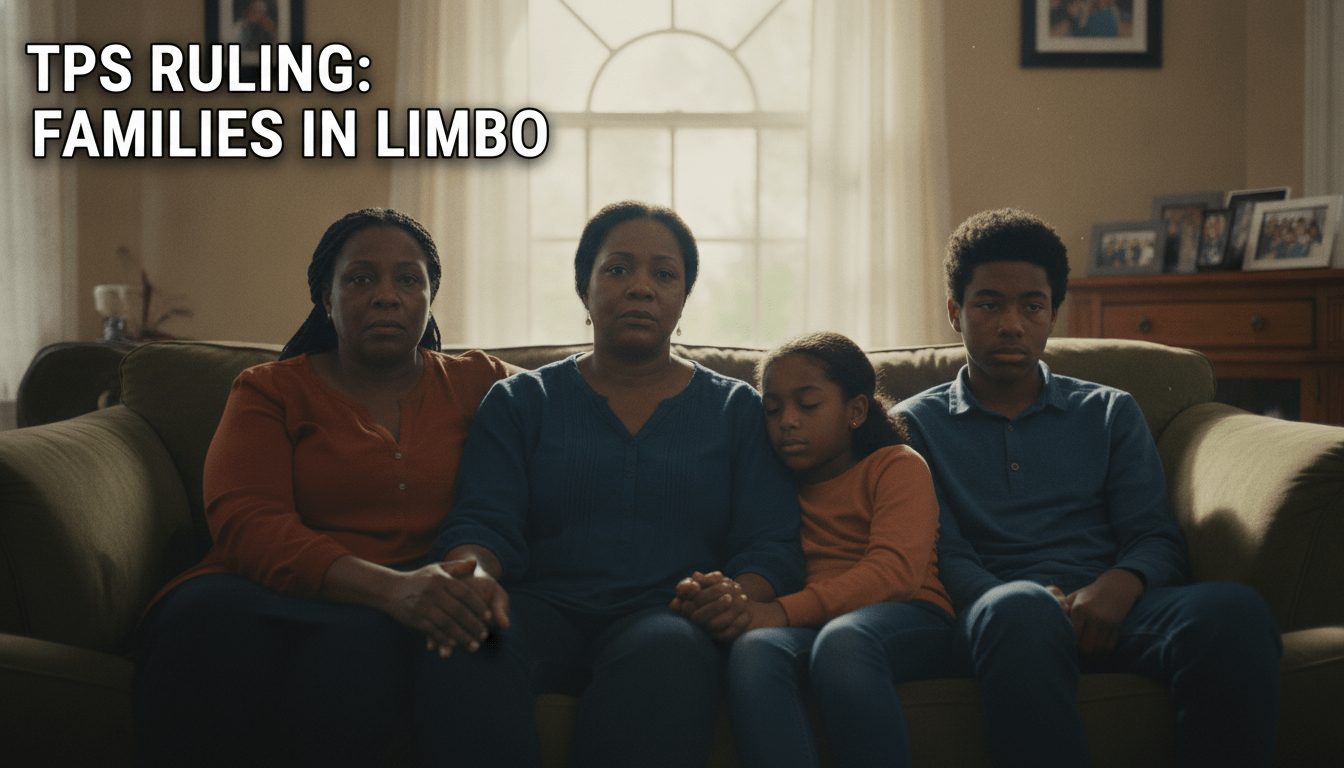
The end of Temporary Protected Status will tear many families apart. Over several decades, many status holders have raised thousands of children who are United States citizens (americanimmigrationcouncil.org). These children have never lived in any other nation (americanimmigrationcouncil.org). Legal organizations estimate that 25,000 citizen children could be pushed into poverty if their parents lose work permits (fwd.us).
Consequently, parents face an impossible choice. They must decide whether to leave their children behind or take them to dangerous nations (fwd.us). Uprooting children to send them to countries like Haiti or Syria exposes them to violence and decay (rescue.org). The psychological toll of this forced separation is immense. These family disruptions demonstrate the deep systemic inequalities inherent in modern legal battles.
Systemic Inequality and the Black Diaspora
The ruling has drawn fierce condemnation from major civil rights organizations. Groups like the NAACP and the Haitian Bridge Alliance have spoken out against the decision (haitianbridgealliance.org, naacp.org). They argue that the policy disproportionately harms Black immigrants (naacp.org). Activists view the decision as a systemic devaluation of Black lives in American policy (haitianbridgealliance.org). This struggle resembles other modern systemic equity initiatives across the nation.
Furthermore, advocates state that the ruling feeds a massive deportation machine that views Black refugees as undesirable (haitianbridgealliance.org). They label this ruling as part of the largest de-documentation effort in modern history (binnews.com). By stripping legal protections, the government pushes hundreds of thousands of people into the shadows (haitianbridgealliance.org). This outcome aligns with historical efforts to deny basic civil rights to marginalized populations.
Conclusion: A Shift in American Asylum Policy
The Supreme Court’s decision in Mullin v. Doe represents a watershed moment in immigration law (supremecourt.gov). By validating the executive branch’s unchecked power to terminate humanitarian protections, the Court limited the ability of judges to intervene (supremecourt.gov). The ruling leaves over 350,000 people without a clear path to legal status (americanimmigrationcouncil.org).
As the 32-day transition window closes, the human and economic costs will begin to accumulate (supremecourt.gov). Haitian communities across the country face a profound crisis of displacement and separation (haitianbridgealliance.org). The legal battle is over, but the struggle for survival for these families is just beginning (haitianbridgealliance.org).
About the Author
Darius Spearman is a professor of Black Studies at San Diego City College, where he has been teaching for over 20 years. He is the founder of African Elements, a media platform dedicated to providing educational resources on the history and culture of the African diaspora. Through his work, Spearman aims to empower and educate by bringing historical context to contemporary issues affecting the Black community.
