


How Extreme Heat Waves Threaten Our Vulnerable Communities
By Darius Spearman (africanelements)
Support African Elements at patreon.com/africanelements and hear recent news in a single playlist. Additionally, you can gain early access to ad-free video content.
During the Fourth of July holiday weekend, a massive weather system known as a heat dome settled over the United States (democracynow.org). This system put more than 185 million people under extreme heat warnings (democracynow.org). Temperatures climbed past 100 degrees Fahrenheit in over 20 states, making outdoor activities highly dangerous. This weather event turned traditional holiday celebrations into a national public health crisis. It showed how rising temperatures put immense pressure on local communities and public safety systems.
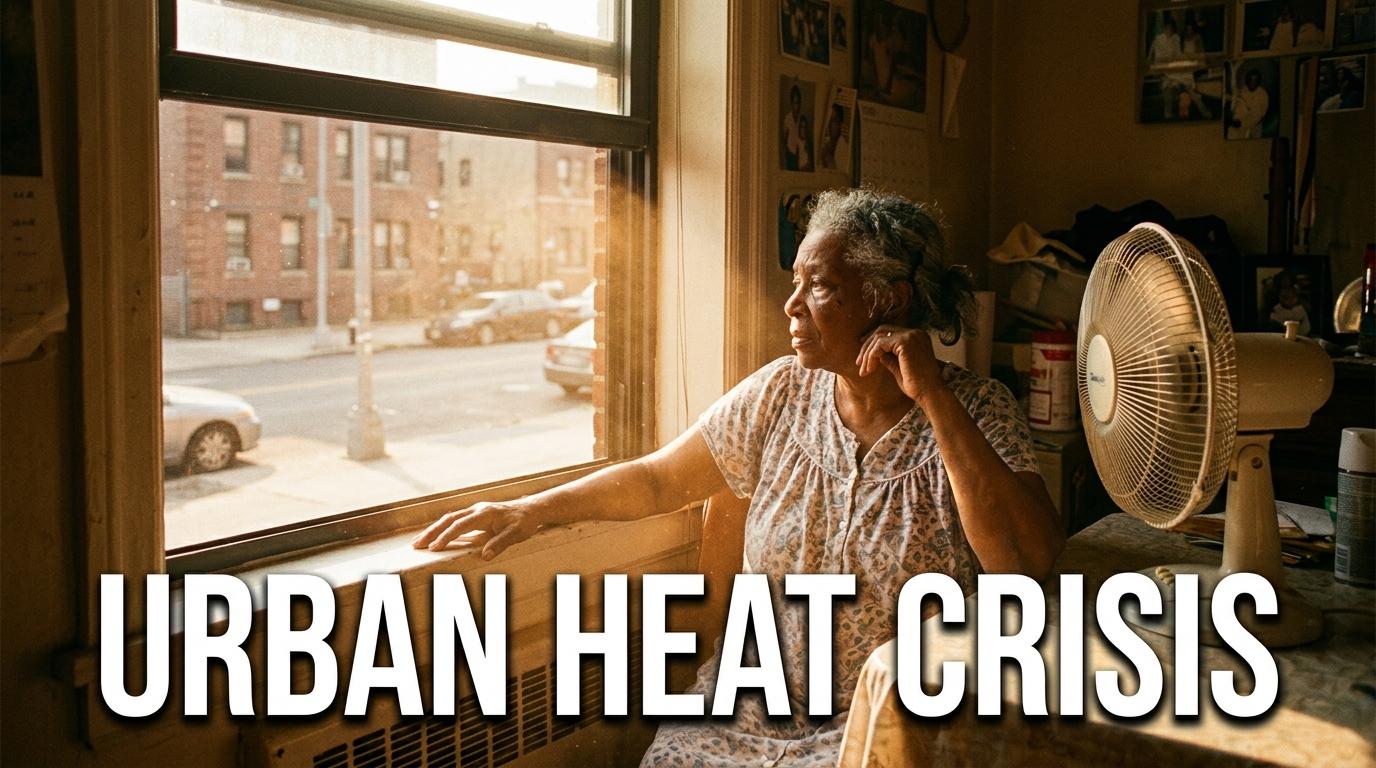
By the time the holiday weekend ended, local officials reported that at least 40 people had died from heat-related causes (democracynow.org). State health departments confirmed that New Jersey alone suffered 29 suspected heat deaths (democracynow.org). Many of these victims were discovered inside homes that lacked functioning air conditioning systems (democracynow.org). At the same time, major transportation networks collapsed. Pavement buckled on interstate highways, and electrical grids failed under the heavy load of cooling units. This disaster is not an isolated event. It is the result of long-term environmental and social trends that have been building for decades.
Lessons From the Deadliest Heat Waves in American History
Extreme heat is the deadliest weather hazard in the United States. However, the dangers of hot weather are not shared equally. Historically, heat waves have evolved from natural weather events into structural disasters that target vulnerable urban populations. To understand the current crisis, one must examine how past disasters affected marginalized urban neighborhoods. These historical events demonstrate that extreme weather becomes deadly when combined with social isolation and systemic neglect.
The Great North American Heat Wave of 1936 remains one of the worst weather disasters in modern American history (epa.gov). During the Dust Bowl era, temperatures exceeded 110 degrees Fahrenheit across the American Midwest (epa.gov). Poor agricultural land management stripped the soil of moisture, turning fields into giant heat-trapping surfaces. Over 5,000 people died during this event (epa.gov). During this period, cities lacked modern cooling infrastructure, leaving poor residents with very few ways to escape the oppressive air.
Decades later, the historic 1995 Chicago heat wave killed over 700 people in just five days (capitalbnews.org). This event changed the way researchers view extreme weather. It showed that social vulnerability determines who lives and who dies during environmental crises. The vast majority of the victims in Chicago were elderly, low-income, and Black residents (capitalbnews.org). Many of these individuals lived in neighborhoods that lacked basic community resources and commercial spaces. The tragedy demonstrated how historical challenges continue to affect the astonishing strength and resilience of African American families when faced with sudden environmental disasters.
In neighborhoods like Lawndale, elderly residents faced a choice between paying rent or paying for electricity to run air conditioners (capitalbnews.org). Many chose to keep their windows closed because they feared local crime (capitalbnews.org). Others lacked trust in public emergency services and remained isolated in their homes. Municipal leaders failed to declare an emergency until local morgues became completely overwhelmed (capitalbnews.org). This tragedy proved that heat waves are social disasters that expose deep infrastructure cracks within major American cities.
U.S. Heat Wave Frequency Over Time
Average number of annual extreme heat waves in the United States since the 1980s.
Redlining and the Creation of Urban Heat Islands
The unequal distribution of heat within modern cities is not an accident of nature. It is the direct result of historical real estate practices and local government policies. The Urban Heat Island effect occurs when built environments trap more heat than nearby rural areas. This happens because pavement, concrete roofs, and asphalt roads absorb solar radiation during the day and release it at night. This phenomenon turns paved inner-city neighborhoods into dangerous micro-climates during summer months.
Historically, federal and local housing agencies used a discriminatory practice called redlining to grade urban neighborhoods (tpl.org). During the 1930s, the Home Owners’ Loan Corporation drew red lines around neighborhoods with high concentrations of Black residents (tpl.org). These areas were marked as hazardous for financial investment. As a result, commercial banks denied mortgages to Black home buyers, and municipal governments starved these districts of critical public funding. This systematic disinvestment prevented the development of parks, gardens, and community green spaces.
Today, these formerly redlined neighborhoods continue to suffer from these historical decisions. A national study of 108 urban areas showed that formerly redlined districts are significantly hotter than wealthier, whiter areas in the same cities (tpl.org). These neighborhoods are, on average, 5 degrees Fahrenheit warmer during the summer months (tpl.org). In some major cities, the temperature difference can reach up to 12 degrees Fahrenheit (tpl.org). The lack of shade and green space makes these areas hazardous to human health. This physical isolation reflects the political shift from civil rights to mass incarceration, which concentrated resources away from marginalized urban centers.
Furthermore, these hotter neighborhoods have only half the tree canopy coverage of wealthier districts (tpl.org). Trees are essential because they provide natural shade and cool the air through moisture evaporation. Without trees, heat-absorbing concrete and asphalt dominate the landscape. Low-income residents find themselves trapped in localized zones of extreme heat. These neighborhoods lack the natural cooling infrastructure needed to survive rising summer temperatures.
The Urban Heat Island Disparity
How historical redlining translates to higher localized summer temperatures today.
Energy Poverty and the Struggle for Air Conditioning
Inside the home, the primary defense against extreme heat is air conditioning. However, millions of low-income families cannot access or afford this basic life-saving technology. This barrier is known as energy poverty. It occurs when a household must spend a disproportionate share of its income on basic utility bills. This economic challenge forces families to make dangerous compromises with their health during heat waves.
Studies show that heat-related mortality is twice as high among Black populations compared to white populations (capitalbnews.org). Researchers have found that 64 percent of this tragic disparity is directly linked to the lack of central air conditioning (capitalbnews.org). Many older, low-income homes are built with poor insulation, which traps heat inside the structure. Without central cooling, indoor temperatures can quickly rise to life-threatening levels.
Furthermore, buying and maintaining a window air conditioning unit is financially impossible for many families. Retail prices for reliable units range from several hundred dollars to nearly one thousand dollars (cfpublic.org). In Brooklyn, a 71-year-old retiree on a fixed income attempted to acquire a free cooling unit through a municipal assistance program (cfpublic.org). However, the program ran out of devices just as the record-breaking July heat wave arrived (cfpublic.org). This failure illustrates how public safety nets often collapse when they are needed most. This economic divide is part of a longer history where the Civil War failed to end slavery, leaving legacy systems of financial inequality that persist in the housing market today.
Even when families own cooling units, the cost of electricity presents a major obstacle. More than one-third of elderly Americans restrict their use of air conditioning during extreme heat waves due to the fear of high utility bills (nih.gov). This fear is well-founded, as utility rates often spike during periods of high demand. As a result, vulnerable residents leave their units turned off, choosing to endure dangerous indoor temperatures to avoid financial ruin. These economic realities make heat waves far more deadly for low-income households.
The Emerging Science of Climate Attribution
For many years, meteorologists treated extreme heat waves as simple products of natural weather cycles. Scientists avoided linking individual weather events to global climate change. However, the field of climate science has advanced rapidly over the past two decades. Today, researchers can calculate exactly how much human activity has influenced specific weather events. This field of study is called climate attribution science.
This scientific breakthrough began in 2004, following a catastrophic European heat wave that killed tens of thousands of people (europa.eu). Researchers developed complex computer models to compare our actual atmosphere with a simulated atmosphere that had no human-caused greenhouse gases (europa.eu). This study proved that industrial emissions had doubled the probability of the heat wave occurring (europa.eu). This marked the first time that scientists could directly link human-induced global warming to a specific weather disaster.
Today, researchers use real-time tracking systems to analyze extreme heat events as they occur. One of these tools is the Climate Shift Index, which was developed by Climate Central (climatecentral.org). During the July holiday weekend, vast areas of the United States reached a Climate Shift Index level of 5 (climatecentral.org). This means that human-caused climate change made the extreme temperatures at least five times more likely to occur (climatecentral.org). These tools remove any doubt about the direct connection between industrial pollution and deadly local heat waves.
Climate Shift Index (CSI) Probability Shift
Measuring how human-caused climate change multiplies the likelihood of extreme heat events.
Holiday temperatures were made 5 times more likely due to global warming.
Breaking Point: Why Our Roads and Grids Collapse
The record-breaking temperatures of the July holiday weekend did not only harm human bodies. The extreme heat also caused severe physical damage to America’s public infrastructure. Across the country, highways cracked and buckled under the sustained thermal pressure. The most dramatic failure occurred on Interstate 97 near Baltimore, where a major highway lane ruptured and forced emergency closures (heraldnet.com). These structural failures are the direct result of thermal expansion acting on materials designed for cooler eras.
Most modern highways are constructed using asphalt or concrete. Both materials expand when they are exposed to high temperatures. Civil engineers select asphalt based on Performance Graded specifications, which rely on historical temperature averages (bts.gov). However, when temperatures exceed these historical averages, the chemical binder within the asphalt begins to soften (bts.gov). Heavy traffic then deforms the softened surface, causing deep ruts and cracks to form along major shipping routes.
Concrete highways fail in an even more dramatic fashion. To allow for normal summer expansion, engineers place small spaces called expansion joints between concrete slabs (bts.gov). If winter sand, gravel, or debris fills these gaps, the concrete has no room to expand when summer arrives. The internal pressure builds until the joints fail completely, forcing the massive concrete slabs to pop upward into the air. These highway blow-ups create sudden, dangerous obstacles for holiday travelers.
At the same time, electrical grids are pushed to their absolute limits during heat waves. During the July holiday weekend, PJM, the nation’s largest grid operator, issued emergency conservation directives to prevent a total power collapse (heraldnet.com). In New York City, Con Edison reported that over 17,000 customers lost power due to localized transformer failures (accuweather.com). When thousands of air conditioners run simultaneously, the massive electrical demand overheats power lines and grid equipment. This creates a dangerous cycle where the grid fails when citizens need cooling the most.
Cultivating Equity on the Path to Climate Resilience
As scientists warn that extreme summer heat waves are becoming the new normal, policymakers must find ways to adapt our cities. However, the expensive road to climate resilience must be traveled equitably. Historically, public funds for environmental improvements have bypassed the low-income and minority neighborhoods that need them most (tpl.org). To correct this imbalance, grass-roots organizations are demanding targeted investments in historically redlined communities.
In many major American cities, minority neighborhoods have 44 percent less park space than white neighborhoods (tpl.org). To address this gap, local coalitions are developing community-led environmental programs. In Atlanta, a local coalition launched the Just Green Hub, which is supported by the Bezos Earth Fund (bezosearthfund.org). This program brings together community organizers and local government offices to plant trees and install cool pavements in historically neglected neighborhoods. These projects help lower local temperatures while ensuring that residents are not displaced by rising property values.
Similarly, the United States Department of Agriculture is funding urban forestry programs across the nation (greenlatinos.org). These initiatives focus on planting native trees in urban concrete jungles to rebuild the protective tree canopy (greenlatinos.org). In New Jersey, the New Jersey Tree Foundation received a 4.2 million dollar federal grant to plant trees in low-income neighborhoods (thesunpapers.com). Crucially, the organization only plants trees where local residents request them, ensuring that communities maintain control over their local environments (thesunpapers.com).
Adapting to climate change requires more than simply modifying concrete and asphalt. It requires rebuilding our social systems to protect the most vulnerable among us. If we do not address historical inequalities, rising summer temperatures will continue to claim lives in marginalized neighborhoods. True climate resilience means creating a world where every neighborhood has the shade, power, and resources to survive the summers of the future.
About the Author
Darius Spearman is a professor of Black Studies at San Diego City College, where he has been teaching for over 20 years. He is the founder of African Elements, a media platform dedicated to providing educational resources on the history and culture of the African diaspora. Through his work, Spearman aims to empower and educate by bringing historical context to contemporary issues affecting the Black community.
