

Why is Colin Kaepernick Funding the Nolan Wells Autopsy?
By Darius Spearman (africanelements)
Support African Elements at patreon.com/africanelements and hear recent news in a single playlist. Additionally, you can gain early access to ad-free video content.
The Disappearance and Tragic Recovery of Nolan Wells
Nolan Xavier Wells was an eighteen-year-old student-athlete who played football at Southwest Mississippi Community College (pbs.org, opb.org). On July 4, 2026, he went on a boating trip to Horn Island (pbs.org). Horn Island is a remote, undeveloped barrier island off the coast of Mississippi (pbs.org). He traveled with a group of high school friends, who were white (pbs.org, opb.org). When the friends returned from the island, Nolan was not with them (pbs.org, opb.org).
A friend contacted the Coast Guard around 11:00 PM that night, and the mother of Wells contacted local sheriffs at midnight (pbs.org). On July 6, two days after he went missing, searchers recovered his body from the water (pbs.org, opb.org). The Jackson County Sheriff’s Department initially stated that they believed Wells drowned and suspected no foul play (pbs.org, supertalk.fm). However, his parents and attorney Ben Crump quickly pointed out several major contradictions in this narrative (pbs.org).
The parents of Wells had raised him with strong values, including the principle of staying with his group at all times (pbs.org). His friends claimed he chose to stay behind on the island with a girl he met (pbs.org). However, the girl told investigators that Wells told her he was returning to the boat (pbs.org). This contradiction raised immediate red flags for his grieving family, who refused to accept the accidental drowning explanation (pbs.org).
The Red Flags: Tampered Evidence and Wiped Accounts
The behavior of the friends after the disappearance deepened the suspicions of the family. When his mother, Christine Wells-Wonsley, tracked his phone via the Life360 application, she located it at the home of one of his friends (pbs.org). The friends initially resisted returning his phone, car keys, and vehicle, which had also been left in their possession (pbs.org). This resistance made the family highly suspicious of what had transpired on the island (pbs.org).
When the family finally recovered the phone, they discovered a startling digital void. Wells was an active social media user who constantly recorded videos and took photographs, especially on holidays (pbs.org). Yet, both of his Snapchat accounts were completely cleared of any media (pbs.org). There were no saved pictures, videos, drafts, or active messages remaining on either account (pbs.org).
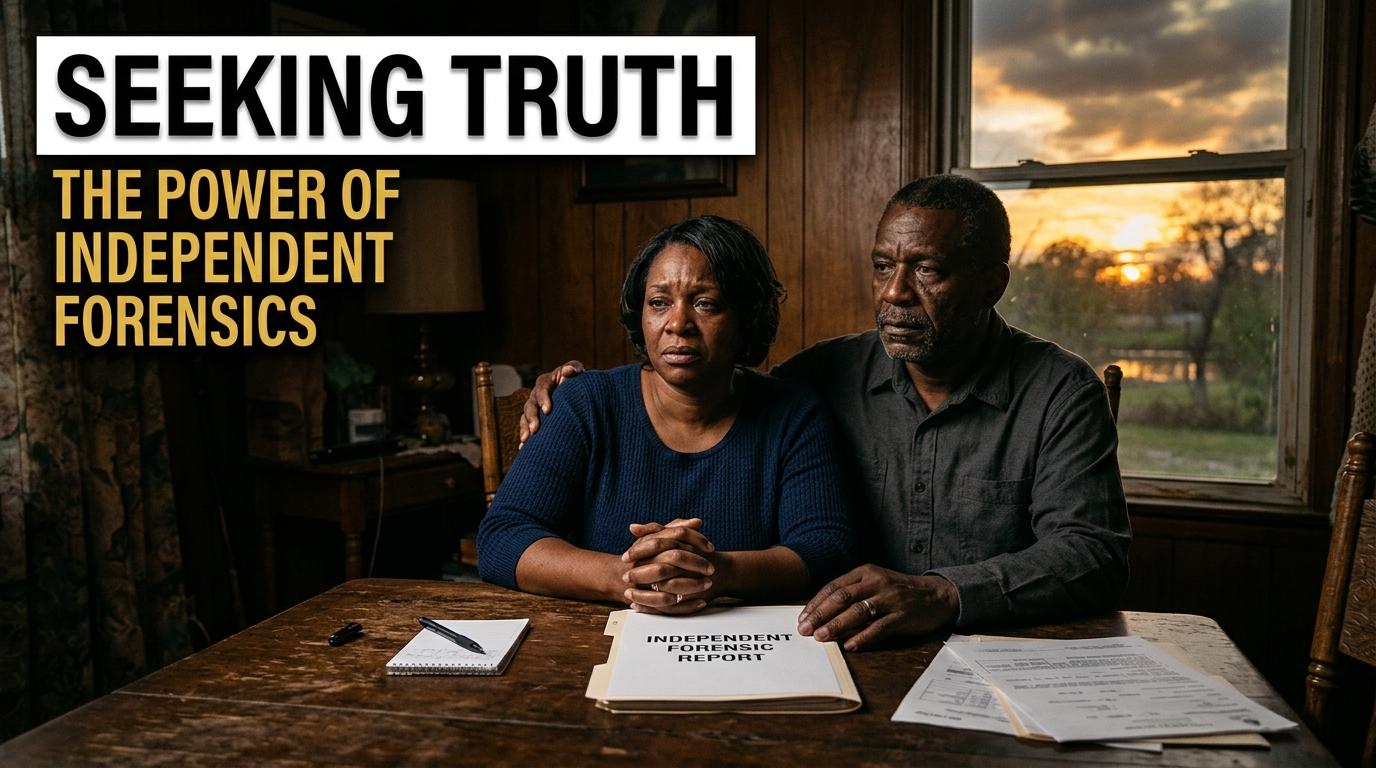
Even though Snapchat automatically deletes viewed messages within twenty-four hours, the total absence of saved files or active media was highly unusual for Wells (pbs.org). Attorney Ben Crump argued that the wiped accounts indicated manual tampering or a coordinated effort to erase evidence before returning the phone (pbs.org). This potential tampering forced the family to seek a fully independent investigation to uncover the truth (pbs.org).
Mississippi’s Death Investigation System and the Trust Crisis
The decision to bypass local authorities was driven by a deep lack of trust in the regional death investigation system. Mississippi utilizes a county-based, mixed coroner and state medical examiner system (pbs.org, supertalk.fm). In Jackson County, the coroner is an elected official who serves a four-year term (pbs.org, supertalk.fm). The coroner acts as the chief county death investigator but does not need to be a medical doctor (pbs.org, supertalk.fm).
The historic struggle of Black families in the South to protect their loved ones highlights the importance of the history of the Black family. They have had to rely on strong kinship networks to fight institutional neglect. In this case, local systemic issues forced the Wells family to seek external help immediately.
Under Mississippi law, actual autopsies must be conducted by the centralized State Medical Examiner’s Office in Jackson (pbs.org, supertalk.fm). However, the Jackson County Sheriff’s Department publicly declared that they suspected no foul play before the official autopsy was even completed (pbs.org, supertalk.fm). At the same time, the department asked the public for bystander videos of an alleged altercation (pbs.org, supertalk.fm). This glaring contradiction prompted Ben Crump to cite a serious trust issue with local officials, and the family had the body flown to Washington, D.C., for an independent autopsy (pbs.org, opb.org).
Source: The Lancet Study (2021)
Colin Kaepernick’s Autopsy Initiative and Dr. Roger Mitchell
The independent autopsy was made possible through the support of Colin Kaepernick’s Know Your Rights Camp Autopsy Initiative (pbs.org, knowyourrightscamp.org). Kaepernick founded the Know Your Rights Camp in 2016 to empower Black and Brown youth (pbs.org, knowyourrightscamp.org). In February 2022, the organization expanded its mission by launching the Autopsy Initiative (pbs.org, knowyourrightscamp.org). This program offers free, secondary autopsies to families of individuals whose deaths are police-related or occur under highly suspicious circumstances (pbs.org, knowyourrightscamp.org).
During its first year of operation, the initiative completed forty free autopsies for grieving families across the nation (pbs.org, knowyourrightscamp.org). The program connects families with a panel of independent, board-certified forensic pathologists (pbs.org, knowyourrightscamp.org). This critical resource ensures that families receive an unbiased medical evaluation free from the influence of local law enforcement (pbs.org, knowyourrightscamp.org).
For the Wells family, the initiative commissioned Dr. Roger A. Mitchell Jr. to perform the independent autopsy in Washington, D.C. (pbs.org, capitalbnews.org). Dr. Mitchell is a highly prominent, board-certified forensic pathologist and the chairman of the Department of Pathology at the Howard University College of Medicine (pbs.org, capitalbnews.org). He previously served as the Chief Medical Examiner of Washington, D.C., from 2014 to 2021 (pbs.org, capitalbnews.org). Dr. Mitchell has a long-standing history of conducting independent evaluations, including the private autopsy of Lashawn Thompson, whose death in a Georgia jail he classified as a homicide (pbs.org, capitalbnews.org).
Parallel Battles: The Tragic Death of Trey Reed in 2025
Nolan Wells is not the first Mississippi youth to receive assistance from Colin Kaepernick’s initiative. In September 2025, Demartravion “Trey” Reed, a twenty-one-year-old Black student at Delta State University, was found hanging from a tree on campus in Cleveland, Mississippi (pbs.org, afro.com). The Bolivar County coroner and the Mississippi State Medical Examiner’s Office officially ruled the death a suicide, finding no signs of physical assault or broken bones (pbs.org, afro.com).
However, the family of Reed deeply disputed these findings, pointing to physical injuries on his body that they believed could not have been self-inflicted (pbs.org, afro.com). Represented by Ben Crump, the family expressed severe skepticism, citing the brutal history of racist lynchings in Mississippi (pbs.org, afro.com). To get answers, they partnered with the Autopsy Initiative to fund a second, independent autopsy (pbs.org, afro.com).
This independent autopsy was conducted by Dr. Matthias I. Okoye, a Nebraska-based forensic pathologist (pbs.org, afro.com). As of mid-2026, the complete and official results of this independent autopsy have not been publicly released (pbs.org, afro.com). The lack of public findings has left the Delta State campus in a state of ongoing speculation, but the family continues to push for transparency and access to campus surveillance footage (pbs.org, afro.com). This case represents another example of Black families utilizing private science to challenge official state conclusions in Mississippi.
The Long Civil Rights Legacy of Independent Autopsies
The use of independent forensic science to challenge southern state narratives has deep roots in the Civil Rights Movement. In June 1964, the Ku Klux Klan abducted and murdered civil rights workers James Chaney, Michael Schwerner, and Andrew Goodman in Neshoba County, Mississippi (pbs.org, afro.com). James Chaney was a Black activist from Mississippi, while Schwerner and Goodman were white activists from New York (pbs.org, afro.com).
This historical fight for truth and justice aligns with the modern call for racial justice. Seeking reparations and systemic transparency remains a continuous struggle for marginalized communities. When local systems fail to act with integrity, families must take the search for truth into their own hands.
Local segregationist authorities in Mississippi were extremely hostile to the civil rights workers and initially issued death certificates with “unknown” causes of death to minimize the crime (pbs.org, afro.com). In response, the Chaney family requested an independent autopsy, which was conducted by Dr. David Spain, an independent pathologist from New York (pbs.org, afro.com). Dr. Spain’s independent findings revealed that James Chaney had been brutally beaten, suffering jaw and skull fractures, before he was shot (pbs.org, afro.com). This directly contradicted the official state narrative that sought to ignore the physical torture Chaney endured (pbs.org, afro.com).
Modern Pathfinders: How Private Science Alters Justice
In modern history, independent autopsies have repeatedly turned the tide of public opinion and legal proceedings. Following the fatal shooting of eighteen-year-old Michael Brown by a police officer in Ferguson, Missouri, in August 2014, early rumors suggested that Brown had been shot in the back while fleeing (pbs.org, cbsnews.com). To find the truth, his family commissioned private pathologist Dr. Michael Baden to conduct an independent autopsy (pbs.org, cbsnews.com).
Dr. Baden’s findings showed that Brown had been shot at least six times from the front, debunking the early rumors while providing concrete physical data (pbs.org, cbsnews.com). St. Louis County Prosecutor Robert McCulloch presented all available autopsy reports to a grand jury, which ultimately declined to indict the officer (pbs.org, cbsnews.com). A subsequent Department of Justice civil rights investigation analyzed Baden’s report and determined that the physical evidence did not support federal charges, proving how independent forensic data shapes federal evaluations (pbs.org, cbsnews.com).
Similarly, the death of George Floyd in Minneapolis in 2020 demonstrated the power of independent forensic science. The initial Hennepin County medical examiner’s press release suggested Floyd’s death was caused by underlying health conditions and potential intoxicants (pbs.org, pbs.org). Floyd’s family commissioned an independent autopsy, which concluded that he died of asphyxiation due to neck and back compression (pbs.org, pbs.org). This independent finding firmly established the death as a homicide and was pivotal in securing the criminal conviction of Officer Derek Chauvin (pbs.org, pbs.org).
The Structural Bias and Misclassification of Official Autopsies
The demand for independent autopsies is driven by well-documented, systemic bias within the American death-investigation system. A landmark thirty-eight-year study published in the medical journal The Lancet in 2021 estimated that 55.5% of deaths caused by police violence between 1980 and 2018 were misclassified or unreported in the federal National Vital Statistics System (pbs.org, nih.gov). This represents more than 17,000 missing deaths in official government records (pbs.org, nih.gov).
This systemic misclassification occurs primarily because local medical examiners and coroners fail to indicate law enforcement involvement on death certificates (pbs.org, nih.gov). Consequently, deaths resulting from physical restraint, Tasers, or custodial neglect are frequently attributed to natural causes, pre-existing conditions, or acute drug intoxication (pbs.org, nih.gov). Furthermore, pathologists under pressure from law enforcement have frequently utilized highly controversial, non-clinical classifications like “excited delirium” to explain away deaths caused by police force (pbs.org, nih.gov).
The Lancet study highlighted that misclassification rates are disproportionately high for Black victims, who are 3.5 times more likely to be killed by police than white Americans (pbs.org, nih.gov). The rate of misclassification for Black victims was found to be 59.5% (pbs.org, nih.gov). Additionally, a national survey revealed that 22% of medical examiners and coroners experienced direct pressure from government or law enforcement officials to change the cause or manner of death on a death certificate (pbs.org, nih.gov). These structural conflicts of interest explain why families feel they must seek independent medical evaluations (pbs.org, nih.gov).
Ben Crump and the Fight for “Honesty and Transparency”
The legal battle for Nolan Wells is led by Benjamin Lloyd Crump, an exceptionally prominent civil rights and personal injury attorney (pbs.org, cbsnews.com). Often referred to as “Black America’s Attorney General,” Crump has achieved national prominence by representing the families of victims in landmark racial justice cases (pbs.org, cbsnews.com). His work representing the families of Trayvon Martin, George Floyd, Michael Brown, and Breonna Taylor has helped shape the modern Black Lives Matter movement (pbs.org, cbsnews.com, bencrump.com).
The resilience of these communities in the face of tragedy reflects the long-standing African American family strength that has sustained Black people through generations of oppression. By organizing to demand transparency, families transform their grief into a powerful force for change. This legacy of mutual support continues to shield families during deep crises.
In the case of Wells, Crump has emphasized the wiped Snapchat accounts and the conflicting accounts of the friends as critical reasons to doubt the initial drowning theory (pbs.org). The decision to fly his body out of Mississippi was a deliberate choice to bypass any potential local bias or political influence (pbs.org, opb.org). Media mogul Tyler Perry also stepped in to cover the funeral expenses, allowing the family to focus on their pursuit of justice (pbs.org).
By utilizing Colin Kaepernick’s Autopsy Initiative, the Wells family is participating in a legacy of resistance that dates back to the civil rights struggles of the Jim Crow era (pbs.org, knowyourrightscamp.org). When institutional trust is broken, independent forensic science becomes more than a medical procedure. It serves as a vital instrument of civil rights, ensuring that the final story of a young life is written with honesty and transparency (pbs.org).
About the Author
Darius Spearman is a professor of Black Studies at San Diego City College, where he has been teaching for over 20 years. He is the founder of African Elements, a media platform dedicated to providing educational resources on the history and culture of the African diaspora. Through his work, Spearman aims to empower and educate by bringing historical context to contemporary issues affecting the Black community.
