
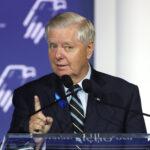


The Hidden Truth Behind Lindsey Graham’s Civil Rights Legacy
By Darius Spearman (africanelements)
Support African Elements at patreon.com/africanelements and hear recent news in a single playlist. Additionally, you can gain early access to ad-free video content.
The passing of Senator Lindsey Graham of South Carolina on July 11, 2026, closed a major chapter in American politics. The lawmaker was 71 years old. His career spanned over three decades in Washington. During this time, he shaped federal policy and federal courts. Today, his relationship with the Black community is a subject of intense debate. For some, his actions defended the rule of law. For others, his record reveals a consistent pattern of blocking racial progress. This division illustrates a deep polarization in the nation.
To understand this record, one must look at the legal theory of colorblind constitutionalism. This philosophy asserts that the United States Constitution must be interpreted without regard to race. Proponents argue that the government should never consider race, even to correct historical wrongs. Conversely, civil rights advocates argue that this perspective ignores systemic racism. They believe colorblindness shields existing racial inequalities instead of solving them. This ideological clash defined the legislative path of the late senator.
The Scorecard Wars and Legislative Conflict
Throughout his career, major civil rights organizations monitored the voting record of the senator. His legislative choices constantly drew criticism from these groups. They used scorecards to track votes on civil rights, economic policies, and democratic access. In the NAACP Federal Legislative Report Card for the 115th Congress, he received a score of only 19% (naacp.org). This failing grade became a permanent point of contention between the lawmaker and civil rights leaders.
The senator did not accept these low scores quietly. During confirmation hearings in 2017 and 2019, he challenged the leaders of the NAACP and the National Urban League directly (mcclatchydc.com). He accused the organizations of using partisan criteria. He argued that the scorecards were biased against conservative principles (mcclatchydc.com). Civil rights leaders maintained that their standards were objective. They argued that their scorecards tracked basic measures of equity and fairness.
The Battle Over the Ballot Box
Voting rights stood at the center of his legislative conflicts. In 2013, the Supreme Court issued its landmark ruling in Shelby County v. Holder (democracydocket.com). This decision invalidated Section 4 of the Voting Rights Act of 1965 (democracydocket.com). As a result, federal preclearance requirements became inoperative (democracydocket.com). Preclearance had forced states with histories of voter discrimination to get federal approval before changing election laws. This mechanism had prevented states from introducing discriminatory voting regulations.
Without federal preclearance, southern states enacted numerous voting restrictions. Advocates of federal protection championed the John Lewis Voting Rights Advancement Act and the Freedom to Vote Act to restore these rules (senate.gov, heritageaction.com). The senator consistently voted against these federal expansions (senate.gov). He asserted that these bills represented federal overreach into state-run elections. He also argued that policies like universal mail-in voting increased the risk of fraud.
Critics rejected these justifications. They pointed out that the Black population of South Carolina is 27% (sc.gov, indexmundi.com). They argued that state-level voting restrictions disproportionately affected Black voters. By opposing federal protections, the senator was accused of maintaining a troubling history of disenfranchisement. This issue highlighted the tension between state versus national power in protecting civil rights.
Criminal Justice and Systemic Racism
The murder of George Floyd in 2020 sparked a national demand for police reform. The senator participated in bipartisan negotiations to find a compromise on police standards (pbs.org). He worked alongside Senator Tim Scott and Senator Cory Booker (pbs.org). However, these discussions ultimately collapsed. The senator opposed the George Floyd Justice in Policing Act because of its provisions on qualified immunity (wikipedia.org, senate.gov). This legal doctrine protects police officers from being sued personally in civil court.
Qualified immunity was introduced by the Supreme Court in 1967. It shields public officials from liability unless they violate clearly established law. Because courts require an almost identical past case to prove a violation, securing justice is extremely difficult. Civil rights advocates argue that this doctrine protects bad actors. It also shields discriminatory policing from accountability in civil courts.
Furthermore, the senator rejected the premise that American law enforcement is systemically racist. He defended police departments and supported “Stand Your Ground” self-defense statutes (wikipedia.org, julianjohnsonlaw.com). Civil rights organizations argued that his position protected a system of bias. This resistance to reform was seen as contributing to the rise of mass incarceration. For critics, his opposition to federal standards allowed discriminatory practices to persist without consequence.
Economic Policy and the Black Farmers Dispute
In economic affairs, the senator consistently resisted progressive policies. He opposed federal minimum wage increases and equal pay legislation (wikipedia.org). He argued that federal regulations harmed business growth. This debate became exceptionally sharp in March 2021 during the passage of the American Rescue Plan (businessinsider.com). The stimulus package included five billion dollars in debt relief for socially disadvantaged farmers (businessinsider.com).
This relief was designed to address decades of documented discrimination by the U.S. Department of Agriculture. Historically, local offices of the agency routinely denied loans to Black applicants. They delayed loans until after the planting season, forcing Black farmers into default. If these farmers fell behind on payments, the agency accelerated their loans immediately. This systemic bias caused Black farm acreage to drop from twenty million acres in 1920 to only 3.5 million acres (theguardian.com, eji.org). This loss left almost all agricultural land in white hands.
The senator strongly criticized this debt relief on national television (businessinsider.com, cbsnews.com). He called the program “out-of-control liberalism” and equated it to “reparations” (businessinsider.com, cbsnews.com). His comments drew immediate condemnation from Black leaders. John Boyd, president of the National Association of Black Farmers, demanded an apology (businessinsider.com). Representative James Clyburn also rebuked the senator for his remarks (businessinsider.com). They argued that the senator was ignoring the historical fight for economic justice.
Conversely, supporters of the senator emphasized his overall economic platform. They pointed out that his pro-business policies helped South Carolina thrive. A 2025 study showed that South Carolina ranked fourth in the nation for Black-owned businesses (sc.gov, thestate.com). Approximately 19% of the businesses in the state were Black-owned (sc.gov, thestate.com). Proponents argued that a strong economy benefits all entrepreneurs, including Black business owners.
Reshaping the Federal Judiciary
The most lasting aspect of his legacy was his leadership on the Senate Judiciary Committee. He served as chairman from 2019 to 2021 (wikipedia.org, wikipedia.org). In this role, he worked closely with President Donald Trump to confirm hundreds of conservative federal judges. These included Supreme Court Justices Brett Kavanaugh and Amy Coney Barrett. His actions shifted the ideological balance of the courts for a generation.
His judicial strategy drew sharp criticism for inconsistency. In 2016, he supported blocking Merrick Garland, claiming the appointment was too close to an election. However, in 2020, he reversed his stance to confirm Amy Coney Barrett just weeks before the presidential election (wikipedia.org, pbs.org). This maneuver solidified a conservative supermajority on the Supreme Court.
Mainstream civil rights organizations viewed this judicial shift as highly damaging. The newly formed conservative majority issued rulings that directly opposed civil rights priorities. In 2023, the Court struck down affirmative action in college admissions in SFFA v. Harvard (harvardlawreview.org). In 2021, the Court narrowed Section 2 of the Voting Rights Act in Brnovich v. DNC (democracydocket.com). This ruling made it harder to challenge discriminatory state election laws by rejecting arguments based on racial disparity alone.
Furthermore, his opposition to Ketanji Brown Jackson in 2022 highlighted this division (wikipedia.org, businessinsider.com). She was the first Black woman appointed to the Supreme Court. The senator had previously voted to confirm her to the appellate court, but he voted against her elevation (wikipedia.org, businessinsider.com). He justified his opposition by accusing her of judicial activism (businessinsider.com, businessinsider.com). He also criticized her sentencing record and her past work representing detainees at Guantanamo Bay (businessinsider.com, businessinsider.com). Civil rights advocates viewed his vote as a rejection of a historic milestone.
Controversial Rhetoric on Race
Several public and private comments by the senator during his career provoked widespread outrage. In his 2020 Senate re-election campaign, he faced a strong challenge from Jaime Harrison, who is Black (thestate.com, pbs.org). During a televised forum, the senator addressed racial mobility in South Carolina. He stated that young Black people and immigrants could go anywhere in the state, but they “just need to be conservative, not liberal” (thestate.com, pbs.org).
Critics found this comment highly offensive. They argued that it implied the safety and acceptance of Black citizens were conditional. Under this view, basic rights depended on conforming to conservative political ideology. His campaign later clarified that he was referring to the state’s conservative electorate (thestate.com, sanluisobispo.com). They pointed to Senator Tim Scott as an example of a successful conservative minority leader (wikipedia.org, pbs.org).
In addition, leaked audio from a private 2014 event at the Hibernian Society of Charleston caused significant backlash (thinkprogress.org). The senator joked to the all-male crowd that “white men who are in male-only clubs are going to do great” under his presidency (thinkprogress.org). Although he defended the comment as a lighthearted joke, advocacy groups saw it differently. They argued that the joke exposed a political agenda focused on maintaining traditional systems of white male power.
Finally, his comments regarding the International Criminal Court in 2024 drew global condemnation (zeteo.com, aa.com.tr). As the court prepared to issue arrest warrants for Israeli officials, the senator protested strongly (zeteo.com). In a telephone call with Chief Prosecutor Karim Khan, he declared that the court was built for Africa and leaders like Vladimir Putin, not for democracies like Israel (zeteo.com, aa.com.tr). Critics argued that his statement exposed a blatant double standard. It suggested that international law is meant only to police the Global South, while Western nations remain immune to accountability.
A Deeply Polarized Retrospective
The legacy of Senator Lindsey Graham is defined by these two irreconcilable perspectives. For civil rights organizations, his legislative record and judicial actions systematically undermined racial progress. They view his opposition to voting rights and his judicial appointments as barriers to equality. They believe his rhetoric revealed a dismissive attitude toward systemic racial bias.
In contrast, his supporters remember him as a champion of constitutional consistency. They argue that his policies protected state sovereignty and fostered a strong economic climate. They believe his support for conservative judges preserved a strict interpretation of the Constitution. Consequently, his impact on the Black community remains a subject of intense division, mirroring the broader political polarization of the United States.
About the Author
Darius Spearman is a professor of Black Studies at San Diego City College, where he has been teaching for over 20 years. He is the founder of African Elements, a media platform dedicated to providing educational resources on the history and culture of the African diaspora. Through his work, Spearman aims to empower and educate by bringing historical context to contemporary issues affecting the Black community.
