



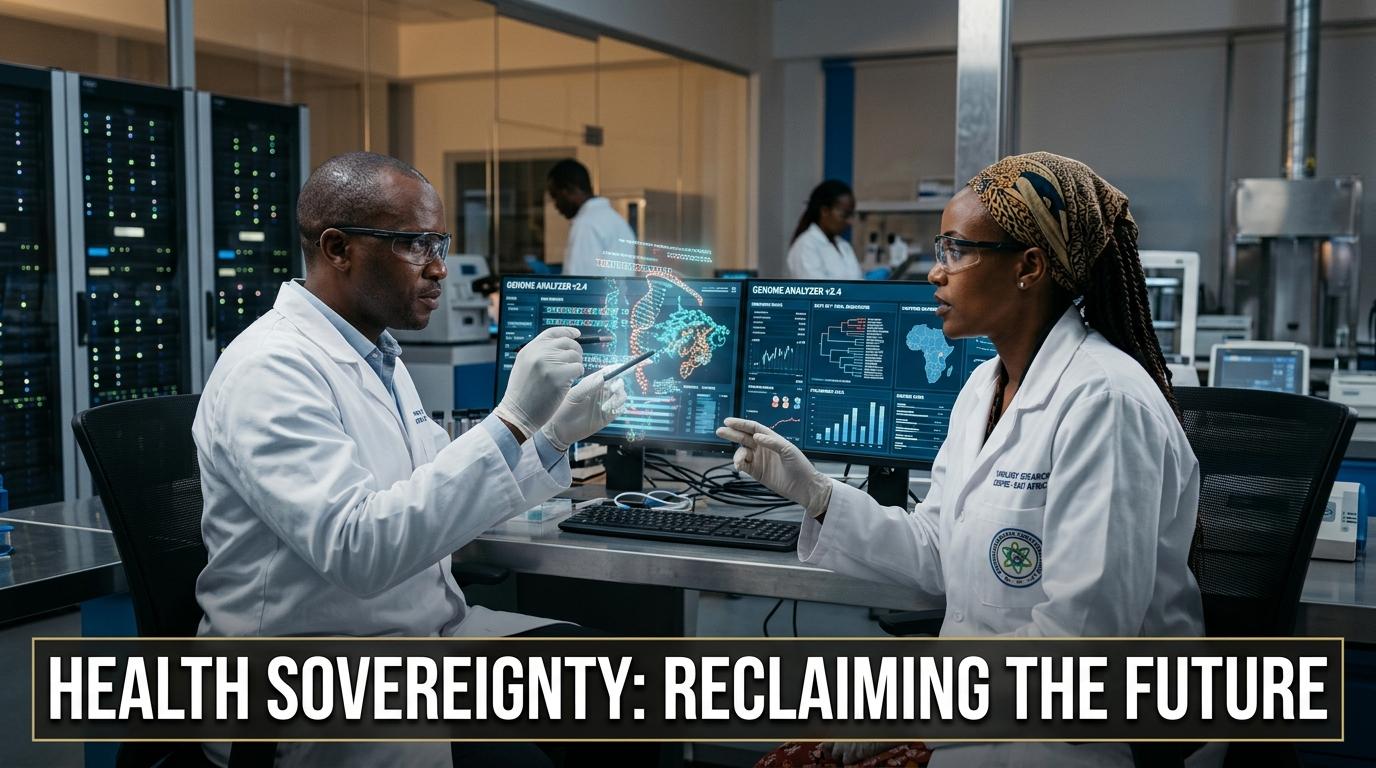
How East African Health Sovereignty is Reshaping Global Medicine
By Darius Spearman (africanelements)
Support African Elements at patreon.com/africanelements and hear recent news in a single playlist. Additionally, you can gain early access to ad-free video content.
In July 2026, the East African Community took a massive leap forward (eac.int, eac.int). They launched major health and data programs in Entebbe, Uganda and Kigali, Rwanda (eac.int, eac.int). These programs are designed to strengthen public health safety and digital integration (eac.int, techafricanews.com). For decades, global systems kept Africa on the sidelines of medical innovation. Now, the region is writing its own rules. This movement is a long journey of reclaiming local power and self-reliance.
To understand these new health and data programs, one must look at the history of the region. Colonial practices often extracted biological resources without building local infrastructure. Today, East African nations are changing this dynamic. By building strong local institutions, they are establishing control over their own public health and economic data.
The Long Road from Colonial Labs to Local Excellence
Historically, African nations had to send patient samples to faraway Western labs (nih.gov). Foreign institutions held the keys to advanced medical research. This unequal system delayed quick responses to local disease outbreaks (nih.gov). It also took valuable genetic data out of the continent.
To break this cycle, the East African Community designated the Uganda Virus Research Institute as a Regional Centre of Excellence in Virology (eac.int, eac.int). This lab sits in Entebbe, Uganda (eac.int). It has a deep history dating back to 1936 (eac.int). The Rockefeller Foundation first built it to study Yellow Fever (eac.int).
This historical reclamation reflects broader efforts across the continent. Just as scholars work toward decolonizing African universities to reclaim intellectual spaces, health experts are reclaiming local medicine. Placing this center under regional control is a major victory for health sovereignty (eac.int). The Entebbe facility now trains scientists from eight partner nations (eac.int, eac.int). It conducts advanced genomic testing directly on African soil (eac.int, topafricanews.com). As a result, the region no longer relies on slow, foreign laboratories (nih.gov).
Inside the Lab: The Power of Genomic Surveillance
Genomic surveillance is a powerful tool in modern medicine. It goes beyond simple disease detection. Scientists map the exact genetic blueprint of a virus (beckman.com). This tracking allows researchers to watch how a virus mutates over time (beckman.com).
In East Africa, tracking mutations is highly critical. The region frequently battles deadly pathogens (eac.int, eac.int). These threats include Ebola, Marburg, and Mpox (eac.int, eac.int). By reading the genetic code, local scientists trace how infections spread across borders (eac.int). They can spot new variants before they trigger massive epidemics (beckman.com).
Furthermore, genomic tracking makes vaccine development highly effective. Generic vaccines made in the West sometimes do not match local virus strains (nih.gov). Local genomic data helps scientists design treatments tailored specifically to the regional environment (nih.gov). The Uganda Virus Research Institute has pioneered this science. In 2020, its scientists sequenced the first complete genomes of the coronavirus in Uganda (nih.gov). Now, the institute uses high-performance computers to guide public health decisions across the entire region (eac.int, nih.gov).
Diagnostic Turnaround Times
Comparing the speed of local genomic sequencing versus shipping biological samples to Western labs.
Rebuilding Integration: The Story of the East African Community
The modern East African Community did not appear overnight. Its origins trace back to a colonial customs union created in 1927 (wikipedia.org). Following independence, Kenya, Tanzania, and Uganda formed the first official community in 1967 (wikipedia.org). However, deep political and economic differences tore the alliance apart. The bloc collapsed in 1977 (wikipedia.org). Member nations chose different economic paths. For over two decades, regional integration remained out of reach (wikipedia.org).
In 1999, leaders signed a new treaty to revive the bloc (wikipedia.org). The community officially resumed operations in 2000 (wikipedia.org). Since then, the alliance has expanded rapidly. It grew from three founding nations to eight member states (eac.int, wikipedia.org). The group added Rwanda, Burundi, South Sudan, the Democratic Republic of Congo, and Somalia (eac.int, wikipedia.org).
Today, the East African Community represents a major economic force. The combined population of the eight partner states is roughly 343.5 million people (worlddata.info, eac.int). Experts project this number to nearly double by 2050 (eac.int). The region has a combined gross domestic product of nearly 359.38 billion dollars (worlddata.info, eac.int). It remains one of the fastest-growing regions in Africa (imf.org). This historical journey mirrors other great stories of perseverance, much like the tapestry of resilience found throughout the African diaspora.
Demographic Power Shift (EAC Population)
The Digital Shield: Creating Regional Public Infrastructure
To connect these diverse nations, leaders are building digital public infrastructure (techafricanews.com). This infrastructure is the foundation of modern public services (techafricanews.com). It relies on three primary pillars (govstack.global). These pillars are digital identity, secure payment systems, and safe data exchange (govstack.global).
The East African Community uses a unique strategy called “DPI-plus” (datagovernance.africa). This strategy adds digital training and regional connectivity to the basic pillars (datagovernance.africa). It addresses the massive technology gaps between member states. Older members like Kenya and Rwanda have highly advanced systems (worldbank.org). Newer members like South Sudan and Somalia are still building their foundations (worldbank.org).
By focusing on local databases first, the community helps newer members catch up (worldbank.org). They connect local birth records and national identity cards directly to healthcare databases (datagovernance.africa). This link allows vital health records to travel safely across borders with citizens (datagovernance.africa). This infrastructure also reduces business barriers (techafricanews.com). Secure payment networks allow small business owners to sell goods across borders without high fees (techafricanews.com). Technology is slowly binding these eight separate nations into one single digital market (worldbank.org).
Money, Metrics, and Transparency: Harmonizing Financial Data
In Kigali, Rwanda, the regional bloc launched several digital statistics courses (eac.int). These courses help officials understand complex financial metrics. Two of the most important concepts are Financial Soundness Indicators and Government Finance Statistics (eac.int, finance.go.ug).
Financial Soundness Indicators monitor the health of banks (finance.go.ug). They help regulators spot weak financial institutions before they collapse (finance.go.ug). This monitoring protects the hard-earned savings of ordinary families. On the other hand, Government Finance Statistics track public spending and national debt (finance.go.ug). This tracking makes public budgets clear and transparent. Citizens can easily see how their governments spend public funds (finance.go.ug). It forces leaders to remain accountable for their economic choices.
Harmonizing these statistics across all eight nations is crucial. It is a key requirement for the proposed East African Monetary Union (thecitizen.co.tz, issafrica.org). The alliance plans to launch a single regional currency by 2031 (thecitizen.co.tz, issafrica.org). To do this safely, all member states must meet strict economic targets (thecitizen.co.tz). Shared data standards make it possible to monitor these goals accurately.
Overcoming the Gender Data Drought
For too long, women in the region have faced deep structural barriers. These barriers limit their economic freedom and growth (unwomen.org). However, governments cannot fix these inequalities without accurate data. Africa currently faces a severe gender data drought (unwomen.org).
Almost eighty percent of countries in Sub-Saharan Africa lack detailed gender statistics (unwomen.org). This lack of data makes the daily struggles of women invisible to lawmakers (unwomen.org). To solve this, the bloc hosted intensive gender statistics training in Kigali (eac.int). This training helps governments collect and analyze gender-disaggregated data (eac.int).
This data breaks down statistics by sex to show the different realities of men and women (unwomen.org). For example, it reveals that women are often funneled into low-wage, informal jobs like subsistence farming (unwomen.org). Meanwhile, men are more likely to secure higher-paying jobs in transport or technology (unwomen.org). By using these detailed statistics, policymakers can design highly targeted programs (eac.int, unwomen.org). They can allocate resources to close the wealth gap. These efforts connect back to historical threads of resilience that have sustained African communities through generations of struggle. Utilizing proper data ensures that the march toward equality is built on facts, not assumptions.
Safeguarding Freedom: Privacy in a Digital Age
As health and financial data move across borders, protecting personal privacy is essential (datagovernance.africa). In mid-2026, data protection experts met in Dar es Salaam to finalize a new regional framework (africa-press.net). This agreement is the Cross-Border Data Flows Framework (africa-press.net).
The framework replaces a confusing web of conflicting national privacy laws (datagovernance.africa). It establishes a single set of rules for the entire region (datagovernance.africa). Under this system, private corporations must protect personal data when moving it between countries (datagovernance.africa). To ensure compliance, the framework introduces an Audit and Verification Toolkit (datagovernance.africa). This toolkit gives local regulators clear checklists to audit companies (datagovernance.africa). It measures how well businesses protect citizen information from cyber threats (datagovernance.africa).
This agreement builds a “free flow with trust” model (datagovernance.africa). It allows secure data exchange for medical and financial services without exposing citizens to surveillance or data theft (datagovernance.africa). It also establishes coordinated enforcement among national data protection authorities (datagovernance.africa). If a breach occurs, regulators can work together to hold companies accountable.
Cutting Costs: The Battle for Affordable Medicine
High medicine prices have long burdened families across East Africa. In addition, dangerous counterfeit drugs often flood local markets (nepad.org). To combat these issues, the region developed the Pooled Procurement Mechanism (nepad.org).
This mechanism acts as a giant buyers’ club (nepad.org). Instead of purchasing drugs individually, the eight partner states pool their orders together (nepad.org). By doing this, they negotiate directly with global manufacturers (nepad.org). This collective bargaining power secures deep discounts that single nations could never get on their own.
The mechanism also streamlines the supply chain (nepad.org). It coordinates transportation, storage, and customs clearance (nepad.org). This coordination reduces shipping delays and lowers extra costs. As a result, the savings go directly to local health centers (nepad.org). Crucially, this system blocks fake medicines from entering the market (nepad.org). By purchasing directly from verified manufacturers, the alliance ensures that local clinics receive safe, high-quality treatments (nepad.org). This protects families from wasting money on dangerous, ineffective therapies.
Pooled Procurement Savings
Visualizing cost savings on life-saving medications through bulk regional purchasing power.
Funding the Future: Sovereign Growth and the World Bank
Building this massive digital network requires significant financial support. The World Bank supplies this backing through the Eastern Africa Regional Digital Integration Project (worldbank.org). This project is scaled to provide hundreds of millions of dollars to the region (worldbank.org, worldbank.org).
Phase one of the project provides one hundred seventy-two million dollars (worldbank.org). Phase two adds another one hundred thirty million dollars (worldbank.org). Crucially, the terms of this funding protect the economic sovereignty of the poorest nations (rightsindevelopment.org). For regional organizations, the World Bank provides the funds as debt-free grants (rightsindevelopment.org). More importantly, the funds allocated to South Sudan and Somalia are entirely in the form of grants (rightsindevelopment.org, mictps.gov.ss). These nations do not have to pay back this money (rightsindevelopment.org). This term prevents them from falling into high-interest debt traps (rightsindevelopment.org).
By securing grants, these developing nations can build modern digital networks without sacrificing their financial independence (worldbank.org, rightsindevelopment.org). This structure shows that regional integration can be achieved while respecting the sovereignty of every partner state (worldbank.org). The East African Community is proving that unified health, data, and economic policies can construct a powerful, self-reliant future.
About the Author
Darius Spearman is a professor of Black Studies at San Diego City College, where he has been teaching for over 20 years. He is the founder of African Elements, a media platform dedicated to providing educational resources on the history and culture of the African diaspora. Through his work, Spearman aims to empower and educate by bringing historical context to contemporary issues affecting the Black community.
