


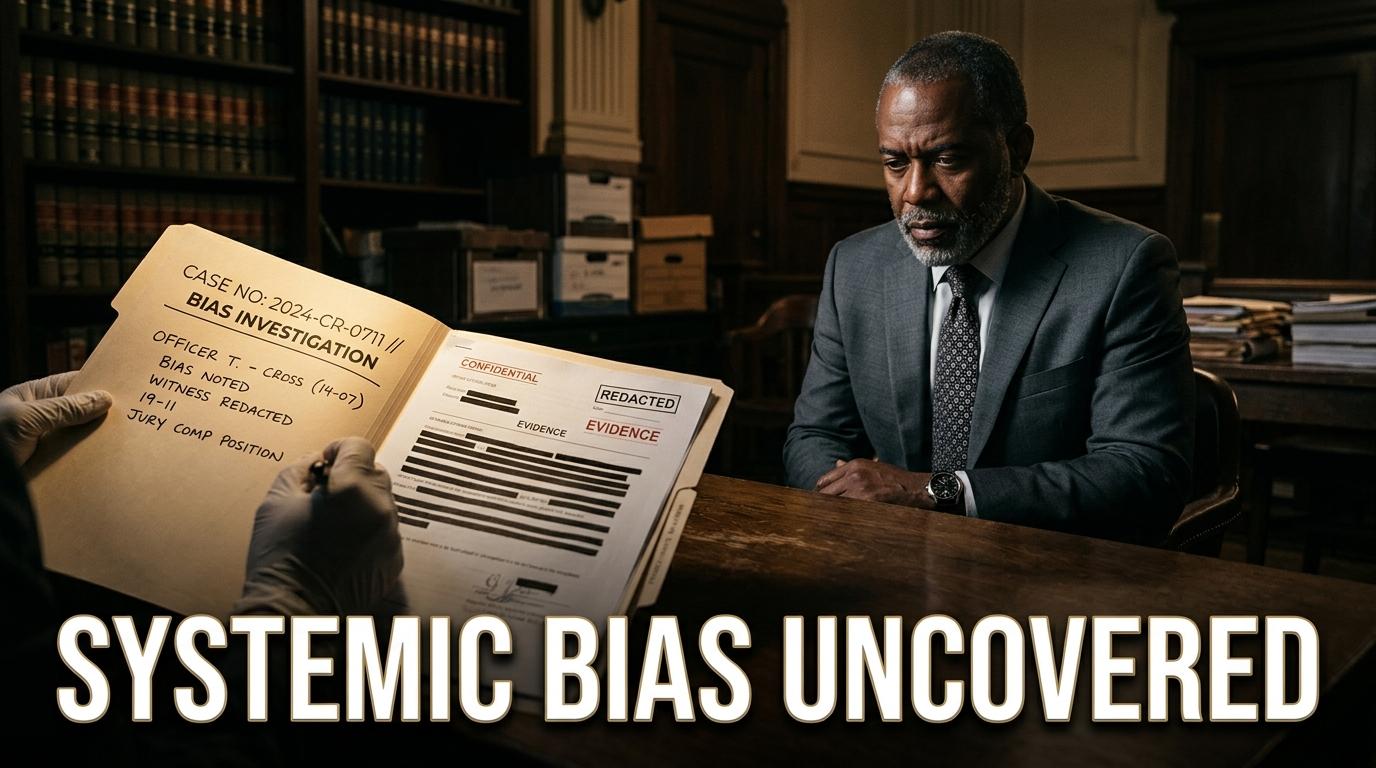
How Alameda County DA Covered Up Racial Misconduct
By Darius Spearman (africanelements)
Support African Elements at patreon.com/africanelements and hear recent news in a single playlist. Additionally, you can gain early access to ad-free video content.
The Modern Clash Over Historical Misconduct
In July 2026, the American Civil Liberties Union of Northern California launched new legal challenges against the Alameda County District Attorney’s office (aclunorcal.org, aclu.org). Civil rights advocates accused top prosecutor Ursula Jones Dickson of attempting to rewrite a well-documented legacy of prosecutorial misconduct (aclunorcal.org, aclunorcal.org). The legal friction centers on the capital case In the Matter of Darren Stanley (aclunorcal.org). In court filings, the District Attorney’s office formally denied that a former deputy district attorney held racist views or used slurs during court proceedings (aclunorcal.org, aclunorcal.org).
However, official archives reveal a starkly different reality. On November 4, 1994, Deputy District Attorney Theodore Landswick repeatedly used a degrading racial slur inside Department One of the Alameda County Superior Court (aclunorcal.org, aclunorcal.org). Former District Attorney John Meehan officially disciplined Landswick by docking his pay and removing him from serious felony trials (aclunorcal.org). Civil rights groups argue that by denying these historical facts today, the current administration actively protects legacy misconduct rather than delivering genuine justice for Black defendants who faced biased prosecutions (aclunorcal.org, aclunorcal.org).
This controversy connects to a broader national movement demanding institutional transparency and institutional calls for racial justice. When public officials minimize historical discrimination, they perpetuate systemic harms. Understanding how prosecutors historically operated provides essential context for the current legal battle surrounding Alameda County’s capital punishment system.
Inside the “Death Team” Era
During the 1990s and early 2000s, Alameda County established itself as a leading capital punishment jurisdiction in Northern California (oaklandside.org, oaklandside.org). At the center of this drive was an elite capital unit known informally within the legal community as the “Death Team” (oaklandside.org, kqed.org). Prosecutors in this division aggressively sought death sentences (oaklandside.org). Defense attorneys long alleged that the unit relied heavily on jury selection tactics designed to exclude prospective Black, Jewish, and LGBTQ+ jurors (oaklandside.org, oaklandside.org).
Two primary figures personified the practices of this unit. Assistant District Attorney James Anderson led the capital unit for years and secured numerous death verdicts (oaklandside.org, oaklandside.org). In a 2005 interview, Anderson publicly defended striking Black and Jewish prospective jurors, asserting that excluding these groups was “just common sense” (oaklandside.org, kqed.org). His trial notes revealed coded annotations marking Black jurors with a “B” to track their elimination (oaklandside.org, oaklandside.org). During the capital trial of Franklin Lynch, Anderson referred to the Black defendant as a “human reptile” during closing arguments (oaklandside.org, deathpenaltyinfo.org, deathpenaltyinfo.org).
Alongside Anderson was Deputy District Attorney Theodore Landswick (aclunorcal.org, aclunorcal.org). While Landswick handled high-profile capital cases, his career was shadowed by explicit racial hostility (aclunorcal.org, the-independent.com). Although upper management privately reprimanded Landswick in 1994 for using racial slurs, officials kept the disciplinary action quiet (aclunorcal.org, aclunorcal.org). As a result, the culture within the prosecution unit remained largely unchanged for decades (oaklandside.org, oaklandside.org).
Mechanics of Exclusion: Peremptory Challenges and Batson
To understand how prosecutors removed Black citizens from capital juries, one must examine legal mechanics. In court proceedings, two types of juror dismissals exist: challenges for cause and peremptory challenges (fatemilaw.com, cornell.edu). A challenge for cause requires proof that a prospective juror cannot remain impartial (fatemilaw.com, findlaw.com). Conversely, a peremptory challenge allows an attorney to reject a prospective juror without stating any reason (fatemilaw.com, cornell.edu).
In 1986, the United States Supreme Court decided Batson v. Kentucky, ruling that prosecutors cannot use peremptory challenges to exclude jurors based on race (cornell.edu, findlaw.com). Under the Batson framework, if a defense attorney objects to a suspicious strike, the prosecutor must offer a “race-neutral” justification (cornell.edu, uark.edu). However, the legal threshold for what constitutes a valid explanation is exceptionally low (cornell.edu, findlaw.com). Prosecutors quickly learned to offer superficial reasons, such as a juror’s posture or minor verbal hesitation, to bypass constitutional protections and conceal racial bias (fatemilaw.com, uark.edu).
This dynamic was aggravated by California’s broad statutory definition of death eligibility under California Penal Code § 190.2 (justia.com, ca.gov). Containing 22 statutory special circumstances, California maintains the highest number of capital aggravating factors in the United States (ppic.org, ucdavis.edu). Because these broad categories encompass the vast majority of first-degree murders, the law fails to perform a narrowing function (ucdavis.edu, stanford.edu). Consequently, prosecutors retained unchecked discretion to decide when to seek the death penalty, allowing racial bias in state legal systems to shape capital outcomes (ppic.org, ucdavis.edu).
The Discovery Breakthrough and Federal Order
For decades, internal trial notes remained shielded from public view under work-product privilege (metnews.com, metnews.com). However, in 2021, the California Supreme Court ruled in People v. Superior Court (Jones) that work-product privilege does not automatically block the disclosure of jury selection notes during post-conviction proceedings (metnews.com, uscourts.gov). This ruling established a vital pathway for post-conviction discovery (metnews.com, metnews.com). Discovery refers to the formal legal phase where both parties must share relevant evidence, files, and records (uscourts.gov, lewisllewellyn.com).
This legal breakthrough culminated in April 2024 during a federal appeal for Ernest Dykes, who received a death sentence in 1995 (berkeleyside.org, deathpenaltyinfo.org). Federal courts ordered the District Attorney’s office to produce the original handwritten jury selection notes (oaklandside.org, kqed.org). The unsealed documents revealed explicit strategies to exclude minority prospective jurors (oaklandside.org, oaklandside.org). In one instance, a prosecutor described a Black female prospective juror as a “short, fat, troll” while another note explicitly flagged Jewish jurors for elimination (oaklandside.org, kqed.org).
United States District Judge Vince Chhabria reviewed the uncovered files and determined that they constituted compelling evidence of systemic prosecutorial misconduct (oaklandside.org, deathpenaltyinfo.org). Judge Chhabria took the extraordinary step of ordering the Alameda County District Attorney’s office to conduct a comprehensive review of all 35 active capital convictions in the county to evaluate whether racial bias infected jury selection (berkeleyside.org, kqed.org, kqed.org).
Political Shifts: Pamela Price, Recall, and Policy Reversals
When Judge Chhabria issued the federal review mandate in 2024, the District Attorney’s office was headed by Pamela Price (berkeleyside.org, kqed.org). Elected in 2022 as Alameda County’s first Black District Attorney, Price ran on an explicit reform agenda (ursulajonesdicksonforda.com, wikipedia.org). Her administration established a specialized Resentencing Unit to address historic trial errors, restricted the use of lengthy sentencing enhancements, stopped charging juveniles as adults, and emphasized community diversion programs (ursulajonesdicksonforda.com, prisonerswithchildren.org, cjcj.org). Price fully embraced the federal mandate, leading to the resentencing of 18 individuals serving death sentences or long prison terms (davisvanguard.org, davisvanguard.org, davisvanguard.org).
These reform policies sparked intense opposition from law enforcement associations and conservative political groups (cbsnews.com, cbsnews.com). Critics cited rising safety concerns and accused Price of being lenient on crime (oaklandreport.org, cbsnews.com). The political friction culminated in a November 2024 recall election, where 63 percent of voters removed Price from office (ballotpedia.org, ballotpedia.org). The structural backlash highlighted the ongoing political obstacles surrounding prosecutor-led reform, directly affecting communities enduring the challenges of imprisonment.
Following the recall, the Board of Supervisors appointed former judge Ursula Jones Dickson as District Attorney in early 2025 (ballotpedia.org, cbsnews.com). Dickson subsequently won election to a full term in June 2026 (ballotpedia.org). Upon taking office, DA Dickson executed a swift policy pivot (davisvanguard.org, davisvanguard.org). She disbanded the specialized Resentencing Unit and filed court motions to withdraw pending resentencing agreements for the remaining 16 capital cases under federal review (davisvanguard.org, davisvanguard.org). Dickson’s administration moved to reinstate original death sentences, arguing that past prosecutorial actions did not warrant broad judicial relief (davisvanguard.org, davisvanguard.org, deathpenaltyinfo.org).
The Racial Justice Act and Courts Striking Back
Despite administrative resistance from the District Attorney’s office, defense attorneys gained powerful legal statutory leverage through California’s Racial Justice Act of 2020 (Assembly Bill 2542) (legiscan.com, nyulawreview.org). The law explicitly prohibits the state from seeking or obtaining a conviction or sentence based on race, ethnicity, or national origin (legiscan.com, davisvanguard.org). Furthermore, the statute was deliberately designed to bypass the restrictive federal precedent set in McCleskey v. Kemp (1987), which previously required defendants to meet an almost impossible burden of proving intentional discrimination in their specific case (deathpenaltyinfo.org, deathpenaltyinfo.org, columbia.edu).
Under the Racial Justice Act, courts must provide remedies if a defendant demonstrates implicit bias, explicit racial slurs, or statistical disparities in charging and sentencing (brownsteinlawgroup.com, legiscan.com). The real-world impact of this law materialized on February 9, 2026, when the Alameda County Superior Court vacated the 32-year-old conviction and death sentence of Franklin Lynch (oaklandside.org, kqed.org, deathpenaltyinfo.org). The court ordered an entirely new trial after the prosecution conceded it could not prove that Assistant DA James Anderson’s use of dehumanizing language did not influence the trial outcome (oaklandside.org, deathpenaltyinfo.org).
This landmark ruling directly bears on the ongoing capital case of Darren Stanley (aclunorcal.org, the-independent.com). Convicted in 1989 for first-degree murder, Stanley had his trial prosecuted by Theodore Landswick, who eliminated five Black female prospective jurors during jury selection (the-independent.com, sfgate.com, sfgate.com). When Stanley’s defense team sought relief under the Racial Justice Act, DA Dickson’s office filed papers defending Landswick’s character and denying his documented history of racial slurs (aclunorcal.org, aclunorcal.org). Civil rights attorneys emphasize that denying past misconduct directly prevents incarcerated individuals from accessing statutory remedies guaranteed by state law (aclunorcal.org, aclunorcal.org).
Confronting Institutional Legacy for True Reform
The legal battle between the ACLU of Northern California and District Attorney Ursula Jones Dickson represents a fundamental struggle over institutional accountability (aclunorcal.org, aclunorcal.org). While decades have passed since the “Death Team” secured its initial convictions, the legal and human consequences remain active (oaklandside.org, oaklandside.org). Dozens of individuals remain incarcerated under sentences produced by a system that routinely excluded Black citizens from jury service (berkeleyside.org, deathpenaltyinfo.org, kqed.org).
Progressive legal scholars maintain that true public safety and judicial integrity cannot coexist with historical denial (aclu.org, aclunorcal.org). When prosecutorial agencies minimize documented racial slurs and constitutional violations, they erode public confidence in the legal system (aclunorcal.org, aclunorcal.org). Moving forward, Alameda County stands at a critical juncture (davisvanguard.org, aclunorcal.org). The integrity of its justice system depends on whether public officials choose to sanitize historical records or fully account for past misconduct under the law (aclunorcal.org, aclu.org).
About the Author
Darius Spearman is a professor of Black Studies at San Diego City College, where he has been teaching for over 20 years. He is the founder of African Elements, a media platform dedicated to providing educational resources on the history and culture of the African diaspora. Through his work, Spearman aims to empower and educate by bringing historical context to contemporary issues affecting the Black community.
