


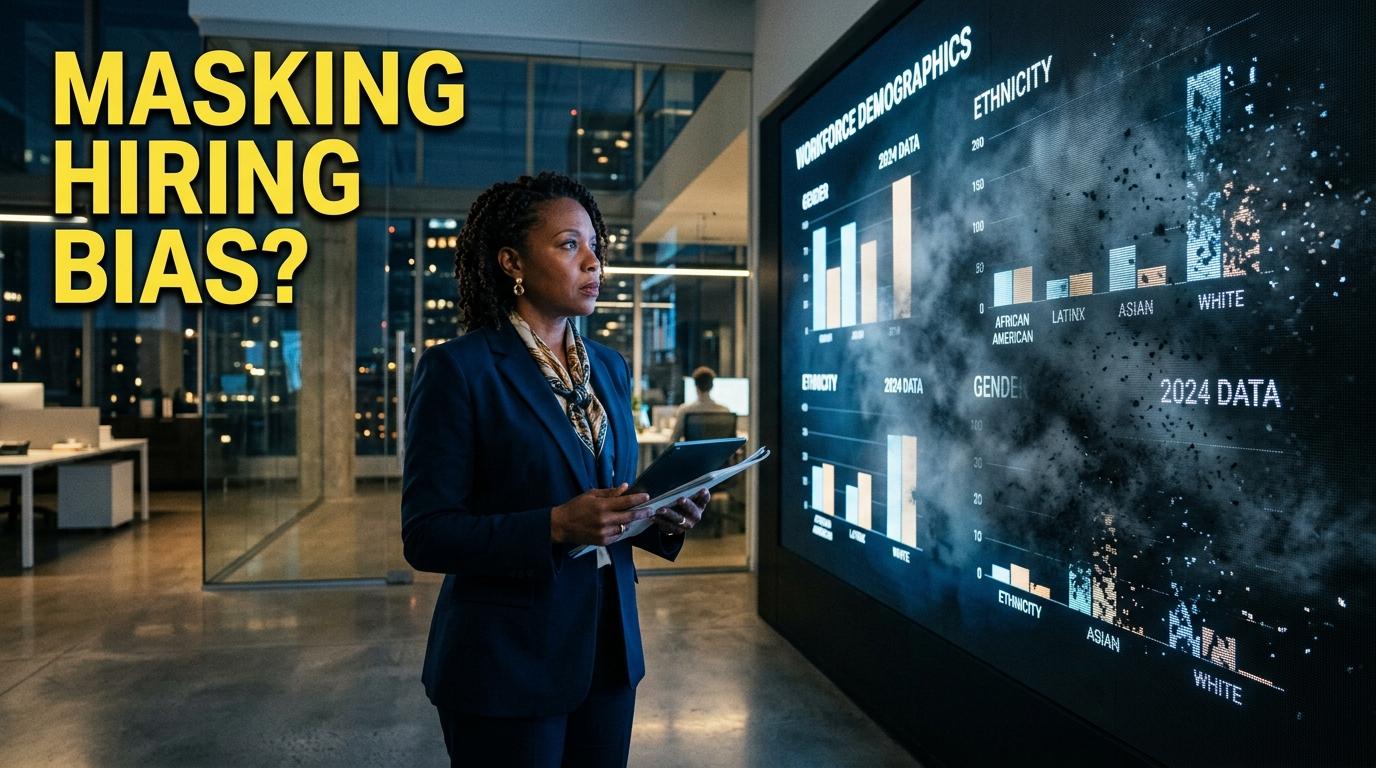
Will Ending EEOC Diversity Reporting Mask Hiring Bias?
By Darius Spearman (africanelements)
Support African Elements at patreon.com/africanelements and hear recent news in a single playlist. Additionally, you can gain early access to ad-free video content.
The High-Stakes EEOC Demographic Data Vote
On July 21, 2026, the Equal Employment Opportunity Commission voted on federal data reporting (eeoc.gov, littler.com). The panel voted two to one along strict party lines (littler.com). Republican Chair Andrea Lucas and Commissioner Brittany Panuccio supported the measure (littler.com). Democratic Commissioner Kalpana Kotagal dissented from the decision (littler.com).
The proposal aims to rescind six decades of demographic reporting requirements (eeoc.gov, federalregister.gov). The notice covers EEO-1 through EEO-6 annual reports (eeoc.gov, federalregister.gov). A Notice of Proposed Rulemaking initiates a formal public comment period (federalregister.gov). It does not immediately alter existing legal obligations for private employers (federalregister.gov). Under the Administrative Procedure Act, public feedback must be carefully analyzed (federalregister.gov).
The three active commissioners constituted a full voting quorum (littler.com, ogletree.com). Two vacant seats remained open on the five-member commission (littler.com, ogletree.com). In January 2025, two Democratic members were removed by the executive branch (ogletree.com). Senate confirmation of Brittany Panuccio in October 2025 restored the three-member quorum (ogletree.com).
The agency argued that data collection costs private employers 275 million dollars annually (federalregister.gov). Private EEO-1 filings account for 273 million dollars of those estimated costs (federalregister.gov). Furthermore, officials noted that administering the portal cost 18 million dollars over five years (federalregister.gov). The leadership believes these resources should support direct investigation work instead (federalregister.gov).
Annual Financial Impact Comparison (EEO Reporting)
Civil Rights Coalitions Mobilize Against the Proposal
Civil rights organizations swiftly organized to challenge the proposed administrative rollback (equalrights.org, nwlc.org). Leaders warned that eliminating workforce data will blind federal enforcement agencies (equalrights.org, nwlc.org). Organizations like Equal Pay Today condemned the commission vote (equalrights.org). Advocates emphasized the vital contributions of Black women in civil rights leadership (nwlc.org).
Katie Sandson of the National Women’s Law Center issued a strong warning (nwlc.org). She stated that ending data collection allows employment discrimination to remain hidden (nwlc.org). Without standardized reporting, detecting pattern-or-practice violations becomes extraordinarily difficult (equalrights.org, nwlc.org).
Additionally, twelve former federal officials formed a nonpartisan group called EEO Leaders (sanfordheisler.com). This coalition published a joint statement opposing the administrative change (sanfordheisler.com). They argued that federal agencies cannot correct discrimination without baseline numbers (equalrights.org, sanfordheisler.com). Former agency leaders stressed that systemic oversight requires routine aggregate reporting (sanfordheisler.com). Dismantling this infrastructure damages civil rights protections for vulnerable workers (equalrights.org, sanfordheisler.com).
The Civil Rights Act of 1964 and the Inception of EEO-1
The Civil Rights Act of 1964 established the Equal Employment Opportunity Commission (eeoc.gov, uchicago.edu). When the agency opened in 1965, critics called it a toothless tiger (uchicago.edu). The agency initially lacked independent litigation authority to sue private employers (uchicago.edu). It relied heavily on worker complaints during the long history of Black employment struggles (uchicago.edu).
To proactively identify systemic barriers, the commission invoked Section 709(c) of Title VII (eeoc.gov, federalregister.gov). The agency mandated the first annual EEO-1 form in 1966 (uchicago.edu). Covered employers submitted workforce counts across nine job categories and five racial groups (uchicago.edu).
Meanwhile, Section 709(e) imposed strict confidentiality rules on all submitted data (eeoc.gov, federalregister.gov). Federal employees who disclose individual corporate reports face criminal misdemeanor charges (eeoc.gov, federalregister.gov). Guilty parties face fines up to 1,000 dollars or one year in prison (eeoc.gov, federalregister.gov). Therefore, public disclosure of company reports remained entirely voluntary for corporations (eeoc.gov, federalregister.gov).
Six Decades of Federal Demographic Reporting
Historical Evidence of Systemic Workplace Exclusion
Early EEO-1 reports provided clear statistical evidence of economic segregation (uchicago.edu). In 1966, textile mills in the South displayed severe racial exclusion (uchicago.edu). Black residents comprised thirty percent of the South Carolina population (uchicago.edu). However, Black workers held under 2.3 percent of craft and supervisory positions (uchicago.edu). Over ninety-nine percent of Black textile workers remained trapped in low-wage positions (uchicago.edu).
Similar patterns emerged across major northern metropolitan centers (uchicago.edu). A 1967 analysis revealed corporate exclusion in New York City office towers (uchicago.edu). Forty-three percent of reporting firms employed zero Black workers in white-collar roles (uchicago.edu). Furthermore, the utility industry recorded the lowest minority hiring among major sectors (uchicago.edu).
These baseline disclosures enabled targeted federal investigations without waiting for complaints (uchicago.edu). Systemic charges challenged entrenched hiring hurdles across whole industries (uchicago.edu). Standardized reporting transformed scattershot enforcement into strategic structural change (uchicago.edu).
The Political Battle Over Component 2 Pay Data
Federal reporting requirements became a central political battleground during the Obama administration (nwlc.org, duanemorris.com). In 2016, the commission added Component 2 to collect pay data (nwlc.org, duanemorris.com). Employers reported W-2 wage info across twelve pay bands (nwlc.org, duanemorris.com). In 2017, the Office of Management and Budget halted the collection (nwlc.org, duanemorris.com).
The National Women’s Law Center challenged the suspension in federal court (nwlc.org). In 2019, District Judge Tanya Chutkan ruled that the suspension was unlawful (nwlc.org). The court ordered the agency to collect retroactive pay data for two years (nwlc.org). Employers achieved a ninety percent compliance rate during that court-ordered collection (duanemorris.com, dciconsult.com).
These battles reflected major shifts in federal civil rights policy over time (duanemorris.com). Later, the commission sunset Component 2, citing unproven regulatory utility (duanemorris.com, dciconsult.com). Officials asserted that pay band reporting created high costs without yielding actionable evidence (duanemorris.com, dciconsult.com).
Modern Corporate Transparency and ESG Disclosure Trends
Demographic reporting evolved into a crucial tool for corporate governance (asyousow.org, justcapital.com). Following 2020 racial justice protests, institutional investors demanded standardized diversity metrics (asyousow.org, justcapital.com). EEO-1 reports became the gold standard for evaluating workforce representation (asyousow.org, justcapital.com). Institutional investors like BlackRock and Vanguard used these disclosures to evaluate human capital (asyousow.org, proxypreview.org).
Public disclosure rates increased dramatically across major financial indices (asyousow.org, justcapital.com). Among Russell 1000 firms, demographic disclosure grew from three percent in 2019 to thirty-four percent (asyousow.org, justcapital.com). Furthermore, over fifty-five percent of those corporations released workforce data by late 2021 (asyousow.org, justcapital.com).
Similarly, public disclosure within S&P 100 companies quadrupled between 2020 and 2022 (justcapital.com). Shareholder advocates used this standardized framework to benchmark corporate social promises (asyousow.org, proxypreview.org). Rescinding mandatory federal reports threatens to erode this standardized investor benchmark (asyousow.org, proxypreview.org). Without official federal forms, corporate diversity tracking risks returning to inconsistent public relations statements (asyousow.org, proxypreview.org).
Russell 1000 Voluntary Demographic Disclosure Growth
Constitutional Arguments and the Colorblind Mandate
The Republican commission majority grounded its proposal in constitutional arguments (eeoc.gov, federalregister.gov). Chair Andrea Lucas argued that collecting race data encourages illegal stereotyping (eeoc.gov, federalregister.gov). Commissioners asserted that mandatory racial categorization violates the Equal Protection Clause (eeoc.gov, federalregister.gov). Under constitutional standards, racial classifications face strict scrutiny from federal courts (eeoc.gov, federalregister.gov).
Proponents of the rollback cited recent legal rulings like Students for Fair Admissions (federalregister.gov). They argued that broad data collection is not narrowly tailored to individual claims (federalregister.gov). Mandatory reporting applies to employers without any prior finding of unlawful discrimination (federalregister.gov).
Furthermore, officials claimed that mandatory metrics conflict with Title VII colorblind enforcement (eeoc.gov, federalregister.gov). The majority argued that statistical imbalances do not automatically prove intentional bias (eeoc.gov, federalregister.gov). This dispute highlights the ongoing debate over the balance between federal authority and local control in workplace oversight (federalregister.gov).
Executive Order 14173 and Federal Contractor Rules
The proposed rulemaking aligns with broader federal changes affecting contractors (federalregister.gov, federalregister.gov). Executive Order 14173 revoked Executive Order 11246 in early 2025 (federalregister.gov). Executive Order 11246 had long mandated affirmative action programs for federal contractors (federalregister.gov, federalregister.gov). In response, the Department of Labor proposed rescinding contractor demographic reporting (federalregister.gov, federalregister.gov).
Despite these regulatory changes, certain core contractor obligations remain active (dciconsult.com, federalregister.gov). Recordkeeping requirements under the Uniform Guidelines on Employee Selection Procedures remain untouched (dciconsult.com). Additionally, statutory mandates covering disability and veteran hiring operate under separate legislation (federalregister.gov).
Section 503 and VEVRAA rules continue to demand specific applicant tracking (federalregister.gov). Federal contractors must still maintain selection records to defend against potential audits (dciconsult.com, federalregister.gov). Therefore, employers face complex compliance decisions amidst changing federal reporting guidelines (dciconsult.com, federalregister.gov).
How Investigators Use Demographic Data to Detect Bias
Federal investigators rely on aggregate EEO-1 data to uncover hidden discrimination (eeoc.gov, eeoc.gov). Specialized analytical tools compare corporate workforces against local labor market benchmarks (eeoc.gov, eeoc.gov). When a firm shows severe statistical underrepresentation, software flags the company (eeoc.gov, eeoc.gov). These analytical flags serve as green lights for deeper targeted inquiries (eeoc.gov, eeoc.gov).
Data collection enables commissioners to initiate systemic charges without single victim complaints (eeoc.gov, eeoc.gov). Commissioner’s Charges address widespread promotional barriers and hiring exclusion across entire industries (eeoc.gov, eeoc.gov). Individual job applicants rarely possess broader corporate demographic data (equalrights.org, eeoc.gov). Standardized reporting provides investigators with the high-level perspective required to detect structural bias (eeoc.gov, eeoc.gov).
Furthermore, the agency shares aggregated data with state Fair Employment Practices Agencies (eeoc.gov, eeoc.gov). Joint enforcement efforts rely on this shared statistical foundation to protect worker rights (eeoc.gov, eeoc.gov). Civil rights leaders stress that ending data collection will eliminate these diagnostic tools (equalrights.org, nwlc.org). Without numbers, systemic workplace discrimination risks becoming invisible once again (equalrights.org, nwlc.org).
About the Author
Darius Spearman is a professor of Black Studies at San Diego City College, where he has been teaching for over 20 years. He is the founder of African Elements, a media platform dedicated to providing educational resources on the history and culture of the African diaspora. Through his work, Spearman aims to empower and educate by bringing historical context to contemporary issues affecting the Black community.
