



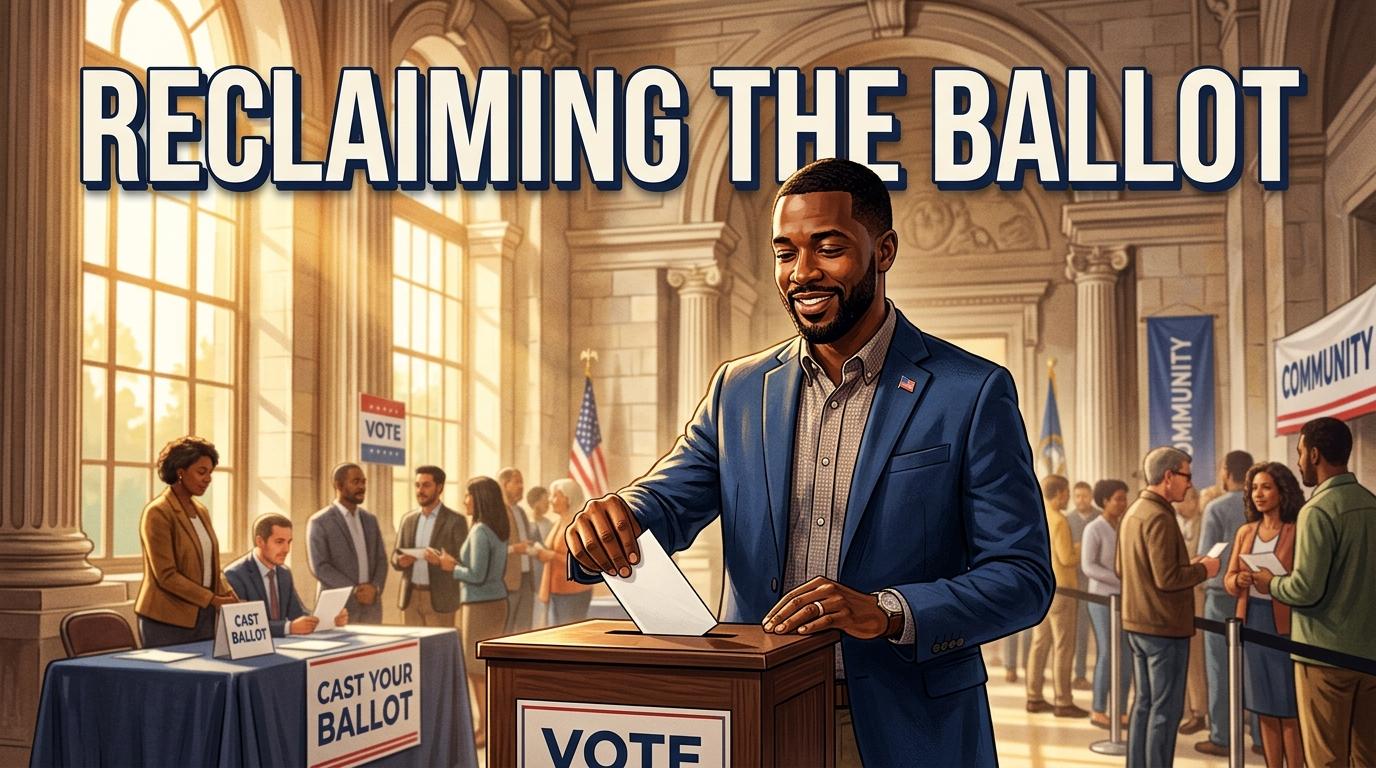
Inside the Fight for Virginia Felony Voting Rights Restoration
By Darius Spearman (africanelements)
Support African Elements at patreon.com/africanelements and hear recent news in a single playlist. Additionally, you can gain early access to ad-free video content.
Executive Power and the Reversal of Disenfranchisement
In July 2026, Virginia Governor Abigail Spanberger announced an executive order that restored civil rights to 66,085 formerly incarcerated individuals (virginia.gov, 13newsnow.com). This executive action returned the right to vote, serve on juries, run for public office, and serve as a notary public (virginia.gov, virginia.gov). The order marks a major shift in state policy. It re-establishes a streamlined executive process to reintegrate returning citizens into democratic life (newsfromthestates.com, virginia.gov).
The executive order directly reverses restrictions set by former Governor Glenn Youngkin (newsfromthestates.com, boltsmag.org). Under the previous administration, rights restoration moved to an opaque, case-by-case review system (protectdemocracy.org, fairelectionscenter.org). Returning citizens had to submit individual applications and clear all court fines, fees, and restitution before regaining their rights (protectdemocracy.org, acluva.org). Governor Spanberger eliminated those financial mandates. She directed state agencies to proactively identify eligible citizens who have completed their prison terms (virginia.gov, virginia.gov). This decision highlights how closely civil rights remain tied to executive power in the state, reflecting the political shift to mass incarceration over recent decades.
The Root of the Law: Reconstruction and the 1870 Act
To understand why a governor must grant executive clemency to restore basic voting rights, one must look at post-Civil War history (eji.org, encyclopediavirginia.org). Following the defeat of the Confederacy, the United States Congress set strict rules for Southern states seeking readmission to the Union (encyclopediavirginia.org, gwu.edu). In 1870, Congress enacted the Virginia Readmission Act. This federal law sought to protect newly emancipated African Americans from discriminatory state laws (eji.org, gwu.edu).
The 1870 federal law stated that Virginia could never alter its constitution to deprive any class of citizens of the right to vote (gwu.edu, encyclopediavirginia.org). It created one narrow exception for criminal disenfranchisement. The state could only strip voting rights from individuals convicted of crimes classified as “felonies at common law” in 1870 (gwu.edu). These common law offenses included murder, manslaughter, arson, burglary, robbery, rape, sodomy, mayhem, and larceny (gwu.edu). Despite federal rules, state leaders sought ways to restrict Black political power as soon as federal military oversight ended, creating forms of legal control that replaced involuntary servitude after the Civil War (eji.org, encyclopediavirginia.org).
Codifying White Supremacy: The 1902 Constitutional Convention
State lawmakers systematically expanded disenfranchisement to bypass the Fifteenth Amendment (eji.org, encyclopediavirginia.org). In 1876, Virginia amended its constitution to strip voting rights for petty larceny, targeting minor property offenses (eji.org). These laws specifically targeted landless Black residents (eji.org, encyclopediavirginia.org). The most dramatic change occurred during the 1902 Constitutional Convention, where white Democratic leaders openly declared their goals (encyclopediavirginia.org, encyclopediavirginia.org).
During the 1902 debates, delegate Carter Glass stated that the convention aimed to eliminate Black citizens as a political factor in the state (eji.org, encyclopediavirginia.org). The resulting 1902 Constitution expanded disenfranchisement from a short list of common law crimes to all felony convictions (protectdemocracy.org, gwu.edu). It mandated lifetime disenfranchisement unless the governor issued an individual pardon or restoration (protectdemocracy.org, virginia.gov). Combined with poll taxes and literacy tests, this constitutional rewrite reduced eligible Black voters in Virginia from roughly 147,000 in 1901 to fewer than 10,000 by 1905 (eji.org, encyclopediavirginia.org). That blanket ban remains written into Article II, Section 1 of the state constitution today (protectdemocracy.org, ballotpedia.org). These historical rules relate directly to ongoing efforts to suppress the vote.
Systemic Disparities in Modern Virginia
Felony disenfranchisement continues to impact Black Virginians at disproportionate rates because of racial disparities across the criminal justice system (sentencingproject.org, usccr.gov). Black residents make up 18 percent of Virginia’s overall population (sentencingproject.org, sentencingproject.org). However, Black individuals account for nearly 52 percent of the state prison population (sentencingproject.org, sentencingproject.org). Black Virginians are incarcerated at almost four times the rate of white Virginians (sentencingproject.org, sentencingproject.org).
This demographic gap stems from long-standing systemic practices, including concentrated policing in Black neighborhoods, cash bail policies, and mandatory minimum sentences (sentencingproject.org, usccr.gov). As a consequence, roughly one in ten Black voting-eligible Virginians cannot vote because of a felony conviction (sentencingproject.org, sentencingproject.org). Black citizens in Virginia are three point five times more likely to lose their political franchise than non-Black residents (sentencingproject.org, sentencingproject.org). Executive restoration directly targets these structural gaps by returning political rights to impacted communities (virginia.gov, newsfromthestates.com). Total disenfranchisement figures show the immense scale of this issue across the state (sentencingproject.org, sentencingproject.org).
Executive Grace and the Pendulum of State Leadership
Article V, Section 12 of the Virginia Constitution gives the sitting governor broad authority to grant executive clemency and restore civil rights (protectdemocracy.org, ballotpedia.org). This authority is called executive grace because rights restoration depends on the individual decisions of each administration (protectdemocracy.org, protectdemocracy.org). Over the past fifteen years, policy approaches have changed significantly with each governor (newsfromthestates.com, nationbuilder.com).
Governors Bob McDonnell, Terry McAuliffe, and Ralph Northam established executive orders to restore rights to large groups of returning citizens (newsfromthestates.com, nationbuilder.com). Governor McAuliffe restored civil rights to over 173,000 Virginians during his term (newsfromthestates.com, nationbuilder.com). Governor Northam expanded eligibility to automatically restore rights upon release from prison, restoring rights to more than 126,000 individuals (newsfromthestates.com, boltsmag.org). When Governor Youngkin took office in 2022, he ended automatic restorations and implemented an individual application model (newsfromthestates.com, boltsmag.org). His administration restored rights to fewer than 10,000 citizens in four years (newsfromthestates.com, boltsmag.org). Critics argued that requiring complete payment of court fines created a modern poll tax that tied political rights to financial wealth (protectdemocracy.org, fairelectionscenter.org).
The Scope of Restored Rights and Remaining Limits
Governor Spanberger’s executive order restores four specific political and civic rights to individuals who served their time (virginia.gov, virginia.gov). First, it restores full voting rights in all federal, state, and local elections (virginia.gov, arlingtonva.us). Second, it allows individuals to serve on civil and criminal juries (virginia.gov, portsmouthva.gov). Third, it permits citizens to run for and hold public office (virginia.gov, virginia.gov). Fourth, it enables individuals to qualify as a notary public in Virginia (virginia.gov, virginia.gov).
However, executive restoration of civil rights does not restore firearm privileges under the Second Amendment (virginia-criminallawyer.com, welchwrightlaw.com). Under Virginia Code § 18.2-308.2, individuals convicted of a felony remain legally prohibited from purchasing, carrying, or possessing firearms (virginia-criminallawyer.com, justia.com). Executive clemency for voting and civil rights operates separately from firearm laws (virginia-criminallawyer.com, welchwrightlaw.com). To regain gun ownership rights, a citizen must file a separate legal petition in the local circuit court where they reside after their civil rights have been restored (virginia-criminallawyer.com, welchwrightlaw.com). The circuit court judge retains final discretion over firearm petitions (virginia-criminallawyer.com, welchwrightlaw.com).
- 1. Florida Highest Disenfranchised
- 2. Texas Strict Limits
- 3. Tennessee Strict Limits
- 4. Virginia > 260,000 Disenfranchised
Federal Court Interventions and the Path to Constitutional Reform
Virginia ranks fourth in the nation in total disenfranchised population, with over 260,000 residents barred from voting (sentencingproject.org, sentencingproject.org). Recent legal rulings have challenged the legal foundation of this system (protectdemocracy.org, protectdemocracy.org). In early 2026, Senior U.S. District Court Judge John A. Gibney Jr. ruled in *King v. Youngkin* that Virginia’s disenfranchisement framework violated federal law (protectdemocracy.org, protectdemocracy.org). The federal court found that Virginia violated the 1870 Virginia Readmission Act by expanding voting bans beyond original common law felonies to include modern statutory offenses like drug possession (protectdemocracy.org, protectdemocracy.org).
The court ruling prohibited the state from disenfranchising individuals convicted of non-common-law felonies (protectdemocracy.org, protectdemocracy.org). This ruling created an immediate legal path for thousands of individuals to register to vote (13newsnow.com, protectdemocracy.org). The ruling highlights ongoing struggles over federalism and Black politics when state laws conflict with federal protections (protectdemocracy.org, gwu.edu). The ultimate resolution of this issue rests with Virginia voters (whro.org, cardinalnews.org).
In November 2026, Virginians will vote on a constitutional amendment referendum (whro.org, cardinalnews.org). The proposed amendment would permanently repeal sole gubernatorial discretion over civil rights restoration (whro.org, ballotpedia.org). If approved by voters, the amendment will automatically restore voting rights to all returning citizens immediately upon release from incarceration (whro.org, ballotpedia.org). This change would align Virginia with twenty-three other states. It would permanently strip the lingering 1902 disenfranchisement provisions from Article II, Section 1 of the state constitution (whro.org, protectdemocracy.org).
About the Author
Darius Spearman is a professor of Black Studies at San Diego City College, where he has been teaching for over 20 years. He is the founder of African Elements, a media platform dedicated to providing educational resources on the history and culture of the African diaspora. Through his work, Spearman aims to empower and educate by bringing historical context to contemporary issues affecting the Black community.
