

The Trap in Florida’s Proof-of-Citizenship Voting Law
By Darius Spearman (africanelements)
Support African Elements at patreon.com/africanelements and hear recent news in a single playlist. Additionally, you can gain early access to ad-free video content.
A major legal showdown has erupted in the Sunshine State over who gets to cast a ballot. Civil rights groups filed a federal lawsuit in Miami challenging Florida’s newly enacted proof-of-citizenship voting restrictions (floridapolitics.com). The Black Voters Matter Fund joined forces with the League of United Latin American Citizens to stop the state measure (floridatrib.org). Litigators argue that the policy builds a discriminatory wall around the ballot box.
State officials defend House Bill 991 as an election integrity safeguard (floridapolitics.com). In contrast, advocates point out that the statute demands documents millions of citizens do not have on hand (projectvote.org). As a result, elderly Black Americans, naturalized citizens, and low-income voters face immediate disenfranchisement. To understand this current struggle, one must examine the long history of bureaucratic suppression across the American South.
A New Legal Battle Over Florida Ballot Access
Florida Governor Ron DeSantis signed House Bill 991 into law on April 1, 2026 (flsenate.gov). Supporters refer to the measure as the state “SAVE Act” (floridapolitics.com). Under the legislation, every person who registers to vote or updates their voter record must provide documentary proof of citizenship (floridapolitics.com, flsenate.gov). The law recognizes only a limited list of records. These records include a valid U.S. passport, a certified birth certificate, or a naturalization certificate (flsenate.gov).
The Southern Poverty Law Center and the Democracy Defenders Fund filed the federal challenge in the Southern District of Florida (floridapolitics.com, floridatrib.org). The complaint targets Florida Secretary of State Cord Byrd alongside county election supervisors (floridatrib.org, floridapolitics.com). According to the lawsuit, HB 991 unlawfully conflicts with the National Voter Registration Act of 1993 (floridapolitics.com, democracydocket.com). Furthermore, litigators argue the mandate violates the Fourteenth Amendment by placing an excessive burden on vulnerable communities (floridapolitics.com, elias.law).
Granny Midwives and the Legacy of Paperwork Segregation
The requirement to present a government-issued birth certificate reopens old wounds from the Jim Crow era (aclu.org, abhmuseum.org). Throughout the early and mid-twentieth century, racial segregation dominated Southern healthcare. White-owned hospitals routinely refused to admit pregnant Black women (aclu.org, usccr.gov). Consequently, Black mothers relied on trusted community lay practitioners known as “granny midwives” (aclu.org, abhmuseum.org).
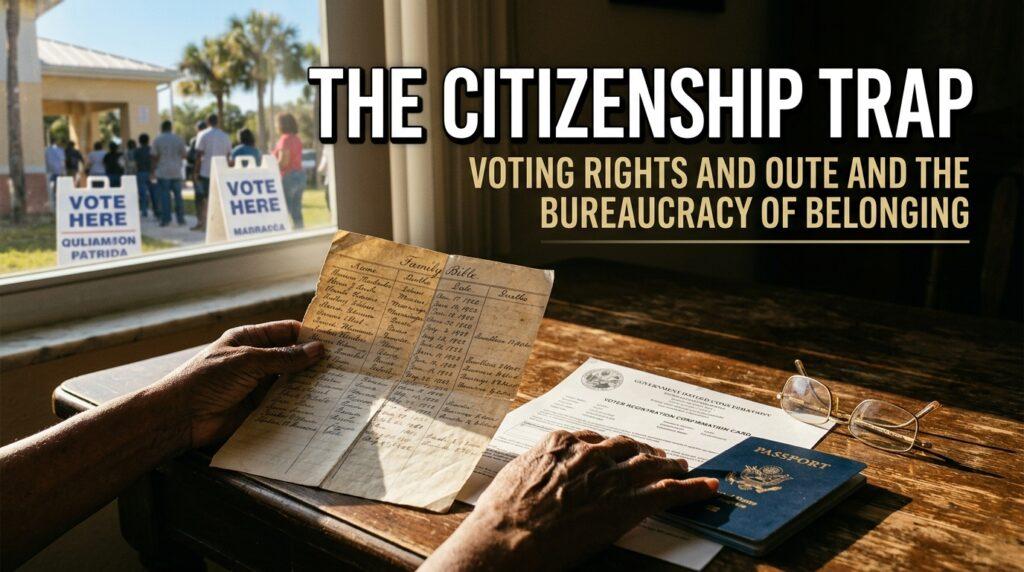
These traditional midwives delivered generations of Black children in rural homes (aclu.org, abhmuseum.org). However, state medical boards actively marginalized Black midwives through restrictive licensing laws like Florida’s 1931 Midwife Practice Act (cambridge.org). Segregated county clerks frequently ignored or refused to file birth records submitted by Black midwives (aclu.org, cambridge.org). Instead, families recorded births inside family Bibles. Historical data reveals that one in five Black Americans born around 1940 never received an official birth certificate (aclu.org, thelensnola.org).
The Jim Crow Birth Registration Deficit
Percentage of U.S. births lacking official birth certificates (1939–1940)
The Administrative Trap of Delayed Birth Certificates
Senior citizens without birth certificates face an agonizing administrative barrier under the new statute (aclu.org, facetofacegermantown.org). To obtain a Delayed Certificate of Birth, state health departments require secondary evidence (facetofacegermantown.org). An elderly person must produce school census entries, church baptismal certificates, or hospital records created during early childhood (facetofacegermantown.org). In addition, they must secure affidavits from living relatives who are older than they are (facetofacegermantown.org).
For someone in their eighties or nineties, those older witnesses have long since passed away (facetofacegermantown.org). Furthermore, segregated schools rarely maintained permanent archives for Black children (aclu.org, abhmuseum.org). Under HB 991, an individual flagged as non-verified receives a notice from the county supervisor of elections (floridapolitics.com, flsenate.gov). The law gives that citizen only thirty days to present qualifying documents (flsenate.gov). The state offers no administrative stay while a voter navigates government archives (flsenate.gov, flsenate.gov). Unverified voters are scrubbed from the active rolls without mercy (floridapolitics.com, flsenate.gov).
Florida’s Long History of Targeted Voter Purges
Modern paperwork barriers fit into a multi-generational pattern of suppression in Florida (tampabay.com, usccr.gov). Following Reconstruction, white conservative lawmakers drafted the Florida Constitution of 1885 (usccr.gov). That charter created poll taxes, complex multiple ballot boxes, and selective literacy evaluations (usccr.gov, abhmuseum.org). State leaders openly designed these rules to neutralize Black political influence. Understanding black voter disenfranchisement requires studying how administrative mechanics silence voters.
That pattern resurfaced during the controversial 2000 presidential election (usccr.gov). Before that contest, Florida officials hired a private contractor to scrub supposed felons from the registration lists (usccr.gov, boltsmag.org). The state matching criteria relied on flawed, broad data points (usccr.gov). Over twelve thousand lawful citizens lost their voting rights, and more than forty percent were Black (usccr.gov). The national election was ultimately decided in Florida by 537 ballots (boltsmag.org). Procedural scrub lists altered the trajectory of modern political history.
The Documentation Possession Disparity
U.S. Passport Ownership Rates by Demographic Group
From Amendment 4 to SB 7050: Modern Retrenchment
The fight over HB 991 follows recent legislative campaigns to limit voter turnout across Florida (fairelectionscenter.org). In 2018, Florida voters overwhelmingly approved Amendment 4 (fairelectionscenter.org). The constitutional amendment restored voting rights to 1.4 million returning citizens with prior felony convictions (fairelectionscenter.org, boltsmag.org). However, lawmakers immediately passed Senate Bill 7066 in 2019 to condition reenfranchisement on full payment of all court fines and administrative fees (pbs.org, boltsmag.org). Many observers compared this financial hurdle to historical practices rooted in post-Civil War servitude, where financial penalties held individuals back.
Next, the legislature targeted grassroots civic organizations through Senate Bill 7050 in 2023 (aclufl.org, aclu.org). Third-party voter registration organizations register minority citizens at five times the rate of white residents (aclufl.org, aclu.org). Senate Bill 7050 imposed massive fines of up to $250,000 on registration groups for minor clerical mistakes (aclufl.org). Additionally, the state barred returning citizens from handling voter registration forms (aclufl.org, aclu.org). HB 991 expands this effort by rejecting common IDs like student cards and public assistance cards at the ballot box (flsenate.gov).
Why Federal Law Clashes With State Proof Mandates
The federal lawsuit contends that Florida lawmakers exceeded their constitutional authority (floridapolitics.com, elias.law). Under the Elections Clause of the Constitution, Congress holds primary power to regulate federal elections (democracydocket.com, democracydocket.com). The balance of federal and state power remains a central theme in civil rights litigation. When Congress passed the National Voter Registration Act of 1993, it established a uniform federal registration form (democracydocket.com, democracydocket.com).
The NVRA mandates that states must accept this federal form (democracydocket.com, democracydocket.com). The federal form requires applicants to attest to their citizenship under penalty of perjury, prison, and deportation (floridapolitics.com, democracydocket.com). In the 2013 case Arizona v. Inter Tribal Council of Arizona, the Supreme Court ruled that states cannot demand extra paperwork alongside the federal form (democracydocket.com, democracydocket.com). Similarly, the Tenth Circuit Court of Appeals struck down Kansas’s proof-of-citizenship statute in Fish v. Kobach (aclukansas.org, kcur.org). The Tenth Circuit emphasized that Kansas disenfranchised over thirty thousand citizens while uncovering virtually no non-citizen voting (aclukansas.org, kcur.org).
The Hidden Threat to Naturalized Citizens and Communities of Color
HB 991 creates an aggressive verification system by cross-referencing voter rolls with motor vehicle databases (elias.law, flsenate.gov). The Florida Department of Highway Safety and Motor Vehicles maintains driver records (elias.law, elias.law). However, state databases do not automatically update when a legal permanent resident becomes a naturalized citizen (elias.law). Consequently, an immigrant who obtained a driver’s license five years ago remains listed as a non-citizen in state files (elias.law, elias.law).
When the state compares voter registrations against outdated driver records, thousands of lawful citizens receive mismatch notices (elias.law, elias.law). If a voter moves or misses the certified letter, the local supervisor strikes them from the rolls within thirty days (elias.law, flsenate.gov). Data analyses reveal that between 872,000 and one million registered Florida voters lack matching citizenship credentials in state motor vehicle systems (elias.law, vote.org). These lawful voters face wrongful purges simply because government computers fail to communicate (elias.law).
The Human Impact: Voters at Immediate Risk
Community Resistance on the Frontlines
Voting rights leaders refuse to back down in the face of these obstacles (facebook.com, facebook.com). The Black Voters Matter Fund was founded in 2016 by organizers LaTosha Brown and Cliff Albright (facebook.com, facebook.com). The organization travels across the rural South to build grassroots political infrastructure (facebook.com, facebook.com). Their iconic “Blackest Bus in America” tour visits isolated towns to register voters and provide civic training (facebook.com, facebook.com).
BVMF does not parachute into communities solely during presidential elections (facebook.com, facebook.com). Instead, the organization funds local activists year-round (facebook.com, facebook.com). This lawsuit is part of a broader commitment to dismantle modern voter suppression (floridapolitics.com, floridapolitics.com). By challenging HB 991, civil rights organizers are defending the democratic rights of rural elders, student voters, and working-class families (floridapolitics.com, floridatrib.org).
Safeguarding Democracy in the Sunshine State
The legal fight against Florida’s proof-of-citizenship requirement will have nationwide consequences (floridapolitics.com, time.com). Conservative lawmakers in other states are closely monitoring the litigation (time.com, ballotpedia.org). If the federal courts uphold HB 991, copycat bills will quickly appear across the country (time.com, ballotpedia.org). The debate exposes a fundamental conflict between administrative barriers and the constitutional right to vote (floridapolitics.com, elias.law).
Florida’s history shows that bureaucratic tests have always served to narrow the electorate (usccr.gov, abhmuseum.org). From grandfather clauses and literacy tests to modern paperwork mandates, the underlying tactic remains consistent (aclu.org, usccr.gov). As the federal court considers this challenge, the fundamental question remains simple. Will citizenship be recognized as a democratic right, or will it depend on who can afford the paperwork?
About the Author
Darius Spearman is a professor of Black Studies at San Diego City College, where he has been teaching for over 20 years. He is the founder of African Elements, a media platform dedicated to providing educational resources on the history and culture of the African diaspora. Through his work, Spearman aims to empower and educate by bringing historical context to contemporary issues affecting the Black community.
