


Will California Capital Punishment End Over Racial Bias?
By A. Darius Spearman (africanelements)
Support African Elements at patreon.com/africanelements and hear recent news in a single playlist. Additionally, you can gain early access to ad-free video content.
A Systemic Reckoning in the Golden State
California capital punishment stands on the edge of a historic legal precipice. For decades, legal challenges to the death penalty occurred on a case-by-case basis. Condemned prisoners raised claims about ineffective trial counsel, forensic errors, or single instances of juror bias. However, a major constitutional challenge titled Office of the State Public Defender et al. v. Bonta has fundamentally altered the battlefield (aclunorcal.org, aclu.org). A coalition of civil rights advocates, public defenders, and racial justice organizations filed an original writ petition directly in the California Supreme Court. They argued that pervasive, documented racial disparities make the state death penalty statute an unconstitutional violation of equal protection (aclunorcal.org, aclunorcal.org).
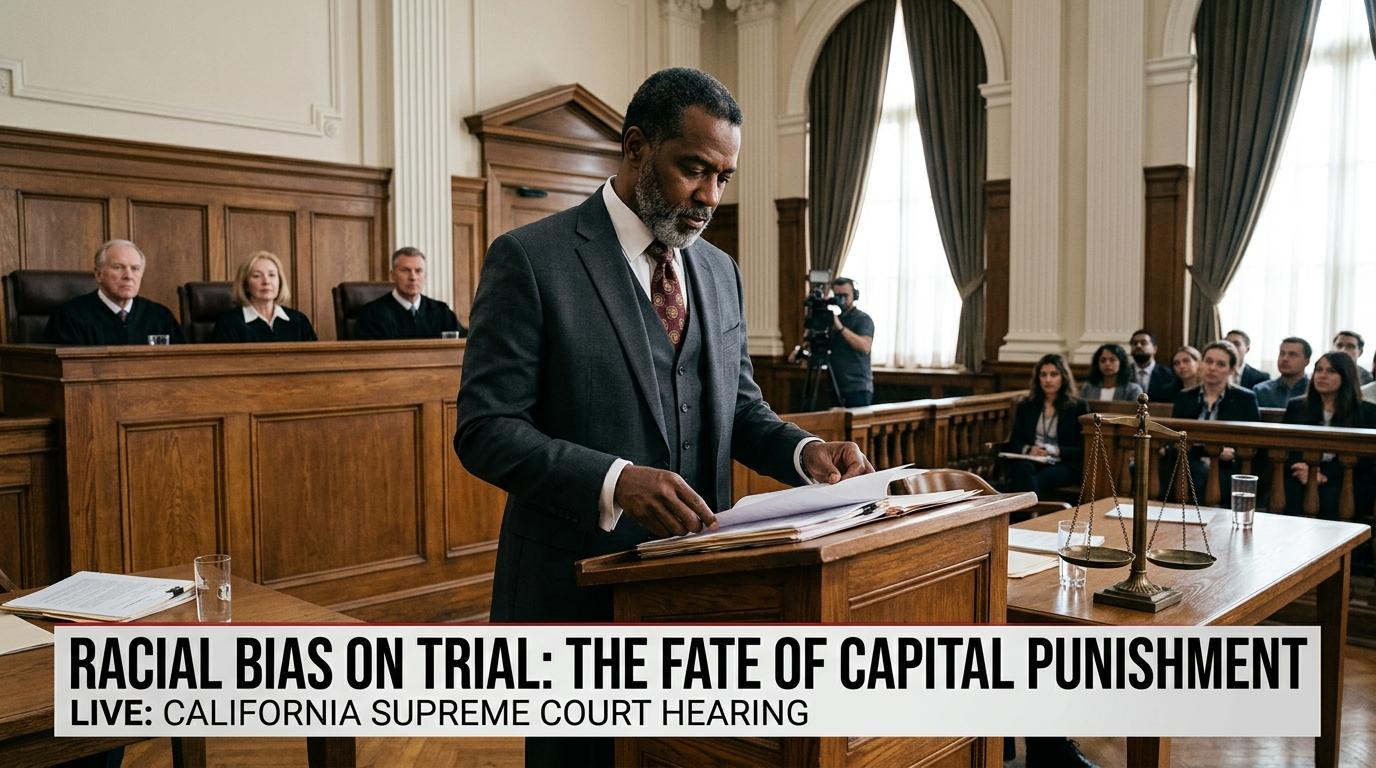
The state high court took an unprecedented step by issuing an Order to Show Cause (aclunorcal.org, horvitzlevy.com). By doing so, the justices determined that the litigators established a viable prima facie case of statewide racial discrimination (horvitzlevy.com). The court ordered the state Attorney General to explain why the entire capital sentencing system should not be declared unconstitutional (aclunorcal.org, ca.gov). The case was remanded to the Sacramento County Superior Court for a full evidentiary hearing on systemic racial bias (washingtonpost.com, horvitzlevy.com). This proceeding marks the first time any court in California history has ordered a systemic trial to examine whether racial disparity permanently invalidates the death penalty (aclunorcal.org, deathpenaltyinfo.org).
The Federal Shadow of McCleskey v. Kemp
To grasp why this legal breakthrough matters, one must examine the legal barrier built by the federal judiciary. In 1987, the United States Supreme Court ruled on McCleskey v. Kemp (washingtonpost.com, deathpenaltyinfo.org). Warren McCleskey was a Black man sentenced to death in Georgia for killing a white police officer. His legal team presented a landmark study by Professor David Baldus (washingtonpost.com, aclusocal.org). The Baldus study evaluated more than 2,000 Georgia homicide cases. It proved that Black defendants accused of killing white victims were more than four times as likely to receive death sentences than those accused of killing Black victims (washingtonpost.com).
In a narrow five to four decision, the Supreme Court shut the door on statistical proof (washingtonpost.com). Justice Lewis Powell Jr. wrote for the majority that general statistical bias did not violate the federal Equal Protection Clause (washingtonpost.com, deathpenaltyinfo.org). The Court declared that a defendant must prove purposeful, intentional discrimination in their individual case (deathpenaltyinfo.org). In a sharp dissent, Justice William Brennan warned that the majority was acting out of a fear of too much justice (washingtonpost.com). Brennan observed that the Court feared acknowledging capital bias because racial disparities infect the entire criminal legal system. Powell later expressed regret for his decisive vote, but the damage remained permanent (washingtonpost.com, deathpenaltyinfo.org).
For nearly four decades, the McCleskey ruling barred defendants across the nation from challenging systemic racism in federal courts (washingtonpost.com, aclunorcal.org). Capital litigators were trapped. They could document broad inequality, yet federal judges dismissed statistical disparities as legally meaningless (deathpenaltyinfo.org, aclusocal.org). The legal system demanded individual confessions of bigotry, an impossible standard in a modern era marked by institutional and implicit bias (aclunorcal.org).
From Anderson to the Briggs Initiative
California developed its own capital apparatus while federal courts closed their doors to racial bias claims. The struggle over executions in the state has roots reaching deep into legal history. Much like early racial control established during the Compromise of 1850, early state institutions relied on severe penal structures to enforce hierarchy. In February 1972, the California Supreme Court boldly struck down the death penalty in People v. Anderson, declaring it unconstitutionally cruel or unusual (scocablog.com). However, political backlash arrived rapidly. Nine months later, state voters passed Proposition 17, placing capital punishment directly into the state constitution (scocablog.com).
The decisive expansion occurred in 1978 with Proposition 7, commonly known as the Briggs Initiative (aclu.org, ca.gov). Drafted by state Senator John Briggs, the measure widened the legal net of special circumstances required for capital murder (aclu.org). These statutory categories turned ordinary homicide charges into capital offenses punishable by death or life without parole (aclu.org, ca.gov). The categories included offenses such as robbery-murder, drive-by shootings, and gang-related homicides (aclu.org).
This statutory expansion aligned directly with the rise of the era of mass incarceration. California enacted broad death penalty laws that gave district attorneys unchecked discretion. Prosecutors gained the authority to choose which defendants faced capital trials and which received non-capital charges. Over four decades, this unchecked discretion filled San Quentin with the largest condemned population in the Western Hemisphere (aclu.org, aclunorcal.org). At its peak, California held more than seven hundred people on death row (aclu.org).
The Devaluation of Black Lives: Victim-Discounting
The statistical evidence presented to California courts reveals a dual pattern of racial disparity. Researchers examined thousands of California homicide cases over multiple decades (aclunorcal.org, washingtonpost.com). A comprehensive empirical study directed by Professors Catherine M. Grosso and Jeffrey Fagan isolated the impact of race from case severity (aclunorcal.org, washingtonpost.com). The data proved that Black defendants were up to 8.7 times more likely to receive a death sentence than similarly situated white defendants (aclunorcal.org, aclunorcal.org). For Latino defendants, the likelihood was 6.2 times higher (aclunorcal.org, aclunorcal.org).
Equally disturbing is the phenomenon known as victim-discounting (deathpenaltyinfo.org, washingtonpost.com). This term describes the systemic devaluation of Black and Latino lives by the criminal justice system. In California, murder cases involving at least one white victim were up to 8.8 times more likely to result in a death sentence than homicides involving victims of color (aclunorcal.org, aclunorcal.org). The prosecutorial apparatus treats crimes against white victims with maximum punitive severity while showing indifference toward homicides inside communities of color (deathpenaltyinfo.org, washingtonpost.com).
This disparity mirrors the historical exploitation seen during the post-Reconstruction period of convict leasing, where legal mechanisms served racial control rather than public safety. Today, Black citizens make up only about six percent of California’s general population (aclunorcal.org, aclu.org). Yet Black men comprise more than thirty-five percent of the condemned row (aclunorcal.org, aclu.org). People of color collectively constitute nearly seventy percent of those condemned to die (aclunorcal.org, aclunorcal.org). These numbers show that the system operates with profound racial selectivity (aclunorcal.org, deathpenaltyinfo.org).
The Geography of Unequal Justice
Racial disparities in California capital punishment are magnified by local county boundaries. Capital charges do not depend primarily on the severity of a crime. Instead, outcomes depend heavily on the county in which the offense takes place (aclunorcal.org, rivcoda.org). A handful of aggressive prosecutorial offices have supplied the vast majority of California death sentences (aclunorcal.org, deathpenaltyinfo.org).
Riverside County stands as the most prominent example of this geographic arbitrariness (davisvanguard.org, rivcoda.org). Between 2015 and 2019, Riverside County alone produced over one-third of all death sentences across California (davisvanguard.org). The county holds only six percent of the state population (davisvanguard.org). Under local District Attorney Michael Hestrin, the office pursued capital verdicts at unprecedented rates (davisvanguard.org, rivcoda.org). More than eighty-five percent of the individuals sentenced to death in Riverside County in recent decades have been people of color (davisvanguard.org).
Black defendants in Riverside County make up more than a quarter of modern death sentences, despite representing only seven percent of county residents (davisvanguard.org). District attorneys in urban counties like San Francisco and Los Angeles largely abandoned capital trials, but conservative suburban jurisdictions accelerated them (davisvanguard.org, deathpenaltyinfo.org). Where a person is prosecuted within California determines whether they face state execution (aclunorcal.org, davisvanguard.org).
The Legislative Cure: California’s Racial Justice Act
Faced with decades of federal inaction, California state lawmakers acted to dismantle the McCleskey roadblock. Following widespread racial justice protests in 2020, Assemblymember Ash Kalra introduced Assembly Bill 2542 (aclu.org, aclusocal.org). This landmark measure created the California Racial Justice Act (CRJA), codified in Penal Code Section 745 (ca.gov, aclusocal.org). The statute targeted systemic discrimination directly by repudiating the federal requirement of proving individual discriminatory intent (ca.gov, aclusocal.org).
Under the CRJA, defendants can challenge convictions and sentences using statistical evidence of racial disparity (ca.gov). The law permits relief if a defendant shows significant disparities in charges, convictions, or sentences based on race, ethnicity, or national origin (ca.gov). Two years later, the legislature passed Assembly Bill 256, known as the Racial Justice Act for All (aclusocal.org, aclunorcal.org). This amendment made the protections retroactive for individuals on death row (aclusocal.org, aclunorcal.org). These legal reforms aligned with ongoing state initiatives, including the groundbreaking reparations task force, designed to unearth and repair generations of institutional harm.
Executive leadership supported this shift away from executions. Governor Gavin Newsom announced a formal execution moratorium in March 2019 (washingtonpost.com, calmatters.org). Newsom stated that the death penalty is discriminatory and inconsistent with democratic values (washingtonpost.com). His administration ordered the complete dismantling of the historic death row housing at San Quentin Rehabilitation Center (washingtonpost.com, deathpenalty.org). In an amicus brief filed in 2021, Newsom wrote that California capital punishment has always been infected by racism (aclu.org, washingtonpost.com). Yet, an executive moratorium remains vulnerable to the choices of future governors (calmatters.org).
The Habeas Crisis and Systemic Litigators
While the Racial Justice Act gave condemned prisoners a mechanism to challenge bias, a catastrophic bottleneck emerged. Post-conviction capital litigation in California moves at an extraordinarily slow pace (aclu.org, deathpenalty.org). Condemned individuals wait between twenty and thirty years simply to receive an appointed habeas corpus attorney (aclu.org, deathpenalty.org). The state suffers from a severe shortage of qualified capital defense counsel (aclu.org).
More than five hundred and sixty individuals remain on California death row (aclu.org, washingtonpost.com). The vast majority have no assigned legal counsel capable of conducting complex countywide statistical investigations (aclu.org, aclunorcal.org). Requiring hundreds of individual CRJA hearings would paralyze county courts for decades (aclu.org, aclunorcal.org). Furthermore, aging prisoners would spend the remainder of their lives behind bars before an attorney could file their individual claims (aclu.org, deathpenalty.org).
Recognizing this crisis, the Office of the State Public Defender joined forces with civil rights litigators (aclunorcal.org, aclu.org). They filed OSPD v. Bonta as an original writ petition to demand a comprehensive statewide solution (aclunorcal.org, aclunorcal.org). Litigators argued that systemic discrimination requires a systemic remedy (aclunorcal.org, aclunorcal.org). Forcing impoverished defendants to run a decades-long procedural marathon to challenge identical statewide disparities violates the core principles of equal protection (aclu.org, aclunorcal.org).
The Order to Show Cause and the Path Forward
The state high court agreed that the statistical evidence demanded a formal judicial hearing (aclunorcal.org, horvitzlevy.com). By issuing an Order to Show Cause, the California Supreme Court shifted the legal burden to the state government (aclunorcal.org, ca.gov). California Attorney General Rob Bonta adopted a unique posture in response to the petition (washingtonpost.com, dailyjournal.com). Rather than defending the death penalty, Bonta acknowledged that the racial disparities documented in the petition are extraordinarily disturbing (washingtonpost.com, dailyjournal.com).
The Attorney General conceded that community organizations possessed standing to bring the action (dailyjournal.com). His office asked the courts to thoroughly examine the methodology of the empirical studies (dailyjournal.com). This measured stance created friction with conservative prosecutors (dailyjournal.com, rivcoda.org). District attorneys from Riverside and San Bernardino counties filed motions opposing the challenge, arguing that voters endorsed capital punishment and that courts must uphold individual verdicts (dailyjournal.com, rivcoda.org).
The evidentiary proceedings ordered by the high court will place the machinery of death on trial in Sacramento (washingtonpost.com, horvitzlevy.com). If civil rights litigators prevail, the legal consequences will be monumental (aclu.org, dailyjournal.com). A ruling striking down the death penalty under the California Constitution would commute all remaining death sentences to life imprisonment without the possibility of parole (aclu.org, dailyjournal.com). It would also permanently bar prosecutors from seeking the death penalty in future trials (aclu.org). Such a decision would rely on independent state constitutional grounds, protecting the ruling from federal reversal (washingtonpost.com). California would close the chapter on its largest death row and complete the work that federal courts abandoned decades ago (aclunorcal.org, washingtonpost.com).
About the Author
A. Darius Spearman is a professor of Black Studies at San Diego City College, where he has been teaching for over 20 years. He is the founder of African Elements, a media platform dedicated to providing educational resources on the history and culture of the African diaspora. Through his work, Spearman aims to empower and educate by bringing historical context to contemporary issues affecting the Black community.
