



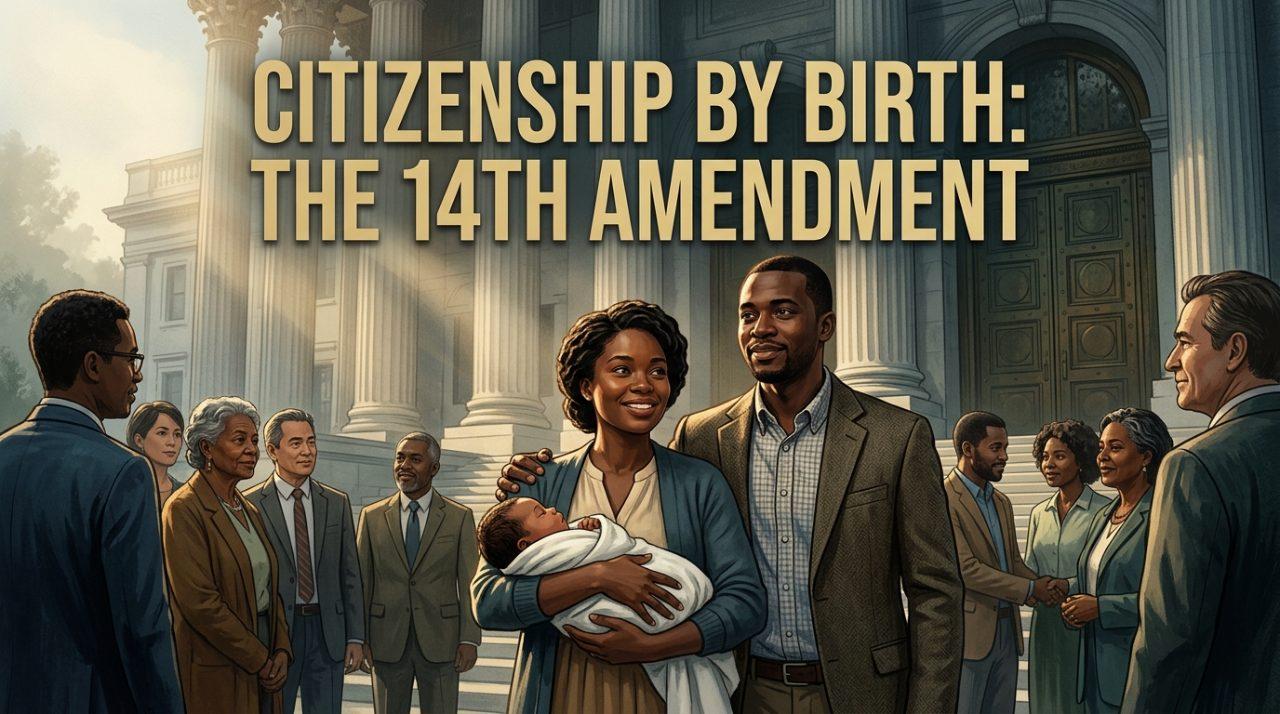
Can an Executive Order End Birthright Citizenship?
By Darius Spearman (africanelements)
Support African Elements at patreon.com/africanelements and hear recent news in a single playlist. Additionally, you can gain early access to ad-free video content.
The Battle in Federal Court
A major legal clash has brought the definition of American identity back into the national spotlight. A federal district court issued an injunction against a renewed executive order that sought to restrict birthright citizenship. United States District Judge Deborah L. Boardman determined that executive actions attempting to narrow the Fourteenth Amendment exceed presidential authority. In her ruling, Judge Boardman stressed that children born on American soil are citizens at birth under long-standing Supreme Court precedent (thedailyrecord.com, courthousenews.com).
The White House attempted to craft narrow exemptions for the children of undocumented residents and temporary visitors. However, civil rights organizations quickly filed class-action challenges to stop the policy from taking effect. Legal analysts emphasize that court challenges against these directives demonstrate how prospective executive policies run directly into constitutional boundaries. Federal courts have consistently maintained that the president cannot rewrite the Constitution by executive decree (aclu.org, statesunited.org).
The Shadow of Dred Scott and Racial Caste
The current struggle over birthright citizenship cannot be understood without examining the deep history of racial subjugation in America. Before the Civil War, the nation had no uniform constitutional rule defining who was an American citizen. Instead, individual states determined legal standing. This decentralized system allowed white political leaders to deny personhood to millions of enslaved people (constitutioncenter.org, archives.gov).
The Supreme Court made this racial hierarchy permanent law in the 1857 decision Dred Scott v. Sandford. Chief Justice Roger B. Taney wrote that people of African descent were never intended to be citizens under the Constitution. Taney declared that Black individuals had no rights that white men were bound to respect (wikipedia.org, archives.gov). This ruling officially established a racial caste. Citizenship became a privilege based on skin color and ancestry rather than the reality of birth on American soil. The tragic legacy of this decision caused untold trauma for African American families fighting for basic recognition (archives.gov).
The Civil Rights Act of 1866 and Johnson’s Veto
Following the Civil War, the Reconstruction Congress took decisive action to destroy the legal foundation of the Dred Scott ruling. Lawmakers passed the Civil Rights Act of 1866. This historic measure marked the very first federal statute to define national birthright citizenship. It guaranteed that all persons born in the United States were citizens entitled to full legal protection (impeach-andrewjohnson.com, emergingcivilwar.com).
President Andrew Johnson fiercely opposed the legislation and issued a presidential veto. Johnson argued that formerly enslaved African Americans did not possess the qualifications necessary for civic standing. He also claimed that granting citizenship to Black people discriminated against the white race (impeach-andrewjohnson.com, owleyes.org). Furthermore, Johnson warned that birthright status would expand beyond Black communities to include Chinese immigrants and Native Americans. Congress took the unprecedented step of overriding Johnson’s veto on April 9, 1866 (impeach-andrewjohnson.com, emergingcivilwar.com). Recognizing that a future Congress could easily repeal standard legislation, lawmakers immediately resolved to embed universal birthright citizenship directly into the Constitution (constitutioncenter.org, archives.gov).
The Reconstruction Amendments and the Second Founding
The period between 1865 and 1870 is recognized by historians as the Second Founding of the United States. During these transformative years, the Reconstruction Congress passed the Thirteenth, Fourteenth, and Fifteenth Amendments. The Thirteenth Amendment abolished chattel slavery across the country (nps.gov, archives.gov). Meanwhile, the Fifteenth Amendment sought to stop the suppression of the vote by granting the franchise to Black men (archives.gov).
The centerpiece of this era was the Fourteenth Amendment, ratified in July 1868. Its Citizenship Clause established that all persons born or naturalized in the United States, and subject to its jurisdiction, are citizens (constitutioncenter.org, archives.gov). Framers like Senator Jacob Howard and Representative John Bingham designed the clause to prevent individual states from ever creating a subordinate subclass (constitutioncenter.org, constitutioncenter.org). By granting Congress explicit enforcement powers under Section 5, the amendment completely transformed the (constitutioncenter.org, archives.gov).
Milestones in the Defense of Birthright Citizenship
Dred Scott v. Sandford
The Supreme Court legally enforces a racial caste, ruling Black people cannot be citizens.
Civil Rights Act of 1866
Congress enacts the first statutory guarantee of birthright citizenship over a presidential veto.
The 14th Amendment
Universal citizenship is formally anchored into the Constitution through the Citizenship Clause.
U.S. v. Wong Kim Ark
The Supreme Court confirms birthright citizenship protects children of foreign noncitizens.
Federal Injunctions Upheld
Courts halt executive orders seeking to bypass the 14th Amendment and create tiered citizenship.
Wong Kim Ark and the Principle of Jus Soli
Critics have claimed that the Fourteenth Amendment was intended exclusively for formerly enslaved African Americans. That restrictionist argument was tested and rejected by the Supreme Court over a century ago in United States v. Wong Kim Ark (wikipedia.org, justia.com). Wong Kim Ark was born in San Francisco to Chinese immigrant parents who were legally barred from naturalization under the Chinese Exclusion Act (wikipedia.org, napaba.org).
When Wong returned from a trip to China, federal officials denied him entry into his own birth nation. In 1898, the Supreme Court ruled in his favor with a decisive 6–2 majority (wikipedia.org, supremecourt.gov). Justice Horace Gray held that the opening words of the Fourteenth Amendment apply universally to all persons born on American soil. Gray affirmed the ancient legal doctrine of jus soli, meaning citizenship by soil (wikipedia.org, justia.com). The Court clarified that foreign residents living in the country are subject to its laws and courts. Consequently, their children born within the territory are automatic American citizens (wikipedia.org, supremecourt.gov).
Why the Legal Defense Fund Enters the Fight
The NAACP Legal Defense and Educational Fund, known as the LDF, stands among the nation’s premier civil rights organizations. Founded in 1940 by Thurgood Marshall, the LDF led the litigation campaign that struck down Jim Crow segregation in landmark rulings such as Brown v. Board of Education (impactfund.org). While the public associates the LDF with school desegregation, the organization actively participates in birthright citizenship litigation (aclu.org, impactfund.org).
Civil rights litigators recognize that any effort to qualify birthright citizenship directly endangers African American constitutional protections. The arguments deployed against the children of immigrant workers borrow the same rhetoric once used in the Dred Scott decision (aclu.org, archives.gov). If an executive administration can strip citizenship from one group of native-born children, no domestic minority group remains safe from political disenfranchisement. Defending the Fourteenth Amendment preserves the very constitutional firewall that guarantees Black freedom (aclu.org, impactfund.org).
The Reality of Tiered Citizenship Today
A tiered citizenship system divides a population into separate legal strata with unequal rights. Historically, Southern states created this arrangement through slavery and subsequent Black Codes (impeach-andrewjohnson.com, archives.gov). These laws stripped individuals of personal autonomy, court access, and property ownership. The nation relied heavily on exploited Black labor while denying these laborers the rights of free citizens (archives.gov).
Modern legal strategies attempting to condition citizenship on parental immigration status threaten to recreate this exact dynamic. Denying birthright status would generate a massive hereditary subclass living inside the borders without basic protections (aclu.org, americanimmigrationcouncil.org). Children born on American soil would be barred from voting, public benefits, and legal employment. This structure exposes millions of people to arbitrary detention, wage theft, and deportation. Creating an inherited underclass directly violates the anti-subordination mandate of the Fourteenth Amendment (aclu.org, constitutioncenter.org).
Annual Births to Unauthorized Immigrant Mothers in the U.S.
Source: Pew Research Center Demographic Reports
Births to noncitizen mothers account for ~9% of all 3.6 million annual U.S. births.
The Wartime Ghost: The Alien Enemies Act
To circumvent established constitutional precedent, administrative efforts have looked to the Alien Enemies Act of 1798. This archaic statute was originally enacted during the Quasi-War with France as part of the Alien and Sedition Acts (nycbar.org, lvcriminallawfirm.com). The law grants the executive branch special authority during wartime. Specifically, the president may apprehend, restrain, and remove noncitizens from hostile nations without ordinary legal process (nycbar.org, lvcriminallawfirm.com).
Throughout American history, the federal government invoked this extraordinary statute strictly during declared military conflicts. The law provided the legal cover for the tragic internment of Japanese, German, and Italian residents during World War II (nycbar.org). Modern legal attempts to apply an eighteenth-century wartime act to civilian immigration violate fundamental due process standards. Standard immigration law requires notice, access to counsel, and judicial hearings before an immigration judge (nycbar.org, americanimmigrationcouncil.org). Misusing wartime authorities against civilian populations subverts constitutional checks and balances (nycbar.org, statesunited.org).
The Overlooked Impact on Black Immigrants
The national conversation surrounding immigration policy often ignores its deep impact on Black diaspora communities. Today, more than 4.6 million Black immigrants reside in the United States, hailing from the Caribbean, Central America, and the African continent (stateofblackimmigrants.com). Approximately 600,000 Black immigrants live without documentation, while thousands more rely on humanitarian programs such as Temporary Protected Status (pewresearch.org, stateofblackimmigrants.com).
Black immigrant families experience heightened vulnerabilities at the intersection of racial profiling and immigration enforcement. Studies show that Black noncitizens represent roughly seven percent of the noncitizen population. Yet, they comprise more than twenty percent of immigrants facing deportation on criminal grounds (stateofblackimmigrants.com). Restricting birthright citizenship would leave countless Black children stateless in their own country. In mixed-status households, the denial of birthright citizenship compounds housing instability, economic marginalization, and institutional fear (pewresearch.org, stateofblackimmigrants.com).
Public Attitudes & International Legal Frameworks
What Weakening the Fourteenth Amendment Costs All Citizens
The push to alter birthright citizenship presents a clear danger to the entire constitutional framework. If an executive administration can redefine “subject to the jurisdiction thereof” without a constitutional amendment, citizenship ceases to be an unalienable right. Instead, national belonging becomes a temporary political favor subject to presidential discretion (aclu.org, constitutioncenter.org).
Every major expansion of freedom in modern history relies directly on the Fourteenth Amendment. Voting rights claims, criminal justice reform, and legal challenges to police abuse draw their authority from its text (aclu.org, impactfund.org). Allowing political leaders to bypass the Constitution would weaken every single guarantee established after the Civil War. True democracy demands that all people born on American soil stand equal before the law (constitutioncenter.org, archives.gov).
About the Author
Darius Spearman is a professor of Black Studies at San Diego City College, where he has been teaching for over 20 years. He is the founder of African Elements, a media platform dedicated to providing educational resources on the history and culture of the African diaspora. Through his work, Spearman aims to empower and educate by bringing historical context to contemporary issues affecting the Black community.
