



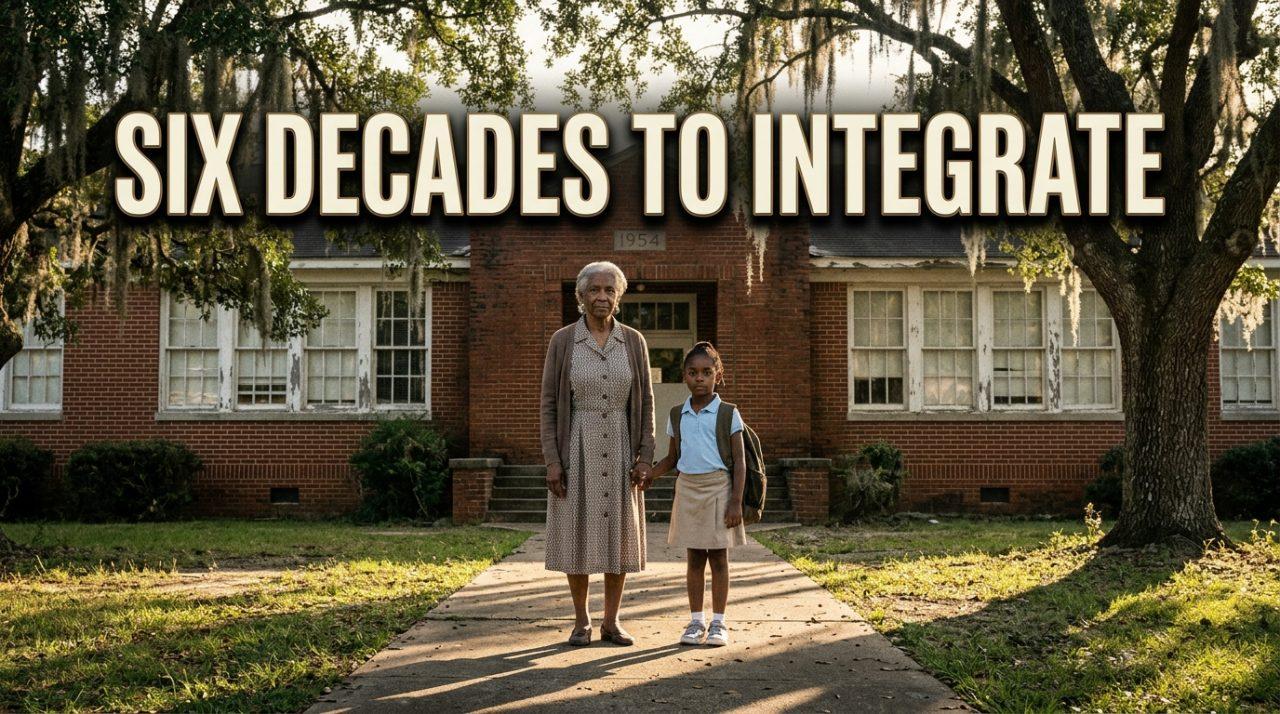
Why Did a Mississippi School Desegregation Order Take 60 Years?
By Darius Spearman (africanelements)
Support African Elements at patreon.com/africanelements and hear recent news in a single playlist. Additionally, you can gain early access to ad-free video content.
A Historic Ruling in Central Mississippi
In September 2026, federal oversight officially ended for the Leake County School District in central Mississippi. Chief Judge Daniel P. Jordan III signed the order granting unitary status to the district (breezynews.com). This historic ruling dissolved a federal desegregation decree that began in 1969 (justia.com, breezynews.com). For nearly six decades, federal judges monitored student assignments, staff hiring, and school facilities across the county (justia.com, breezynews.com).
Superintendent Will Russell announced the legal victory to local residents shortly after the judge signed the ruling (breezynews.com). Achieving unitary status means the court determined the district eliminated the vestiges of prior state-sponsored separation (ldfrecollection.org). Consequently, local elected trustees now hold complete authority over educational governance once again (ldfrecollection.org). However, this milestone also closes a long chapter of civil rights history that demanded immense community sacrifice (mississippifreepress.org).
The Courageous Stand of the Hudson Sisters
The legal fight began in Harmony, an independent rural community of landowning Black farmers in Leake County (mississippifreepress.org). In the early 1960s, white county officials closed Harmony’s historic community school to centralize administrative control (mississippifreepress.org). Black residents wanted their cherished neighborhood facility repaired, reopened, and adequately funded (mississippifreepress.org). Community organizers refused to accept inferior accommodations forced upon their children by an all-white school board (mississippifreepress.org, mississippifreepress.org).
Sisters Winson Hudson and Dovie Hudson took charge of the local movement as officers of the county NAACP (mississippifreepress.org, ldfrecollection.org). They traveled directly to Jackson to seek formal legal representation (mississippifreepress.org). There, they met Derrick Bell, an attorney with the NAACP Legal Defense and Educational Fund (ldfrecollection.org). Bell explained that the federal courts would only accept lawsuits demanding constitutional desegregation (ldfrecollection.org). In March 1963, Bell filed Hudson v. Leake County School Board alongside Mississippi field secretary Medgar Evers (mississippifreepress.org, ldfrecollection.org).
-
1963
Derrick Bell files Hudson v. Leake County alongside local leaders and Medgar Evers.
-
1964
Six-year-old Debra Lewis desegregates Carthage Attendance Center as the sole Black first grader.
-
1969
The Fifth Circuit mandates a comprehensive integration decree under Supreme Court authority.
-
2011
Federal court orders the closure of racially identifiable schools at Edinburg and Thomastown.
-
2026
Judge Daniel P. Jordan III grants unitary status, concluding 57 years of federal monitoring.
White Backlash and Economic Retaliation
White supremacists responded to the civil rights litigation with extreme hostility and coordinated violence (mississippifreepress.org). Members of the local Citizens’ Council mobilized white business owners across the region (mississippifreepress.org, mississippifreepress.org). Local merchants immediately canceled credit accounts for Black petitioners who signed school affidavits (mississippifreepress.org). Furthermore, white landlords evicted tenant farmers who dared to support educational equality for their children (mississippifreepress.org).
Armed night riders also carried out direct terror attacks against local civil rights organizers (mississippifreepress.org). Extremists firebombed the home of Winson Hudson and threw dynamite at Dovie Hudson’s residence twice (mississippifreepress.org). In the autumn of 1964, six-year-old Debra Lewis walked into Carthage Attendance Center alone (mississippifreepress.org). Intimidation forced every other family to withdraw, and white employers fired Debra’s father that very morning (mississippifreepress.org). Her courage echoed the ongoing struggle for freedom that defined generations of Black resistance.
Legal Stalling and Freedom-of-Choice Ploys
For more than a decade, Mississippi officials exploited the vague language of federal court mandates (ldfrecollection.org). The United States Supreme Court originally called for integration with all deliberate speed (ldfrecollection.org). Segregationists treated that ambiguous phrase as a green light for infinite stalling and resistance (ldfrecollection.org). School boards across the South adopted deceptive freedom-of-choice policies instead of real integration (justia.com, ldfrecollection.org).
These plans placed the entire burden of integration upon vulnerable African American children (ldfrecollection.org). White students never elected to attend underfunded Black campuses under these voluntary rules (ldfrecollection.org). Meanwhile, Black families faced severe economic reprisals and physical terror whenever they selected white campuses (mississippifreepress.org). Finally, in 1969, the Supreme Court demanded immediate integration in Alexander v. Holmes County (mississippifreepress.org, ldfrecollection.org). The Fifth Circuit Court of Appeals subsequently enforced a strict desegregation decree upon Leake County (justia.com, mississippifreepress.org).
The Rise of Private Segregation Academies
Rather than obey the federal court mandate, white families orchestrated massive disinvestments from public education (mississippifreepress.org, propublica.org). Between 1965 and 1972, white communities established dozens of private schools across rural Mississippi (mississippifreepress.org, propublica.org). Commonly called segregation academies, these private institutions allowed white families to bypass federal integration completely (mississippifreepress.org, propublica.org). In central Mississippi, schools like Leake Academy retained almost exclusively white student bodies for generations (mississippifreepress.org).
This widespread white flight transformed rural public school districts into majority-minority systems almost overnight (mississippifreepress.org, propublica.org). White landowners who enrolled their children in private academies routinely voted against local school bonds (mississippifreepress.org). Consequently, public institutions suffered chronic funding deficits that starved Black students of essential academic resources (mississippifreepress.org). These structural realities reinforced racial inequality in education throughout the Deep South for decades (mississippifreepress.org, propublica.org).
Federal Intervention and School Consolidations
Four decades after the 1969 mandate, severe racial separation still persisted inside Leake County public facilities (justice.gov). In 2007, the Educational Opportunities Section of the Department of Justice conducted a comprehensive compliance review (justice.gov). Federal investigators found that the county continued to operate four virtually single-race attendance centers (justice.gov). Edinburg was overwhelmingly white, while Thomastown and South Leake served almost exclusively African American children (justice.gov).
Federal authorities demanded direct administrative changes to eliminate these racially identifiable campuses (justice.gov). In March 2011, Judge Jordan approved a joint modification order between the school board and the federal government (justice.gov). The court mandated the immediate closure of both Edinburg and Thomastown attendance centers (justice.gov). Over vigorous protests from white neighborhood groups, students and teachers consolidated into unified regional facilities (justice.gov).
Rethinking the Costs of Racial Integration
Derrick Bell eventually re-evaluated the long-term outcomes of early civil rights litigation (ldfrecollection.org). As the intellectual founder of Critical Race Theory, Bell challenged traditional liberal approaches to integration (ldfrecollection.org). He observed that physical integration often resulted in closing historic Black community schools (ldfrecollection.org). Furthermore, integration frequently led to the widespread firing or demotion of experienced African American educators (ldfrecollection.org).
Bell introduced the concept of interest convergence to explain shifting legal attitudes toward racial equality (ldfrecollection.org). He argued that white elites accommodate Black interests only when those changes serve broader white priorities (ldfrecollection.org). The original desire of the Harmony community was quality resources for their own children (mississippifreepress.org, ldfrecollection.org). This analytical skepticism paralleled later Black Power struggles that prioritized institutional self-determination over mere demographic mixing (ldfrecollection.org).
The Justice Department Audits the Deep South
The dissolution of the Leake County order represents part of a coordinated national strategy (justice.gov, justice.gov). In recent years, the Department of Justice conducted widespread audits of remaining civil rights decrees (justice.gov, justice.gov). Federal authorities reviewed more than one hundred historical orders across Alabama, Georgia, and Mississippi (justice.gov, justice.gov). In August 2025, Copiah County secured unitary status after fifty-five years under federal supervision (justice.gov).
Similarly, federal judges lifted court oversight in neighboring Rankin County during August 2026 (justice.gov). Federal attorneys argue that ongoing monitoring creates expensive administrative burdens when districts maintain consistent compliance (justice.gov). Yet, nearly thirty school systems across Mississippi still operate under active desegregation mandates (mississippifreepress.org, propublica.org). This gradual withdrawal reshapes the balance of national and state power regarding institutional civil rights enforcement across the South.
Funding Equity in the Post-Oversight Landscape
Ending federal supervision brings immediate attention back to long-standing inequities in state funding systems (mississippifreepress.org, maetoday.org). In 1997, state lawmakers established the Mississippi Adequate Education Program to assist property-poor school districts (maetoday.org). The statutory formula aimed to bridge resource gaps between wealthy suburbs and impoverished rural communities (maetoday.org). However, the Mississippi Legislature fully funded that statutory formula only twice across nearly three decades (maetoday.org).
In May 2024, state lawmakers passed House Bill 4130, replacing the old formula with the Mississippi Student Funding Formula (maetoday.org). The new 2.95 billion dollar policy allocates funds through weighted student need categories (maetoday.org). Lawmakers directed additional dollars toward low-income children, special education, and English language learners (maetoday.org). Nevertheless, rural districts still encounter severe difficulties because local property tax bases remain small and fragile (mississippifreepress.org, maetoday.org).
Looking Ahead to an Uncertain Educational Future
The return of local control offers new flexibility along with substantial risks for rural Black residents (breezynews.com, mississippifreepress.org). Trustees can now build facilities, redraw boundary zones, and assign staff without federal approval (breezynews.com, ldfrecollection.org). However, minority families simultaneously lose a direct, inexpensive pathway to challenge institutional bias in federal court (mississippifreepress.org, ldfrecollection.org). School choice legislation and private school voucher expansions now threaten to drain public tax dollars toward private academies (mississippifreepress.org).
The brave parents of Harmony fought for equal dignity, modern classrooms, and fair treatment for their children (mississippifreepress.org). While the historic federal lawsuit has concluded, structural battles over educational funding and classroom equity continue (mississippifreepress.org, maetoday.org). Community leaders must remain vigilant to ensure that hard-won civil rights protections do not disappear from public classrooms (mississippifreepress.org). True educational equity requires sustained community action long after federal judges leave the courtroom (mississippifreepress.org, ldfrecollection.org).
About the Author
Darius Spearman is a professor of Black Studies at San Diego City College, where he has been teaching for over 20 years. He is the founder of African Elements, a media platform dedicated to providing educational resources on the history and culture of the African diaspora. Through his work, Spearman aims to empower and educate by bringing historical context to contemporary issues affecting the Black community.
