


Haiti Displacement Crisis: The Hidden Roots of Famine
By Darius Spearman (africanelements)
Support African Elements at patreon.com/africanelements and hear recent news in a single playlist. Additionally, you can gain early access to ad-free video content.
The Expanding Humanitarian Emergency
A joint alert from United Nations agencies describes an unprecedented catastrophe across Haiti. Relentless armed violence has now displaced nearly 1.5 million residents. Children represent approximately half of the displaced population, enduring harsh conditions without basic shelter or protection (iom.int). The International Organization for Migration reports that families are fleeing repeatedly as gang alliances capture new ground (iom.int).
At the same time, hunger has reached alarming emergency thresholds. More than 253,000 young children will face acute malnutrition this year, with nearly 94,000 suffering from severe wasting (unicef.org). In crowded urban centers like Cité Soleil and Cabaret, conditions have deteriorated to critical phase four levels (un.org). Furthermore, roughly 5.7 million people across the nation endure crisis levels of food insecurity (unicef.org).
Data Snapshot: Scale of Human Suffering
Supply Choke Points and Broken Lifelines
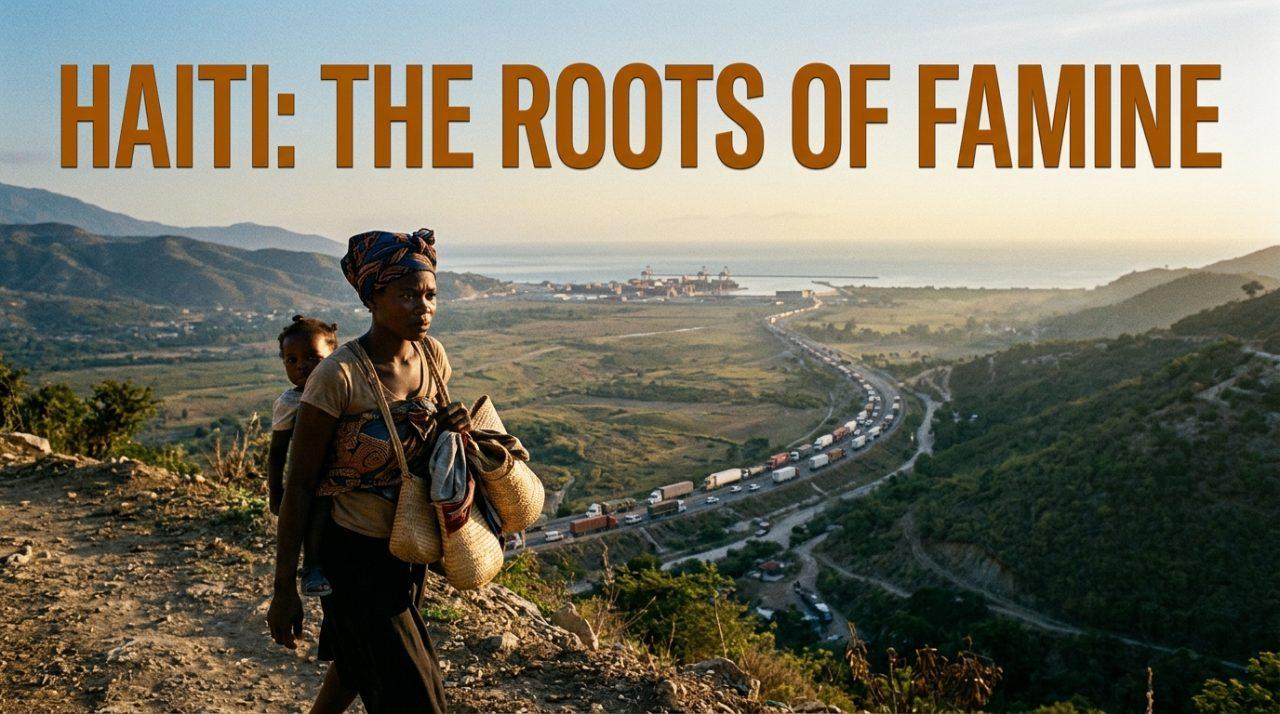
Modern starvation in Haiti operates through calculated spatial paralysis. Heavily armed federations have severed both National Route 1 and National Route 2. These two vital arteries link Port-au-Prince to northern farms and southern shipping ports. Consequently, transport trucks loaded with commercial grain, clean drinking water, and medical supplies cannot pass through (un.org, unocha.org).
Criminal coalitions extort exorbitant transit fees and hijack essential convoys. As a direct result, basic staples rot in rural storage or remain stranded at maritime ports. In the capital, only ten percent of major inpatient healthcare facilities can open their doors (rescue.org). Gang members regularly loot clinics, kidnap doctors, and hijack diesel shipments required to power surgical generators (un.org, rescue.org).
Schools have suffered immense damage from this widespread urban warfare. More than 1,600 educational facilities have closed across the country (unicef.org). These institutions long functioned as community nutrition hubs for destitute families. When classroom doors shut, vulnerable children lost their only guaranteed meal of the day (unicef.org, unicef.org).
The Iron River: Foreign Weapons Arming Gangs
Mainstream media frequently depicts Haiti as an inherently chaotic society. However, the heavy weaponry driving this terror is not manufactured on Haitian soil. The vast majority of firearms, assault rifles, and ammunition flow directly from the United States (unodc.org). Gun traffickers exploit loose sales regulations in southern states, especially Florida, to acquire military weaponry (unodc.org).
Straw buyers easily purchase semi-automatic rifles and large caliber sniper systems. Smugglers conceal these armaments inside commercial cargo ships, freight containers, and modified motor vehicles (unodc.org). These shipments arrive at secondary ports like Port-de-Paix and Cap-Haïtien, where maritime inspections remain sparse (unodc.org). UN analysts term this uninterrupted supply line the Iron River (unodc.org).
Powerful rifles empower criminal groups to outgun local law enforcement squads. Observers in the Black diaspora recognize how foreign gun manufacturing drives urban misery across poor neighborhoods. Criminalizing Haitian youths ignores the international trafficking pipeline profiting from their desperation. External markets provide the deadly firepower that keeps Haitian families trapped in perpetual terror (unodc.org).
The ‘Iron River’: Arms Pipeline to Haitian Ports
Colonial Retaliation and the Double Debt
Today’s hollowed infrastructure cannot be understood without examining colonial vengeance. When the victorious Haitian Revolution crushed French chattel slavery in 1804, European powers panicked. White slaveholding empires imposed total diplomatic and commercial quarantines on the sovereign Black republic. They feared that self-liberated Black people would inspire revolts across the Atlantic world.
In 1825, French King Charles X sent fourteen warships armed with 500 cannons to the Haitian coast. He demanded an astronomical indemnity of 150 million francs to compensate slaveholders for lost human property. To prevent immediate naval bombardment and invasion, Haitian leaders accepted the ruinous arrangement. The young nation secured extortionate bank loans from French financiers to pay the initial balance.
Historians describe this extraction as the double debt. Servicing foreign lenders consumed up to eighty percent of the national budget for decades. Haiti endured a predatory rising debt crisis that delayed modern public investments for over a century. The treasury could not build rural highways, modern sewer systems, or municipal hospitals. The financial penalty for Black freedom starved Haiti of modern infrastructure before development could begin.
Occupation and American Centralization
In 1915, United States Marines landed in Port-au-Prince to secure Wall Street investments. The National City Bank of New York sought direct control over Haitian gold reserves and customs revenue. The military occupation lasted until 1934, leaving behind deep institutional scars. Foreign administrators dismantled democratic municipal assemblies and imposed a client police state.
American authorities also dissolved the constitutional ban on foreign land ownership. Foreign corporations quickly acquired fertile peasant farmland to establish export plantations. Tens of thousands of rural farmers lost ancestral lands through physical displacement and legal trickery. The regime instituted forced labor road crews reminiscent of sharecropping and forced labor in the American South.
Crucially, the occupying forces centralized all administrative power inside the capital city. Provincial port authorities were stripped of tax collection revenue. Customs intake, judicial authority, and public utilities were concentrated exclusively within Port-au-Prince. This policy created an extreme bottleneck that persists today. When armed groups blockade the capital, the entire national economy collapses instantly.
The Duvalier Shadow: Paramilitarism as Statecraft
The rise of irregular street gangs reflects the dark history of the Duvalier family dictatorship. François Duvalier assumed power in 1957 and systematically undermined the national military. He created a loyal paramilitary group known as the Volontaires de la Sécurité Nationale. Civilians terrified by their ruthlessness nicknamed them the Tonton Macoutes.
The Macoutes operated entirely outside formal legal structures. Recruited from urban slums, they silenced political dissent through torture, public executions, and financial extortion. State power became permanently intertwined with informal armed thugs. Political bosses maintained dominance by delegating violence to irregular street fighters.
When the dictatorship fell in 1986, authorities never disarmed or rehabilitated these militia fighters. The weapons, tactical networks, and extortion methods simply dispersed across poor neighborhoods. Successive political parties hired armed neighborhood gangs to intimidate voters and suppress protests. Today’s gang federations are the direct descendants of these state-sponsored mercenary squads.
The Destruction of Food Sovereignty
Killing Food Sovereignty: The Cost of Miami Rice
The acute malnutrition documented by the UN is the deliberate outcome of neoliberal trade mandates. During the 1980s and 1990s, the International Monetary Fund forced Haiti to slash its agricultural import protections. Tariffs on foreign rice fell from roughly fifty percent down to three percent. This decision devastated Haitian agrarian life.
Heavily subsidized grain from American corporate farms immediately flooded local marketplaces. Haitians called this cheap foreign import Miami rice. Hardworking peasant farmers in the fertile Artibonite Valley could not compete against subsidized foreign prices. Small farms collapsed rapidly, forcing millions of destitute rural workers into urban informal settlements.
Former U.S. President Bill Clinton later apologized to the American Congress for forcing these tariff reductions. He admitted that the policy enriched Arkansas agribusiness while stripping Haiti of its agricultural self-sufficiency. Today, the nation must import more than eighty percent of its basic grain. When gangs capture major highways, families face instant starvation because local food systems were dismantled decades ago.
Foreign Missions and the Current Power Vacuum
Foreign interventions have repeatedly destabilized Haitian society. The United Nations Stabilization Mission, known as MINUSTAH, operated in Haiti from 2004 to 2017. Rather than securing peace, peacekeepers inadvertently contaminated the Artibonite River with cholera. The resulting epidemic killed nearly 10,000 citizens and sickened hundreds of thousands more.
State fragility accelerated sharply following the assassination of President Jovenel Moïse in 2021. With state institutions paralyzed, rival street factions formed a massive umbrella alliance called Viv Ansanm. Former de facto Prime Minister Ariel Henry resigned under heavy public pressure in early 2024. A Transitional Presidential Council stepped in and appointed businessman Alix Didier Fils-Aimé as Prime Minister to restore basic governance (unocha.org, youtube.com).
The United Nations authorized the Multinational Security Support mission to assist local police forces (un.org, rescue.org). Led by Kenyan police units, this foreign force attempts to guard strategic transit routes and public facilities (unocha.org, rescue.org). However, Haitian civil society organizations question whether foreign military interventions can ever build lasting democratic stability without local community control.
Reclaiming Sovereignty Beyond Manufactured Charity
The acute hunger and mass displacement in Haiti are not accidents of nature. They represent the compounding results of foreign debt extortion, military occupations, weapon proliferation, and destructive agricultural policies. International aid shipments offer temporary emergency relief, but humanitarian aid alone cannot resolve structural oppression. The crisis demands total structural transformation.
Dismantling the illicit gun pipeline from Florida is an immediate legal requirement (unodc.org). Wealthy nations must respect Haitian political sovereignty and support domestic peasant agriculture. Furthermore, the global African diaspora maintains long shared struggles against oppression alongside Haitian communities. True solidarity demands rejecting racist tropes of inherent dysfunction.
Haitian farmers possess the agricultural knowledge to feed their communities if trade policies allow them to flourish. Peace will not arrive through external occupations or imported meals. Lasting stability requires returning sovereignty, resources, and self-determination to the Haitian people. Only then can the world’s first free Black republic overcome two centuries of engineered isolation.
About the Author
Darius Spearman is a professor of Black Studies at San Diego City College, where he has been teaching for over 20 years. He is the founder of African Elements, a media platform dedicated to providing educational resources on the history and culture of the African diaspora. Through his work, Spearman aims to empower and educate by bringing historical context to contemporary issues affecting the Black community.
