


Sahel Climate Crisis: Why Waiting for Disaster Fails
By Darius Spearman (africanelements)
Support African Elements at patreon.com/africanelements and hear recent news in a single playlist. Additionally, you can gain early access to ad-free video content.
An Urgent Warning from the Heart of the Continent
The United Nations Development Programme issued a grave alert from its hub in Dakar (undp.org). A powerful El Niño weather cycle is expanding drought risks across West and Central Africa (undp.org, noaa.gov). These dry conditions threaten millions of people who already live along fragile ecological fault lines (undp.org). Furthermore, this looming climatic shock is colliding with long active conflict zones (undp.org, brookings.edu).
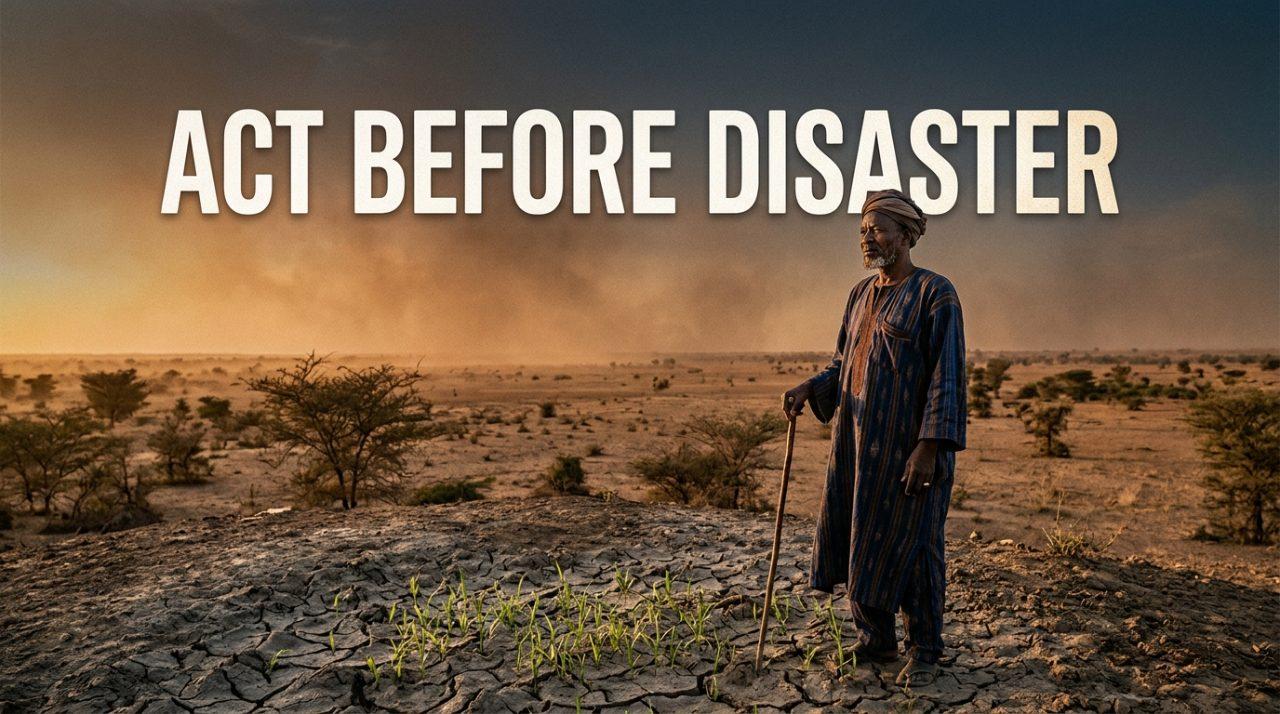
Drought does not strike empty land in the Sahel or Lake Chad Basin (undp.org). It strikes communities that are already enduring prolonged insurgencies and displacement (undp.org, climate-refugees.org). In response, international officials are urging a decisive break from old relief models (undp.org). Humanitarian groups historically wait for famine before dispatching emergency supplies (undp.org, undrr.org). However, the United Nations Development Programme insists that waiting for disaster guarantees catastrophe (undp.org). Modern leaders must invest resources before the dry spells destroy vulnerable family livelihoods (undp.org).
Echoes of the Great Sahelian Megadroughts
To understand the current crisis, one must revisit the painful environmental disasters of the late twentieth century (wikipedia.org). Between 1968 and 1985, the Sahel experienced the most severe rainfall collapse on modern record (wikipedia.org). Seasonal precipitation fell forty percent below previous historical baselines (wikipedia.org). Consequently, over one hundred thousand people died from severe famine (wikipedia.org). Millions of livestock perished across Mauritania, Senegal, Mali, Burkina Faso, Niger, and Chad (wikipedia.org).
Those historical droughts stripped fertile topsoil and shattered ancient communal safety nets (wikipedia.org). Communities had adapted their agricultural systems over centuries before colonial rule disrupted regional trade routes. However, modern environmental degradation undermined those traditional practices (wikipedia.org, brookings.edu). In September 1973, regional heads of state created the Interstate Committee for Drought Control (wikipedia.org). Soon after, regional monitoring institutions began tracking rainfall volatility across the arid belt (wikipedia.org). Despite these scientific initiatives, chronic structural vulnerability remained deeply rooted across the rural landscape (undp.org, wikipedia.org).
Historical Retreat of Lake Chad Water Surface
Comparison of open water surface area from peak historical levels to modern conditions.
Data Source: NASA Earth Observatory & UN OOSA Satellite Records (unoosa.org, nasa.gov)
The Shrinking Waters of Lake Chad
The Lake Chad Basin clearly demonstrates how environmental distress damages human society (unoosa.org, climate-refugees.org). In 1963, Lake Chad covered more than twenty-five thousand square kilometers (wikipedia.org, unoosa.org). It sustained an intricate web of seasonal fishers, crop cultivators, and semi-nomadic herders (wikipedia.org, climate-refugees.org). However, persistent droughts and aggressive river irrigation diverted essential inflows (wikipedia.org, unoosa.org). By the 1990s, the open water surface had shrunk by roughly ninety percent (wikipedia.org, unoosa.org).
The retreating shoreline displaced farming populations and disrupted stable livelihoods for thirty million residents (unoosa.org, climate-refugees.org). As open water vanished, pastoralist herders migrated south in search of pastures (ebsco.com, climate-refugees.org). Consequently, nomadic communities came into direct friction with sedentary farming villages (ebsco.com, climate-refugees.org). These shared natural resources dwindled quickly under intense seasonal demands (ebsco.com, climate-refugees.org). The resulting economic void created ideal conditions for militant groups to thrive (ebsco.com, brookings.edu).
When Climate Volatility Meets Armed Conflict
The climate crisis does not operate in a political vacuum (brookings.edu). In 2009, an armed insurgency led by Boko Haram exploded across northeastern Nigeria (ebsco.com). The violence soon spread into Cameroon, Chad, and Niger (ebsco.com, brookings.edu). Insurgent factions, including the Islamic State West Africa Province, exploited regional despair (ebsco.com). Militant recruiters offered small business loans and security to disaffected youth who lost livelihoods (ebsco.com). Thus, resource scarcity served as a catalyst across vulnerable territories (ebsco.com, brookings.edu).
Similar instability has engulfed the Central Sahel in recent years (undp.org, brookings.edu). Militant coalitions have established deep operational footholds across Mali, Burkina Faso, and Niger (brookings.edu, unocha.org). These armed factions actively manipulate ancestral grievances over grazing corridors and local water access (brookings.edu). Moreover, active warfare prevents humanitarians from reaching communities trapped along frontlines (undp.org, unocha.org). Civilians cannot plant their fields because armed groups plant landmines along rural roads (undp.org, unocha.org).
Sahel Lean Season Hunger Surge (Phase 3+)
Projected expansion of populations facing crisis-level acute food insecurity or worse.
Data Source: Cadre Harmonisé / Regional Food Security Monitoring (undp.org, reliefweb.int)
The Gathering Storm: El Niño in 2026 and 2027
The physical threat on the horizon stems from an intensifying El Niño event (undp.org, noaa.gov). Global monitoring systems indicate an ocean warming anomaly approaching two degrees Celsius (noaa.gov). Climatologists report a near certainty that this pattern will persist into early 2027 (noaa.gov). The regional climate center in Niamey has highlighted significant late-season rainfall deficits (undp.org). These dry conditions threaten agricultural outputs across the Western Sahel and Chad (undp.org).
Forecasting weather in West Africa presents exceptional meteorological challenges (undp.org, noaa.gov). Unlike Southern Africa, where El Niño reliably brings drought, West Africa exhibits complex patterns (undp.org, noaa.gov). Multi-model ensembles often show dry anomalies in specific corridors while projecting moisture in others (undp.org). Therefore, international observers cannot rely on broad regional generalizations (undp.org). Decision-makers must instead use localized data to identify vulnerable agrarian communities (undp.org, undrr.org).
Understanding Cadre Harmonisé and Phase 3+ Hunger
The scale of food insecurity is measured through a standardized regional framework (undp.org, reliefweb.int). The Cadre Harmonisé scale classifies the severity of acute nutrition crises across West Africa (undp.org, reliefweb.int). Reaching Phase 3 on this scale indicates an acute humanitarian crisis (reliefweb.int). Families classified under Phase 3 suffer severe food consumption deficits (reliefweb.int). Many parents sell essential productive tools simply to purchase daily grain (savethechildren.net, reliefweb.int).
Phase 4 represents an emergency, while Phase 5 represents catastrophic starvation (reliefweb.int). When analysts combine Phases 3, 4, and 5 into Phase 3+, it establishes an emergency mandate (undp.org, reliefweb.int). Over forty-one million people occupied this critical danger zone in late 2025 (undp.org). Furthermore, projections show that number rising to nearly fifty-three million people during 2026 (undp.org). Households reaching these elevated tiers cannot survive on standard community mechanisms alone (undp.org, savethechildren.net).
Transhumance Under Pressure: Pastoralists in Peril
Transhumance represents an essential way of life across the semi-arid grasslands of West Africa (ebsco.com, climate-refugees.org). It refers to the seasonal migration of livestock herders between distinct ecological zones (ebsco.com). Traditionally, pastoralists graze their cattle in dry northern rangelands during the wet season (ebsco.com, climate-refugees.org). They move south toward wetter pastures when the dry season begins (ebsco.com, climate-refugees.org). In previous decades, this movement rested upon negotiated agreements with settled agrarian families (ebsco.com).
Farmers historically welcomed herders because cattle manure provided valuable organic fertilizer for fallow fields (ebsco.com). However, modern climate volatility has wrecked this peaceful ecological balance (ebsco.com, brookings.edu). Persistent droughts dry up water points prematurely along historical pastoral corridors (undp.org, ebsco.com). As a result, herders are forced to move south before farmers have harvested their crops (ebsco.com, climate-refugees.org). When cattle consume standing maize or sorghum, violent disputes often erupt between neighbors (ebsco.com, brookings.edu).
The Economic Logic of Anticipatory Investment
Financial returns of proactive intervention versus late humanitarian emergency response.
Early cash transfers and fodder distributions prevent catastrophic loss of productive family assets.
Major donor reductions since 2022 leave response appeals severely underfunded across the Sahel.
Data Source: UNDRR, UNDP & UN OCHA Financial Tracking (undp.org, reliefweb.int, undrr.org)
The Funding Collapse and Climate Justice
This impending meteorological disaster arrives alongside an unprecedented collapse in international humanitarian assistance (undp.org, reliefweb.int). Global funding for humanitarian food assistance has fallen by roughly sixty percent since 2022 (reliefweb.int). Western donor nations have redirected their foreign aid budgets toward geopolitical conflicts elsewhere (reliefweb.int, unocha.org). Domestic economic pressures in traditional donor capitals have worsened this funding retreat (reliefweb.int). Consequently, humanitarian agencies are slashing rations for displaced families across the Sahel (reliefweb.int, unocha.org).
This shortfall illustrates a fundamental injustice facing African communities (climate-refugees.org). The African continent produces less than four percent of global greenhouse gas emissions (climate-refugees.org). Yet its agrarian communities suffer the most devastating consequences of global temperature anomalies (undp.org, climate-refugees.org). In addition, sovereign nations face a growing debt crisis that constrains their domestic budgets. Developing nations are forced to pay steep loan interest rather than funding climate adaptation programs. Wealthy industrial nations have failed to fulfill their financial promises to vulnerable populations (climate-refugees.org).
The Case for Anticipatory Action
Humanitarian agencies cannot rely on obsolete relief strategies in complex conflict environments (undp.org, undrr.org). Delivering emergency aid after crops fail is too slow and exceptionally expensive (undp.org, undrr.org). In active conflict zones, fighting often prevents trucks from reaching starving rural villages (undp.org, brookings.edu). The United Nations Development Programme is championing a proactive alternative known as anticipatory action (undp.org). This approach triggers pre-arranged funding before seasonal dry spells fully materialize (undp.org, undrr.org).
Every single dollar invested in anticipatory action saves four to seven dollars in emergency response (undp.org, undrr.org). Early interventions distribute drought-resistant seeds and livestock supplements directly to vulnerable farmers (undp.org). Furthermore, unconditional cash transfers allow families to secure basic resources ahead of market panics (undp.org). Effective programs also incorporate indigenous knowledge systems alongside modern meteorological tools. By shielding family assets early, communities maintain their independence and avoid regional displacement (undp.org, undrr.org).
About the Author
Darius Spearman is a professor of Black Studies at San Diego City College, where he has been teaching for over 20 years. He is the founder of African Elements, a media platform dedicated to providing educational resources on the history and culture of the African diaspora. Through his work, Spearman aims to empower and educate by bringing historical context to contemporary issues affecting the Black community.
