

Louisiana Redistricting News: Black Voters Fight Gerrymandering
By Darius Spearman (africanelements)
Support African Elements at patreon.com/africanelements and hear recent news in a single playlist. Additionally, you can gain early access to ad-free video content.
The latest Louisiana redistricting news highlights a prolonged constitutional conflict over democratic access, racial equity, and political power. In St. Landry Parish and its historic seat of Opelousas, Black civic leaders are mobilizing against congressional district maps that divide their communities (capitalbnews.org, stlandrynow.com). This current controversy follows a multi-year courtroom battle that briefly established a second majority-Black congressional district, only for state lawmakers to dismantle it ahead of midterm elections (democracydocket.com, democracydocket.com). The debate centers on St Landry Parish Black voting rights and asks a fundamental question: why is Louisiana redistricting repeatedly at the center of national voting rights jurisprudence (brennancenter.org)?
To understand why local organizers are actively resisting these boundaries, one must examine the history behind the headlines. The contemporary effort to dilute Black voting strength in south-central Louisiana is not an isolated legislative maneuver. Instead, it reflects a continuous pattern that stretches across more than a century and a half (64parishes.org, eji.org). From nineteenth-century political violence to twentieth-century registration bans and twenty-first-century legal disputes, the struggle of Black Louisianians to secure fair representation reveals the enduring mechanisms of political marginalization (eji.org, capitalbnews.org).
Louisiana Redistricting Map Explained: The Fracturing of St. Landry Parish
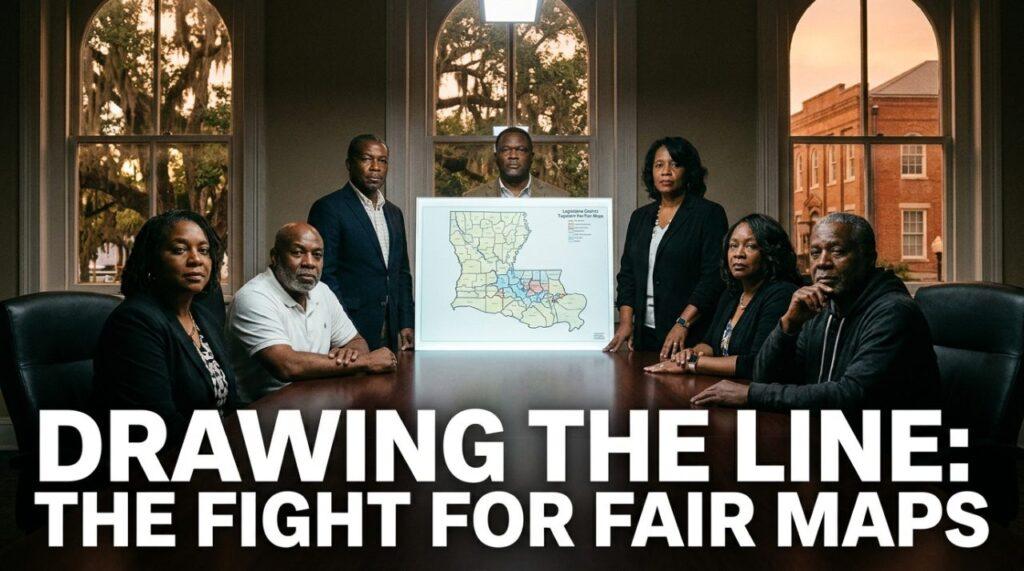
A review of the Louisiana redistricting map explained through census data demonstrates a clear structural contradiction. Black residents account for 33.1 percent of the total population in Louisiana (census.gov). Despite comprising one-third of the state, Black voters have historically held an effective electoral majority in only one of the state’s six congressional districts (brennancenter.org, naacpldf.org). In January 2024, following federal court orders, the Louisiana Legislature passed Senate Bill 8, which created a second majority-Black district (the 6th District) connecting Shreveport, Alexandria, Lafayette, and Baton Rouge (democracydocket.com, la.gov). However, following subsequent judicial interventions, lawmakers enacted Senate Bill 121 in May 2026, eliminating that newly created district (democracydocket.com, democracydocket.com).
Under the enacted 2026 map, St. Landry Parish was split directly through its center (capitalbnews.org). Instead of remaining intact within a single district, the parish was divided between Congressional District 3 and Congressional District 5 (capitalbnews.org, ballotpedia.org). The southern portion of the parish was placed into District 3, represented by conservative Republican Clay Higgins and anchored in coastal southwest Louisiana (capitalbnews.org). The northern and eastern sections were absorbed into District 5, an expansive, heavily white rural district stretching across northeast Louisiana to the Arkansas border (capitalbnews.org, ballotpedia.org). This geographic division fractured a cohesive voting corridor, diluting local Black political leverage (capitalbnews.org, capitalbnews.org).
The city of Opelousas serves as the economic and cultural center of St. Landry Parish. Census figures indicate that Black Americans make up between 76.5 percent and 78.0 percent of the municipal population (censusreporter.org, datausa.io). In addition, more than 37 percent of municipal residents live below the poverty line, with a median household income of roughly $33,000 (censusreporter.org, usafacts.org). Local leaders emphasize that dividing the parish across disparate congressional districts prevents urban Black residents from securing federal representation focused on urgent infrastructure, flood management, and public health needs (capitalbnews.org, stlandrynow.com). Understanding this structural suppression requires examining the ongoing struggle for representation that has shaped Black political life across generations.
Louisiana Demographics vs. Congressional Power (2026)
1868 Opelousas Massacre History: Bloodshed at the Ballot Box
The contemporary fragmentation of St. Landry Parish builds upon an explicit historical tradition of electoral nullification. The 1868 Opelousas Massacre history stands as the deadliest recorded instance of political violence during the Reconstruction era (64parishes.org, eji.org). Earlier that year, Louisiana adopted its 1868 state constitution, which enfranchised African American men and recognized their full civil rights (64parishes.org, zinnedproject.org). In St. Landry Parish, newly registered Black voters joined the Republican Party in large numbers, outnumbering white registered voters and establishing an organized political majority (wikipedia.org, eji.org).
White conservative elites organized armed paramilitaries, centered on the Knights of the White Camelia and the Seymour Knights, to dismantle Black political organization (wikipedia.org, 64parishes.org). Tensions peaked in late September 1868 when white supremacists assaulted Emerson Bentley, an eighteen-year-old white schoolteacher and editor of the local Republican newspaper, *The St. Landry Progress* (wikipedia.org, eji.org). When Black residents mobilized in Opelousas to investigate reports of Bentley’s death, armed white posses ambushed them (wikipedia.org, eji.org). Over the next two weeks, white mobs systematically hunted down, executed, and terrorized Black citizens across the parish (64parishes.org, eji.org).
Historians document that between 150 and 300 African Americans were killed during the massacre (64parishes.org, eji.org). The armed terror accomplished its primary objective: absolute political suppression (eji.org). In the November 1868 presidential election, Republican candidate Ulysses S. Grant received exactly zero votes in St. Landry Parish (wikipedia.org, eji.org). Armed patrols stood outside voting precincts, forcing Black citizens to register as Democrats or face execution (64parishes.org, zinnedproject.org). This lethal campaign illustrated how physical violence was used to nullify Black constitutional rights, inaugurating a period of intense Reconstruction-era labor controls and racial terror across rural Louisiana (eji.org, eji.org).
Louisiana Redistricting History: Jim Crow and the Decades of Disenfranchisement
Following the withdrawal of federal troops in 1877, white political authorities replaced vigilante violence with institutional exclusion. A comprehensive look at Louisiana redistricting history demonstrates how statutory barriers codified political suppression (64parishes.org). In 1898, Louisiana ratified a new state constitution explicitly designed to eliminate Black voting power (64parishes.org). The convention established property requirements, literacy tests, annual poll taxes, and understanding clauses administered by white registrars (64parishes.org). Within four years of the 1898 convention, registered Black voters in Louisiana plummeted from over 130,000 to approximately 5,300, eliminating more than 95 percent of the Black electorate (64parishes.org).
In St. Landry Parish, institutional disenfranchisement persisted well into the twentieth century. During the 1940s and 1950s, Black residents who attempted to register faced economic retaliation, police harassment, and mob threats (capitalbnews.org). Organizers were stalked by vigilantes and threatened with lynching for merely visiting the parish courthouse (capitalbnews.org). Because of this systematic intimidation, not a single Black citizen was permitted to cast a ballot in the city of Opelousas for more than ten consecutive years leading up to the mid-1950s (capitalbnews.org). The complete absence of Black electoral participation allowed local authorities to neglect Black public schools, municipal sanitation, and paved roads without political accountability (capitalbnews.org).
Even after the passage of the Voting Rights Act of 1965 dismantled formal registration bans, legislative mapmakers adopted map-drawing techniques to achieve similar outcomes (brennancenter.org, naacpldf.org). When population growth required new boundaries following the 1990 census, Louisiana created a second majority-minority district (District 4), which elected Cleo Fields to Congress in 1992 (brennancenter.org, ballotpedia.org). However, in *Hays v. Louisiana* (1995), federal courts invalidated the district under the Equal Protection Clause, ruling that lawmakers had impermissibly elevated race over traditional redistricting standards (brennancenter.org, lls.edu). For the next three decades, the state operated under maps with only one majority-Black district, freezing Black representation despite substantial population growth (brennancenter.org, naacpldf.org).
Black Demographics: Local vs. State Benchmarks
Louisiana Gerrymandering Explained: Cracking Communities of Interest
Is Louisiana gerrymandered? When citizens review Louisiana gerrymandering news, the primary mechanism observed in south-central Louisiana is the practice of “cracking” (capitalbnews.org, brennancenter.org). Cracking occurs when a cohesive minority voting bloc is intentionally divided across multiple districts (brennancenter.org). By splitting the group into separate boundaries, mapmakers submerge minority voters into overwhelming, conservative white majorities (capitalbnews.org, brennancenter.org). Consequently, minority voters cannot achieve an electoral plurality in any individual district under conditions of racially polarized voting (brennancenter.org, naacpldf.org).
With Louisiana gerrymandering explained through the lens of St. Landry Parish, the dilution is stark. Black residents make up 41.4 percent of the parish and over 76 percent of Opelousas (censusreporter.org, censusreporter.org). Dividing the parish between District 3 and District 5 dilutes that concentration (capitalbnews.org, ballotpedia.org). In District 3, Black voters are submerged within the white majorities of Cameron, Iberia, and Vermilion Parishes (capitalbnews.org, ballotpedia.org). In District 5, rural Black residents are joined with expansive agricultural jurisdictions across north Louisiana (capitalbnews.org, ballotpedia.org). This division denies local Black residents a competitive voice in either congressional delegation (capitalbnews.org, capitalbnews.org).
This division damages a distinct cultural and historic community of interest (capitalbnews.org). St. Landry Parish contains one of Louisiana’s oldest populations of Creoles of color, tracing their lineage to antebellum Free People of Color (*gens de couleur libres*) (capitalbnews.org). These communities developed unique rural settlements, such as Frilot Cove and Mallet, established historic Black Roman Catholic parishes like St. Ann, and maintained cultural traditions rooted in Louisiana Creole (Kouri-Vini) and French dialects (capitalbnews.org). Non-dilutive redistricting plans presented in federal court proved that keeping St. Landry Parish intact along the Interstate 49 and Interstate 10 corridors satisfies traditional districting criteria, respecting geographic contiguity while protecting minority voting rights (democracydocket.com, brennancenter.org). Splitting these communities disrupts the coherent dynamics of Black political power developed over generations.
Louisiana Redistricting Case Explained: From Robinson to Callais
The legal controversy that redrew Louisiana’s congressional boundaries involves an intricate judicial conflict. With the Louisiana redistricting case explained through statutory precedent, the debate centers on the tension between the Voting Rights Act and the Equal Protection Clause (democracydocket.com, brennancenter.org). Following the 2020 census, civil rights organizations filed *Robinson v. Ardoin* (later *Robinson v. Landry*) (laaclu.org, democracydocket.com). The plaintiffs argued that Louisiana’s single majority-Black district violated Section 2 by diluting Black votes (democracydocket.com, brennancenter.org). Federal courts applied the three-part test established in *Thornburg v. Gingles*, determining that Louisiana’s Black population was sufficiently compact, politically cohesive, and routinely defeated by white bloc voting (democracydocket.com, brennancenter.org).
Under federal court order, the Louisiana Legislature met in special session in January 2024 and passed Senate Bill 8 (democracydocket.com, la.gov). This statute established District 6 as a second majority-minority district with a 54 percent Black voting-age population (democracydocket.com, la.gov). The district connected Shreveport through Alexandria and Opelousas down to Baton Rouge (democracydocket.com, la.gov). However, non-Black plaintiffs filed *Callais v. Landry*, challenging the configuration as an unconstitutional racial gerrymander under *Shaw v. Reno* (democracydocket.com, democracydocket.com). In spring 2026, the federal courts ruled that the legislature had allowed race to predominate over traditional redistricting criteria, noting the district’s non-compact 250-mile span across parish boundaries (democracydocket.com, democracydocket.com).
The *Callais* ruling established heightened evidentiary limits on remedial redistricting under Section 2 (democracydocket.com). The court determined that states cannot rely on compliance with the Voting Rights Act to justify race-conscious line drawing if the resulting map abandons traditional redistricting principles like compactness and preserving municipal boundaries (democracydocket.com, democracydocket.com). In response, the legislature enacted Senate Bill 121 in May 2026, dismantling District 6 and returning Louisiana to five white-majority districts and only one Black-majority district (democracydocket.com, democracydocket.com). This legislative reversal left St. Landry Parish fractured and renewed legal challenges regarding equal representation (capitalbnews.org, democracydocket.com).
Poverty Disparities Across Jurisdictions
Section 2 Voting Rights Act: Grassroots Mobilization and the Road Ahead
Faced with legislative setbacks and judicial limitations placed upon Section 2 Voting Rights Act enforcement, grassroots organizers in Opelousas are reshaping their strategies (capitalbnews.org, capitalbnews.org). Canvassers and civic workers are engaging residents directly to combat voter cynicism (capitalbnews.org). Organizers encounter widespread fatigue among citizens who observe their district lines shifting across successive election cycles (capitalbnews.org). Community leaders, including descendants of families terrorized during twentieth-century registration drives, emphasize that political disengagement only accelerates the erosion of public resources (capitalbnews.org).
Local advocacy groups have connected the fight for fair electoral boundaries to everyday material conditions (capitalbnews.org, stlandrynow.com). Opelousas contends with critical municipal challenges, including aging water pipes, inadequate wastewater infrastructure, and underfunded community clinics (capitalbnews.org, stlandrynow.com). State Representative Dustin Miller and municipal leaders point out that when congressional districts dilute the Black electorate, federal representatives have little incentive to allocate community project funding to neglected neighborhoods (capitalbnews.org, stlandrynow.com). Equal representation is directly tied to clean drinking water, hospital resources, and public school funding (capitalbnews.org).
To address precinct confusion created by the 2026 redistricting map, civic coalitions are organizing educational workshops and door-to-door voter registration campaigns (capitalbnews.org, capitalbnews.org). Organizations such as the NAACP Legal Defense Fund, the Power Coalition for Equity and Justice, and local ministerial alliances are coordinating nonpartisan outreach (naacpldf.org, lwv.org). Their goal is to inform voters of their assigned congressional districts, counter split-precinct confusion, and mobilize high turnout during midterm balloting (capitalbnews.org, lwv.org). By linking historical awareness to civic action, organizers in St. Landry Parish are determined to ensure that political boundaries do not silence their community (capitalbnews.org, capitalbnews.org).
About the Author
Darius Spearman is a professor of Black Studies at San Diego City College, where he has been teaching for over 20 years. He is the founder of African Elements, a media platform dedicated to providing educational resources on the history and culture of the African diaspora. Through his work, Spearman aims to empower and educate by bringing historical context to contemporary issues affecting the Black community.
