

Eljay Crisp-Carr Lawsuit: $20M Claim for False Arrest
By Darius Spearman (africanelements)
Support African Elements at patreon.com/africanelements and hear recent news in a single playlist. Additionally, you can gain early access to ad-free video content.
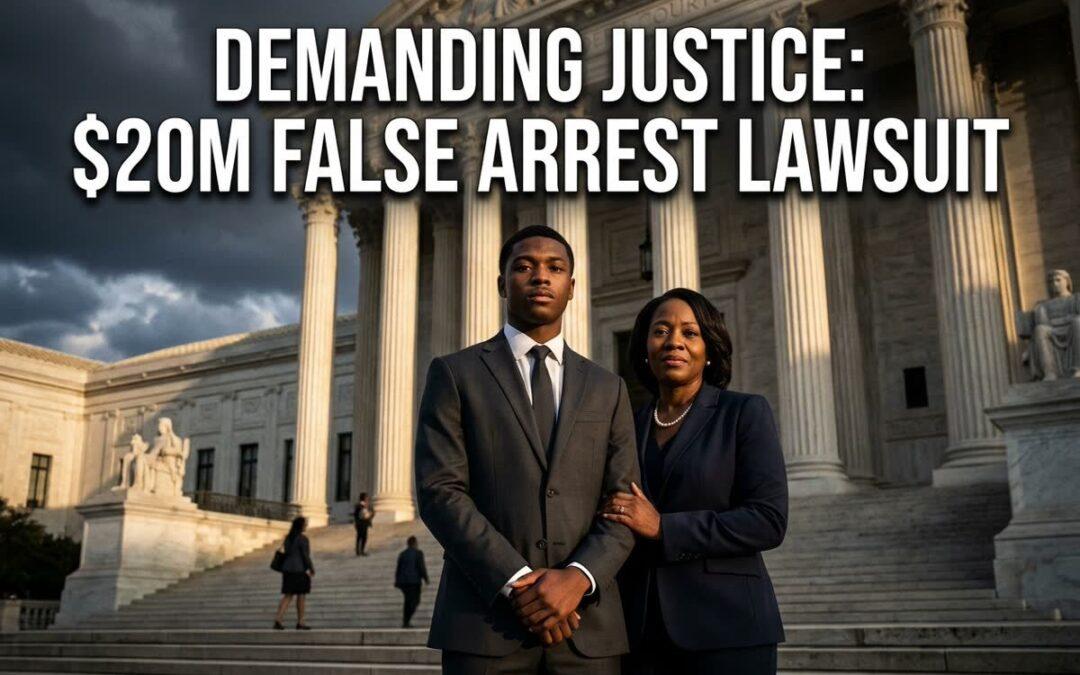
On November 9, 2026, twenty-year-old Eljay Crisp-Carr and his mother, April Carr, filed a federal civil rights lawsuit against the City of Toledo, Lucas County, and municipal police investigators (binnews.com, toledoblade.com). The complaint seeks $20 million in combined compensatory and punitive damages after Crisp-Carr spent 141 days in maximum-security confinement for a violent crime he did not commit (binnews.com, theguardian.com). Law enforcement accused the young Black man of firing into a crowded street festival, leveling more than fifty felony counts that carried aggregate penalties exceeding eight centuries behind bars (wtol.com, wtol.com).
The civil complaint reveals that municipal investigators possessed clear exculpatory material pointing directly to another shooter from the earliest hours of the arrest (theguardian.com, toledoblade.com). Rather than investigating those leads, authorities concealed alternative suspect photographs, ignored third-party confessions, and discounted objective geographic alibis (binnews.com, theguardian.com). This legal struggle illustrates how contemporary arrests mirror long-standing practices within American law enforcement, where young Black men frequently encounter systemic presumptions of guilt and severe carceral penalties during public crises (umich.edu).
Panic, Chaos, and the Old West End Festival Shooting
The prosecution began in the wake of the Old West End festival shooting on June 6, 2026 (wtol.com, toledoblade.com). Gunfire erupted near Delaware Street and Robinwood Avenue in Toledo, Ohio, as rival groups traded shots in a crowded public park (toledoblade.com, toledoblade.com). The crossfire wounded twelve bystanders and triggered municipal panic (wtol.com, wtol.com). Public officials immediately demanded swift arrests, creating intense pressure on local police detectives to deliver suspects to the public (toledoblade.com).
Five days later, on June 11, Toledo police arrested Crisp-Carr (wtol.com, wtol.com). Lead Detective Danielle Mooney signed a sworn criminal complaint alleging that surveillance footage captured Crisp-Carr participating in an initial brawl and firing indiscriminately into the crowd (binnews.com, toledoblade.com). However, defense counsel observed that the grainy video failed to show the gunman’s facial features (theguardian.com, toledoblade.com). Detectives relied instead on generalized clothing descriptions and vague hairstyle comparisons to justify taking Crisp-Carr into custody (wtol.com, toledoblade.com).
Following his arrest, municipal authorities constructed an overwhelming trial posture (wtol.com). The Toledo Municipal Court initially set bail at an unattainable $1.1 million (wtol.com, wtol.com). One week later, prosecutors secured an inflated 56-count indictment that included 25 counts of attempted murder and 26 counts of felonious assault (wtol.com, wtol.com). Citing the sheer volume of charges and claiming the defendant was an armed menace to public safety, the Lucas County Court of Common Pleas denied bail entirely, remanding the twenty-year-old to a jail cell without bond (wtol.com, wtol.com).
Ignored Alibis and Withheld Exculpatory Evidence
The federal civil action asserts that investigators deliberately suppressed evidence that completely eliminated Crisp-Carr as a viable suspect (binnews.com, theguardian.com). On June 11, the day police took Crisp-Carr into custody, the Toledo Police Department received two Crime Stoppers tips (theguardian.com, toledoblade.com). One informant provided the full name and booking photograph of an alternative shooter, appending the unambiguous phrase, “This is him” (binnews.com, toledoblade.com). Investigators concealed this submission from the presiding judge, the grand jury, and defense attorneys (binnews.com, theguardian.com).
The suppression of evidence worsened as the summer advanced (theguardian.com). On September 2, a cooperating informant told detectives that the named alternative suspect openly confessed to being the festival gunman (binnews.com, theguardian.com). Police officials withheld this documented admission for weeks while Crisp-Carr sat locked inside a county cell (theguardian.com, toledoblade.com). Throughout his detention, the defense supplied cellular tower records and multiple witness affidavits proving that Crisp-Carr was stranded two and a half blocks away next to a pickup truck that had run out of fuel (binnews.com, toledoblade.com).
This pattern of withheld exculpatory evidence represents a direct breach of core constitutional protections established under federal common law (wikipedia.org, duke.edu). Confronted with undeniable alibi documentation and photographic proof, prosecutors did not drop the charges immediately (wtol.com, toledoblade.com). Instead, four days before trial, the state altered its primary narrative, claiming Crisp-Carr had merely provided a weapon to an unidentified trigger puller (wtol.com, toledoblade.com). This sudden strategic modification highlights how police agencies protect initial investigative errors rather than correcting them (innocenceproject.org).
Timeline of Detention and Concealed Evidence
Duration of Crisp-Carr’s incarceration compared to investigative suppression windows
Historical Tunnel Vision and Racial Bias in Wrongful Convictions
The swift criminalization of Crisp-Carr reflects an established continuum in the American justice system (umich.edu). When public panics occur, municipal authorities frequently default to the rapid apprehension of young Black men to project civic control (umich.edu, uci.edu). This practice traces directly from post-Reconstruction legal structures designed to enforce racial subordination through criminal statutes (wikipedia.org). In many southern jurisdictions, vagrancy laws and the expansion of involuntary servitude after the Civil War ensured that Black labor remained under state control (wikipedia.org).
This dynamic solidified across twentieth-century criminal jurisprudence (deathpenaltyinfo.org, northwestern.edu). In 1931, the wrongful prosecution of the Scottsboro Boys demonstrated how southern legal systems rushed to execute nine Black youths without credible evidence or adequate legal representation (wikipedia.org, deathpenaltyinfo.org). Decades later, the 1989 Central Park jogger case showcased modern northern policing methods (umich.edu). Detectives fixated entirely on five Black and Latino teenagers, ignoring forensic discrepancies and timeline contradictions until the true attacker confessed years later (umich.edu). The Toledo investigation deployed similar tunnel vision, ignoring outside evidence to preserve its preferred narrative (binnews.com, theguardian.com).
Modern empirical research confirms that racial bias in wrongful convictions remains deeply rooted across municipal jurisdictions (umich.edu). The National Registry of Exonerations published a landmark 2022 study titled Race and Wrongful Convictions in the United States (umich.edu). The report revealed that while Black citizens make up under 14 percent of the domestic population, they account for 53 percent of all documented exonerations (umich.edu). Furthermore, Black individuals convicted of murder are seven times more likely to be innocent than their white counterparts (umich.edu, uci.edu).
This reality helped fuel the political shift toward mass incarceration over the last half-century (civiljusticeinitiative.org, umich.edu). When police misconduct contaminates high-stakes homicide investigations, the impact falls disproportionately on minority defendants (umich.edu). Research demonstrates that official misconduct occurs 50 percent more often in murder exonerations involving Black defendants than in cases involving white defendants (umich.edu). As Crisp-Carr’s case shows, this institutional practice routinely elevates narrative over truth (binnews.com, toledoblade.com).
Disproportionate Impact of Wrongful Convictions
Demographic rates versus share of total U.S. exonerations (NRE Data)
From Reconstruction to Toledo: The Section 1983 Civil Rights Lawsuit
To seek accountability for 141 days of false imprisonment, Crisp-Carr turned to federal statutory law (binnews.com). His attorneys filed their complaint under 42 U.S.C. § 1983, a landmark measure originally passed by Congress as the Ku Klux Klan Act of 1871 (wikipedia.org). Enacted during Reconstruction, the law created a federal civil cause of action against any local actor who uses official authority to deprive citizens of their constitutional guarantees (wikipedia.org). This legislation established federal supremacy over state courts that refused to defend emancipated Black citizens (wikipedia.org).
For almost a century, federal courts narrowed the statute, rendering it largely ineffective against abusive local policing (wikipedia.org). That changed with the Supreme Court decision in Monroe v. Pape in 1961 (wikipedia.org, peopleslawoffice.com). The ruling held that private citizens could sue municipal police officers directly in federal court for unconstitutional searches and arrests (wikipedia.org). Later, in Monell v. Department of Social Services (1978), the high court held that municipalities themselves could be sued if an unconstitutional act stemmed from official policy, entrenched custom, or deliberate failure to train personnel (wikipedia.org). Crisp-Carr’s lawsuit targets both the City of Toledo and Lucas County under this legal standard (binnews.com, toledoblade.com).
Civil litigation under Section 1983 represents one of the few legal mechanisms capable of exposing institutional misconduct (upenn.edu). Such lawsuits have prompted historic municipal settlements across the nation (peopleslawoffice.com, cbsnews.com). In North Carolina, Ronnie Long received a $25 million settlement in 2024 after spending 44 years in prison because police suppressed 40 latent fingerprints and biological testing (cbsnews.com). In Illinois, Cook County paid $36 million to the Ford Heights Four, who were framed by county investigators who hid exculpatory evidence (peopleslawoffice.com). The Section 1983 civil rights lawsuit filed by Crisp-Carr seeks comparable accountability for systemic failure in Toledo (binnews.com, theguardian.com).
This struggle underscores the structural tensions inherent in the balance of federalism across American history (wikipedia.org). When local authorities fail to provide basic due process protections, victims must seek relief from federal institutions (wikipedia.org, upenn.edu). Section 1983 remains a critical tool for exposing municipal failures and obtaining justice for constitutional harms (wikipedia.org).
Shielding Misconduct Under the Qualified Immunity Doctrine
Although Section 1983 provides a federal forum for victims of police abuse, plaintiffs face substantial procedural hurdles (wikipedia.org, civiljusticeinitiative.org). The most significant legal barrier is the qualified immunity doctrine (wikipedia.org). The Supreme Court introduced this principle in Pierson v. Ray (1967), grafting common-law defenses onto federal civil rights statutes (wikipedia.org). The doctrine expanded in Harlow v. Fitzgerald (1982), creating a protective standard that shields government officials from civil damages unless their conduct breaches clearly established constitutional law (wikipedia.org).
To overcome qualified immunity today, civil rights plaintiffs must cite existing precedent involving near-identical factual scenarios (wikipedia.org, upenn.edu). This requirement often prevents misconduct claims from reaching a civil jury (upenn.edu). Furthermore, under Imbler v. Pachtman (1976), state prosecutors enjoy absolute civil immunity for actions taken within their prosecutorial capacity (wikipedia.org). This grants complete legal protection even if prosecutors deliberately withhold exculpatory materials or pursue tainted indictments in court (wikipedia.org, upenn.edu).
Consequently, Crisp-Carr’s legal team must focus its claims on the investigative misconduct of Toledo police officers (binnews.com, toledoblade.com). In Brady v. Maryland (1963), the Supreme Court ruled that withholding material exculpatory evidence violates constitutional due process (wikipedia.org, duke.edu). Later, in Kyles v. Whitley (1995), the court clarified that this disclosure obligation applies equally to law enforcement officers who possess favorable information (wikipedia.org, duke.edu). Because Detective Mooney and municipal investigators possessed alternative suspect evidence on the day of the arrest, their deliberate concealment forms the legal foundation to challenge qualified immunity (binnews.com, theguardian.com).
Official Misconduct in Murder Exonerations
Proportion of exonerations involving official investigative misconduct (NRE)
Perpetual Jeopardy and the Trap of Dismissal Without Prejudice
On October 30, after Crisp-Carr spent nearly five months incarcerated, the Lucas County Prosecutor’s Office moved to dismiss all 56 felony indictments (wtol.com, wtol.com). Prosecutors cited “new and developing evidence” that undermined their ability to proceed to trial (wtol.com, toledoblade.com). However, the state made a deliberate procedural choice: it sought a dismissal without prejudice (binnews.com, toledoblade.com). This distinction carries lasting consequences for Crisp-Carr’s civil liberties (toledoblade.com, toledoblade.com).
Under American criminal law, a dismissal without prejudice leaves legal jeopardy open (wikipedia.org). It is not an adjudication on the merits, nor does it establish legal exoneration (wikipedia.org). Unlike an outright acquittal, which triggers the Fifth Amendment Double Jeopardy Clause to bar retrial, a dismissal without prejudice permits prosecutors to refile identical charges at any time before the statute of limitations expires (toledoblade.com, wikipedia.org). The decision left Crisp-Carr free from jail, but still burdened by the cloud of potential prosecution (theguardian.com, toledoblade.com).
This unresolved legal status creates major obstacles under state law (toledoblade.com, toledoblade.com). Under Ohio Revised Code § 2953.33, violent felony indictments—including attempted murder and felonious assault—are categorically excluded from statutory expungement, even when dismissed by the prosecutor (toledoblade.com, toledoblade.com). Consequently, the public arrest record remains in criminal databases, accessible to background check agencies, landlords, and employers (toledoblade.com, toledoblade.com). Furthermore, state and national law enforcement repositories retain the defendant’s biometric information and DNA samples (binnews.com, toledoblade.com).
Because statutory state remedies remain closed, the federal complaint demands equitable relief alongside monetary damages (binnews.com, toledoblade.com). Crisp-Carr’s legal team has petitioned the federal court to order the complete expungement of his arrest records and the destruction of all collected biometric data (binnews.com, theguardian.com). Without federal intervention, the bureaucratic markers of an unjust arrest will follow him indefinitely, demonstrating that administrative injuries often persist long after a prisoner leaves his cell (binnews.com, umich.edu).
Old West End festival shooting: The Enduring Demand for Structural Accountability
The circumstances surrounding Eljay Crisp-Carr illustrate the systemic defects built into modern American criminal administration (umich.edu). When public violence occurs, municipal institutions face intense pressure to deliver rapid closures (umich.edu, uci.edu). Too often, this pressure produces hasty conclusions, tunnel vision, and the criminalization of young Black men who happen to be in the vicinity (innocenceproject.org, umich.edu). Crisp-Carr spent nearly five months isolated in maximum security, facing centuries in prison, while evidence exonerating him sat untouched in police files (binnews.com, theguardian.com).
His lawsuit serves as a broader indictment of an accountability system shielded by protective doctrines like qualified immunity and limited expungement laws (wikipedia.org, toledoblade.com). True accountability requires more than releasing an innocent person when the state case collapses (innocenceproject.org, umich.edu). It demands compensating the injured, expunging police records, and confronting the racial bias that continues to drive wrongful arrests across the country (binnews.com, umich.edu).
About the Author
Darius Spearman is a professor of Black Studies at San Diego City College, where he has been teaching for over 20 years. He is the founder of African Elements, a media platform dedicated to providing educational resources on the history and culture of the African diaspora. Through his work, Spearman aims to empower and educate by bringing historical context to contemporary issues affecting the Black community.
