
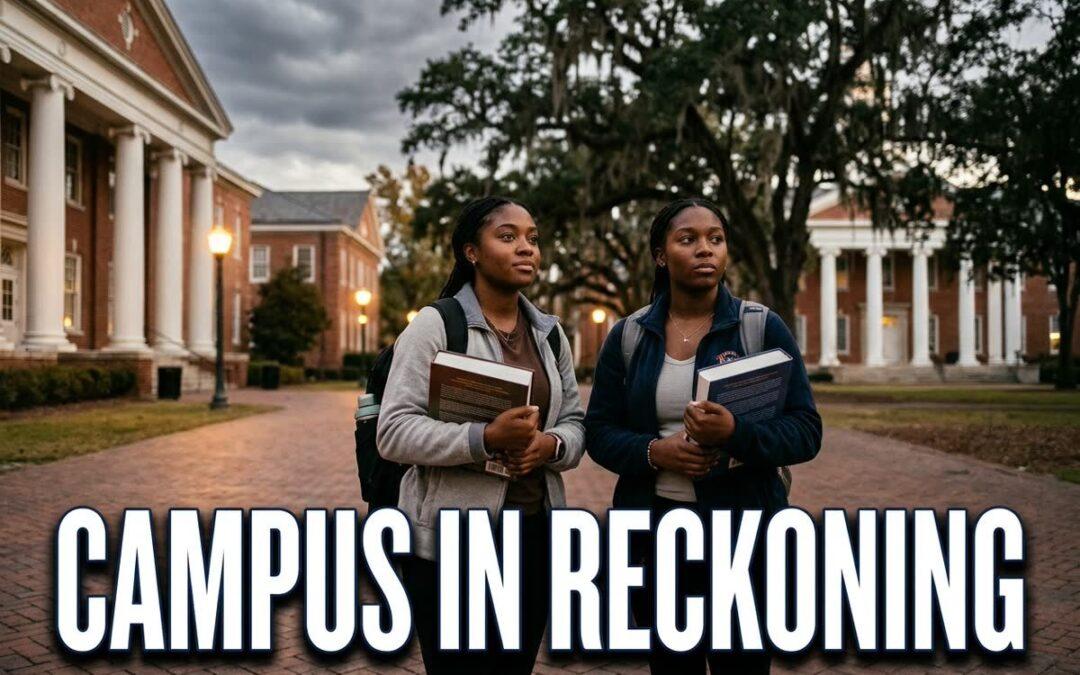

Ole Miss Racist Video: Investigation, Outrage, and Campus History
By Darius Spearman (africanelements)
Support African Elements at patreon.com/africanelements and hear recent news in a single playlist. Additionally, you can gain early access to ad-free video content.
Ole Miss Viral Ring Video Sparks Administrative Probe
A national controversy erupted after video footage surfaced showing white college students performing racist gestures directly outside the residence of Black students at the University of Mississippi (binnews.com). The recording, captured on Friday, November 6, at approximately 8:37 p.m., came from a Ring doorbell camera at an off-campus Oxford apartment complex (mandatory.com). The footage documented three white women approaching the front door (cbsnews.com). Two of the women stared into the camera lens, made ape-like noises, and pounded their chests, while a third woman walked past without intervening (binnews.com, morninghoney.com).
The apartment was occupied by three Black female students, including university freshman Jakiyra Metcalf (cbsnews.com). Metcalf posted the timestamped footage to TikTok on Saturday, November 7, accompanied by the caption, “What do we have to say about this??” (mandatory.com). In subsequent comments, Metcalf confirmed that the individuals in the video lived in the upstairs unit of the same complex (thedmonline.com). Within forty-eight hours, the post accumulated more than eleven million views across social media networks, generating widespread public condemnation and media attention (morninghoney.com).
University administrators intervened formally on Sunday, November 8, and Monday, November 9 (thedmonline.com). Dr. Shawnboda Mead, the Vice Chancellor for Student Affairs, released an official statement describing the behavior as deeply troubling, hurtful, and unacceptable (supertalk.fm). Mead noted that the administration forwarded the matter to the Office of Conflict Resolution and Student Conduct and the Office of Equal Opportunity and Regulatory Compliance for formal investigation (thedmonline.com). Concurrently, the Ole Miss Black Student Union issued a public statement urging the institution to enforce the UM Creed, an institutional code mandating mutual respect and individual dignity across the academic community (thedmonline.com).
The viral spread of the footage also triggered unverified accusations on social media (mandatory.com). Internet users circulated names of uninvolved students, prompting sorority chapters and campus officials to clarify that several targeted individuals had no connection to the incident (thedmonline.com). Beyond digital debates, the episode reopened enduring discussions about how educational inequities facing Black students persist within historically white spaces.
Black Representation: State vs. Ole Miss Undergraduates
The 1962 Ole Miss Integration Crisis and Modern Parallels
To evaluate the intensity of the Ole Miss racist video, observers must examine the violent struggle that defined the university during the civil rights movement. In the autumn of 1962, James Meredith, an African American Air Force veteran, sought admission to the all-white institution (supertalk.fm). Mississippi Governor Ross Barnett openly defied federal court integration orders, asserting that the sovereign authority of the state superseded federal civil rights mandates (supertalk.fm). This political posturing incited thousands of segregationist protesters, students, and armed white sympathizers to descend upon Oxford (supertalk.fm).
The standoff escalated into the Battle of Oxford on September 30, 1962, as a mob attacked federal marshals surrounding the Lyceum administration building (supertalk.fm). Rioters threw Molotov cocktails, fired hunting rifles, and drove construction machinery into law enforcement barricades (supertalk.fm). President John F. Kennedy mobilized more than thirty-one thousand federal soldiers and nationalized Mississippi National Guard troops to suppress the insurrection (supertalk.fm). The clash resulted in two fatalities, hundreds of casualties, and an armed military occupation to ensure Meredith could attend his first morning lecture (supertalk.fm).
The physical violence of 1962 established an institutional precedent where Black enrollment required armed federal intervention. Although state-sanctioned segregation dissolved through federal mandates, cultural resistance remained embedded within campus traditions. The recent apartment harassment illustrates how racial hostility continues to surface in private living spaces, revealing unfinished aspects of the historical desegregation process.
Lost Cause Confederate Iconography and Institutional Traditions
The cultural atmosphere at the University of Mississippi developed under the deliberate influence of Lost Cause ideology during the late nineteenth and early twentieth centuries. Established in the decades following the American Civil War by neo-Confederate associations such as the United Daughters of the Confederacy, the Lost Cause reframed Confederate rebellion around states’ rights while romanticizing the system of chattel slavery (supertalk.fm). The university adopted the moniker “Ole Miss” in 1897 following a contest organized for a student publication (supertalk.fm). The phrase originated as an antebellum plantation colloquialism used by enslaved African Americans to refer to the wife of an enslaver (supertalk.fm).
Institutional customs reinforced these historical affiliations for over a century. In 1936, the university designated “Colonel Reb”—an illustration modeled on an idealized Confederate plantation owner—as its official athletic mascot (supertalk.fm). Students and alumni routinely carried thousands of Confederate battle flags at university sporting events until stadium administration prohibited wooden flag sticks in 1997 (supertalk.fm). The school marching band played the nineteenth-century Southern anthem “Dixie” before athletic contests until 2016, and campus leadership relocated a prominent Confederate monument from the central campus Circle to a secluded cemetery only in 2020 (supertalk.fm).
These symbols preserved a romanticized antebellum narrative that flourished long after the Civil War ended slavery. When public institutions retain Confederate signifiers for generations, minority students frequently encounter a campus climate that celebrates an era of racial subjugation. The environment fostered by these traditions explains why racial taunts persist despite administrative efforts toward inclusion.
The Racist Monkey Taunts History and Dehumanization Tropes
The conduct recorded outside the student apartment reflects long-standing racial tropes rather than modern improvisations. During the eighteenth and nineteenth centuries, European and American theorists created pseudo-scientific hierarchies to justify colonial domination and the transatlantic slave trade. Theorists like Josiah Nott and Louis Agassiz published fraudulent anatomical arguments claiming that individuals of African descent occupied an evolutionary position between primates and white Europeans. By reducing Black human beings to simian caricatures, white supremacist ideology attempted to rationalize forced servitude and deny constitutional equality.
Simian gestures remain a specific weapon for racial harassment across contemporary institutions. In May 2024, the University of Mississippi faced international scrutiny during a confrontation between pro-Palestinian demonstrators and approximately two hundred counter-protesters (reddit.com, cbsnews.com). During that demonstration, a white male student jumped up and down, made ape sounds, and beat his chest at Jaylin Smith, a Black female graduate student (reddit.com, cbsnews.com). Following widespread public outrage, the Phi Delta Theta fraternity chapter expelled the individual, and the university initiated a disciplinary review (cbsnews.com).
The repetition of the identical gesture in the November 2026 video demonstrates a continuing pattern. Performing ape noises at Black peers represents an explicit effort to demean their personhood. When students reproduce these gestures, they draw upon centuries of dehumanizing propaganda intended to communicate that Black students do not belong in academic institutions.
Reported Campus Bias Crimes by Motivation
Title VI Racial Harassment Laws and Disciplinary Authority
When investigating off-campus bias incidents, public universities operate within distinct constitutional and statutory boundaries. Under the First Amendment, state institutions cannot discipline students solely for expressing offensive, derogatory, or abhorrent ideas (ed.gov). Landmark judicial precedents, including the Supreme Court ruling in Papish v. Board of Curators of the University of Missouri, established that state university administrators do not possess broad authority to censor speech simply because it offends conventional community standards. Therefore, an administrative investigation must identify conduct that extends beyond protected verbal expression.
Simultaneously, federal civil rights legislation places legal responsibilities on universities that receive public funding. Title VI of the Civil Rights Act of 1964 prohibits discrimination on the basis of race, color, or national origin in federally funded programs (ed.gov). According to guidance from the U.S. Department of Education Office for Civil Rights, universities must respond to conduct that creates a racially hostile educational environment (ed.gov). This obligation applies even if harassment occurs outside classroom buildings or off campus, provided its ongoing impact denies or limits a student’s ability to participate in educational opportunities (ed.gov).
Federal civil rights enforcement requires colleges to balance free expression against student safety. The targeted harassment of students outside their private residence poses severe concerns under student conduct regulations. When conduct crosses from speech into targeted intimidation, institutional disciplinary boards hold legal authority to issue sanctions, suspensions, or expulsions without violating constitutional guarantees.
Primary Non-Assault Campus Bias Incidents (FBI/Clery)
Ole Miss viral Ring video: Campus Demographics and Social Enclaves
The institutional friction at the University of Mississippi is tied to demographic disparities between the student body and the surrounding state. Mississippi maintains the highest percentage of Black residents in the United States at roughly 37.8 percent (collegefactual.com). In contrast, Black students represent only 10.7 percent of the undergraduate population at the Oxford campus, while white students comprise over 76 percent (collegefactual.com). Other state institutions show different demographics; for example, the University of Southern Mississippi enrolls a Black student population of approximately 28 percent, and Jackson State University serves an overwhelmingly Black student body (collegefactual.com).
This numeric underrepresentation is reinforced by social structures within the university. Predominantly white Greek organizations maintain immense political and social capital at Ole Miss, enrolling approximately one-third of the undergraduate student body. Historically, several fraternity chapters embraced neo-Confederate heritage traditions. Chapters celebrated “Old South Week” with Confederate military uniforms, while members took part in incidents such as placing a noose on the James Meredith statue in 2014 and posing with firearms at the bullet-pocked historical marker for Emmett Till in 2019.
These organizations operate as influential networks that frequently resist structural integration. Understanding these campus enclaves reveals why systemic patterns of anti-Black politics remain visible within the student body. Underrepresented students often navigate academic spaces where historical customs shield exclusionary behavior from accountability.
1962 Ole Miss integration crisis: Accountability in the Digital Age
The investigation into the Ole Miss racist video reflects how consumer technology has altered the documentation of racial bias. For decades, minority students reported discriminatory treatment that went uncorroborated, allowing institutions to dismiss complaints as isolated misunderstandings. Today, connected doorbell cameras, mobile smartphones, and social platforms democratize oversight by establishing permanent visual records of harassment that administrators cannot disregard (binnews.com, cbsnews.com).
However, digital exposure creates institutional friction alongside student privacy rights. The Family Educational Rights and Privacy Act (FERPA) prevents state universities from publicly disclosing student disciplinary records and individual punishments. Consequently, when administrators complete conduct hearings, civil rights inquiries, or university expulsions, they are prohibited by federal law from releasing the results. This required silence often generates community skepticism regarding whether institutions deliver genuine consequences for racial harassment.
Sixty-four years after federal marshals enforced James Meredith’s civil rights on campus, the University of Mississippi remains engaged in an ongoing effort to ensure equal dignity for all students. The recorded harassment of Jakiyra Metcalf and her roommates demonstrates that civil rights protections cannot be measured solely by admissions figures. Genuine integration requires learning environments where Black students can pursue their education without being subjected to historical dehumanization.
About the Author
Darius Spearman is a professor of Black Studies at San Diego City College, where he has been teaching for over 20 years. He is the founder of African Elements, a media platform dedicated to providing educational resources on the history and culture of the African diaspora. Through his work, Spearman aims to empower and educate by bringing historical context to contemporary issues affecting the Black community.
