
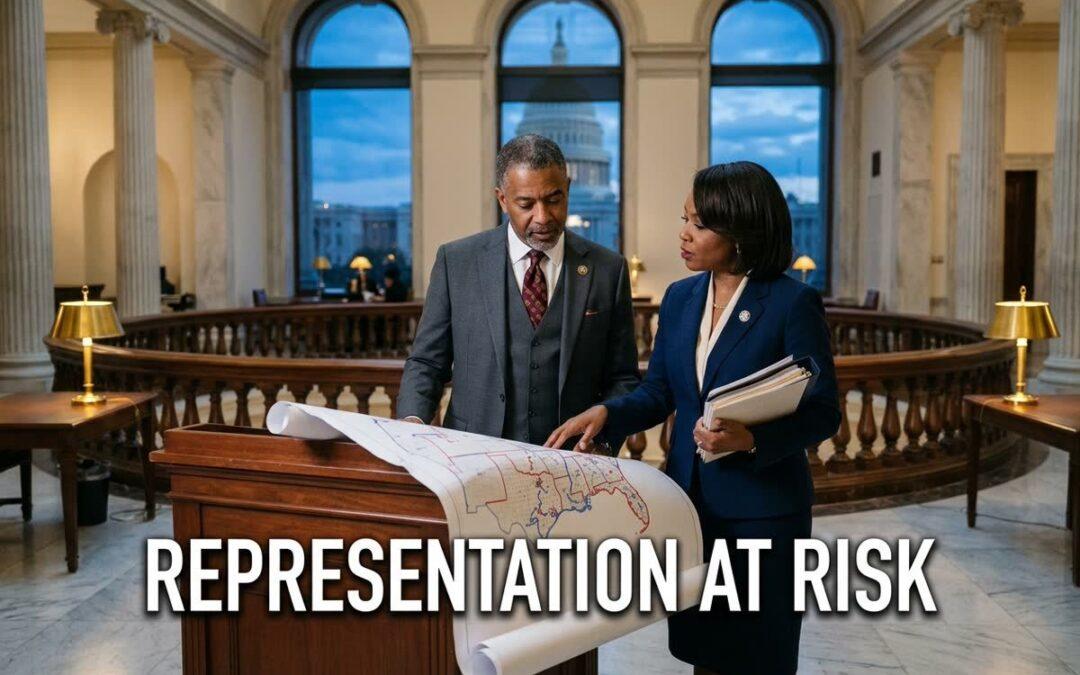


Black House Representation Drops Near Historic 1876 Record
By Darius Spearman (africanelements)
Support African Elements at patreon.com/africanelements and hear recent news in a single playlist. Additionally, you can gain early access to ad-free video content.
A national analysis released by NPR on November 12, 2026, revealed an unsettling shift in the balance of political power in Washington. Following the midterm elections, the total number of Black lawmakers in the United States House of Representatives will drop from 63 to 60 (northernpublicradio.org). While a decline of three seats might look small at first glance, its historical context is serious. This reduction represents the sharpest single-cycle decline in Black House representation since 1876, falling only one seat short of the all-time record set during the collapse of Reconstruction (northernpublicradio.org, wuwm.com).
This loss of representation occurred alongside a historic milestone in the upper chamber. A record seven Black senators will take office in the 120th Congress (northernpublicradio.org). Furthermore, robust Southern voter turnout blunted legislative efforts to eliminate as many as nineteen majority-minority districts across the Deep South (northernpublicradio.org, whqr.org). To understand how this mixed outcome happened, one must explore the long relationship between racial progress, institutional pushback, and federal law across the United States.
Reconstruction Black representation and the First Era of Power
The original emergence of Black political power in the United States was born during the Reconstruction era. Following the Civil War, the ratification of the Thirteenth, Fourteenth, and Fifteenth Amendments extended freedom, citizenship, and voting rights to formerly enslaved men (wikipedia.org, wikipedia.org). Federal troops occupied former Confederate states to enforce federal law and safeguard elections. Under these protections, Black voters registered in extraordinary numbers. In states like South Carolina, Mississippi, and Louisiana, Black citizens formed outright majorities of registered voters (wikipedia.org).
During these early years, formerly enslaved people navigated intense resistance. The institutional struggles after emancipation included economic traps like sharecropping and convict leasing, yet Black communities organized politically (eji.org). In 1870, Hiram Rhodes Revels of Mississippi was seated as the first Black member of the United States Senate (wikipedia.org). Later that same year, Joseph Hayne Rainey of South Carolina became the first Black American sworn into the House of Representatives (wikipedia.org). Over the next decade, approximately 2,000 Black men held public office across local, state, and federal levels throughout the South (wikipedia.org, govinfo.gov).
By the 44th Congress, which sat between 1875 and 1877, Reconstruction Black representation reached its nineteenth-century peak. Seven Black representatives served in the House of Representatives, alongside Senator Blanche K. Bruce of Mississippi (govinfo.gov, everycrsreport.com). Lawmakers such as Robert Smalls and John R. Lynch used their committee posts to champion civil rights legislation, public education funding, and federal infrastructure investment (wikipedia.org). However, this flourishing of multiracial democracy faced relentless opposition from white Southern political leaders who organized to reclaim state power (eji.org).
Largest Single-Cycle Drops in Black House Seats
Compromise of 1877 history and the Disenfranchisement Playbook
The hard-won political power of the Reconstruction era unraveled quickly following the presidential election of 1876. A bitter constitutional deadlock developed between Republican Rutherford B. Hayes and Democrat Samuel J. Tilden over disputed electoral votes in Florida, Louisiana, and South Carolina (history.com). Behind closed doors, party leaders struck an agreement. This settlement is known throughout Compromise of 1877 history as the moment federal protections ended in the South (history.com, eji.org).
Under the agreement, Hayes gained the presidency in exchange for withdrawing federal occupation troops from Southern state capitols (history.com). Deprived of federal protection, Black voters faced organized campaigns of intimidation and ballot box fraud led by groups such as the Ku Klux Klan and the White League (eji.org). The immediate outcome appeared in the 45th Congress. The total number of Black representatives dropped from seven to three, establishing a record four-seat loss that stood unbroken for 150 years (northernpublicradio.org, everycrsreport.com).
Over the subsequent two decades, Southern state legislatures consolidated this advantage. They enacted revised state constitutions that weaponized literacy tests, poll taxes, grandfather clauses, and white-only primaries (eji.org, hrw.org). This structural apparatus of black voter disenfranchisement suppressed civic participation across the region. When Representative George Henry White of North Carolina stepped down in 1901, he delivered a famous speech declaring that Black Americans would rise again like a phoenix (mobituaries.com, mobituaries.com). Despite his optimism, nearly three decades passed before another Black lawmaker entered Congress (everycrsreport.com).
Voting Rights Act Section 2 and Modern Representation
The modern era of minority electoral representation began with the passage of the Voting Rights Act of 1965. Signed into law by President Lyndon B. Johnson after the Selma marches, the statute dismantled Jim Crow voting tests and created federal oversight mechanisms (ncdsv.org, hrw.org). The legislation established two core protections. Section 5 forced states with documented histories of voting bias to obtain federal approval before changing election laws. Simultaneously, Voting Rights Act Section 2 prohibited any voting practice that resulted in the denial or abridgment of the right to vote on account of race (lls.edu).
During the Civil Rights Movement, leadership from grassroots organizers and dedicated women activists helped secure these foundational reforms. These civil rights organizers sustained the public pressure required to pass national voting protections. In 1982, Congress amended Section 2 to clarify that plaintiffs did not need to prove intentional discrimination; showing a discriminatory impact was sufficient (lls.edu). Four years later, in the benchmark ruling *Thornburg v. Gingles*, the Supreme Court established clear criteria requiring states to draw majority-minority districts when minority populations were sufficiently large and politically cohesive (electionlawblog.org, lls.edu).
These legal protections transformed the makeup of Capitol Hill. When the Congressional Black Caucus was established in 1971, it counted only thirteen founding members (everycrsreport.com). As court-mandated redistricting forced states to map districts reflecting minority populations, CBC membership grew steadily over the next five decades. By the 118th and 119th Congresses, Black House representation reached historic heights, surpassing 60 members and providing Black communities with sustained legislative influence on major national policies (northernpublicradio.org, usafacts.org).
Evolution of Black House Members (1875-2026)
Louisiana v Callais ruling and Judicial Retrenchment
The statutory architecture safeguarding minority electoral districts began eroding over the past decade through a sequence of federal court decisions. In the 2013 decision *Shelby County v. Holder*, the Supreme Court invalidated the coverage formula under Section 4(b) of the Voting Rights Act (hrw.org). This ruling effectively halted Section 5 preclearance, allowing states with long records of racial discrimination to implement new electoral boundaries and voting requirements without federal pre-approval (hrw.org, lls.edu).
Judicial retrenchment reached a new benchmark in April 2026 with the Louisiana v Callais ruling (electionlawblog.org). In that decision, the Supreme Court curbed the legal use of race in redistricting under Section 2. The Court overturned a lower court order that had established a second majority-Black congressional district in Louisiana (electionlawblog.org, scotusblog.com). By narrowing the circumstances under which states or federal courts can prioritize race to remedy vote dilution, the ruling signaled that many long-standing opportunity districts were vulnerable to elimination (electionlawblog.org, electionlawblog.org).
The direct impact of the ruling surfaced immediately in Louisiana. Democratic Representative Cleo Fields lost his newly created seat in the 6th Congressional District after state legislators redrew the map to eliminate the second Black-majority district (northernpublicradio.org, scotusblog.com). Voting rights litigators cautioned that the legal reasoning applied in Louisiana set a dangerous precedent, opening the door for neighboring states to crack cohesive minority populations across fragmented districts (electionlawblog.org, electionlawblog.org).
mid-decade redistricting Across Southern Battlegrounds
State legislatures moved rapidly following the spring judicial decisions. Under Article I, Section 4 of the United States Constitution, state legislatures possess primary authority over the time, place, and manner of congressional elections (texas.gov). Furthermore, the 2006 Supreme Court ruling in *LULAC v. Perry* affirmed that federal law does not prohibit mid-decade redistricting unless specific state constitutions forbid the practice (texas.gov, bipartisanpolicy.org). Because Southern state charters lack bans on off-cycle map drawing, legislative majorities capitalized on the legal latitude provided by the federal courts (bipartisanpolicy.org).
Lawmakers in states such as Texas, Alabama, and North Carolina quickly initiated mid-decade redistricting plans designed to alter favorable minority lines (northernpublicradio.org, whqr.org). Nonpartisan election observers and national civil rights groups projected that anywhere from fifteen to nineteen House seats held by Black lawmakers were at immediate risk of disappearing ahead of the midterms (northernpublicradio.org). In Texas, the reconfiguration of the 9th Congressional District, previously represented by veteran lawmaker Al Green, resulted in the seat shifting to a non-Black candidate (northernpublicradio.org).
However, an expected wave of seat eliminations was blunted by high voter mobilization across the South (northernpublicradio.org, whqr.org). High turnout among Black voters in key districts enabled several threatened incumbents to hold their positions against redrawn boundaries. In Alabama’s 2nd Congressional District, freshman Representative Shomari Figures mounted a disciplined ground campaign to win reelection, despite state legislators adding conservative rural counties to his district (northernpublicradio.org, whqr.org). Similarly, Representative Don Davis defended his redrawn seat in North Carolina’s 1st District, demonstrating how grassroots mobilization can offset structural disadvantages (northernpublicradio.org, whqr.org).
2026 House Turnover: Gross Losses vs Offsets
Congressional Black Caucus losses versus Senate Milestones
A detailed examination of election data explains the exact dynamics behind Congressional Black Caucus losses in the House. The net decline of three seats reflects a total gross loss of eight seats previously held by Black lawmakers, balanced by five new seat pickups across the country (northernpublicradio.org). Importantly, political churn accounted for more departures than redistricting alone. Five seats became vacant due to retirements and campaigns for higher office (northernpublicradio.org, jointcenter.org).
Three Black Republican representatives chose not to seek reelection to their House seats, instead pursuing bids for governor or the United States Senate: Byron Donalds in Florida, Wesley Hunt in Texas, and John James in Michigan (northernpublicradio.org). In New Jersey, long-serving Representative Bonnie Watson Coleman retired, and her district elected a non-Black successor (northernpublicradio.org). In Utah, Representative Burgess Owens saw his district redrawn (northernpublicradio.org). These churn losses were offset by five incoming Black freshmen who won seats previously held by non-Black officials, including Cyril Jefferson and LaKesha Womack in North Carolina, Melat Kiros in Colorado, Donavan McKinney in Michigan, and Adrian Boafo in Maryland (northernpublicradio.org, whqr.org).
The structural divergence between House losses and historic Senate victories highlights the mechanics of American elections. House seats depend on geographic lines drawn by state legislatures, making them susceptible to gerrymandering and legal challenges under the Voting Rights Act (northernpublicradio.org, brookings.edu). In contrast, United States Senate seats are decided through at-large, statewide popular votes that cannot be altered by legislative mapmakers (northernpublicradio.org, bipartisanpolicy.org). By assembling statewide coalitions of Black voters, suburban moderates, and urban communities, Black candidates secured landmark Senate victories in states like Mississippi and Illinois, pushing Senate representation to seven members even as House numbers fell (northernpublicradio.org, 19thnews.org).
| Electoral Cycle | Starting Seats | Ending Seats | Net Change | Primary Structural Driver |
|---|---|---|---|---|
| 1876 Election (45th Cong.) | 7 Seats | 3 Seats | -4 Seats | Troop Withdrawal, KKK Violence, Poll Taxes |
| 2026 Midterms (120th Cong.) | 63 Seats | 60 Seats | -3 Seats | VRA Dilution (*Callais*), Gerrymandering, Churn |
The findings from the NPR analysis demonstrate an enduring rhythm in American political history. Every historical era of minority electoral expansion has encountered sustained resistance designed to restrict shared political power (northernpublicradio.org, eji.org). Following the 1876 election, the dismantling of legal protections wiped out federal Black representation within a generation (everycrsreport.com, history.com). While modern voter mobilization prevented an immediate collapse in 2026, the reduction from 63 to 60 seats highlights the structural precarity facing minority representation when federal voting rights protections are dismantled by the courts (northernpublicradio.org, electionlawblog.org).
About the Author
Darius Spearman is a professor of Black Studies at San Diego City College, where he has been teaching for over 20 years. He is the founder of African Elements, a media platform dedicated to providing educational resources on the history and culture of the African diaspora. Through his work, Spearman aims to empower and educate by bringing historical context to contemporary issues affecting the Black community.
