
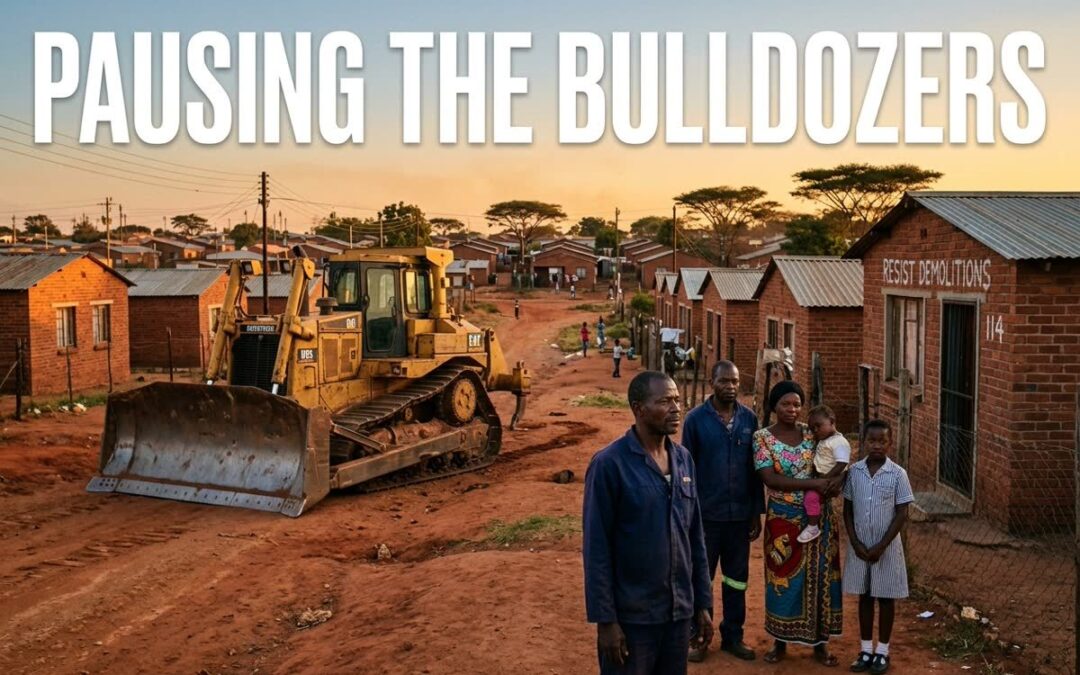


Harare Housing Demolitions: Why Zimbabwe Paused the Bulldozers
By Darius Spearman (africanelements)
Support African Elements at patreon.com/africanelements and hear recent news in a single playlist. Additionally, you can gain early access to ad-free video content.
Across the African diaspora, the struggle for land, shelter, and self-determination remains a defining thread of modern history. From the spatial segregation imposed on urban Black communities in the United States to the municipal boundaries of post-colonial Southern Africa, the regulation of physical space frequently reflects broader structures of political control. In Zimbabwe, urban land has long served as both a refuge for working families and a contested battleground between municipal councils and the national state (aljazeera.com, researchgate.net).
In mid-November, the Harare City Council abruptly suspended all planned and active residential demolitions across the capital city (heraldonline.co.zw, allafrica.com). The decision followed an intense wave of public outrage sparked by armed municipal police actions in the high-density suburb of Glen View (pindula.co.zw, newzimbabwe.com). The administrative halt offers temporary relief to an estimated 5,000 to 10,000 households facing eviction (allafrica.com, zimbabwesituation.com). However, the sudden pause exposes deep historical fissures dating back decades, illuminating an ongoing clash between administrative bureaucracy, political patronage, and the fundamental human demand for housing (aljazeera.com, thezimbabwean.co).
Glen View Market Demolitions: Sparking National Outcry
The immediate catalyst for the national crisis began in Glen View, an expansive working-class suburb in southwestern Harare known across the region for informal furniture manufacturing and retail trade (pindula.co.zw, newzimbabwe.com). Early on November 14, armed municipal police teams accompanied by national police detachments carried out coordinated dawn operations (pindula.co.zw). Bulldozers leveled informal carpentry workshops, retail stalls, and tuckshops along arterial roads, destroying thousands of dollars in timber, finished goods, and equipment (pindula.co.zw, newzimbabwe.com).
Glen View represents a critical hub of grassroots enterprise in an economy where more than 70 percent of working-age adults operate in informal markets (degi.co.zw, reall.net). For millions of urban Zimbabweans, micro-commerce provides an essential lifeline absent formal industrial employment. The destruction of these livelihoods mirrors historical patterns where the state disrupts independent survival networks, much like early structural impediments faced during independent enterprise development across the diaspora (aljazeera.com, newzimbabwe.com).
Public outrage intensified as the municipal blitz expanded beyond market stalls toward residential structures (allafrica.com, zimbabwesituation.com). Harare City Council had scheduled enforcement drives to execute 37 outstanding High Court demolition orders targeting thousands of homes across Glen View, Budiriro, Kuwadzana, and St Martins Extension (allafrica.com, zimbabwesituation.com). Confronted by community blockades, widespread street demonstrations, and public condemnation, municipal authorities faced an escalating civil standoff that threatened to spread across the metropolitan area (pindula.co.zw, zimbabwesituation.com).
Harare Housing Deficit (2014–2024)
Harare City Council Directive: Halting the Immediate Blitz
As civil unrest mounted, administrative machinery shifted into reverse. Harare Acting Town Clerk Advocate Warren Chiwawa issued an immediate departmental directive commanding all municipal units to halt pending residential demolitions across the capital city (heraldonline.co.zw, allafrica.com). The internal notice instructed law enforcement teams to stand down, freezing operations in high-tension areas such as Belvedere Ridgeview and the contested St Martins Extension Demolitions zone (allafrica.com, zimbabwesituation.com).
Simultaneously, central government intervened. Local Government and Public Works Minister Daniel Garwe announced a comprehensive national moratorium directing all 92 local authorities—comprising 32 urban councils and 60 rural district councils—to halt residential evictions immediately (heraldonline.co.zw, allafrica.com). Minister Garwe characterized the demolitions as inhumane, demanding that municipal leaders pursue dialogue and legal regularisation rather than physical displacement (heraldonline.co.zw, allafrica.com).
Harare Mayor Jacob Mafume, serving concurrently as Chairman of the Urban Councils Association of Zimbabwe, affirmed the suspension and called for tripartite negotiations between municipalities, the Ministry of Local Government, and resident associations (heraldonline.co.zw, allafrica.com). While the directive defused an imminent confrontation, it introduced acute administrative ambiguities. The suspension froze physical demolitions, yet 37 binding High Court eviction orders remained legally valid on the judicial docket, leaving thousands of working families in unresolved jurisdictional limbo (allafrica.com, zimbabwesituation.com).
Operation Murambatsvina Legacy: The Roots of Urban Displacement
The contemporary housing crisis cannot be understood without examining the long shadow of Operation Murambatsvina in May 2005 (aljazeera.com, researchgate.net). Officially translated as “Restore Order” or “Drive Out the Filth,” the military-style campaign unleashed bulldozers on informal settlements, backyard extensions, and market stalls across every major Zimbabwean city (aljazeera.com, aljazeera.com). Over a matter of months, the state demolished decades of accumulated urban capital built by ordinary citizens seeking shelter in rapidly expanding metropolitan centers (aljazeera.com, researchgate.net).
A United Nations fact-finding mission led by Special Envoy Anna Tibaijuka documented that Operation Murambatsvina directly caused 700,000 individuals to lose their homes, livelihoods, or both (aljazeera.com, aljazeera.com). Indirectly, the clearance impacted approximately 2.4 million people, representing nearly one-fifth of Zimbabwe’s total population at the time (aljazeera.com, researchgate.net). The operation shattered social safety nets and decimated the informal urban economy without providing alternative shelter (researchgate.net, aljazeera.com).
“Operation Murambatsvina was carried out in an indiscriminate and unjustified manner, with indifference to human suffering, and, in repeated cases, with disregard to several provisions of national and international legal frameworks.”
— United Nations Special Envoy Anna Tibaijuka, Official Report (2005)
Historical evidence confirms that the 2005 demolitions functioned as state-sponsored political retribution (aljazeera.com, researchgate.net). The campaign followed the March 2005 parliamentary elections, in which the opposition Movement for Democratic Change retained control over urban legislative seats (aljazeera.com, aljazeera.com). By dispersing informal urban strongholds into rural districts governed by ruling party patronage structures, the central government sought to neutralize political opposition in the cities (aljazeera.com, researchgate.net). The resulting devastation created a permanent Zimbabwe Housing Deficit that continues to destabilize municipal planning twenty years later (researchgate.net, reall.net).
Populations Displaced vs. At Risk
Zimbabwe Land Barons Scandal: The Rise of Shadow Developers
In the aftermath of the 2005 clearances, formal municipal housing delivery broke down almost entirely (researchgate.net, property.co.zw). Between 2014 and 2024, the Harare municipal waiting list surged from 150,000 to over 300,000 registered applicants, yet the municipality constructed fewer than 4,000 serviced residential units (propzone.co.zw, property.co.zw). This profound institutional failure created an opening for politically connected middlemen, widely known across Zimbabwe as land barons (thezimbabwean.co, heraldonline.co.zw).
These syndicates appropriated public greenbelts, state farms, and peri-urban wetlands, registering fraudulent housing cooperatives that invoked ruling party connections to project legitimacy (thezimbabwean.co, heraldonline.co.zw). Desperate working-class families—unable to secure municipal stands or afford private rental rates—purchased residential plots for prices ranging from US$2,000 to US$10,000 (thezimbabwean.co, property.co.zw). Homeowners invested life savings to construct permanent brick-and-mortar houses on land that lacked approved engineering plans, sewer lines, or municipal water connections (thezimbabwean.co, heraldonline.co.zw).
The scale of this institutional extraction was formally documented by the Commission of Inquiry into the Sale of State Land in and Around Urban Areas, chaired by Justice Tendai Uchena (heraldonline.co.zw, heraldonline.co.zw). The Uchena Commission findings revealed that politically connected syndicates illegally parceled out and sold urban state land valued at nearly US$3 billion (thezimbabwean.co, heraldonline.co.zw). Harare Metropolitan accounted for more than a third of all criminal referrals (thezimbabwean.co, heraldonline.co.zw).
Crucially, the Uchena report underscored deep structural impunity (thezimbabwean.co, heraldonline.co.zw). While municipal authorities routinely sent bulldozers to crush the homes of working-class purchasers, the political figures and shadow developers who profited from illegal subdivisions consistently evaded criminal prosecution (thezimbabwean.co, heraldonline.co.zw). This dynamic mirrors classic analyses of postcolonial urban identity and governance, where legal sanctions fall overwhelmingly on the dispossessed while elite actors operate above statutory constraints (thezimbabwean.co, researchgate.net).
Estimated Scale of Land Fraud & Needs
Harare Housing Regularisation Crisis: The 14-Day Ultimatum
The immediate administrative dispute leading to the November standoff centered on impossible bureaucratic mandates (allafrica.com, zimbabwesituation.com). In Zimbabwean urban planning, a “stand” refers to an officially surveyed and demarcated land parcel zoned for residential or commercial development (thezimbabwean.co, property.co.zw). “Regularisation” defines the statutory process of retroactively bringing unauthorized settlements into compliance with town planning laws, primarily the Regional, Town and Country Planning Act (heraldonline.co.zw, property.co.zw).
In late October, Harare municipal authorities issued strict 14-day ultimatums to residents in unapproved settlements across Glen View, Budiriro, and Kuwadzana (allafrica.com, zimbabwesituation.com). Homeowners were instructed to pay steep regularization penalties, settle survey fees, and submit approved civil engineering plans before November 17 or face summary eviction and demolition (allafrica.com, zimbabwesituation.com). Complying with this demand within two weeks proved technically and financially impossible for several reasons (allafrica.com, property.co.zw):
- Prolonged Bureaucratic Workflows: Statutory regularisation requires mandatory Environmental Management Agency ecological impact assessments, layout approvals by the local authority, and cadastral boundary verification conducted by the national Surveyor-General. These procedures routinely take twelve to thirty-six months (heraldonline.co.zw, property.co.zw).
- Heavy Infrastructure Demands: Town planning statutes prohibit the issuance of compliance certificates or title deeds until an area is fully serviced with piped water lines, connected sewage mains, storm drains, and engineered roads. Civil engineering projects of this scale cannot be procured or constructed in fourteen days (heraldonline.co.zw, reall.net).
- Prohibitive Financial Levies: Municipal regularisation penalties, administrative charges, and private engineering fees routinely total thousands of U.S. dollars per household. Having already been defrauded by land cartels, informal residents lacked the immediate liquidity to clear council debts on two weeks notice (thezimbabwean.co, property.co.zw).
By issuing an ultimatum that informal settlers could not meet, municipal authorities established administrative grounds for summary clearance (allafrica.com, zimbabwesituation.com). This bureaucratic maneuver sparked widespread resistance, forcing central government to step in before eviction deadlines triggered violent confrontations across the capital city (heraldonline.co.zw, allafrica.com).
Contested Urban Land Allocations: Political Stalemate and Legal Limbo
The recurrent demolition cycle in Harare is sustained by an unresolved political conflict between municipal and national authorities (aljazeera.com, researchgate.net). Since 2000, Harare City Council has been led by opposition parties, while the national Ministry of Local Government and Public Works remains firmly under ruling party administration (aljazeera.com, thezimbabwean.co). This split mirrors tensions examined in historical studies of shared governance dynamics, where overlapping municipal and central powers produce institutional gridlock (aljazeera.com, researchgate.net).
| Administrative Actor | Institutional Position | Primary Policy Mechanism |
|---|---|---|
| Harare City Council | Enforce master plan; clear unapproved settlements to prevent waterborne disease outbreaks. | High Court eviction orders and 14-day compliance notices. |
| Ministry of Local Government | Halt demolitions; advocate dialogue while maintaining political support in peri-urban areas. | Ministerial moratoria and national administrative directives. |
| Urban Councils Association | Urge negotiated regularisation and infrastructure funding support for municipal authorities. | Tripartite negotiation frameworks and statutory audits. |
This dynamic fuels institutional finger-pointing. The City Council argues that unapproved settlements constructed over wetlands and sewer trunk lines cause recurrent cholera outbreaks, degrade municipal master plans, and threaten public infrastructure (researchgate.net, property.co.zw). Consequently, council lawyers regularly secure High Court eviction orders (allafrica.com, zimbabwesituation.com). Conversely, central government periodically intervenes to halt demolitions, presenting itself as a protector of working families while shielding informal settlements that serve as vital voting blocs during national elections (aljazeera.com, thezimbabwean.co).
This political dynamic introduces serious constitutional dilemmas (zimbabwesituation.com, zimbabwesituation.com). Under Section 164 of the Constitution of Zimbabwe, judicial authority is independent, and orders of the courts bind all persons and state organs, including cabinet ministers (zimbabwesituation.com). An executive directive issued by Minister Daniel Garwe cannot legally override, amend, or nullify valid eviction orders issued by the High Court of Zimbabwe (zimbabwesituation.com, zimbabwesituation.com). The ministerial decree provides an informal political shield rather than a binding legal stay of execution (zimbabwesituation.com).
Consequently, thousands of families across Glen View, Budiriro, and St Martins Extension remain in precarious legal limbo (allafrica.com, zimbabwesituation.com). The bulldozers have paused, but the underlying structural crisis remains unaddressed (heraldonline.co.zw, thezimbabwean.co). Unless the state confronts the legacy of state land fraud, invests the estimated US$2.5 billion required for basic urban civil infrastructure, and delivers accessible municipal land, Harare will remain trapped in this destructive cycle of informal settlement and state clearance (thezimbabwean.co, heraldonline.co.zw).
About the Author
Darius Spearman is a professor of Black Studies at San Diego City College, where he has been teaching for over 20 years. He is the founder of African Elements, a media platform dedicated to providing educational resources on the history and culture of the African diaspora. Through his work, Spearman aims to empower and educate by bringing historical context to contemporary issues affecting the Black community.
