


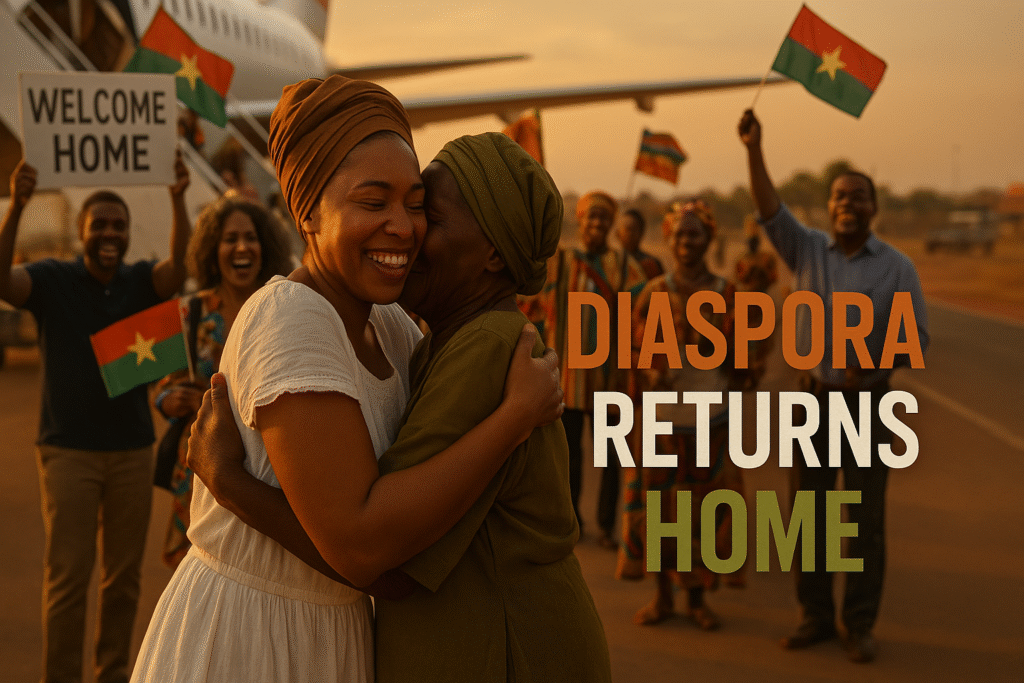
Burkina Faso Welcomes 700 Diaspora Descendants Home in Historic Pan-African Homecoming
The History Behind The Headlines
By Darius Spearman (africanelements)
Support African Elements at patreon.com/africanelements and hear recent news in a single playlist. Additionally, you can gain early access to ad-free video content.
A Call Answered: Diaspora Returns to African Soil
Nearly 700 people of African descent recently set foot on Burkinabè soil, answering a call that has echoed through generations. The October 26 through November 8, 2025 visit represents more than tourism (Sputnik Africa). It marks a symbolic homecoming organized by the African Diaspora Development Institute (ADDI) and welcomed by Captain Ibrahim Traoré’s government (Sputnik Africa).
The delegation includes African Americans, Caribbeans, and Europeans of African descent. They come not as tourists but as descendants reconnecting with ancestral land (Africa View Facts). Dr. Arikana Chihombori-Quao, ADDI president and former African Union representative to the United States, leads the historic delegation (Sputnik Africa).

Pan-African Vision Drives Historic Welcome
Captain Ibrahim Traoré has declared Burkina Faso the home of all Africans. This declaration carries weight beyond diplomatic niceties (Sputnik Africa). The young military leader positions his nation as a “land of hope” for diaspora seeking meaningful connection to Africa (Sputnik Africa).
The visit program includes official meetings with government ministers. Delegates attend conferences exploring investment opportunities in agriculture, renewable energy, mining services, and technology (Zero13). Cultural visits and solidarity actions for internally displaced persons round out the agenda (Sputnik Africa).
Burkinabè Foreign Ministry representatives describe the event as “symbolic return and memorial reconciliation” (Sputnik Africa). The timing coincides with Burkina Faso’s National Cultural Week, a biennial celebration in Bobo Dioulasso showcasing the country’s rich cultural heritage (Wikipedia).
Economic Partnership Takes Center Stage
This homecoming transcends cultural symbolism. Real economic opportunities drive much of the delegation’s interest. Burkina Faso offers investment potential in sectors critical to African development (Zero13).
The nation ranks as Africa’s fourth-largest gold producer. Mining sector revitalization creates openings for equipment manufacturing, finance, and consulting services (U.S. Department of Commerce). Agriculture remains central to the economy, employing a quarter of the population and offering opportunities in irrigation, agro-processing, and livestock value chains (IRENA).
Renewable energy presents another frontier. Only one-quarter of Burkina Faso’s population has reliable electricity access (New Business Ethiopia). This gap creates space for solar, wind, and off-grid solutions backed by international development institutions (New Business Ethiopia).
President Traoré personally invited diaspora investors, emphasizing mutually beneficial partnerships respecting Burkinabè identity and values (ADDI Burkina Faso Program). His government amended the Mining Code to mandate foreign companies transfer 15 percent ownership to Burkina Faso and train local workers (BBC).

Citizenship Pathways Spark Debate and Hope
Citizenship represents the ultimate reconnection for many diaspora members. ADDI claims its members can access permanent residency without the standard five-year continuous residency requirement (Kenganda). This fast-track pathway generates both excitement and skepticism within diaspora communities.
Burkina Faso’s government waived the five-year pre-residency requirement for ADDI members who applied for citizenship and submitted background checks (ADDI). Permanent residents can enter and re-enter Burkina Faso freely without time requirements (ADDI). They gain rights to work, invest, and own property (Kenganda).
However, political rights like voting and holding office remain restricted initially (Kenganda). The pathway to full citizenship requires continuous investment in the country, though specific monetary amounts remain unclear (Kenganda).
Critics caution that Burkina Faso faces challenges. The nation ranks 151st in the World Bank’s ease of doing business report (U.S. Department of Commerce). Security concerns affect mining and agricultural regions (IRENA). French serves as the official language, creating barriers for English-speaking diaspora (Kenganda).
Marcus Garvey’s Dream Finds New Life
The Burkina Faso homecoming connects to a long history of diaspora return movements. Marcus Garvey founded the Universal Negro Improvement Association in 1914, promoting racial pride and African nation-building (The Black Wall Street Times). His Black Star Line shipping company aimed to repatriate African Americans and other diaspora members to their African homeland (Journal of Pan African Studies).
Garvey’s vision faced setbacks. Liberia, founded by freed American slaves in 1847, ultimately rejected mass settlement by UNIA followers in 1924 (Transatlantic Cultures). Yet his philosophy shaped generations of Black nationalists and Pan-Africanists (National Humanities Center).

Malcolm X advocated for African reconnection in the 1960s. He believed separation with equal resources could repair damages from oppressive systems (The Black Wall Street Times). His trips to Africa between 1959 and 1964 emphasized collective visibility and equality (The Black Wall Street Times).
Modern movements build on this foundation. Ghana launched its Year of Return in 2019, marking 400 years since the first enslaved Africans arrived in North America (Africa Renewal). The West African nation granted citizenship to hundreds of African Americans and Caribbean migrants (African Diaspora Group). Ghana extended this initiative through “Beyond the Return,” granting citizenship to 524 individuals in November 2024 (Facebook).
Thomas Sankara’s Revolutionary Spirit Resurfaces
Captain Traoré’s Pan-African vision echoes Thomas Sankara’s legacy. Sankara led Burkina Faso from 1983 until his 1987 assassination. He renamed the nation from Upper Volta to Burkina Faso, meaning “Land of Upright People” (TRT Afrika). This symbolic act shed French colonial identity while embracing indigenous African cultures (University of Victoria).
Sankara’s brief presidency focused on decolonization and Pan-African unity. He promoted local languages, festivals, and traditions while rejecting Western influences (University of Victoria). His anti-Western, anti-colonialist stance aimed to cut foreign interference from Burkina Faso’s economy, culture, and identity (University of Victoria).
Under Sankara’s leadership, literacy rates soared from 13 percent in 1983 to 73 percent in 1987 (TRT Afrika). Millions of children received vaccinations. Forest cover increased despite the dry tropical climate (TRT Afrika). His revolutionary approach to development prioritized self-reliance over dependence on foreign aid.
Traoré builds on Sankara’s foundation while adapting to current geopolitical realities. He expelled French troops in February 2023 and forged closer ties with Russia and Turkey (Wikipedia). His government established a state-owned mining enterprise and constructed Burkina Faso’s first gold refinery (BBC). These moves aim to ensure Burkinabè people benefit from their mineral resources (BBC).
Neocolonialism Shapes African Realities
Understanding diaspora return movements requires examining neocolonialism’s ongoing impact. Ghanaian president Kwame Nkrumah defined neocolonialism as a state appearing independent while its economic system remains externally controlled (Carleton University). This dynamic perpetuates exploitation despite formal political independence.
Africa loses more wealth than it receives. A 2014 study found African countries received approximately 19 billion dollars in aid while 68 billion dollars flowed out, mainly through multinational companies deliberately misreporting import and export values to reduce taxes (Carleton University). These financial outflows dwarf the benefits of foreign aid and investment (Carleton University).
Resource extraction drives much of this exploitation. Multinational companies repatriate 32 billion dollars in profits annually from African operations (Carleton University). Meanwhile, some West African nations still pay colonial-era taxes to France and substantial interest on loans (Carleton University).
Local elites often collaborate with foreign capital to maintain this system. These comprador bourgeoisie lack commitment to national development, prioritizing personal accumulation over collective progress (Internet Encyclopedia of Philosophy). Their actions authorize dependency on foreign capital, providing legitimacy for continued neocolonial relationships (Internet Encyclopedia of Philosophy).
Traoré explicitly challenges this arrangement. He describes terrorism as imperialism designed to keep Africa in permanent warfare, preventing development while enabling resource plunder (International People’s Assembly). His government’s sovereignty-focused policies represent resistance to neocolonial control (Shamillah Wilson).
Transatlantic Slavery’s Genetic Footprints Endure
The diaspora homecoming movement addresses wounds that span centuries. Historical records document the forced deportation of approximately 12.5 million people from African Atlantic coastline ports between the 16th and 19th centuries (National Institutes of Health). This trauma created the African diaspora scattered across the Americas and beyond.
Genetic research confirms these historical patterns. A study analyzing data from over 50,000 research participants found that genetic connections between people in slave trading regions of Africa and disembarkation regions of the Americas generally mirror documented slave voyage proportions (National Institutes of Health). West Central Africa experienced the highest proportion of deportations, consistent with genetic evidence showing people of African descent in the Americas share the most recent common ancestors with West Central Africans (National Institutes of Health).
These genetic links provide scientific validation for diaspora members seeking to reconnect with ancestral homelands. DNA testing helps descendants trace their origins to specific African regions. Several nations now offer citizenship pathways based on documented ancestral connections.
Benin enacted Law No. 2024-31 in September 2024, granting citizenship to individuals of sub-Saharan African descent whose ancestors suffered forced deportation during the transatlantic slave trade (African Diaspora Group). Applicants must provide DNA tests, testimonies, or family records demonstrating ancestral links (African Diaspora Group). The My Afro Origins digital platform streamlines the application process (African Diaspora Group).
Diaspora Capital Powers African Development
Economic participation distinguishes modern return movements from earlier symbolic efforts. Diaspora communities in Sub-Saharan Africa remitted an estimated 54 billion dollars in 2023 (Forbes). These financial flows exceed foreign aid and often surpass foreign direct investment.
Diaspora investors bring more than capital. They possess skills and knowledge from experiencing cutting-edge technologies and industries rarely found on the continent (World Economic Forum). Their understanding of cultural practices positions them uniquely to develop solutions tailored to African needs (World Economic Forum).
David Mullings, founder and CEO of Blue Mahoe Capital, channels diaspora investment into Caribbean and African ventures. His firm backs Seed Jamaica, providing micro-loans without requiring branch visits or extensive paperwork (Forbes). Blue Mahoe also funds affordable housing construction in Jamaica, building homes for teachers, nurses, and public sector employees rather than tourist accommodations (Forbes).
The African Diaspora Investment Symposium marks its tenth anniversary in 2025. This premier global convening celebrates and champions the entrepreneurial spirit of Africans, descendants of Africa, and friends of Africa (African Diaspora Network). The symposium provides a platform for diaspora-led initiatives, public-private partnerships, and transformative investments strengthening economic ties between Africa and the United States (African Diaspora Network).
Youth Movements Embrace Pan-African Revival
Young Africans drive much of the renewed Pan-African consciousness. Traoré’s leadership resonates particularly with youth who question why poverty persists on a resource-rich continent (BBC). His anti-imperialist messages and sovereignty-focused policies challenge accepted relationships with Western powers (Australian Institute of International Affairs).
Social media amplifies Traoré’s influence. Young people across Africa celebrate his rejection of neocolonial arrangements (Australian Institute of International Affairs). Demonstrations supporting Burkina Faso’s leadership occurred in Ghana, Liberia, and diaspora communities following a foiled coup attempt in April 2025 (Australian Institute of International Affairs). Some Ghanaian youth offered to volunteer fighting in support of the Burkinabè regime (Australian Institute of International Affairs).
ADDI’s youth empowerment component addresses this energy. The organization thanks Burkinabè youth for their patriotism while inspiring involvement in their country’s future (ADDI Burkina Faso Program). Events aim to help youth seek financial independence pathways (ADDI Burkina Faso Program).
The movement transcends Burkina Faso. Mali and Niger joined in forming the Alliance of Sahel States in July 2024 (Wikipedia). All three countries operate under military leadership pursuing similar sovereignty-focused agendas. This regional coordination strengthens Pan-African solidarity while challenging external interference (Wikipedia).
Challenges Temper Optimism About Return Movement
Diaspora return movements face significant obstacles. Burkina Faso confronts a fragile security environment as insurgent groups control portions of territory (New Business Ethiopia). The conflict affects mining and agricultural regions, disrupting economic activity and displacing populations (IRENA).
Infrastructure gaps limit business opportunities. Limited electricity access, weak transportation networks, and poor telecommunications constrain productivity (Institute for Security Studies). Landlocked geography increases transport costs for imports and exports (New Business Ethiopia).
Human rights organizations present a contrasting narrative to social media celebration. Critics note that Traoré’s government curtails civil liberties, suppresses media, and criminalizes dissent (Deutsche Welle). Elections promised within a year of his 2022 coup remain unscheduled, with Traoré declaring them not a priority (Deutsche Welle).
Previous return movements offer cautionary tales. The 1878 Liberian Exodus from Charleston proved disastrous, marked by mismanagement, high mortality, and unfulfilled promises (Coastal Carolina University). Later waves of Arkansas emigrants to Liberia in the 1890s faced brutal conditions and diseases to which they no longer had biological resistance (Encyclopedia of Arkansas).
Diaspora returnees sometimes become new elites, creating tensions with existing populations (Coastal Carolina University). The inability to reconcile expectations with reality challenges many return movements (Coastal Carolina University). Authors like Maya Angelou and Chimamanda Ngozi Adichie explored these dissonances in their works (Coastal Carolina University).
Why This Matters: Reclaiming African Futures
The Burkina Faso diaspora homecoming matters because it represents a fundamental shift in African self-determination. For centuries, enslaved Africans and their descendants questioned whether return was possible. Marcus Garvey’s vision faced institutional opposition. Malcolm X’s advocacy met resistance from integration-focused civil rights leaders.
Today’s movements operate in a changed context. Multiple African nations actively court diaspora engagement. Ghana, Benin, and now Burkina Faso offer concrete pathways to citizenship and investment. Technology enables coordination across continents. Genetic testing provides scientific validation for ancestral connections.
The movement challenges neocolonial assumptions about African development. Rather than waiting for Western aid or foreign direct investment, these initiatives position diaspora capital and expertise as primary drivers of growth. They reject the narrative of Africa as perpetually dependent on external救助.
For Black Americans and other diaspora members, these homecomings offer healing. Centuries of forced separation created trauma passed through generations. DNA evidence confirming African origins transforms abstract ancestry into tangible connection. Citizenship formalizes belonging in ways impossible under previous systems.
Economic implications extend beyond individual investment. Diaspora engagement could redirect the 54 billion dollars in annual remittances toward productive enterprises rather than consumption. Skills and knowledge transfer accelerates African innovation and competitiveness. Political pressure from engaged diaspora communities might constrain neocolonial exploitation.
The Pan-African dimension matters most for continental unity. Borders dividing Africa remain colonial constructs designed to facilitate exploitation. Movements transcending these artificial divisions rebuild pre-colonial networks of trade, culture, and solidarity. The Alliance of Sahel States demonstrates how sovereignty-focused leadership can cooperate across national boundaries.
Youth embrace this vision because it offers agency. Rather than accepting poverty amid abundance, young Africans demand control over their resources and futures. Traoré’s popularity stems from his willingness to articulate this frustration and pursue concrete alternatives to failed models.
Challenges remain substantial. Security, infrastructure, and governance issues will not disappear quickly. Some diaspora members will face disappointment when expectations clash with reality. Success requires sustained effort from both African governments and returning diaspora.
Yet the historic significance of nearly 700 diaspora members setting foot on Burkinabè soil as welcomed guests cannot be overstated. This represents progress impossible even a generation ago. It builds on decades of Pan-African organizing while creating new possibilities for future generations.
The question shifts from whether diaspora return is possible to how it can succeed sustainably. Burkina Faso’s experiment with welcoming displaced descendants offers one answer. Time will reveal whether this model spreads and endures. For now, the presence of African Americans, Caribbeans, and Europeans of African descent in Ouagadougou signals that the long journey home continues, step by determined step.
ABOUT THE AUTHOR
Darius Spearman has been a professor of Black Studies at San Diego City College since 2007. He is the author of several books, including Between The Color Lines: A History of African Americans on the California Frontier Through 1890. You can visit Darius online at africanelements.org.”
