
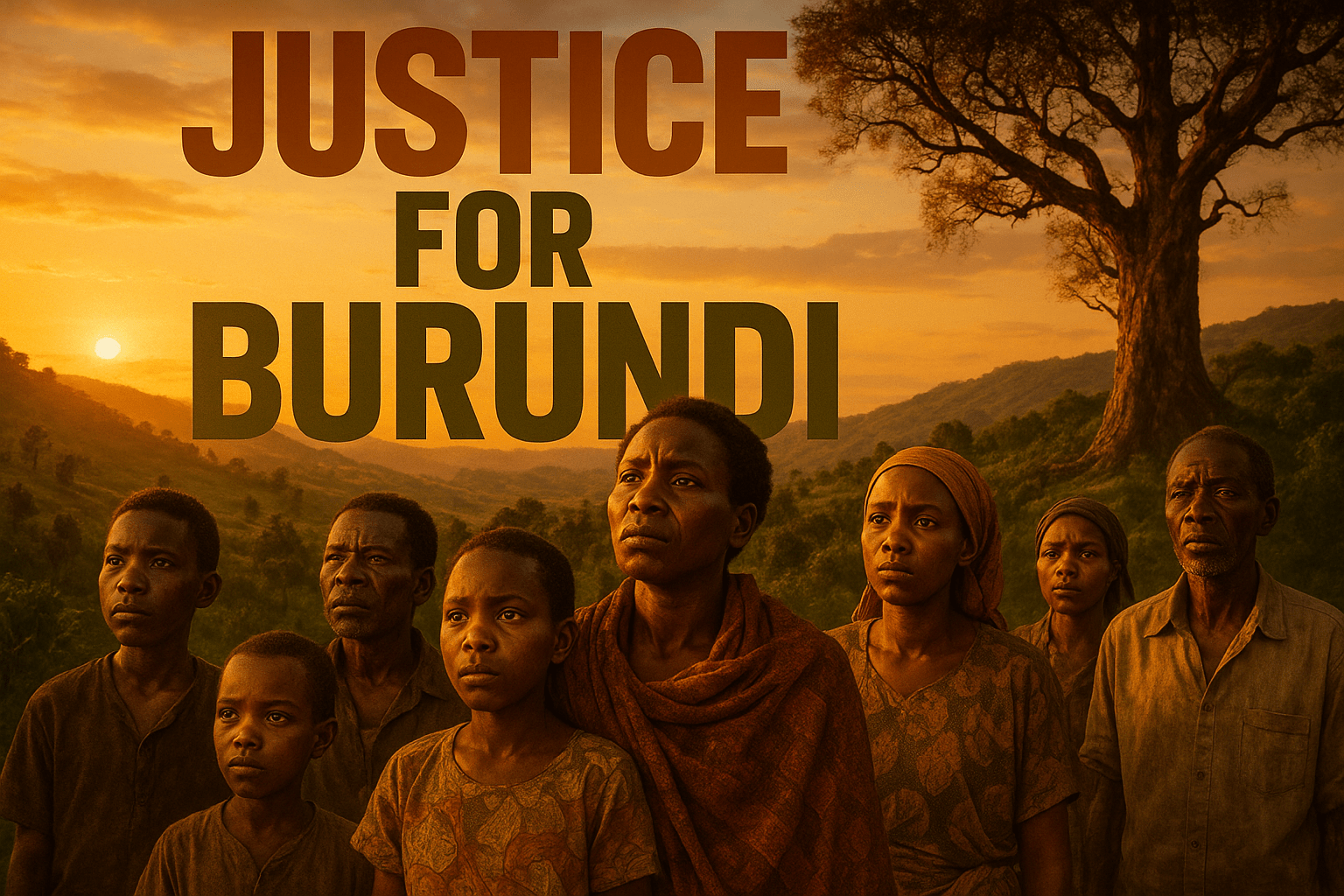
Burundi’s Quest for Justice: Recognizing the 1972 Genocide
By Darius Spearman (africanelements)
Support African Elements at patreon.com/africanelements and hear recent news in a single playlist. Additionally, you can gain early access to ad-free video content.
A Long-Awaited Call for Recognition
Burundi is now urging the United Nations to officially recognize the mass killings of Hutus in 1972–1973 as a genocide (africanews.com). This call comes over five decades after the violence claimed tens of thousands of lives. For many in the African diaspora, this push for recognition highlights the enduring struggle for historical truth and justice across the continent.
Pierre Claver Ndayicariye, President of Burundi’s Truth and Reconciliation Commission, recently stated that the international community should acknowledge these tragic events (africanews.com). He emphasized that over fifty years is far too long for this recognition to be delayed (africanews.com). The commission believes that the established facts, testimonies, and collected archives are sufficient for this crucial recognition (africanews.com). Burundi is calling for the matter to be brought before the United Nations Security Council (africanews.com).
Unearthing a Painful Past
The 1972 killings remain a sensitive and unresolved chapter in Burundi’s history. The Truth and Reconciliation Commission (TRC) has been actively investigating these events for years (africanews.com). The commission has been exhuming mass graves and compiling evidence of targeted violence against the Hutu population (africanews.com).
The TRC in Burundi began exhuming bodies of victims from various waves of political and ethnic violence since the nation’s independence in 1962 (bloomberg.com). The Burundian government established a National Truth and Reconciliation Commission (NTRC) in 2014 by presidential decree (accord.org.za). This commission was modeled after the South African Truth and Reconciliation Commission (accord.org.za). The UN Security Council had previously recommended the merger of a truth commission and a special chamber into a single mechanism for Burundi (reliefweb.int).
The Path to Healing and Stability
Recognition of the 1972 genocide is seen as crucial for healing and regional stability. Ndayicariye stated that recognition would offer healing to victims and survivors (africanews.com). Furthermore, it would contribute to peace and stability in the Great Lakes region (africanews.com). The Great Lakes region, a vital area in East-Central Africa, has a long history of ethnic tensions and conflicts, making stability here important for the entire continent.
Burundi’s ongoing peace and reconciliation processes, including truth-telling and transitional justice, aim to address cyclic violent conflicts that have victimized thousands (accord.org.za). The Truth and Reconciliation Commission in Burundi faces challenges in its work, as highlighted in a 2012 article by Peace Insight (en.wikipedia.org). Despite these hurdles, the pursuit of truth remains paramount for a nation seeking to reconcile with its past.
Key Milestones in Burundi’s Path to Reconciliation
1962: Independence
Burundi gains independence, setting the stage for future political and ethnic complexities.
1972-1973: Mass Killings of Hutus
Tens of thousands of Hutus are killed in events now being called for UN recognition as genocide.
2003: Genocide Law Approved
Burundi approves a domestic genocide law, indicating an earlier commitment to addressing such crimes.
2014: TRC Established
The National Truth and Reconciliation Commission (NTRC) is established to investigate past atrocities.
2025: Call for UN Recognition
Burundi formally urges the United Nations to recognize the 1972-1973 killings as genocide.
Navigating the TRC’s Difficult Path
The Truth and Reconciliation Commission in Burundi faces several challenges in its vital work. These include the politicization of its efforts, difficulties in accessing complete historical records, and the sensitive nature of addressing deeply rooted ethnic tensions. The commission’s effectiveness can be hampered by a lack of trust from certain segments of the population. In addition, the immense task of investigating events that occurred over fifty years ago presents significant obstacles.
The events of 1972 in Burundi have been a source of intense controversy, making the work of any truth commission challenging (migs.concordia.ca). This is due to differing interpretations and sensitivities surrounding the term “genocide” itself (migs.concordia.ca). The 1972 killings were a culmination of decades of frustration and fear (globalvoices.org). This suggests that the TRC must navigate a complex historical landscape where fear played a significant role in driving actions (globalvoices.org). The government in power at the time, UPRONA, sought information about Hutu students and teachers (globalvoices.org).
A Muted International Response in 1972
The international community’s response to the 1972 killings in Burundi was notably muted compared to later genocides. While the events were horrific, they did not garner the same level of immediate international attention or intervention as, for example, the Rwandan genocide (sciencespo.fr). This lack of robust immediate response has contributed to the prolonged delay in international recognition. The 1972 drama in Burundi “never received anything approaching the extensive media exposure generated by the far more devastating Rwanda genocide” (sciencespo.fr).
The case of Burundi’s 1972 killings has been a source of intense controversy, both within and outside the country (migs.concordia.ca). This controversy may have contributed to a hesitant international response at the time (migs.concordia.ca). The silence from global powers during such a critical period underscores a pattern of selective engagement with African crises. This pattern often leaves communities to grapple with immense suffering without adequate external support or acknowledgment.
Evidence Collected by Burundi’s TRC
- Testimonies from survivors and witnesses.
- Extensive archival research.
- Exhumation of mass graves.
- Documentation of systematic targeting of Hutu students and teachers.
- Historical analysis of factors contributing to the conflict.
Building the Case for Genocide
The Burundian Truth and Reconciliation Commission has been actively collecting evidence to support the claim of genocide in 1972. This evidence includes testimonies from survivors and witnesses, as well as archival research. While specific details on the scope of the evidence are not extensively publicized, the commission’s mandate is to investigate and establish the truth about the mass killings. The events of 1972 involved the Tutsi-controlled government seeking information about Hutu students and teachers (globalvoices.org). There were claims of Tutsi soldiers possessing lists of Hutu victims, suggesting a systematic targeting (globalvoices.org).
The TRC has an investigations officer, Aloys Batungwanayo, who has pointed to historical factors like the role of King Albert I of Belgium in dividing society (globalvoices.org). This historical context could be part of the evidence collected to understand the roots of the conflict (globalvoices.org). Burundi’s call for recognition aligns with broader regional efforts to address past atrocities. Burundi’s initiative adds to ongoing efforts in the region to reckon with historical injustices and seek international acknowledgment (africanews.com). In 2003, Burundi approved a genocide law, indicating an earlier commitment to addressing such crimes (news.bbc.co.uk).
Regional Context of Reconciliation Efforts
The broader regional context for recognizing past atrocities in the Great Lakes region is complex. Rwanda’s genocide is the most widely recognized and documented. While Burundi shares many similarities with Rwanda, including ethnic configurations and historical influences, the recognition of its 1972 killings as genocide has lagged (sciencespo.fr). This regional dynamic highlights the varying degrees of international attention and political will directed towards historical injustices in different countries.
Burundi and Rwanda share many commonalities, including a shared border, strikingly similar ethnic configurations, social customs, and languages (sciencespo.fr). Their histories have influenced each other significantly (sciencespo.fr). While there is little doubt about the genocidal quality of the Rwanda bloodbath, the case of Burundi’s 1972 killings has been a source of intense controversy, both within and without the country (migs.concordia.ca). This differentiates its path to recognition from Rwanda’s (migs.concordia.ca). The regional context includes the fear of the Tutsi losing control over the government and military (globalvoices.org). This fear played a significant role in the actions of 1972 in Burundi (globalvoices.org), a dynamic that has also been present in the broader Great Lakes region (globalvoices.org).
ABOUT THE AUTHOR
Darius Spearman has been a professor of Black Studies at San Diego City College since 2007. He is the author of several books, including Between The Color Lines: A History of African Americans on the California Frontier Through 1890. You can visit Darius online at africanelements.org.
