

Cabo Delgado Crisis: History Behind the Violence
By Darius Spearman (africanelements)
Support African Elements at patreon.com/africanelements and hear recent news in a single playlist. Additionally, you can gain early access to ad-free video content.
In Mozambique’s northernmost province, Cabo Delgado, a tragic story unfolds daily. This region is a place of deep contrasts. Immense natural gas reserves lie offshore, promising incredible wealth (mongabay.com). Yet on land, Black coastal communities face deepening poverty and a brutal insurgency. For years, this violence has displaced families, destroyed villages, and inflicted terrible trauma on people losing their homes, farms, and fishing grounds (thenewhumanitarian.org). Aid groups continually warn of a humanitarian crisis spiraling out of control. It is a disaster marked by hunger, constant fear, and the devastating impact of war on children who have known nothing else (unicef.org).
The headlines often focus on the violence, but the story runs much deeper. Recent reports confirm that insurgent attacks continue to push families from their homes in districts like Chiúre, Macomia, and Mecufi (acaps.org). The violence hits a region where multi-billion dollar gas projects were meant to bring prosperity. Instead, local communities are left with nothing but loss (hudson.org). To understand the current crisis, one must look into the history behind the headlines, a history of neglect, inequality, and broken promises that set the stage for one of Africa’s deadliest conflicts.
The Deep Roots of Discontent and Neglect
The insurgency in Cabo Delgado, which formally began in 2017, did not emerge from a vacuum (acleddata.com). Its origins are woven into decades of socio-economic marginalization and a profound sense of abandonment by the central government in Maputo. For many in this northern province, the government has been a distant and often neglectful force. This long history of neglect is a form of historical exploitation that left the region ripe for dissent (afrobarometer.org).
These grievances are also rooted in specific ethnic dynamics. The “predominantly Black coastal communities” are not a single group. They include distinct peoples like the Makonde, Mwani, and Makua, each with unique languages and cultures ((mozambiqueexpert.com), (worldatlas.com)). The Mwani, whose name means “people of the sea,” have lived along the coast for generations, their lives tied to fishing and trade (wikipedia.org). The Makonde are known for their strong cultural traditions, while the Makua are the largest ethnic group in Mozambique ((worldatlas.com), (mozambiquehighcommission.org.uk)). This diversity is critical to understanding the conflict. Subsequently, resentments have festered over perceptions of ethnic favoritism. The ruling FRELIMO party has long been dominated by the Makonde ethnic group, leading other groups, particularly the Mwani, to feel politically and economically excluded since Mozambique’s independence (crisisgroup.org).
This exclusion is not just a feeling; it is visible. In cities like Mocímboa da Praia, Makonde neighborhoods have shown more signs of wealth, while Mwani areas remained marginalized (gga.org). The government’s response to the insurgency has only deepened these ethnic divides. For instance, it enlisted local militias composed mainly of Makonde people to fight in Muslim-dominated coastal areas, fueling tensions and framing the conflict along ethnic and religious lines (gga.org). These governance failures created a landscape of inequality where some communities benefited while others were left behind, planting the seeds for future conflict.
The Gas Curse: A Promise of Wealth, A Reality of Hardship
The discovery of massive offshore natural gas reserves in the Rovuma Basin starting in 2009 should have changed Cabo Delgado for the better (mongabay.com). International energy giants like TotalEnergies planned multi-billion dollar projects, and expectations for jobs and development soared among the local population. Instead, the gas boom became what is often called a “resource curse.” The anticipated prosperity never trickled down to ordinary people. Instead, it intensified existing grievances and created new ones (saiia.org.za).
The arrival of the gas industry led directly to the displacement of farming and fishing communities, who lost their lands and livelihoods with little compensation (climatejusticecentral.org). A sense of injustice grew as locals watched corrupt elites, often with political connections, get rich while their own communities suffered. Many of these elites were perceived to be from the politically connected Makonde ethnic group, including liberation-era generals with business interests in the region (crisisgroup.org). This dynamic reinforced the feeling among the Mwani and other coastal groups that the wealth of their land was being stolen from them (crisisgroup.org).
The disappointment was profound. Hopes for jobs and improved infrastructure were crushed, replaced by environmental degradation and increased inequality. A 2022 study revealed the depth of this anger, finding that 45% of people in Cabo Delgado blamed the discovery of natural resources and their poor governance for the rise of terrorism (afrobarometer.org). The gas projects, meant to be a beacon of progress, instead became a symbol of the government’s failure to care for its people, adding explosive fuel to a fire that was already burning.
The Rise of an Insurgency From Local Grievances
The insurgency’s ideological roots trace back to 2007, with the formation of a radical Islamic sect known locally as Ahlu Sunnah Wa-Jammah (ASWJ) (acleddata.com). Formed by followers of the radical Kenyan cleric Aboud Rogo, the group claimed that Islam as practiced in Mozambique had been corrupted by secularism and traditional religious leaders ((scielo.org.za), (fpri.org)). They preached a return to a stricter form of Islam, advocating for the implementation of Sharia law and rejecting state institutions like secular schools and courts (dergipark.org.tr).
This ideology, however, found fertile ground precisely because it spoke to the deep-seated local grievances of the region’s youth. ASWJ, often called “Al-Shabaab” by locals (though distinct from the Somali group), exploited the widespread poverty, high unemployment, and sense of political marginalization to attract followers (issafrica.org). For many disaffected young men with no jobs and no future, the group offered a sense of purpose, identity, and a way to fight back against a system they saw as corrupt and unjust (gga.org). The insurgency’s message was powerful because it blended a global Salafi-Jihadist ideology with a narrative that directly addressed the local realities of neglect and inequality (scielo.org.za).
The conflict formally erupted in October 2017, when militants attacked police stations in Mocímboa da Praia, killing 17 people (acleddata.com). From there, the violence escalated rapidly. The group began targeting government buildings, kidnapping and beheading civilians, and seizing territory (thenewhumanitarian.org). By 2019, the insurgency had pledged allegiance to the Islamic State, which announced the formation of the Islamic State Central Africa Province (ISCAP) to incorporate the Mozambican militants (dni.gov). This affiliation gave the local movement international branding, even though its core drivers remained profoundly local.
Displacement Crisis in Northern Mozambique
Violence has forced large numbers of people to flee within the country.
A Devastating Attack and Its Aftermath
A pivotal moment in the conflict came in March 2021 with a coordinated and devastating attack on the town of Palma (aljazeera.com). Palma was not just any town; it was the logistical hub for TotalEnergies' $20 billion liquefied natural gas (LNG) project. The assault was brutal and shocking. Insurgents killed more than 1,190 people, making it one of the deadliest such attacks on the African continent (aljazeera.com). The violence sent shockwaves through the international business community and exposed the Mozambican government's inability to secure the region.
In response, TotalEnergies declared "force majeure," a legal clause that frees a party from contractual obligations due to extraordinary and unforeseeable events ((totalenergies.com), (corporatefinanceinstitute.com)). Essentially, the security situation had become so untenable that the company suspended its massive project indefinitely (gtreview.com). The Palma attack was a turning point, forcing the Mozambican government to accept foreign military support. Consequently, troops from Rwanda and the Southern African Development Community (SADC) were deployed to launch counter-insurgency operations (thenewhumanitarian.org). While these forces helped reclaim some territory, the insurgents adapted, melting into the countryside and continuing their attacks on civilians.
The Staggering Human Cost of War
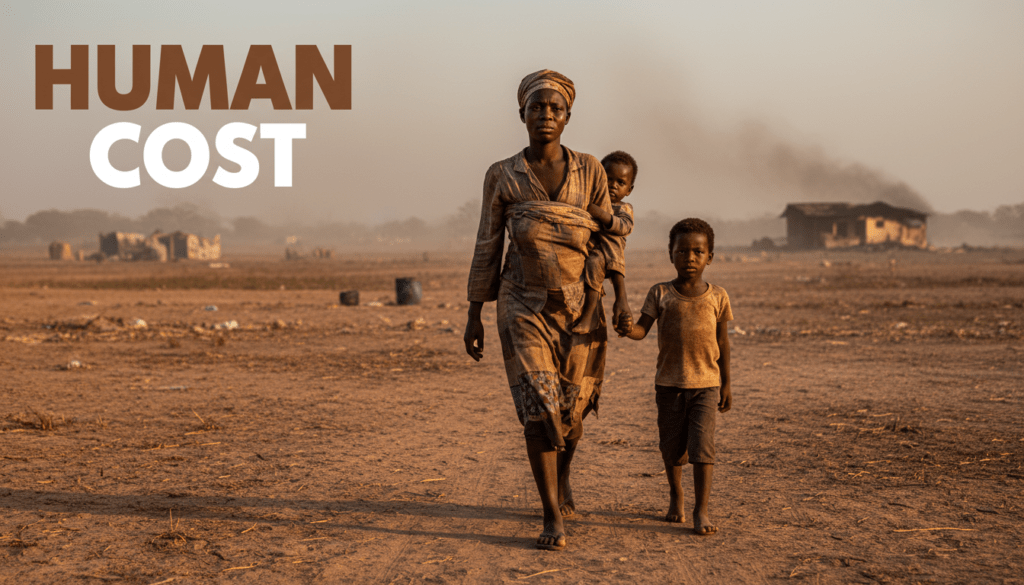
The human cost of the Cabo Delgado insurgency is immense and heartbreaking. Since 2017, the conflict has killed over 6,000 people and displaced more than 1.3 million ((acleddata.com), (unocha.org)). Even with military interventions, the violence persists. In the first five months of 2024 alone, nearly 200,000 people were internally displaced, a number greater than the previous three years combined (iom.int). Approximately 583,000 people, mostly women and children, remain unable to return home (unocha.org). Many families have been uprooted multiple times, living in a constant state of fear and uncertainty. The resilience of Black families is tested daily under these unimaginable conditions.
The humanitarian crisis extends far beyond displacement. Food insecurity is rampant. Across the three northern provinces, 1.6 million people are struggling with hunger due to the combined effects of conflict and climate shocks (wfp.org). The situation is particularly dire in Cabo Delgado, where nearly one million people are food insecure (fscluster.org). Humanitarian agencies use a scale to measure the severity of hunger, and the numbers are alarming. Over 219,000 people are in IPC Phase 4 (Emergency), meaning they face extreme food shortages and high rates of malnutrition ((fscluster.org), (ipcinfo.org)). Another 680,000 are in IPC Phase 3 (Crisis), forced to sell essential assets just to eat ((fscluster.org), (ipcinfo.org)). Displaced families often spend over 75% of their budget on food, a sign of extreme economic distress (impact-initiatives.org).
Food Insecurity in Cabo Delgado
A severe hunger crisis grips the conflict-torn region.
900,034
People Facing Acute Food Insecurity
IPC Phase 3 (Crisis)
680,263 People
IPC Phase 4 (Emergency)
219,771 People
Source: IPC Data, June/December 2024 (fscluster.org)
A Generation Scarred by Violence
Perhaps the most tragic victims of this conflict are the children. Over 60% of those recently displaced are children, many of whom have witnessed horrific violence (savethechildren.net). Their education has been stolen. As of July 2024, 151 schools in Cabo Delgado remained closed due to insecurity, affecting over 50,000 children (unicef.org). These closures not only deny children an education but also leave them more vulnerable. There are widespread reports of grave violations, including the abduction and recruitment of children by armed groups (unicef.org).
The psychological trauma is immeasurable. Children suffer from severe mental distress after seeing their homes burned and loved ones killed. Malnutrition is another silent killer. In 2021, an estimated 33,000 children in the province were severely malnourished (unicef.org). The crisis has created a generation of children who have known little more than war and displacement. The international aid response has been unable to keep up with the scale of the need. For example, the World Food Programme was forced to cut support for hundreds of thousands of people in late 2025 due to funding shortfalls, leaving many vulnerable families with no assistance (wfp.org).
The Impact on Children
The conflict has had a devastating effect on the youth of Cabo Delgado.
60%+
Of Displaced Are Children
151
Schools Remained Closed (July 2024)
50,000+
Children Out of School
Source: UNICEF Data ((unicef.org), (savethechildren.net))
An Uncertain Future Amidst Persistent Threats
Despite the presence of foreign troops, the insurgency remains a persistent and evolving threat. Militants continue to carry out attacks, forcing new waves of displacement. Between November 10 and 23, 2025, an ISIS-linked group killed dozens of civilians in Cabo Delgado and the neighboring Nampula province, displacing approximately 108,000 people in Nampula's Memba district alone (hrw.org). This shows the conflict is not contained. The militants have proven to be resilient, adapting their tactics to survive military pressure.
Meanwhile, TotalEnergies aims to resume its $20 billion LNG project between June and August 2025 (energynews.pro). However, a coalition of NGOs has raised serious alarms, warning that restarting the project without addressing the root causes of the conflict and ensuring community safety is reckless (climatejusticecentral.org). Reports have also surfaced of alleged human rights abuses by the Mozambican military near the project site, adding another layer of complexity (climatejusticecentral.org). The situation in Cabo Delgado is a clear example of how communities across the globe find themselves in shared struggles against oppression, caught between state forces and non-state actors.
The violence in Cabo Delgado is far more than a simple story of terrorism. It is a crisis born from a history of state neglect, ethnic marginalization, and the broken promises of resource wealth. The suffering of its people, especially its children, is a catastrophic human tragedy. Any path toward lasting peace must go beyond a military response. It must address the deep-seated grievances that have fueled this devastating conflict for years. Without justice, development, and inclusion for all of its communities, the cycle of violence in northern Mozambique is likely to continue.
About the Author
Darius Spearman is a professor of Black Studies at San Diego City College, where he has been teaching for over 20 years. He is the founder of African Elements, a media platform dedicated to providing educational resources on the history and culture of the African diaspora. Through his work, Spearman aims to empower and educate by bringing historical context to contemporary issues affecting the Black community.
