

Can the New ECOWAS Army Stop Terror Across West African Borders?
By Darius Spearman (africanelements)
Support African Elements at patreon.com/africanelements and hear recent news in a single playlist. Additionally, you can gain early access to ad-free video content.
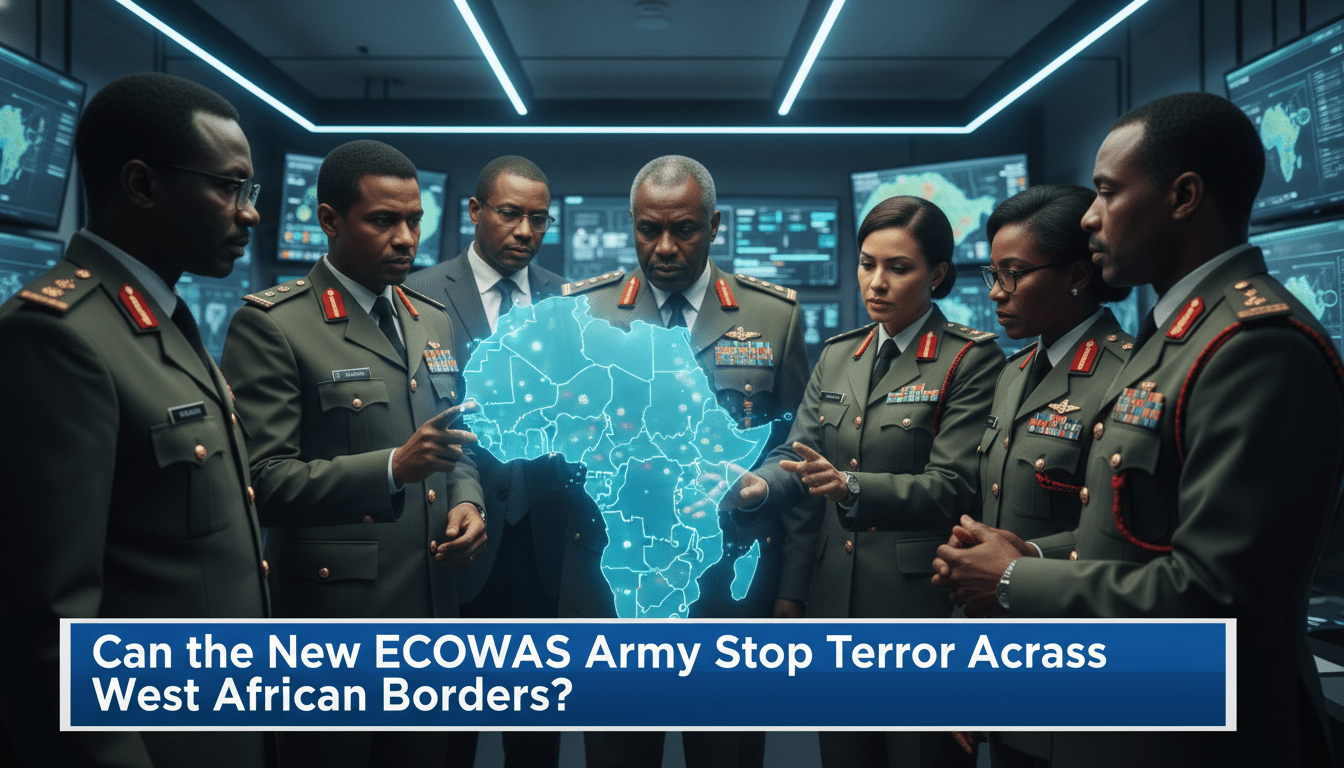
West African leaders gathered in Freetown, Sierra Leone, in early 2026 to solve a massive security puzzle. They finalized a plan for a new regional army to fight growing threats. This meeting focused on two main problems: who will patrol the dangerous borders and who will pay for the troops (africa-press.net). The Economic Community of West African States, known as ECOWAS, is trying to fix a security gap that has existed for decades. This effort comes at a time when military coups and violent groups have split the region apart. The current administration of President Donald Trump is watching these shifts closely as global alliances change (trtworld.com).
The plan calls for an initial force of 2,000 soldiers to be ready by the end of 2026 (myjoyonline.com). These troops are intended to act quickly against terrorist attacks and illegal takeovers of government. However, the history of such efforts shows that promises on paper do not always lead to action on the ground. For decades, the region has struggled to balance the needs of different nations with the goal of a united defense. Many people in the African diaspora see these struggles as part of a long fight for justice and freedom from outside control.
The Massive Funding Gap
Proposed vs. Current Military Budgets (Millions USD)
A History of Regional Intervention
The idea of a West African army is not a new concept. It started over forty years ago when leaders realized that economic growth needs a peaceful environment (britannica.com). ECOWAS was founded in 1975 to help member states trade more easily and grow their economies. But the leaders soon saw that internal wars and outside attacks could destroy their hard work. In May 1981, they signed a major agreement in Freetown called the Protocol on Mutual Defence Assistance (britannica.com). This document laid the groundwork for an allied force that could protect any member state under attack.
The most famous version of this force was the ECOWAS Monitoring Group, or ECOMOG. It was formed in 1990 to step into the brutal civil war in Liberia (britannica.com). This was a historic moment because it was the first time a regional group in Africa decided to intervene in a member state’s conflict. ECOMOG later went to Sierra Leone in 1997 and Guinea-Bissau in 1999. These missions were often led by Nigeria, which provided most of the soldiers and the money (leadership.ng). While ECOMOG helped bring peace, it also faced criticism for human rights issues and the high cost of life.
After the wars of the 1990s, ECOWAS tried to make their security plans more permanent. In 1999, they created a new mechanism for conflict prevention and peacekeeping (youtube.com). This led to the creation of the ECOWAS Standby Force. The goal was to have troops ready to deploy at a moment’s notice. However, the system relied heavily on western partners like the European Union for money (europa.eu). This dependence often slowed down the response time when crises hit the region. Today, leaders want to move toward economic independence to fund their own safety (apanews.net).
The Battle Over Patrol and Pay
The recent meetings in Freetown highlight a major split among West African nations. Nigeria has historically carried the heaviest burden for regional security (leadership.ng). Between 70 and 80 percent of intervention personnel usually come from the Nigerian military. Because of this, Nigeria has a large say in how the region is patrolled. In 2025, Nigeria nearly doubled its defense spending to $2.29 billion to maintain its leadership role (statehouse.gov.ng). Other leaders now argue that every nation must contribute real assets instead of just making promises on paper (africa-press.net).
Smaller states like Togo and Sierra Leone are now taking on leadership roles to balance Nigeria’s power. For example, Brigadier General Sheik Sulaiman Massaquoi of Sierra Leone was appointed as the Chief of Staff for the new force (africa-press.net). He will lead the arrangement from 2026 until 2029. After that, Togo is scheduled to take over the command. This rotation is meant to ensure that no single country dominates the regional army. Still, the question of “who patrols” is tied to the geographical location of the threats, which are mostly in the north and along the coast.
Paying for this 5,000-man brigade is the biggest obstacle. The estimated annual cost for the full force is a staggering $2.61 billion (apanews.net). ECOWAS uses a system called the Community Levy to raise money. This is a 0.5 percent tax on goods brought into the region from outside countries (apanews.net). This levy provides about 98 percent of the regular budget for the ECOWAS commission and parliament. But military operations are much more expensive than office work. Many member states are currently behind on their payments, which makes the plan for a self-funded army look very difficult.
West Africa: The Global Epicenter of Terrorism
In 2024, West Africa accounted for over half of all global deaths related to terrorism (aa.com.tr).
The Threat of Jihadist Insurgencies
The urgency of the new army plan comes from a massive rise in violence. West Africa has become the global center for terrorist deaths (aa.com.tr). In 2024, more than half of all people killed by terrorists worldwide were in this region. Groups like Boko Haram have caused terror in the Lake Chad Basin for years (worldnewworld.com). In 2015, Boko Haram was named the deadliest terrorist group in the world. They have killed over 27,000 people and displaced millions more from their homes.
Other groups have also gained strength in the Sahel region. The group known as JNIM is the Al-Qaeda branch in the Sahel. It is responsible for over 60 percent of militant attacks in that area since 2017 (worldnewworld.com). Another dangerous group is the Islamic State in the Greater Sahara, or ISGS. They operate in the borders between Mali, Burkina Faso, and Niger (worldnewworld.com). These groups target both the military and innocent civilians. The violence has forced 6.1 million people to leave their homes and seek safety elsewhere (tacticsinstitute.com).
The spread of this violence is moving toward the coastal countries. Nations like Togo, Benin, and Ghana are now seeing attacks on their northern borders (medafricatimes.com). This “spillover” is why coastal leaders are so eager to start the new regional army. They want a force that can act before the terrorists gain a foothold in their countries. Many of these nations are also trying to remove colonial influences from their security structures. They believe that an African-led force will be more effective than relying on foreign troops from Europe or America.
A Region Divided: The Sahel Schism
The push for a new ECOWAS army is complicated by a major political split. In 2024, three countries—Mali, Burkina Faso, and Niger—decided to leave ECOWAS (trtafrika.com). They formed their own group called the Alliance of Sahel States, or AES. These countries have military governments that took power through coups. They claimed that ECOWAS was no longer serving the interests of the people. Instead, they accused the bloc of being a tool for Western powers like France (trtworld.com). This split has created a massive gap in the regional security wall.
The AES countries are right in the middle of the terrorist conflict. Burkina Faso is now considered the country most affected by terrorism in the world (aa.com.tr). By leaving ECOWAS, these nations have made it harder to coordinate military actions against the jihadists. The AES has even started its own unified force of 5,000 soldiers (trtworld.com). Now, there are two different regional armies trying to operate in the same area. This creates a risk of confusion or even conflict between the two groups of soldiers.
This division is also an economic problem. Mali, Burkina Faso, and Niger are landlocked, meaning they have no coast. They rely on ECOWAS countries like Togo and Nigeria to reach the ocean for trade (malawiace.com). When they left ECOWAS, they lost many trade benefits and faced harsh sanctions. Many people in these countries saw the sanctions as a punishment that hurt poor citizens (trtworld.com). This has fueled a sense of anger and a desire for total sovereignty. These political tensions make it very hard to decide who will patrol the borders between the two blocs.
The 2026 Troop Deployment Goal
Initial Troops
Target: 5,000 by 2027
The Human Cost and Human Rights
The new army plan is not just about soldiers and maps. It is about the lives of millions of people who live in fear. Many citizens supported the military coups in Mali and Niger because they felt the democratic governments had failed to protect them (trtworld.com). They saw the military takeovers as a way to prioritize security. However, military rule often leads to fewer freedoms and more human rights abuses. This is why the new ECOWAS force has added rules about protecting civilians into its training (africaintelligence.com).
The ECOWAS Community Court of Justice is a key place where citizens can fight for their rights. It allows people to sue the regional body or their own governments if their rights are violated (youtube.com). This is a vital safeguard as the regional army prepares for “preemptive” action. Preemptive action means the army could intervene before a coup or an attack even happens. While this sounds good for safety, critics worry it could be used to keep unpopular leaders in power. The court must remain strong to ensure the army serves the people and not just the politicians.
The instability in West Africa also has a global reach. There is a “new diaspora” of people fleeing the violence and seeking safety in other parts of the world (worldnewworld.com). In recent years, more West Africans have traveled through South and Central America to reach the United States border. This migration is a direct result of the lack of security in the Sahel region. For those in the diaspora, the struggle of West African nations to find peace is a deeply personal issue. It connects to the shared cultural heritage and the ongoing search for a stable homeland.
A Rapid Response for the Future
The transition from a “standby” force to a “rapid intervention” force is the most significant change in the 2026 plan. The old system was too slow to stop modern threats. On December 7, 2025, ECOWAS showed how the new system might work. They quickly sent Nigerian fighter jets and troops to the Republic of Benin to stop a coup attempt (africansecurityanalysis.org). This fast response showed that the bloc is serious about protecting constitutional order. By moving quickly, they hope to prevent long civil wars like those seen in the past.
The success of the new ECOWAS army will depend on the “patrol and pay” details worked out in Freetown. If nations do not pay their share of the Community Levy, the force will remain underfunded. If they do not contribute their best soldiers, the patrols will be weak. The region stands at a crossroads between unity and further division. As West African leaders look toward 2027, they must overcome deep-seated arguments to build a force that truly protects the people. The world is watching to see if this latest iteration of the regional army can finally bring the stability that has been missing for so long.
About the Author
Darius Spearman is a professor of Black Studies at San Diego City College, where he has been teaching for over 20 years. He is the founder of African Elements, a media platform dedicated to providing educational resources on the history and culture of the African diaspora. Through his work, Spearman aims to empower and educate by bringing historical context to contemporary issues affecting the Black community.
