
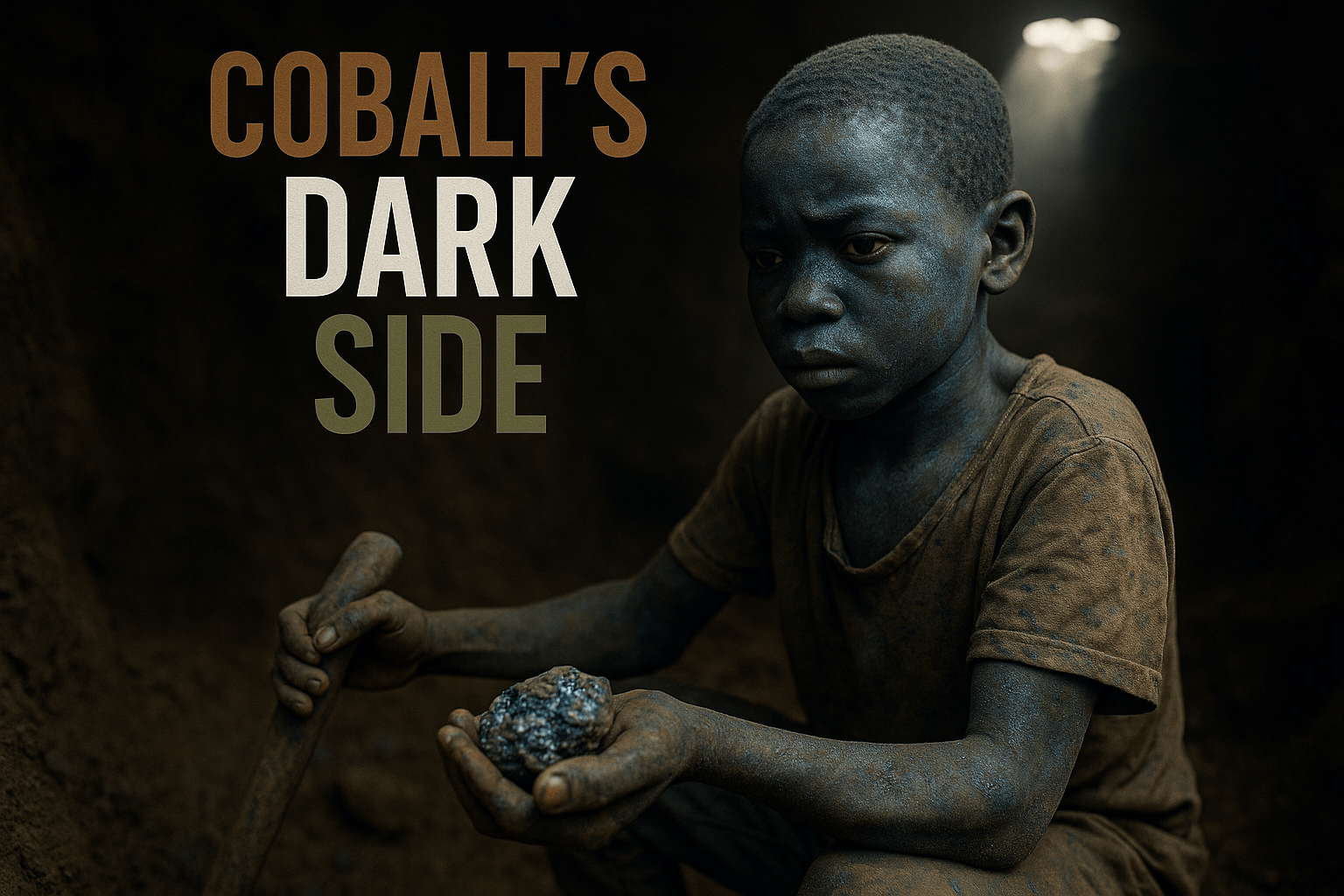
Cobalt’s Dark Side: A Call for Justice in the DRC
By Darius Spearman (africanelements)
Support African Elements at patreon.com/africanelements and hear recent news in a single playlist. Additionally, you can gain early access to ad-free video content.
The Democratic Republic of Congo (DRC) holds a vital position in the global economy. It is the world’s leading producer of cobalt, a critical metal essential for modern technology. Cobalt is a silvery-blue element that plays a crucial role in the rechargeable batteries powering our smartphones, computers, and electric vehicles. The demand for these technologies continues to grow rapidly, making the DRC’s cobalt reserves incredibly valuable. However, this mineral wealth comes at a devastating human cost. Its extraction is deeply linked to significant humanitarian issues, including widespread child labor and extremely hazardous working conditions for many Congolese people.
The DRC accounts for over 50 percent of the world’s cobalt reserves. Furthermore, it produces more than 70 percent of the global cobalt supply (dol.gov; dol.gov). This dominance means that the choices made in the DRC’s mining sector have a profound impact on global supply chains. A large portion of this cobalt production comes from artisanal and small-scale mining (ASM). In these mines, thousands of children work in dangerous environments, often using basic tools and without any protective gear (dol.gov). The exploitation of these vulnerable workers, particularly children, represents a severe human rights crisis that demands urgent attention and action from the international community.
The Cobalt Crisis in the DRC
The Democratic Republic of Congo is undeniably the heart of the global cobalt supply. This nation holds more than half of the world’s known cobalt reserves. Moreover, it supplies nearly three-quarters of the cobalt used worldwide (dol.gov). This makes the DRC an indispensable player in the rapidly expanding market for electric vehicles and portable electronics. Cobalt, a key component in lithium-ion batteries, is vital for the energy transition away from fossil fuels. Its importance is only set to increase as global demand for these technologies continues to surge (dol.gov).
The history of the DRC is unfortunately marked by exploitation, dating back to the 1880s when Belgium’s King Leopold II brutally forced Congolese people to extract rubber, ivory, and minerals. This painful past casts a long shadow over the present-day cobalt industry. Today, a significant portion of cobalt extraction occurs in what is known as artisanal and small-scale mining (ASM). Unlike large industrial mines that use heavy machinery, ASM operations rely on manual labor. Miners often dig by hand, using rudimentary tools, in unregulated and highly dangerous conditions. These informal mines account for 15 to 30 percent of the DRC’s cobalt production. This informal sector is where the most severe human rights abuses, including child labor, are concentrated. The lack of proper oversight and regulation in these areas allows exploitation to flourish, perpetuating a cycle of poverty and suffering for many Congolese families.
The Scourge of Child Labor
Child labor is a pervasive and deeply disturbing issue within the DRC’s artisanal cobalt mining sector. Children as young as 5 years old, and up to 17, are forced to work in these dangerous mines across the country (dol.gov; humanium.org). These young workers often receive no payment for their grueling efforts. They are exploited, sometimes required to crawl into small, unstable holes, making the work frequently fatal (ipsnews.net). The conditions are dire, with children using only their hands or basic tools, completely unprotected from the inherent dangers of mining (humanium.org).
The health consequences for these child miners are severe and long-lasting. Exposure to cobalt dust and fumes can lead to serious respiratory problems, including a condition known as “hard metal disease,” which is a type of interstitial lung disease (CDC). Asthma and various skin conditions, such as dermatitis, are also common among those exposed to cobalt (CDC). The severity of these health issues depends on the level and duration of exposure. However, for children working in these mines for extended periods, the risks are incredibly high. The Agency for Toxic Substances and Disease Registry (ATSDR) provides detailed information on these health effects, highlighting the grave dangers faced by miners (ATSDR; ATSDR). Many companies that source cobalt from the DRC lack strict policies regarding transparency. They often do not fully disclose how the cobalt is extracted, by whom, or how it is transported. This lack of transparency contributes significantly to the ongoing problem of child labor and makes it difficult to hold responsible parties accountable (humanium.org).
DRC’s Dominance in Global Cobalt Production
Understanding Artisanal Mining
Artisanal and small-scale mining (ASM) refers to mining operations that are typically low-tech, labor-intensive, and often informal or unregulated. Unlike large industrial mines that employ vast machinery and structured processes, ASM relies heavily on manual labor. Miners use basic tools like shovels, picks, and buckets to extract minerals from the earth. This distinction is crucial because ASM operations often lack the safety protocols, environmental controls, and labor protections found in larger, more formalized mining companies. The informal nature of ASM makes it particularly vulnerable to exploitation and human rights abuses, including the widespread use of child labor.
While the conditions are dangerous, artisanal mining can surprisingly offer a better income source for populations with limited education and qualifications. Miners in the DRC can earn around 2.7 to 3.3 U.S. dollars per day (ipsnews.net). This is significantly higher than the national average, where about 73 percent of the population lives on 1.90 U.S. dollars or less per day (ipsnews.net). However, even with these comparatively higher wages, miners still struggle to make ends meet. The economic desperation drives many, including children, into these hazardous jobs. Furthermore, armed groups often control many artisanal mining operations. These groups use the profits from mineral trading to fund weapons and fighters, exacerbating the long-standing conflict and instability in the region. The DRC has experienced violence from around 120 armed groups and security forces for the past two decades, making the situation even more complex and dangerous for local communities.
Global Efforts to Combat Exploitation
Despite the deeply entrenched challenges, significant efforts are underway by international organizations to address child labor and improve working conditions in the DRC’s cobalt industry. The U.S. Department of Labor’s COTECCO project is one such initiative. This project actively works to reduce child labor and enhance working conditions within artisanal and small-scale mines that feed into the cobalt supply chain in the DRC (dol.gov). These efforts are crucial for creating a more ethical and sustainable mining sector.
The International Labour Organization (ILO) has also launched impactful projects, building on previous efforts. The ILO’s Global Accelerator Lab (GALAB) project aims to strengthen accountability among both public and private actors. It also promotes fundamental rights and decent work conditions throughout supply chains (ilo.org). GALAB includes vital initiatives like the Child Labour Monitoring and Remediation System (CLMRS). This system registered over 6,200 children involved in mining in the Haut-Katanga and Lualaba provinces in 2024 alone (ipsnews.net). Additionally, GALAB is working to train more labor and mining inspectors. This training will help monitor conditions and practices more effectively across the DRC, ensuring better enforcement of labor laws and protections for workers. These coordinated efforts by international bodies are essential steps toward mitigating the humanitarian crisis fueled by cobalt demand.
Children Registered in Child Labour Monitoring and Remediation System (CLMRS)
The Path Forward: Partnership and Accountability
Finding a lasting solution to the cobalt crisis in the DRC is complex. Simply shutting down artisanal mining operations is not a viable answer. Mining provides a significant source of income for many Congolese people living in extreme poverty. Without alternative livelihoods, closing these mines would only push more families into deeper destitution. The challenge lies in transforming these dangerous, informal operations into safe, regulated, and ethical sources of income. This transformation requires a multi-faceted approach, addressing both the humanitarian and economic dimensions of the problem.
Stricter laws and regulations are essential to curb exploitation and ensure fair labor practices. Many humanitarian organizations, including the United Nations (UN) and the International Labour Organization (ILO), strongly advocate for such changes. The UN has maintained a consistent presence in the DRC since its independence, deploying peacekeepers and launching initiatives to combat illegal mineral trading. The UN Children’s Fund (UNICEF) also works tirelessly to help children caught in humanitarian crises. Pétronille Vaweka, a Congolese peace mediator, powerfully stated that the world’s economies and new technologies are increasing demand for rare minerals in the eastern Congo. She emphasized that the world is allowing criminal organizations to brutalize her people by stealing and selling these minerals. She believes that ending this criminality requires a global awakening and a strong partnership between Africans and Americans, as well as other developed countries. The path to justice and sustainable development in the DRC’s cobalt sector requires continued international support, robust local governance, and a commitment to transparency and human dignity throughout the supply chain.
Daily Income Comparison: Artisanal Miners vs. DRC Population
The legal framework in the DRC allows children aged 15 and older to perform light work, but this provision is often misused. The core issue is not light work, but rather forced labor and hazardous conditions imposed on children far younger than 15. The lack of effective enforcement of existing laws allows these abuses to continue unchecked. Recent developments, such as the DRC’s consideration of a cobalt export ban and a potential quota system, highlight the government’s attempts to gain more control over the industry. These measures could potentially improve working conditions and transparency, but their effectiveness will depend on rigorous implementation and international cooperation. Ultimately, addressing the cobalt crisis requires a collective commitment from governments, corporations, and consumers to demand ethical sourcing and support initiatives that protect the most vulnerable. This is not merely an economic issue; it is a profound moral imperative to ensure that the pursuit of technological advancement does not come at the cost of human dignity and childhood.
The call for action is clear. As Vaweka stated, “We need an awakening of the world now to do the same in Congo.” This awakening requires the United Nations, the African Union, neighboring countries, and especially America as a leader, to work together. The goal is to replicate successes seen in places like Sierra Leone and Liberia, where similar conflicts fueled by resources were eventually halted. This demands a sustained partnership, where the international community supports African leadership in bringing peace and justice to the DRC. Only through such concerted efforts can the humanitarian crisis linked to cobalt mining be truly addressed, ensuring a future where technology is powered by ethical means, not by the exploitation of children and vulnerable communities.
The story of cobalt in the DRC is a stark reminder of the interconnectedness of global supply chains and human rights. As consumers, our choices have power. Supporting companies committed to ethical sourcing and advocating for stronger regulations can contribute to positive change. For the people of the DRC, particularly the children trapped in these mines, the time for action is now. Their future depends on the world’s willingness to prioritize human dignity over profit, and to ensure that the minerals powering our modern world are extracted without fueling a humanitarian catastrophe.
The struggle for justice in the DRC’s cobalt mines is a fight for the rights and dignity of Black people. It is a fight against the historical and ongoing exploitation of African resources and labor. The children toiling in these mines are part of the global African diaspora, and their plight is a testament to the continued need for vigilance and advocacy against systemic injustices. Their voices, though often silenced, echo a powerful call for freedom, safety, and a future where their lives are valued above the minerals beneath their feet. It is our collective responsibility to answer that call.
ABOUT THE AUTHOR
Darius Spearman has been a professor of Black Studies at San Diego City College since 2007. He is the author of several books, including Between The Color Lines: A History of African Americans on the California Frontier Through 1890. You can visit Darius online at africanelements.org.
