
Listen to this article
Download AudioColtan’s Cost: Blood in the Soil
By Darius Spearman (africanelements)
Support African Elements at patreon.com/africanelements and hear recent news in a single playlist. Additionally, you can gain early access to ad-free video content.
The Price of Progress: Coltan’s Dark Side
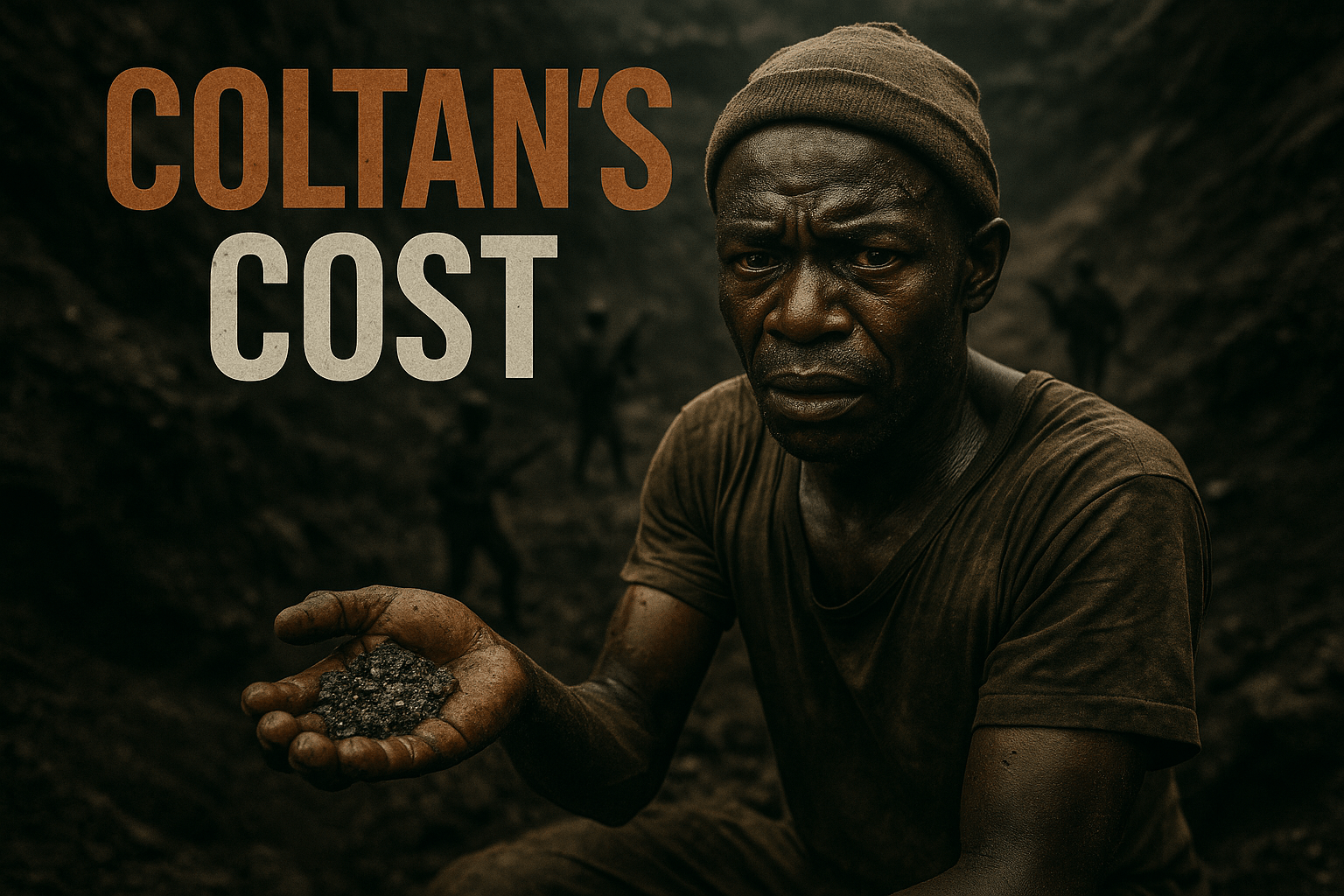
The demand for coltan, a vital mineral for our electronics, has a devastating impact on the Democratic Republic of Congo (DRC). This mineral, essential for smartphones and laptops, fuels violence and human rights abuses (civicus.org). The eastern provinces of Kivu and Tanganyika are particularly affected, where coltan mining intensifies conflict and insecurity (civicus.org).
The Rubaya mine in North Kivu, which produces over half of the DRC’s coltan, is a hotbed of tension. Ethnic armed groups and illegal coltan traders frequently clash there (civicus.org). The M23 rebel group, among others, is stealing minerals like coltan, lithium, cobalt, and zinc, using them to fund their violence and disrupt global supply chains (europarl.europa.eu). For many communities in the DRC, mining has become the only way to survive, forcing them into dangerous artisanal mining conditions (africasacountry.com).
What is Coltan?
Coltan is a metallic ore, short for columbite-tantalite. It is the source of the elements niobium and tantalum. Tantalum is a vital component in capacitors found in electronic devices like smartphones and laptops. The Democratic Republic of Congo holds significant coltan reserves. (ipisresearch.be)
Exploitation and Danger in the Mines
Coltan mining in the DRC is marked by widespread illegality, forced labor, and dangerous conditions. These factors lead to severe human rights violations. Armed groups force people to work, demand illegal taxes, and control access to mines (civicus.org). They create a climate of fear for miners. The military also extorts money from miners at these sites (civicus.org).
Miners work in extreme physical conditions without protection. This leads to frequent fatal accidents. For example, a mine collapse at the Rubaya mine on June 19 killed 12 people (reuters.com). Despite laws against it, pregnant women and children still work in the mines. Poverty and weak enforcement of regulations drive them to these dangerous jobs (civicus.org). Over 40,000 child miners continue to work illegally in dangerous conditions, including as washers and diggers (globalforestcoalition.org). The exploitation of coltan mines has led to severe human rights abuses, fueling a cycle of poverty and violence (globalforestcoalition.org).
Who is the M23 Rebel Group?

The M23 rebel group is a major player in the ongoing conflict in eastern DRC. They are known for capturing key cities like Goma, which they did in January 2025 with support from the Rwandan Defence Forces (ipisresearch.be). Their actions are often linked to controlling mineral resources and have worsened the humanitarian crisis. Illicit mineral supply chains are fueling their insurgency (atlanticcouncil.org).
Humanitarian Crisis and Displacement
The conflict in eastern DRC, fueled by mineral exploitation, has led to a severe humanitarian crisis. This includes mass displacement of people. The DRC faces one of Africa’s largest displacement crises, with 6.7 million internally displaced persons (europarl.europa.eu). Of these, 4.6 million are in South and North Kivu (europarl.europa.eu).
The recent surge in violence has displaced over half a million people since the beginning of the year (europarl.europa.eu). Overcrowding in displacement sites and a lack of infrastructure increase the risk of cholera and Mpox outbreaks (europarl.europa.eu). The European Union has pledged 60 million Euros for 2025 to boost emergency assistance, especially for newly displaced populations around Goma (europarl.europa.eu).
Controversial International Agreements
International agreements concerning minerals in the DRC are controversial. They raise concerns about their effectiveness and potential to worsen existing problems. On June 27, the DRC signed a peace agreement with Rwanda (civicus.org). This was part of a broader deal with the Trump administration, promising US access to Congolese coltan in exchange for help in quelling armed rebellions (civicus.org).
A controversial agreement signed in February 2024 between the EU and Rwanda regarding strategic minerals is problematic (civicus.org). Rwanda has little to no coltan reserves, suggesting it acts as a conduit for minerals from the DRC (civicus.org). The European Parliament has questioned the EU-Rwanda memorandum of understanding. They suggest an immediate embargo on minerals labeled as Rwandan origin to pressure Rwanda to withdraw its troops and the M23 Movement from the DRC (europarl.europa.eu). Concerns exist that money from these agreements could increase corruption among the Congolese political elite. This could also keep the DRC dependent on unprocessed raw materials (civicus.org).
What is Artisanal Mining?

Artisanal mining refers to small-scale, often informal mining operations. Individuals or small groups carry out these operations using basic tools and methods. While it provides a livelihood for many, it is often linked to dangerous working conditions, environmental damage, and human rights abuses, including child labor (globalforestcoalition.org).
The Challenge of Supply Chain Transparency
Ensuring conflict-free coltan in international supply chains is a major challenge. Regulations like the Dodd-Frank Act and OECD guidelines aim to promote ethical sourcing (atlanticcouncil.org). However, the reality on the ground is complicated. Companies are urged to conduct due diligence. Yet, the widespread illicit mineral trafficking and the difficulty in tracing minerals from artisanal mines make verification hard (atlanticcouncil.org).
A UN report found that a major Rwandan coltan exporter, Boss Mining, bought smuggled Congolese minerals (reuters.com). Boss Mining has a concession in Rwanda where it mines wolframite. However, that area does not have major coltan mining sites, suggesting the coltan it exports comes from elsewhere (reuters.com). An investigation suggests that EU trader Traxys may be buying conflict minerals from the DRC (globalwitness.org). Some of its named suppliers have a history of sourcing minerals from areas where no actual mining occurred or buying conflict minerals (globalwitness.org).
Civil Society’s Role in Change
Civil society organizations in the DRC are working to improve the mining sector. They use advocacy, training, and site assessment. These organizations advocate with state authorities to improve living conditions for artisanal miners (civicus.org). They also work to clean up supply chains and expose irregularities (civicus.org).
These groups invest in training mining operators on the mining code. They also help set up cooperatives to professionalize artisanal mining (civicus.org). Civil society organizations participate in assessment missions to identify risks at mining sites. These risks include exploitation, security, human rights, and environmental impact (civicus.org). Their efforts are crucial in pushing for more responsible practices in the coltan industry.
ABOUT THE AUTHOR
Darius Spearman has been a professor of Black Studies at San Diego City College since 2007. He is the author of several books, including Between The Color Lines: A History of African Americans on the California Frontier Through 1890. You can visit Darius online at africanelements.org.
