

DeAundre Hill: Why Wichita Demands Full Police Body Cam Footage
By Darius Spearman (africanelements)
Support African Elements at patreon.com/africanelements and hear recent news in a single playlist. Additionally, you can gain early access to ad-free video content.
The Midnight Encounter at Brickstone Apartments
On the night of January 20, 2026, the quiet atmosphere of the Brickstone Apartments in Wichita, Kansas, was shattered by a lethal encounter. Officers from the Wichita Police Department arrived at the complex after receiving a disturbance call at approximately 12:47 a.m. (youtube.com, apnews.com). The report suggested a verbal dispute between a man and a woman. Within minutes, DeAundre Hill, a 27-year-old resident, lay dead after being shot nine times by a responding officer (youtube.com, communityvoiceks.com).
The official police narrative describes a scene where officers knocked and announced their presence multiple times. They claim that DeAundre Hill exited his apartment while pointing a handgun at them. According to the department, the officer fired in self-defense. However, this version of events is based on a very short, five-second clip of body camera footage released to the public (apnews.com, communityvoiceks.com). This brief glimpse has not satisfied those who knew Hill. They argue that a five-second video cannot possibly explain the full context of a life taken so abruptly.
The community response was immediate and filled with grief. Family members and advocates quickly pointed out that Hill was a legal gun owner with no felony record. They believe he may have been acting as a protector, investigating a loud and suspicious knock at his door in the middle of the night (youtube.com, communityvoiceks.com). This clash of perspectives has turned Wichita into a focal point for the national conversation on police transparency and accountability.
The Battle for Complete Transparency
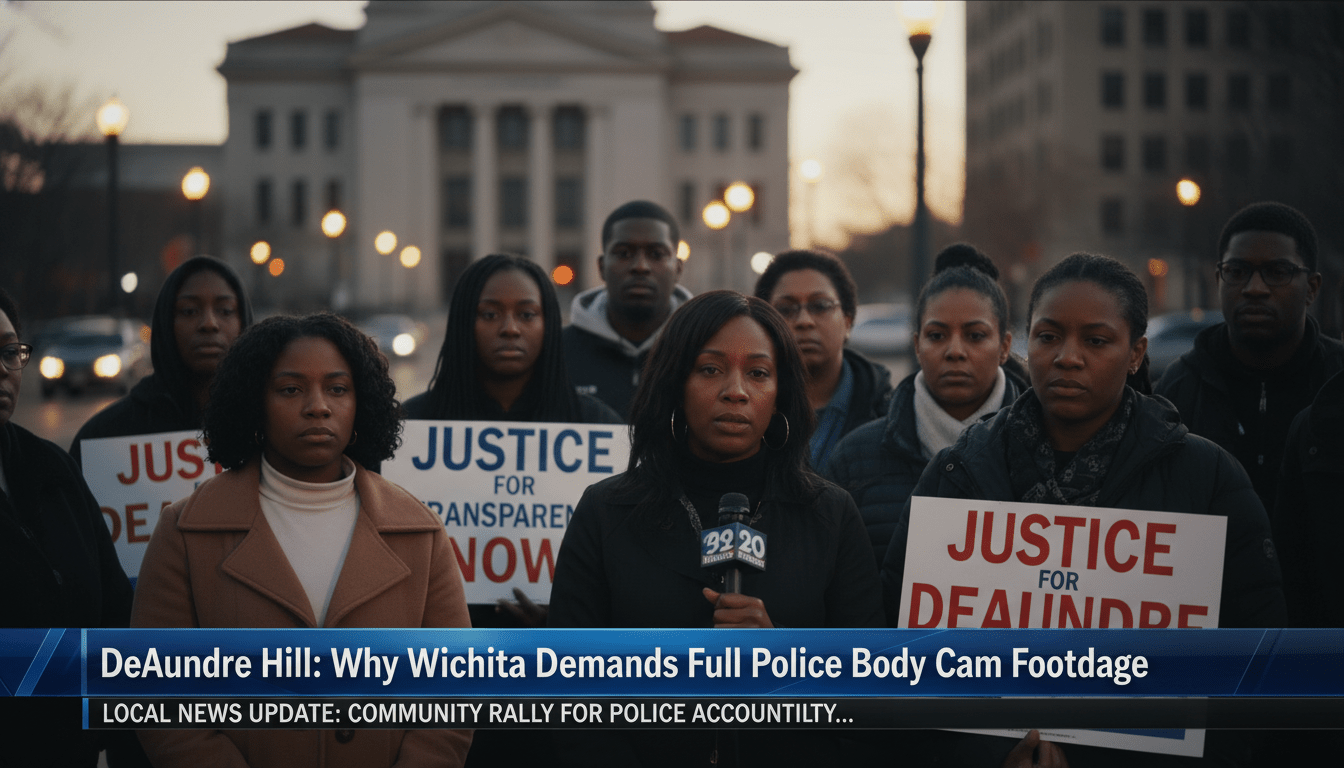
By February 10, 2026, the frustration of the community reached the halls of the Wichita City Council. Family members and advocates like Helen Riker, a leader in the “Exposing Wichita” initiative, stood before local leaders to voice their demands (youtube.com, youtube.com). Their message was clear: the public deserves to see more than a curated snippet of the encounter. They called for the release of all body camera footage from every officer present at the scene. They also demanded the full 911 call and all dispatch recordings (youtube.com, youtube.com).
The request for fuller body camera release is not merely about curiosity. It is about the fundamental right of a community to oversee those who are sworn to protect it. Speakers at the council meeting described the current release as “sketchy” and designed to favor the police narrative. They argued that by withholding the full video, the city is engaging in a form of storytelling rather than fact-sharing. They believe that an unflinching investigation is impossible if the investigators control what the public is allowed to see (youtube.com, youtube.com).
Under the current administration of President Donald Trump, discussions regarding federal oversight of local police departments remain a critical issue for civil rights organizations. These advocates seek to understand why certain pieces of evidence are kept hidden for months or even years. They argue that transparency is the only way to heal the rift between the police and Black residents. Without it, the cycle of suspicion and anger will continue to grow in Kansas and beyond.
A History of Friction and the Finch Case
The skepticism surrounding the death of DeAundre Hill does not exist in a vacuum. It is deeply rooted in a history of controversial incidents involving the Wichita Police Department. One of the most painful memories for the city is the 2017 death of Andrew Finch. Finch was an unarmed man who was killed by a police sniper after a “swatting” prank (apnews.com, apnews.com). A “swatting” call involves making a false report to emergency services to draw a massive, armed police response to a specific location (cbsnews.com).
In the Finch case, a dispute over a very small amount of money in an online video game led to a fake hostage report. The officer who fired the shot, Justin Rapp, was never criminally charged and was even promoted later (cbsnews.com). For many in the Wichita community, this outcome sent a message that officers would not be held accountable for taking a life, even when the victim was completely innocent. This history shapes how the community views every new shooting today.
The legacy of these incidents has created what many describe as a “culture of impunity.” Reports from the U.S. Commission on Civil Rights going back to the late 1970s noted that police-community relations in Wichita were poor (usccr.gov). For decades, the Black community has lived with a sense that the rules for police conduct are different when they are the ones being policed. The shaping of political dynamics within the city often revolves around these recurring themes of justice and safety.
Legal Gatekeeping and Kansas Law
A major obstacle to transparency in Wichita is a specific provision of the Kansas Open Records Act known as K.S.A. 45-254. This law classifies body-worn camera and vehicle recordings as “criminal investigation records” (kslegislature.gov, kautschlaw.com). Because of this classification, police departments have the power to keep these recordings hidden from the public for as long as an investigation is considered “pending.” This can mean that footage is not seen for years, or in some cases, never at all.
Advocates argue that this law serves as a gatekeeping tool. It allows law enforcement agencies to control the flow of information and protect their own interests (kautschlaw.com, planetavenus.online). While the law was intended to protect the integrity of investigations, critics say it is often used to “spin” a narrative before the public has a chance to see the evidence. Even family members of those killed by police must navigate a complex and often expensive process just to view the final moments of their loved ones (kslegislature.gov).
The city of Wichita has been a pioneer in using body cameras, having started its program as early as 2011 (wichita.gov). However, having the technology is not the same as being transparent. In 2021, a judge even ruled that the city acted in “bad faith” by withholding footage from two high-profile incidents (thebeaconnews.org). This legal battle highlights the ongoing struggle between the public’s right to know and the department’s desire for secrecy. The struggle for basic rights remains a constant theme in the Black experience within the legal system.
The Disturbance Call and the Nine Warnings
To understand the DeAundre Hill case, one must look closely at the timeline of the encounter. The police arrived after a “disturbance call,” which is a broad term used for various disruptions of public peace. In this instance, it was a reported domestic dispute involving a crying female (youtube.com, apnews.com). When officers arrived at 1:02 a.m., they began a process of knocking and identifying themselves. Over a period of about 90 seconds, they identified themselves as Wichita Police nine times (youtube.com, apnews.com).
During this time, Hill was inside his apartment. He was heard on dispatch recordings telling someone else inside to get a gun (apnews.com, communityvoiceks.com). At 1:04 a.m., the door opened, and Hill stepped out. Just five seconds after he appeared, he was shot nine times. The police focus on the “nine warnings” as proof that they were patient and clear. However, advocates argue that these warnings were given while a door was closed in the middle of the night. They question whether Hill truly knew who was outside or if he felt his home was under attack by criminals (youtube.com, communityvoiceks.com).
The speed of the shooting is a point of major concern. If Hill was a legal gun owner trying to protect his home, the rapid use of lethal force raises serious questions about training and de-escalation. The community asks why the officers did not move to a safer position or use other methods to communicate. They believe the “nine warnings” are being used to justify an outcome that was decided in just a few seconds once the door opened (youtube.com, youtube.com).
The Second Amendment Paradox
Kansas is known for its strong support of firearm rights. The state has laws that allow for “Stand Your Ground” and “Castle Doctrine” protections. These laws generally say that a person has the right to use force, including lethal force, to defend their home from an intruder. However, for Black gun owners like DeAundre Hill, these rights often seem to vanish when the police are involved (communityvoiceks.com). This creates a dangerous paradox where owning a gun for safety can actually lead to a fatal encounter with the state.
In many police-involved shootings, the mere presence of a gun is used as the primary justification for lethal force. Officers describe a “reasonable fear” for their lives the moment they see a weapon. In the Hill case, police emphasized that he was holding a handgun (youtube.com, apnews.com). Yet, Hill was in his own home and had no criminal history that would prevent him from owning a gun. Advocates argue that if Hill were white, the police might have been more likely to view him as a homeowner defending his property rather than a threat to be neutralized.
This double standard is a central theme in modern civil rights activism. It highlights how the law is applied differently based on the race of the individual. The resilience of kinship in Black communities is often tested by these tragedies. When a family member is killed while exercising a constitutional right, it sends a wave of fear through the entire community. It suggests that for some citizens, the Second Amendment does not provide protection, but instead provides a reason for police to shoot.
The SWAT Team Text Scandal and Oversight
The lack of trust in the Wichita Police Department is also fueled by recent internal scandals. In 2022, an independent report was released after a “SWAT team text scandal” came to light (thebeaconnews.org). Officers were found to have exchanged racist, homophobic, and sexist messages. These messages included images mocking the death of George Floyd and celebrating police violence. This discovery confirmed the worst fears of many residents regarding the internal culture of the department.
The report also criticized the department for “botched investigations” and “poor oversight” (thebeaconnews.org). It suggested that the department was more interested in protecting its image than in disciplining officers for misconduct. This context is vital for understanding why the community is now demanding an “unflinching” investigation into the death of DeAundre Hill. They do not trust the department to investigate itself because the history shows a pattern of covering up for colleagues.
Wichita does have a “Citizens Review Board,” but many critics call it “toothless.” The board does not have the power to conduct its own investigations or to issue subpoenas (wichita.gov, thebeaconnews.org). It can only review the findings that the police department provides to them. Without independent power, the board is often seen as a rubber stamp for the department’s decisions. The community is calling for a change in this system to allow for real, civilian-led oversight that can hold officers accountable.
The Financial Toll of Misconduct
While the emotional toll of police violence is immeasurable, there is also a significant financial cost to the residents of Wichita. Since 2011, the city has paid out more than $6.3 million in settlements related to police use-of-force cases (thebeaconnews.org). These millions of dollars do not come from the police budget or from the personal bank accounts of the officers involved. Instead, they are funded by the taxpayers through the city’s general fund and insurance reserves.
Advocates argue that this system creates a lack of institutional incentive for reform. Because the department does not “feel the pain” of these payouts, there is less pressure to change dangerous policies or to fire problematic officers (thebeaconnews.org). The $6.3 million paid in the Andrew Finch case is a prime example of how one tragic mistake can cost a city immensely. These funds could have been used for schools, parks, or community mental health programs, but instead, they are used to settle lawsuits caused by police actions.
The community is now watching the DeAundre Hill case with both social and financial concern. They know that if the investigation is not handled correctly, it could lead to another massive settlement. However, the priority for the family is not money, but justice. They want to see the officer who fired nine shots held accountable for his actions. They believe that without personal consequences for officers, the pattern of violence will never end (youtube.com, communityvoiceks.com).
Demands for an Unflinching Investigation
The call for an “unflinching investigation” is a demand for a process that does not shy away from uncomfortable truths. In Wichita, investigations into police shootings are typically turned over to a specialized team called ALERT, led by the Sedgwick County Sheriff’s Office (youtube.com, apnews.com). This is intended to avoid a conflict of interest. However, many residents feel that even this process is too close to the law enforcement community to be truly independent.
An unflinching investigation would require a look at the entire context of the night. It would examine the decision to send armed officers to a verbal disturbance call in the first place. It would look at whether the officers followed de-escalation training and whether they exhausted all other options before firing. Most importantly, it would include a full review of the body camera footage by the public and independent experts, rather than just the District Attorney (youtube.com, youtube.com).
The speakers at the City Council meeting were clear that they would not settle for a standard internal review. They have seen too many cases where officers were “cleared” by their peers despite evidence of misconduct. The death of DeAundre Hill has become a test for the city’s leadership. Will they continue the historical pattern of gatekeeping, or will they choose a new path of transparency? The future of police-community relations in Wichita depends on the answer to that question.
Conclusion: Breaking the Cycle
The story of DeAundre Hill is more than just a headline from early 2026. It is a chapter in a long history of a community fighting for the right to be seen and heard. The demands for full body camera release and criminal charges are not just about one man; they are about a system that many feel has failed them for generations. Wichita stands at a crossroads where the old ways of secrecy are being challenged by a new wave of activism.
By looking at the statistics, the legal barriers, and the historical trauma, it becomes clear why this case is so significant. The people of Wichita are tired of waiting for answers that never come or for videos that only show part of the truth. They are demanding that their city leaders and the District Attorney act with the urgency that a life taken deserves. They want an end to the “culture of impunity” that has haunted their streets for decades.
The fight for justice for DeAundre Hill will likely continue for a long time. It will involve legal battles, community protests, and difficult conversations at the City Council. However, the goal remains the same: a Wichita where everyone, regardless of the color of their skin, can feel safe in their own home. Breaking the cycle of violence and mistrust will require more than just technology; it will require a fundamental shift in how power and accountability are shared within the city.
About the Author
Darius Spearman is a professor of Black Studies at San Diego City College, where he has been teaching for over 20 years. He is the founder of African Elements, a media platform dedicated to providing educational resources on the history and culture of the African diaspora. Through his work, Spearman aims to empower and educate by bringing historical context to contemporary issues affecting the Black community.
