

Did Dallas Primary Chaos Revive a Century of Voter Suppression?
By Darius Spearman (africanelements)
Support African Elements at patreon.com/africanelements and hear recent news in a single playlist. Additionally, you can gain early access to ad-free video content.
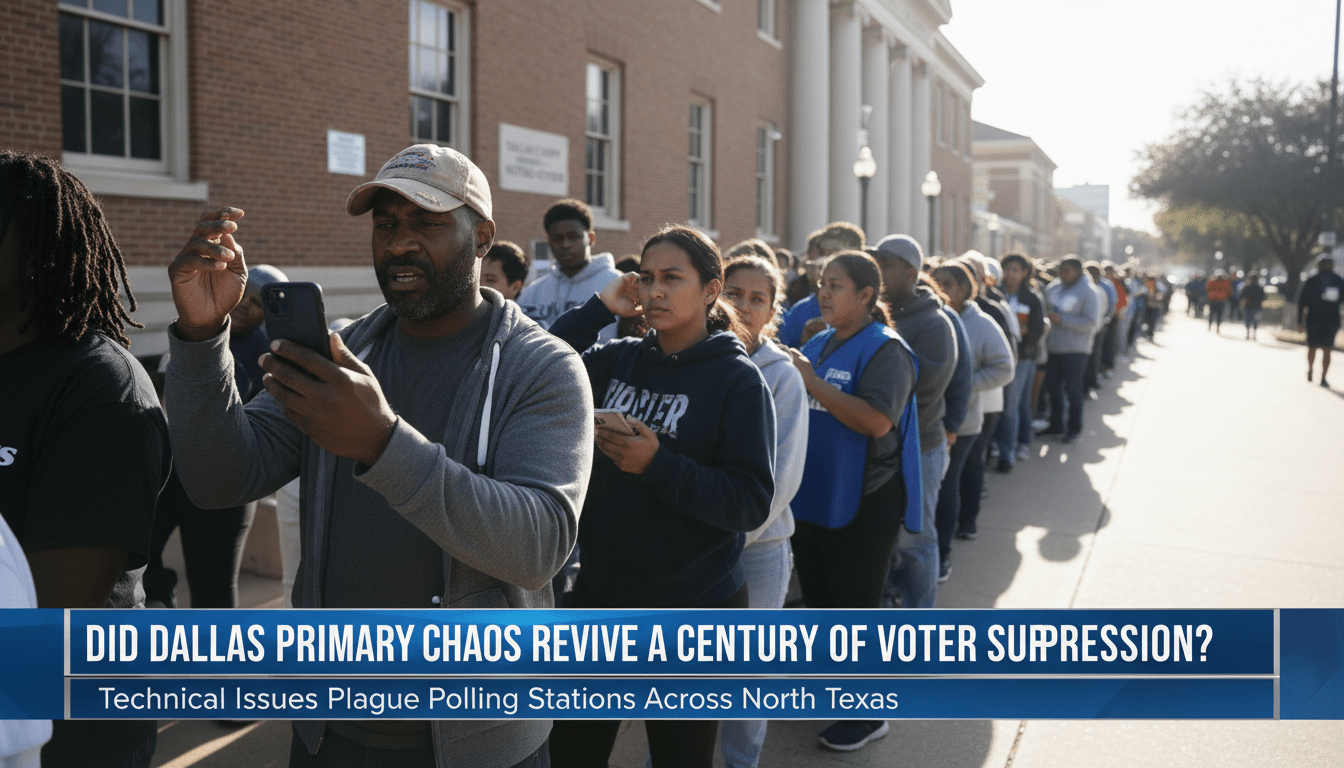
The primary elections in March 2026 brought a wave of confusion to North Texas. On March 4, the NAACP issued an emergency statement regarding what it called “documented interference” in the voting process. Reports from Dallas and Williamson Counties described hundreds of voters being turned away from polling sites. These issues primarily affected neighborhoods where the majority of residents are Black (kare11.com). The organization is currently investigating these events as a form of modern voter suppression. President Donald Trump remains in office as these local conflicts highlight deep divisions in the American electoral system. For many in the community, the “chaos” felt less like an accident and more like a return to the past.
The trouble began when local Republican party leaders decided to change how people vote. For years, Dallas County used a “countywide voting” system. This allowed any registered voter to go to any polling place in the county. However, in 2026, the local GOP chairs moved back to a precinct-based system. This meant voters had to go to one specific location assigned to their home address (democracydocket.com). This sudden change led to a phenomenon called the “Precinct Trap.” Voters went to the same locations they had used for years, only to find they were in the wrong place. The confusion was compounded by website crashes at the Dallas County Elections Department. Many citizens felt this was a deliberate attempt to reduce the impact of anti-Black politics and control the outcome of the primary (kare11.com).
Texas leads the nation in closing polling locations following the Shelby decision (civilrights.org).
The Roots of the All-White Primary
History shows that Texas has a long record of creating rules to limit who can participate in democracy. Between 1923 and 1944, the state used what was known as the “all-white primary.” During this time, Texas was essentially a one-party state controlled by Democrats. Because the winner of the primary almost always won the general election, the primary was the only vote that mattered (ajhssr.com). To keep Black citizens out of power, the party claimed it was a “private club.” As a private group, they argued they could choose their own members and exclude anyone they wished based on race (libretexts.org). This legal loophole effectively silenced Black voices for decades.
The fight against this “private club” logic took years of legal struggle. Civil rights activists challenged these rules in the courts multiple times. It was not until the 1944 Supreme Court case Smith v. Allwright that the practice was ruled unconstitutional. The court decided that a primary is part of the public election process. Therefore, it cannot be used to discriminate (ajhssr.com). Even after this victory, the state found new ways to discourage participation. This historical struggle is part of the troubling history of black voter disenfranchisement that still echoes in current events. Today, administrative changes often serve the same purpose as the old bans.
Another tool of suppression was the poll tax. In 1902, Texas required voters to pay between $1.50 and $1.75 to register. While this seems like a small amount today, it was a heavy burden for the working class at the time. This tax specifically targeted Black, Hispanic, and poor white residents (libretexts.org). Alongside the poll tax, some states used “grandfather clauses.” These rules allowed anyone to vote without a literacy test or tax if their grandfather had been eligible to vote before the Civil War. Since Black people were enslaved and could not vote before the war, they could never meet this requirement (libretexts.org, medium.com). These laws ensured that the most vulnerable people were kept away from the ballot box.
The Legacy of Intimidation in Dallas
The atmosphere of “chaos” in 2026 cannot be separated from the history of physical intimidation in North Texas. In the 1920s, Dallas was a major center for the Ku Klux Klan. The city’s Commissioner of Health, Dr. Hiram Wesley Evans, rose to become the Imperial Wizard of the national KKK (libretexts.org). The Klan did not only operate in the shadows. They held large public events and influenced local government. This environment created a culture of fear for Black residents who wanted to exercise their political rights. This history of exclusion is a reminder of how involuntary servitude took on new forms even after slavery ended.
However, the history of Texas is also full of resistance. Jessie Daniel Ames was a reformer from Williamson County who fought back. In 1918, she led a massive effort to register 3,300 women for the primary election in only two weeks (libretexts.org). Her work showed that the community could organize against restrictive laws. Today, organizations like the NAACP continue this tradition by monitoring elections and demanding transparency. They argue that when polling places are closed or rules are changed at the last minute, it is a modern form of the same intimidation used a century ago (kare11.com). The struggle for access remains a central theme in the pursuit of justice.
The white population dropped from 63.8% in 2010 to 54.6% in 2022 (medium.com).
The Gutting of the Voting Rights Act
To understand why the 2026 election was so chaotic, one must look at a major legal change in 2013. The Supreme Court case Shelby County v. Holder removed a key part of the Voting Rights Act known as “preclearance.” Under preclearance, states with a history of discrimination, like Texas, had to get federal approval before changing any voting laws (democracydocket.com). This rule was the “teeth” of the law. It stopped discriminatory changes before they could ever harm a voter. Without it, the burden of proof shifted. Now, citizens must sue the state after a harmful law has already been passed (civilrights.org). This change opened the door for a wave of new restrictions.
Since the 2013 decision, Texas has closed more polling locations than any other state in the country. A total of 750 sites have been shut down (civilrights.org). Dallas County alone closed 74 locations, even as the number of Black and Hispanic residents grew (medium.com). These closures often happen in urban centers where voters depend on public transportation. Research shows that the gap in turnout between white voters and voters of color has grown significantly since the Shelby decision (medium.com). This trend suggests that removing federal oversight has made it harder for the community to have a say in their government. The struggle for black liberation is tied directly to the ability to cast a ballot without barriers.
Following the loss of preclearance, the Texas Legislature passed Senate Bill 1 in 2021. This law banned 24-hour voting and drive-thru voting. These were methods used heavily by minority voters in large cities during the 2020 pandemic (democracydocket.com, texastribune.org). The law also created new hurdles for mail-in ballots. Critics argue that these rules target “time poverty.” Many working-class residents do not have the luxury of waiting in long lines during the standard workday. By banning convenient voting hours, the state disproportionately affects those who work multiple jobs or lack flexible schedules (texastribune.org). These modern laws are often presented as “election integrity” measures, but their impact mirrors historical suppression.
The Mechanics of the 2026 Precinct Shift
The specific “chaos” reported by the NAACP in 2026 was tied to the authority of party chairs. In Texas, primary elections are considered “party” events. This gives county chairs the power to decide how the election is run (sos.state.tx.us). In Dallas and Williamson Counties, the GOP chairs opted out of the joint election agreement. They chose to move away from the Countywide Polling Place Program (democracydocket.com). This program was originally created in 2005 to reduce confusion and lower costs (sos.state.tx.us). By returning to a precinct-based system, the chairs forced voters to find specific locations that had not been used in years.
This shift created a logistical nightmare. In Dallas County, more than 2,000 people had to cast “provisional ballots” because they were at the wrong precinct. A provisional ballot is only counted if the voter’s eligibility is verified after the election (democracydocket.com). In Texas, if a person votes in the wrong precinct, their entire ballot is usually rejected. This rule applies even if they are a registered voter in that county (sos.state.tx.us). This “Precinct Trap” is especially effective at disenfranchising people who move frequently, such as students or renters. It turns a simple mistake into a lost vote, which is why the NAACP called it a “blueprint for voter suppression” (kare11.com).
Confusion over precinct changes led to a record number of provisional ballots (kare11.com).
The Role of the Texas Supreme Court
When the chaos became clear on election night, local judges in Dallas tried to help. They ordered polling places to stay open late to make up for the confusion and technical issues. However, Texas Attorney General Ken Paxton immediately fought these extensions. He petitioned the Texas Supreme Court to block the extra hours. The state’s highest court agreed with Paxton. They ordered that any ballots cast after 7:00 PM had to be “segregated” or kept separate from the rest (democracydocket.com). This legal battle mirrored a similar situation in Harris County in 2022. In that case, ballots cast during an extra hour were eventually invalidated (texastribune.org).
The Texas Supreme Court is an elected body, and all of its current justices are members of the Republican party. This partisan structure often leads to rulings that favor state-level officials over local county leaders (texastribune.org). When the court blocks local efforts to extend hours, it creates a sense of uncertainty for voters. If a person waits in a long line and casts a ballot, they have no guarantee that their vote will actually be counted if the rules change after they leave the booth. This legal back-and-forth adds to the feeling of “chaos” that discourages people from participating in future elections.
The targeting of Dallas and Williamson Counties is likely due to their shifting demographics. A “purple” region is an area where the number of Democratic and Republican voters is nearly equal. These areas are highly competitive. Political scientists have noted that suppression tactics are most common in “purple” regions because even a small change in turnout can decide the entire election (medium.com). As Williamson County becomes more diverse, with the white population dropping below 55 percent, the pressure to control the electorate increases. In these regions, the margin of victory is often smaller than the number of voters impacted by new restrictions (medium.com, texastribune.org).
Conclusion: A Continuing Pattern
The events of the March 2026 primary are not isolated incidents. They are part of a long-standing pattern in Texas history. From the all-white primary to the modern precinct shift, the methods of management have changed, but the goals often remain the same. The NAACP characterizes these irregularities as a “blueprint” being tested for future elections. By creating “administrative” hurdles, the state can achieve the same results as the overt racial bans of the past. The community continues to face these challenges with resilience, just as Jessie Daniel Ames did a century ago.
Understanding the history behind the headlines is the first step in protecting the right to vote. The “chaos” in Dallas and Williamson Counties serves as a reminder that democracy requires constant vigilance. As the legal battles over the 2026 ballots continue, the eyes of the nation are on Texas. The outcome of these investigations will determine whether the state moves toward greater access or returns to a period of restricted citizenship. The struggle for a fair and transparent election system is a defining issue for the African American community and for the future of the state as a whole.
About the Author
Darius Spearman is a professor of Black Studies at San Diego City College, where he has been teaching for over 20 years. He is the founder of African Elements, a media platform dedicated to providing educational resources on the history and culture of the African diaspora. Through his work, Spearman aims to empower and educate by bringing historical context to contemporary issues affecting the Black community.
