
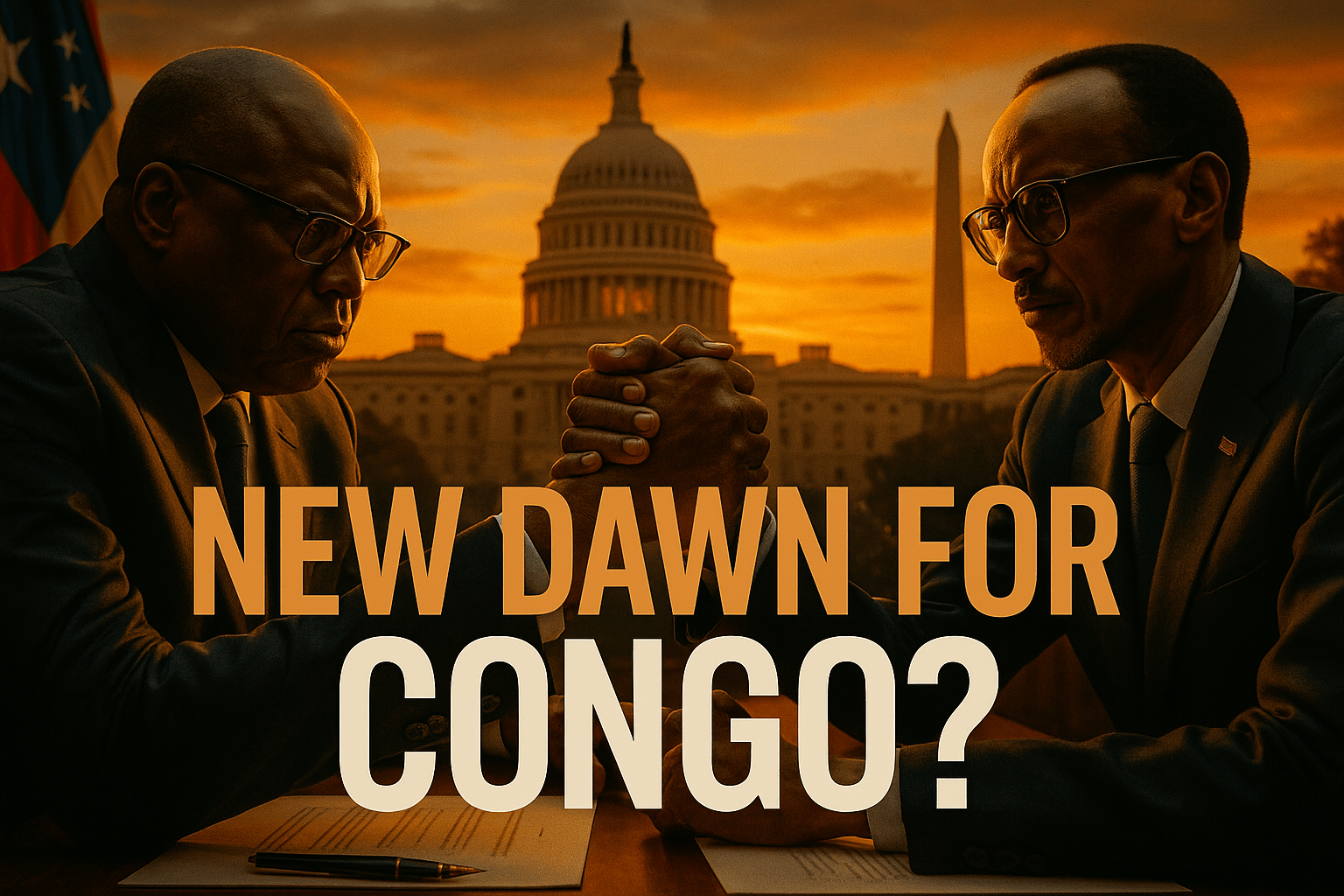
DRC-Rwanda Peace Deal: A New Dawn for Congo?
By Darius Spearman (africanelements)
Support African Elements at patreon.com/africanelements and hear recent news in a single playlist. Additionally, you can gain early access to ad-free video content.
A Historic Peace Agreement Unfolds
The Democratic Republic of Congo (DRC) and Rwanda are on the cusp of a landmark moment, poised to sign a comprehensive peace agreement in Washington D.C. on June 27, 2025. This significant event follows intense diplomatic efforts aimed at resolving a conflict that has plagued the Great Lakes region of Africa for decades. Representatives from both nations took a crucial step forward by initialing a preliminary peace agreement on June 18, setting the stage for the formal signing (usnews.com).
The agreement emerged from three days of “constructive dialogue regarding political, security, and economic interests” between DRC and Rwandan officials in the U.S. capital (lemonde.fr). This high-level engagement underscores the seriousness with which both nations, and their international partners, approach this opportunity for peace. U.S. Secretary of State Marco Rubio is expected to witness the signing, signaling strong American support for the initiative (cbsnews.com). Furthermore, Qatar has also played a vital role, contributing to bridging the divide between the two countries’ efforts to bring stability to the region (upi.com).
Key Provisions for Lasting Peace
The newly drafted peace agreement is designed to address the core issues fueling the conflict, laying a foundation for a more stable future. It includes explicit provisions for respecting territorial integrity and prohibiting hostilities (upi.com). These clauses represent a formal commitment by both nations to cease military engagements and to honor each other’s borders, which is a critical step toward de-escalation and mutual respect for sovereignty. While the agreement signifies a legal commitment, the practical mechanisms for enforcing these provisions are yet to be fully detailed.
In addition, the agreement outlines measures for disengagement, disarmament, and the conditional integration of non-state armed groups (cbsnews.com). This is a crucial element, as the presence of numerous armed factions has been a major destabilizing factor. The accord also aims to establish a “Joint Security Coordination Mechanism” to help maintain peace and facilitate the safe return of refugees and internally displaced persons (cbsnews.com). Moreover, it seeks to facilitate humanitarian access and create a regional economic integration framework, which could foster shared prosperity and reduce incentives for conflict (cbsnews.com).
Key Dates in the DRC-Rwanda Peace Process
Understanding the Conflict’s Roots: M23 and Regional Tensions
The conflict between the Democratic Republic of Congo and Rwanda is deeply rooted in history, particularly influenced by the devastating 1994 Rwandan genocide and its complex aftermath. At the heart of the recent escalation lies the M23 rebel group, primarily composed of ethnic Congolese Tutsis (horninstitute.org). This group claims to be fighting against systemic injustices and discrimination by the DRC government, arguing that their rights have not been protected and that past peace agreements remain unimplemented (horninstitute.org).
Congo has consistently accused Rwanda of backing these M23 rebels in the eastern part of the country (abcnews.go.com). Despite Rwanda’s denials, United Nations experts have provided evidence suggesting that the M23 rebels receive support from approximately 4,000 troops from Rwanda (abcnews.go.com). Furthermore, UN investigations indicate that M23 also receives support from Uganda (africacenter.org). This external backing has allowed M23 to emerge as the most formidable armed rebel group among the estimated 100 operating in eastern DRC, equipped with sophisticated weapons and significant personnel (horninstitute.org). The conflict dramatically escalated in January 2025 when M23 rebels seized the strategic city of Goma, followed by Bukavu in February, intensifying the humanitarian crisis and regional instability (abcnews.go.com).
The Web of Non-State Armed Groups
Eastern Democratic Republic of Congo is a complex landscape, home to an estimated 100 armed groups, all vying for influence and control (africanews.com). Among these, M23 stands out as the most powerful and organized. The pervasive presence of these non-state armed groups significantly fuels the ongoing conflict and instability, impacting the lives of millions of Congolese people. Their activities contribute to widespread violence, displacement, and the exploitation of natural resources.
A key component of the new peace agreement is the provision for the conditional integration of these non-state armed groups (cbsnews.com). While this offers a pathway to disarm and reintegrate fighters into society, the specific steps for disarmament, the criteria for “conditional” integration, and the exact definition of what “conditional” entails are not yet detailed. The success of this provision will depend heavily on clear guidelines, robust implementation mechanisms, and genuine commitment from all parties involved to ensure these groups lay down their arms and become productive members of society.
Armed Groups in Eastern DRC
The Shadow of Mineral Wealth and Humanitarian Crisis
The conflict in eastern Congo is inextricably linked to the region’s vast and rich mineral resources. This area is abundant in minerals such as cobalt, coltan, and cassiterite, which are crucial for modern technologies, including smartphones and electric vehicle batteries. M23 is one of approximately 100 armed groups that have been vying for control over these mineral-rich territories near the border with Rwanda (africanews.com). The struggle for control over these valuable resources often fuels the violence, as various factions seek to profit from illegal mining and trade. Disturbingly, U.S. government estimates indicate that Chinese companies currently control over 80% of the cobalt reserves in the DRC (cbsnews.com).
The human cost of this resource-driven conflict is catastrophic, creating one of the world’s worst humanitarian crises (africanews.com). More than 7 million people have been displaced by the fighting, forced to abandon their homes, livelihoods, and communities in search of safety (africanews.com). These displaced individuals, predominantly Black Congolese, face immense challenges, including
ABOUT THE AUTHOR
Darius Spearman has been a professor of Black Studies at San Diego City College since 2007. He is the author of several books, including Between The Color Lines: A History of African Americans on the California Frontier Through 1890. You can visit Darius online at africanelements.org.
