
Listen to this article
Download AudioEthiopia’s Sea Access Quest Ignites Regional Tensions
By Darius Spearman (africanelements)
Support African Elements at patreon.com/africanelements and hear recent news in a single playlist. Additionally, you can gain early access to ad-free video content.
Mediating Horn of Africa Tensions
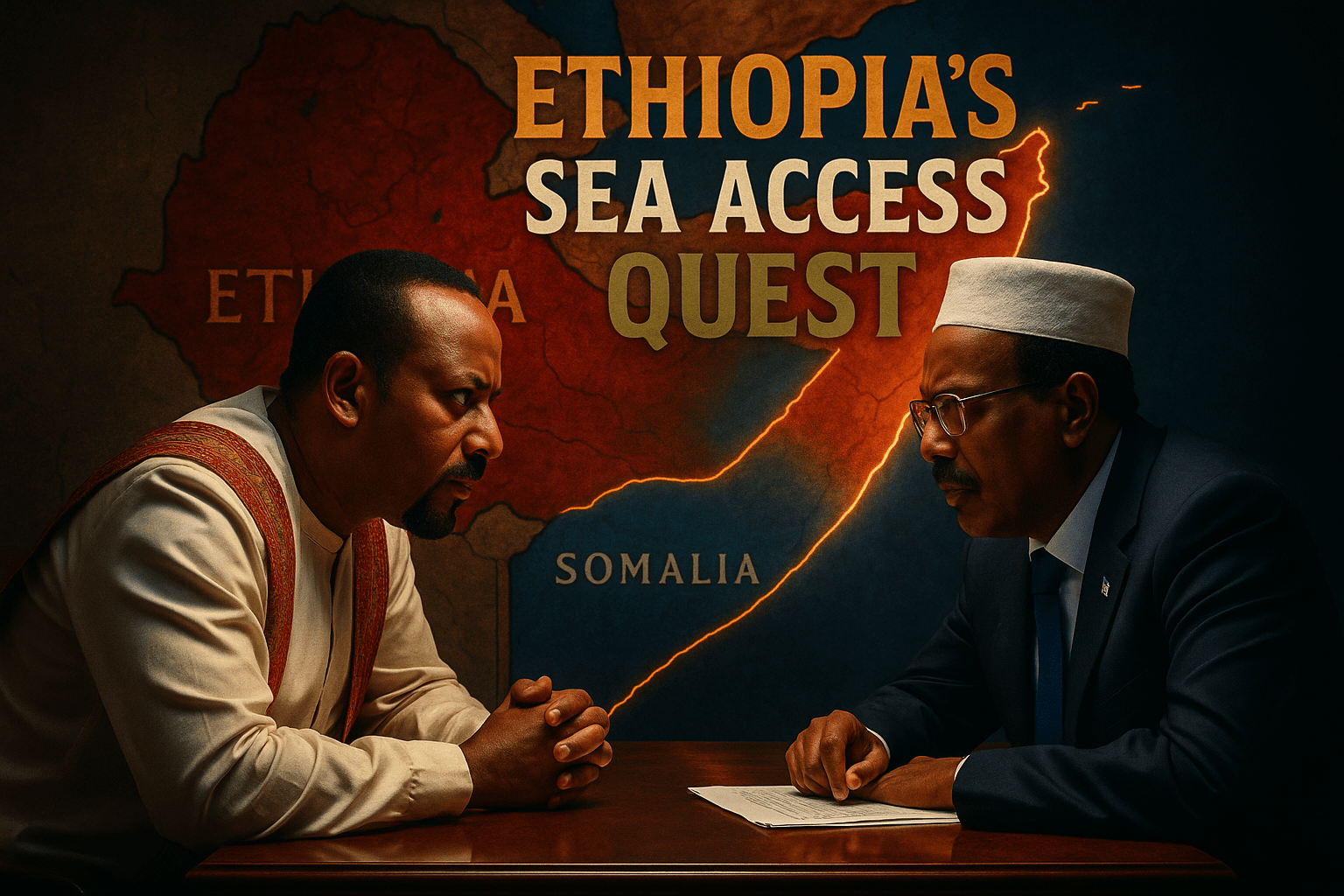
Turkey is actively working to ease tensions between Somalia and Ethiopia, a dispute that has stirred significant concern across the Horn of Africa. Recent high-level meetings in Ankara underscore the need for a peaceful resolution. Turkish President Recep Tayyip Erdoğan recently hosted Somali President Hassan Sheikh Mohamud in Ankara, focusing on strengthening ties and regional cooperation (aljazeera.com).
This meeting took place amid escalating tensions between Somalia and Ethiopia, primarily due to a contentious port access agreement. The core of the disagreement stems from a January 2024 deal between Ethiopia and Somaliland. This agreement promises Ethiopia access to a 20-kilometer stretch of coastline. In exchange, Somaliland hopes for international recognition, a status it has long sought. Somalia, however, views this deal as a grave violation of its sovereignty, considering Somaliland an integral part of its territory (aljazeera.com). This complex situation has drawn in regional and international players, all seeking to prevent further destabilization in an already fragile region.
The Genesis of the Dispute: Ethiopia’s Maritime Ambitions
The dispute originated from a January 2024 agreement between Ethiopia and Somaliland (aljazeera.com). Under this agreement, Ethiopia agreed to lease 20 kilometers of coastline from Somaliland (aljazeera.com). This lease is intended for a naval facility, providing Ethiopia with crucial sea access. In return for this access, Ethiopia offered potential recognition of Somaliland’s independence (aljazeera.com).
Ethiopia’s desire for sea access is presented by its leaders as an existential issue (aljazeera.com). Since Eritrea’s independence in 1993, Ethiopia, a landlocked nation, has relied heavily on Djibouti for its port needs. Djibouti charges Ethiopia approximately $1.5 billion annually in port fees (orfonline.org). This substantial cost has driven Ethiopia to seek alternative, more direct access to the sea, making the deal with Somaliland a significant strategic move.
Somaliland, a self-declared independent state in the Horn of Africa, unilaterally declared independence from Somalia in 1991 (crisisgroup.org). Despite its effective governance and relative stability, its sovereignty is not recognized by any country (crisisgroup.org). Nevertheless, Somaliland has attracted significant foreign investment, partly due to its strategically important Berbera port (crisisgroup.org). Ethiopia’s potential recognition would be a groundbreaking step, legitimizing Somaliland’s claim to statehood on the international stage and setting a powerful precedent.
Ethiopia’s Costly Quest for Sea Access
Somalia’s Unwavering Opposition
Somalia strongly opposes the deal, viewing it as a profound violation of its sovereignty and territorial integrity (aljazeera.com). Somalia considers Somaliland an integral part of its territory (aljazeera.com). Therefore, any agreement Somaliland makes with a foreign state, especially one involving land lease, is seen by Somalia as an infringement on its sovereign rights over its internationally recognized borders (crisisgroup.org).
In response to the deal, Somalia accused Ethiopia of attempting to annex part of its territory (aljazeera.com). Somali President Hassan Sheikh Mohamud stated that his country would “defend itself” if Ethiopia proceeded with the agreement (aljazeera.com). As a direct consequence of the dispute, Somalia expelled the Ethiopian ambassador and shut down Ethiopian consulates in Hargeisa, Somaliland, and Garowe, Puntland, in April 2024 (aljazeera.com).
The outrage was not limited to official government actions. Somali people marched against the Ethiopia-Somaliland port deal in Mogadishu in January 2024 (reuters.com). This widespread public opposition has created significant pressure on the Somali government to reject any mediation with Ethiopia (warontherocks.com). Somalia is actively rallying international opposition to the deal, emphasizing that it undermines its national unity and international legal standing (crisisgroup.org).
Somaliland’s Unrecognized Status
Turkey’s Diplomatic Intervention
Turkey has stepped in as a key mediator in the escalating dispute between Somalia and Ethiopia (aljazeera.com). Turkish President Erdogan met separately with Somali President Hassan Sheikh Mohamud and Ethiopian Prime Minister Abiy Ahmed in Ankara on December 11, 2024 (reuters.com). These meetings marked their first direct engagement since the announcement of the controversial port deal.
Turkey began mediating talks between Somalia and Ethiopia in July 2024 (reuters.com). The Turkish foreign minister stated that tensions could be resolved if Ethiopia’s access to the sea through Somalia is secured (aljazeera.com). This condition, however, is contingent upon Ethiopia recognizing Somalia’s territorial integrity and political sovereignty (aljazeera.com).
The Somali and Ethiopian foreign ministers were scheduled to meet in Ankara to discuss the disagreements over the port deal (aljazeera.com). Turkey’s involvement highlights its growing influence in the Horn of Africa, a region of strategic importance for trade and security. Turkey has long-standing ties with Somalia, providing significant humanitarian aid and military support, which positions it uniquely to facilitate these delicate negotiations.
Regional Ripples: Beyond the Immediate Conflict
The dispute over the Ethiopia-Somaliland deal has far-reaching implications for broader regional dynamics. Somalia’s President Mohamud has actively sought to galvanize regional support against the deal (bbc.com). For instance, he flew to Eritrea in January and again in March as part of these efforts (bbc.com).
Interestingly, Eritrea’s leader, Isaias Afeworki, was a close ally of Ethiopian Prime Minister Abiy Ahmed during the brutal civil war in northern Ethiopia between 2020 and 2022 (bbc.com). However, relations between the two countries have since deteriorated (bbc.com). This shift in alliances adds another layer of complexity to the regional power play.
The crisis also risks playing into the hands of Al-Shabaab, the Islamist insurgency in Somalia (crisisgroup.org). Al-Shabaab has already come out in strong opposition to the memorandum, implicitly threatening to attack Ethiopia and Somaliland over a deal it claims “violates Somalia’s sovereignty” (warontherocks.com). This potential for increased instability is a major concern for all regional actors.
Furthermore, the United Arab Emirates may also be a key player in this unfolding drama. The UAE has cordial relations with both Ethiopia and Somaliland (aljazeera.com). It is possible that the UAE, with its ambition to expand its presence in the Red Sea, the Gulf of Aden, and the Indian Ocean ports, may have encouraged the parties to proceed with the deal (aljazeera.com). Earlier this week, Egyptian President Abdel Fattah el-Sisi met with Somali President Hassan Sheikh Mohamud, during which Egypt pledged to strengthen military cooperation and support maritime security in the Red Sea. This highlights the broader geopolitical interests at stake.
Timeline of the Somalia-Ethiopia Port Deal Dispute
Ethiopia and Somaliland announce port deal for naval access and potential recognition.
Somalia expels Ethiopian ambassador and closes consulates in response to the deal.
Turkey begins mediating talks between Somalia and Ethiopia to resolve tensions.
Turkish President Erdogan meets separately with Somali and Ethiopian leaders in Ankara.
Local Voices and Stakes: A Nation United in Opposition
The port deal has sparked powerful reactions within Somalia, resulting in widespread protests and a unified opposition to the agreement (warontherocks.com). The rhetoric from the government in Mogadishu has been uncompromising and, at times, bellicose (warontherocks.com). This strong stance mirrors the sentiments of ordinary Somalis who have rallied across the country in opposition to the memorandum (warontherocks.com).
This intense public pressure presents a significant challenge for the Somali government. It faces immense public expectations to reject any mediation that does not uphold its territorial integrity. Somalia has rejected overtures from international partners to engage in mediation with Ethiopia, stressing that its position is nonnegotiable (warontherocks.com).
In Ethiopia, by contrast, the deal is largely perceived as a diplomatic success (orfonline.org). It fulfills a long-standing strategic need for sea access, which is likely to garner significant public support for the government’s stance (orfonline.org). Ethiopian Prime Minister Abiy Ahmed has reiterated his government’s position, describing sea access as essential for Ethiopia’s economic development.
The Path Forward: Navigating a Complex Future
Despite Turkey’s mediation efforts, no breakthrough has yet been reached in the negotiations between Somalia and Ethiopia. The initial talks, brokered by Turkey since February 2024, aimed to resolve the dispute (aljazeera.com). However, the path to resolution remains unclear.
The current status of the talks beyond December 2024, as well as the outcomes of any planned technical negotiations for early 2025, are not yet public. This uncertainty leaves many questions about the progress or potential stalemate in resolving this critical regional issue. The international community continues to closely monitor the situation, urging both sides to find a peaceful and mutually agreeable solution that respects international law and maintains regional stability.
The ongoing diplomatic efforts underscore the deep complexities involved in balancing Ethiopia’s strategic need for sea access with Somalia’s unwavering commitment to its territorial integrity. The outcome of these negotiations will undoubtedly shape the future of the Horn of Africa, influencing trade, security, and political alliances for years to come.
ABOUT THE AUTHOR
Darius Spearman has been a professor of Black Studies at San Diego City College since 2007. He is the author of several books, including Between The Color Lines: A History of African Americans on the California Frontier Through 1890. You can visit Darius online at africanelements.org.
