


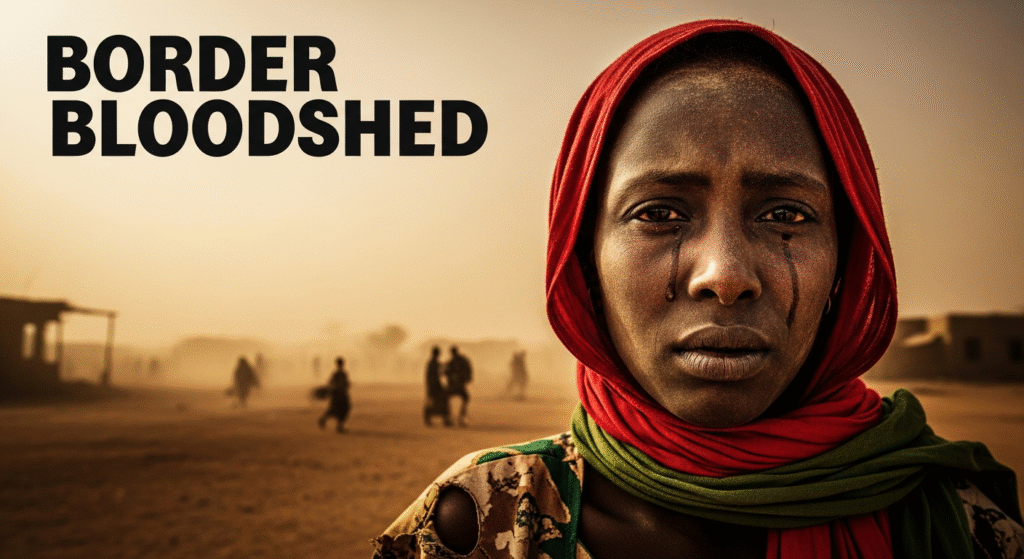
Europe Border Deals Fuel Sudan’s Bloodshed
By Darius Spearman (africanelements)
Support African Elements at patreon.com/africanelements and hear recent news in a single playlist. Additionally, you can gain early access to ad-free video content.
Sudan’s Current Crisis: A Deep Dive
The violent conflict tearing Sudan apart today is a tragedy with deep roots, particularly for those in the African diaspora. Many critics argue that European nations, in their determination to stop migrants from reaching their borders, made deals that unexpectedly strengthened a brutal paramilitary group now accused of widespread atrocities against Sudanese civilians (aljazeera.com). These anti-migrant strategies abroad, many argue, have tragically fueled violence within the African continent (aljazeera.com).
The situation in Sudan reflects a global pattern where racial identity can impact a person’s movement, safety, and access to basic human rights. The conflict in Sudan involves grave violations of international law, often referred to as “ethnic cleansing,” “genocide,” and “war crimes.” These terms describe horrific acts like killing, causing serious harm, or creating conditions meant to destroy a group, reflecting a global commitment to prevent mass atrocities.
Origins of RSF: From Janjaweed to Power
The story of Sudan’s current bloodshed must begin with the Rapid Support Forces, known as the RSF. This powerful group did not simply appear overnight; it grew from the infamous Janjaweed militias (clingendael.org). In 2003, former Sudanese President Omar al-Bashir mobilized these militias to brutally suppress a non-Arab rebellion in Darfur ((clingendael.org), (wikipedia.org)). The Janjaweed became notorious for mass killings, burning villages, rape, and ethnic cleansing, actions that led to an International Criminal Court indictment against Bashir for genocide (clingendael.org).
In 2013, the Janjaweed militias were formally reorganized and renamed the Rapid Support Forces, under the command of Mohammed Hamdan Dagalo, widely known as Hemedti ((clingendael.org), (newarab.com)). Initially operating under the National Intelligence and Security Services (NISS), a 2017 law controversially integrated the RSF into the Sudanese Armed Forces (SAF) ((clingendael.org), (britannica.com)). This law also granted the RSF significant independence and placed it directly under the president’s command, effectively turning the Janjaweed into a permanent part of Sudan’s power structure (clingendael.org).
Europe’s Migration Strategy and “Irregular Migration”
The roots of the current crisis can be traced to the early 2010s, when European countries greatly increased their efforts to stop “irregular migration” from Africa (clingendael.org). “Irregular migration” refers to people moving across borders or staying in a country without the necessary legal papers. Sudan, positioned along key migration routes from the Horn of Africa towards Libya and Europe, became a vital partner in this strategy (clingendael.org). Migrants in these irregular situations face increased risks of exploitation, abuse, and discrimination.
In 2014, the European Union (EU) and African nations launched the “Khartoum Process,” also known as the EU Horn of Africa Migration Initiative ((clingendael.org), (reliefweb.int)). Its stated purpose was to fight human trafficking and manage irregular migration by making border controls stronger in countries like Sudan (clingendael.org). However, critics called this agreement a “pact with the devil,” arguing it gave legitimacy to Sudan’s “militia state” (clingendael.org). A “militia state” is where armed groups, often outside of formal government, hold great power and influence, sometimes even more than official government groups. These militias often act without being held accountable, using violence to control people and suppress any opposition.
EU Funding for Migration Control in Sudan (2014-2018)
This bar chart illustrates the significant EU funding channeled into Sudan for migration control efforts between 2014 and 2018 (clingendael.org).
Dual-Use Support and a Dangerous Empowerment
From 2015 to 2016, the Sudanese government, likely seeing the RSF as an “effective counterinsurgency force,” made the RSF the main group for patrolling Sudanese borders to stop migrant movements (clingendael.org). This happened within the partnership with the EU for migration control, which meant the RSF was in a position to receive EU funds (clingendael.org). Between 2014 and 2018, the EU sent over 200 million euros through programs like the EU Emergency Trust Fund for Africa (EUTF) and the Better Migration Management (BMM) program (clingendael.org). These programs were supposed to strengthen migration control, border security, and anti-trafficking efforts, but in reality, they created “entrenched cooperation” between the EU and Sudan’s security groups, including units that eventually joined the RSF (clingendael.org).
Specific plans from 2016 included giving training and equipment, such as cameras, scanners, and electronic servers for migrant registration, to Sudanese border forces, which included the RSF (clingendael.org). Even though the EU denied directly funding the RSF, reports indicated that an EUTF-funded program planned a 10 million euro training program for the RSF in 2020, which involved high-ranking RSF officials, including Hemedti ((clingendael.org), (investigativejournalismforeu.net)). Advocacy groups like the Enough Project warned as early as 2017 that the EU’s new partnership with Sudan was very risky, especially because the RSF, “one of the most abusive paramilitary groups,” stood to benefit from EU funding ((clingendael.org), (enoughproject.org)). They pointed out that the equipment and training provided were “dual-use,” meaning they could be used not only for migration control but also to “strengthen the tools of a government and forces that violently suppress citizens” ((clingendael.org), (enoughproject.org)). Hemedti himself reportedly presented himself as “Mr. Migration” to the EU, using the Khartoum Process to gain diplomatic leverage (clingendael.org).
Initial Casualties in Sudan Conflict (June 2023)
- Killed (800+)
- Injured/Displaced (Thousands)
This pie chart shows the initial reported deaths of over 800 people from the Sudan conflict, with thousands more injured or displaced, as of June 2023 (clingendael.org).
Sudan’s Current Bloodshed and Its Legacy
The civil war in Sudan, which began in April 2023 between the RSF and the Sudanese Armed Forces (SAF), has completely devastated the country (clingendael.org). This conflict is a power struggle between General Abdel Fattah al-Burhan of the SAF and RSF commander General Mohamed Hamdan Dagalo (Hemedti) (clingendael.org). The RSF, now a dominant and semi-independent force, has been accused of massacres, thousands of civilian deaths, and mass displacement (clingendael.org). They are also accused of using starvation as a weapon of war (clingendael.org).
The RSF is documented to have committed war crimes on a huge scale against non-Arab ethnicities in Darfur and against Northern Sudanese Arabs in Khartoum and Gezira State (clingendael.org). Reports indicate RSF fighters have attacked hospitals, executed fleeing civilians, and imposed sieges (clingendael.org). Under RSF control, Khartoum, the capital, has become a “lawless and violent city,” with accusations of looting and harassment against civilians (clingendael.org). These actions sadly mirror the atrocities committed by the Janjaweed during the Darfur war (clingendael.org). The training and equipment given to the RSF under the idea of migration control are now seen by critics as having helped the paramilitary become stronger and more legitimate (clingendael.org). The EU’s “obsession with halting migration” is viewed as having indirectly empowered a force that has a documented history of severe human rights violations (clingendael.org). As one analyst put it, the RSF’s makeup is “built on bloodshed and conflict” (clingendael.org).
Connecting to Global Racial Justice and Advocacy
The atrocities against African populations and problematic European policies discussed here connect to larger global racial justice issues. They highlight systemic anti-Black racism and the differing value placed on Black lives internationally. These events often reflect historical patterns of colonialism, exploitation, and racial discrimination that still shape global power dynamics and humanitarian responses. European migration policies, for example, have been criticized for affecting people of African descent much more severely, showing a racialized approach to border control and asylum that often puts national security before human rights.
The violence and exploitation in Sudan, including ethnic cleansing, modern slavery, and state-backed violence against African populations, have deep historical similarities to the African American experience. Modern slavery, especially human trafficking, connects to the legacy of chattel slavery and its ongoing impact on Black communities, showing continuous systemic exploitatio. State-sanctioned violence and “militia states” can be compared to historical and current issues of state-sponsored racial oppression, police brutality, and the suppression of civil rights movements faced by African Americans. Furthermore, the targeting of specific ethnic groups for violence, as seen in Darfur, reminds many of the racialized violence and terror tactics used against African Americans during periods like Jim Cro. These comparisons highlight a shared historical struggle against systemic injustice and the importance of looking at racial justice globally).
In the Darfur conflict, the main groups targeted are often called “non-Arab” or African ethnic groups, including the Fur, Masalit, and Zaghawa. These groups started a rebellion in 2003, saying they were being ignored and discriminated against by the Sudanese government and allied Arab militias have been accused of systematic attacks against these communities, including killings, forcing people from their homes, and destroying property. Understanding these specific identities is vital for grasping the ethnic and racial nature of the violence and its terrible impact on particular communities within Darfur.
For readers interested in helping with the Sudanese conflict and related human rights issues, many organizations, including Black-led and pan-African groups, offer ways to advocate and support. Humanitarian groups like Doctors Without Borders (Médecins Sans Frontières – MSF) ((doctorswithoutborders.org), (doctorswithoutborders.org), (doctorswithoutborders-apac.org)) and the International Rescue Committee (IRC) ((rescue-committee.org), (rescue.org)) provide direct aid and support for displaced people. Human rights organizations such as Human Rights Watch ((hrw.org), (hrw.org), (hrw.org)) and Amnesty International ((amnesty.org), (amnestyusa.org), (amnestyusa.org), (amnesty.org)) document abuses and advocate for accountability for war crimes and genocide in Sudan. Groups specifically focused on the Darfur crisis or wider Sudanese human rights include the Darfur Women Action Group ((darfurwomenaction.org), (darfurwomenaction.org)) and Act for Sudan ((against-genocide.org), (actforsudan.org)), which raise awareness and push for policy chang. In addition, pan-African organizations and groups focused on racial justice, such as the African Union ((wikipedia.org), (au.int), (au.int)) and the NAACP ((naacp.org), (naacp.org)), often address human rights and justice issues affecting people of African descent globally, offering broader platforms for involvement.
Humanitarian Impact of Sudan Conflict (Since April 2023)
| Impact Category | Statistic |
|---|---|
| People Forced to Flee | Approximately 14 million (30% of population) |
| Official Death Toll (Khartoum State) | Around 61,000 people |
| Killed (Overall) | More than 800 people |
| Injured (Overall) | 5,000 people |
| Displaced (Overall) | Nearly 1 million people |
| RSF Strength | 100,000 to 150,000 personnel (2023 estimate) |
| Sudan’s Rank for Modern Slavery | 14th globally per capita |
This table summarizes the devastating humanitarian impact of the Sudan conflict since April 2023, including displacement, casualties, and the estimated strength of the RSF (clingendael.org).
About the Author
Darius Spearman is a professor of Black Studies at San Diego City College, where he has been teaching for over 20 years. He is the founder of African Elements, a media platform dedicated to providing educational resources on the history and culture of the African diaspora. Through his work, Spearman aims to empower and educate by bringing historical context to contemporary issues affecting the Black community.
