


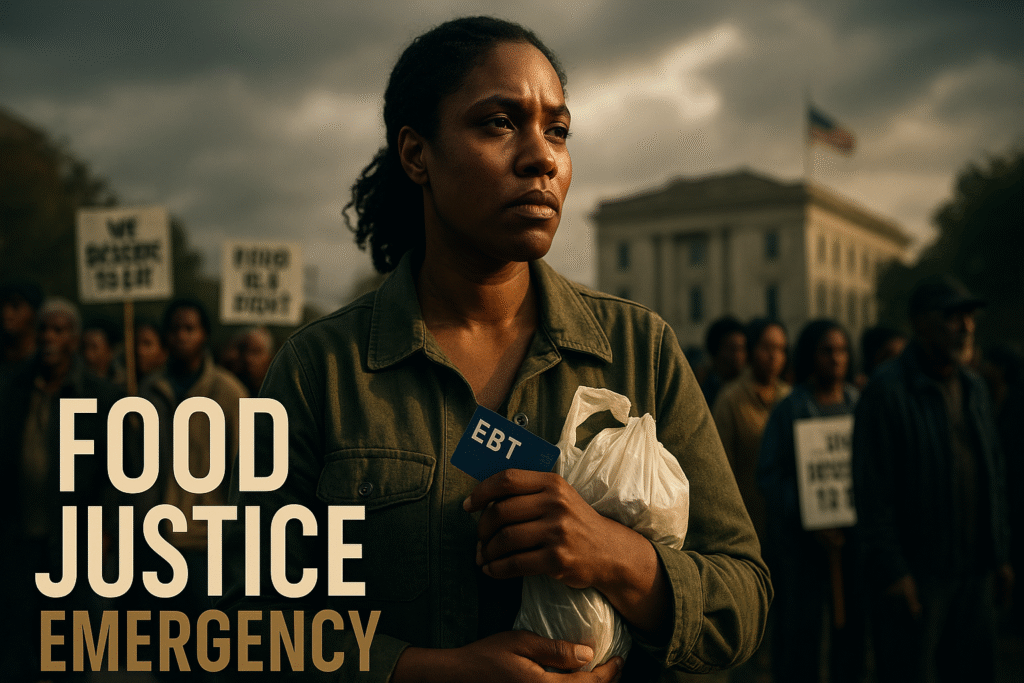
Federal Judges Mandate SNAP Funding Amid Crisis: Food Justice Becomes Racial Justice Emergency
The History Behind The Headlines
By Darius Spearman (africanelements)
Support African Elements at patreon.com/africanelements and hear recent news in a single playlist. Additionally, you can gain early access to ad-free video content.
When Federal Courts Stand Against Hunger: Understanding the SNAP Victory and What It Means
Federal judges in Rhode Island and Massachusetts issued historic rulings on October 31, 2025, mandating that the Trump administration continue funding the Supplemental Nutrition Assistance Program (SNAP) during the government shutdown (Reuters). The court decisions represent a landmark victory for food justice advocates fighting to protect millions of Americans from sudden hunger. However, significant delays persist, leaving Black families and communities of color in precarious positions as November benefits remain uncertain (AP News).
U.S. District Judge John McConnell Jr. in Rhode Island emphasized the stakes clearly: “There is no doubt that the contingency funds are available and that irreparable harm will start to occur if it has not already, considering the anxiety it has caused many regarding the availability of food funding for their families” (NBC News). McConnell directed the USDA to use $5.25 billion in contingency funds immediately, noting that if these proved insufficient, another $23 billion in discretionary funds remained available. The administration was given until Monday, November 3, 2025, to report its compliance plan.
This victory did not come easily. Consequently, a coalition of 25 states, the District of Columbia, cities, nonprofits, and community organizations filed lawsuits challenging the USDA’s suspension of SNAP. Their legal strategy proved sound, based on the fact that federal law mandates SNAP continuation even during government shutdowns through available contingency funds. Democracy Forward, the advocacy organization involved in the litigation, called the ruling “a temporary restraining order blocking the Trump-Vance administration’s unlawful effort to halt the Supplemental Nutrition Assistance Program during the ongoing government shutdown” (Government Executive).
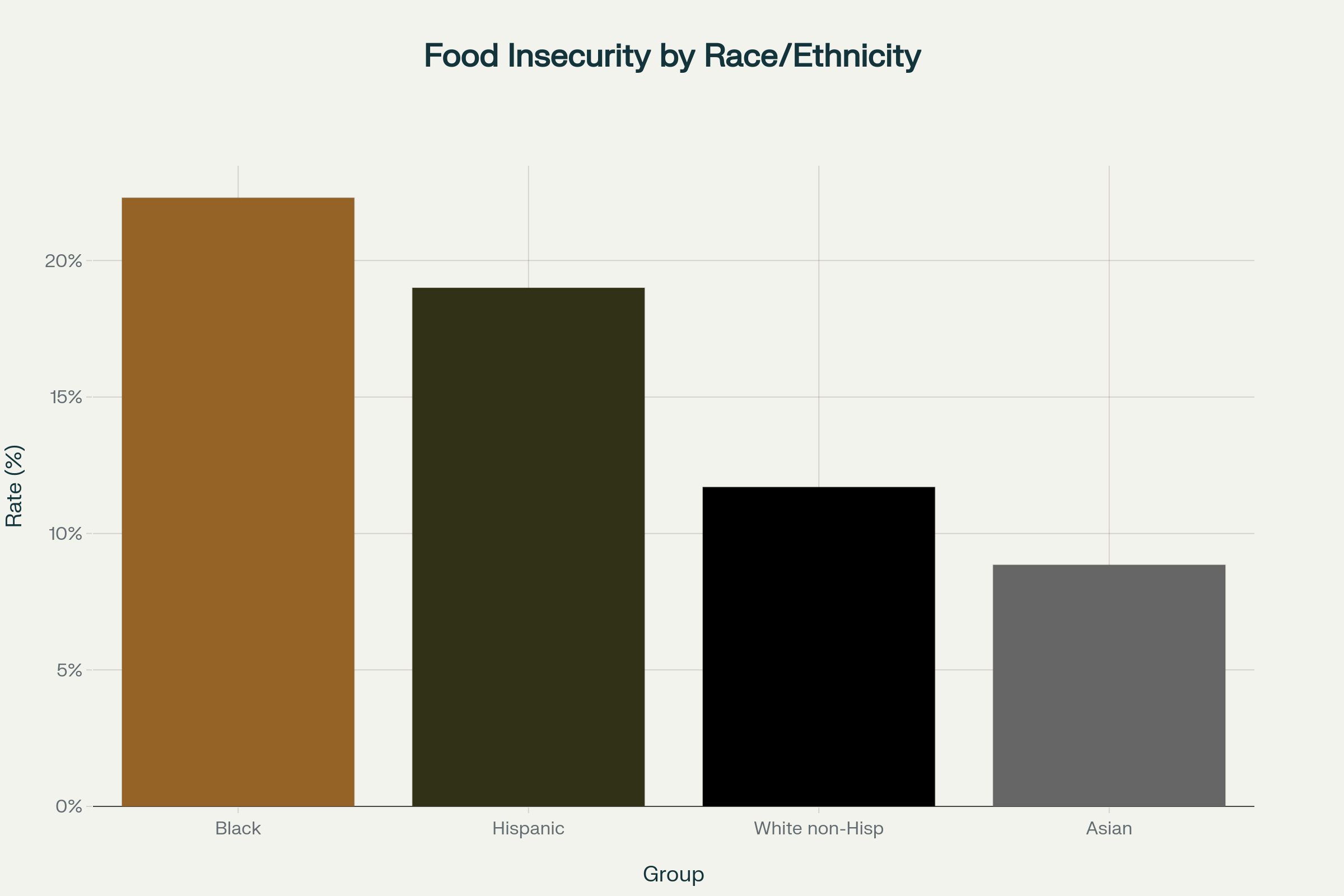 Food insecurity rates show Black Americans experiencing hunger at approximately double the rate of white Americans
The Disproportionate Impact on Black Communities: Why SNAP Failure Equals Racial Injustice
Black Americans do not experience SNAP suspension equally with other populations. While Black people represent 13.7 percent of the total U.S. population, they comprise 25.7 percent of SNAP recipients, making them nearly twice as dependent on the program relative to their population share (AP News). The numbers tell a story of systemic inequality rooted in centuries of discrimination.
Food insecurity among Black Americans has reached crisis levels. In 2023, approximately 22 to 23.3 percent of Black households faced food insecurity, compared with only 9.9 to 13.5 percent among white non-Hispanic households (Harvesters). This disparity translates into personal suffering. One in four Black children live in food-insecure households, meaning approximately 27 percent of Black children lack reliable access to adequate nutrition (Annie E. Casey Foundation). The concentration of hunger in Black communities reflects what advocates correctly frame as a racial justice emergency.
The USDA data from 2024 shows that approximately 5.8 million Black households received SNAP benefits, with an additional 26 percent of all SNAP participants identifying as Black (Word in Black). Therefore, any disruption to the program creates cascading harm throughout Black neighborhoods already strained by unemployment, poverty, and historical disinvestment. Social justice organizations understood immediately that federal authorities withholding SNAP funding would constitute an attack on Black survival itself.
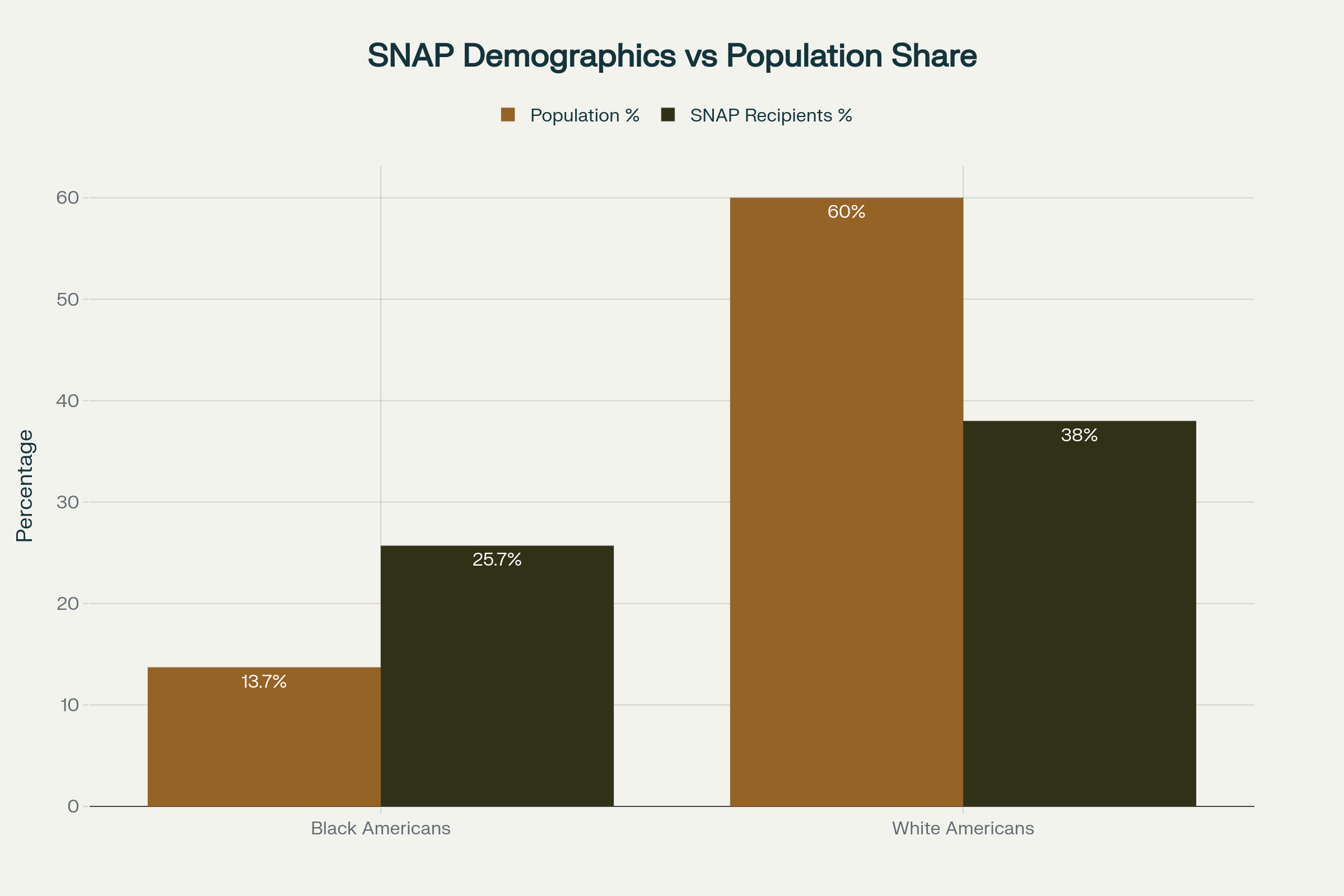 Black Americans comprise 25.7% of SNAP recipients despite representing only 13.7% of the U.S. population
The Implementation Crisis: Delays in Victory Create Ongoing Hunger
The court victories proved incomplete. Even though judges ruled that the Trump administration must fund SNAP, processing delays meant that millions lost benefits on November 1, 2025 (USA Today). The Treasury Secretary indicated that payments could flow by Wednesday at the earliest, but state officials warned that reloading benefits onto Electronic Benefit Transfer (EBT) cards could take seven or more days in many states. Additionally, the USDA had cancelled existing waivers exempting older adults, veterans, and others from work requirements during the shutdown (NPR).
The practical consequences proved devastating. In Sacramento County, California, more than 270,000 residents lost access to CalFresh (California’s version of SNAP) benefits with no guaranteed restoration date (Center for Health Journalism). Black families and other communities of color faced impossible choices between purchasing food, paying rent, or affording transportation. Community organizations stepped into the breach, but food banks could not replace government nutrition assistance. Additionally, nonprofits reported that the psychological toll of uncertainty itself created anxiety and stress, particularly in households already experiencing economic precarity.
SNAP Origins: How a Depression-Era Program Became Civil Rights Infrastructure
Understanding SNAP requires understanding American food policy history rooted in both agriculture and racism. The Food Stamp Program began in 1939 during the Great Depression, when massive unemployment and agricultural surpluses created a political crisis requiring federal intervention (National Institutes of Health). The original program operated from 1939 to 1943, serving approximately 4 million people monthly at its peak. Notably, the primary beneficiaries were farmers seeking markets for surplus goods rather than hungry families seeking food.
The program languished until President John F. Kennedy initiated pilot programs in 22 states during 1961 (Virginia Humanities). By the mid-to-late 1960s, however, civil rights organizations reframed food assistance as a justice issue. The sharecropper and tenant farmer economies in the South were collapsing due to mechanization and federal agricultural policies that eliminated the need for labor. Therefore, Black farm workers and their families faced literal starvation while government programs remained inadequate. Consequently, civil rights activists, including Martin Luther King Jr. through his Poor People’s Campaign in 1968, elevated hunger and food access to the status of civil rights demands (Virginia Humanities).
The Black Panther Party and Community Food Justice: Ancestors Who Fed Us
While the federal government moved slowly, the Black Panther Party took direct action. In 1969, the Black Panther Party launched the Free Breakfast for School Children program, feeding thousands of children before school each morning. At its peak, the program served 20,000 children weekly across multiple cities (Food Research and Action Center). FBI Director J. Edgar Hoover declared the program a threat to national security, and federal agents raided breakfast sites to destroy food and terrorize participants. Nevertheless, the Black Panther Party’s courage created political pressure that eventually forced the U.S. government to establish the School Breakfast Program in 1975.
This history demonstrates that Black communities have always understood food security as a foundation for liberation. The Black Panther Party’s free breakfast program represented a revolutionary commitment to ensuring that children could learn and develop on full stomachs. Therefore, when President Nixon eventually expanded the food stamp program significantly, and the Carter administration extended it nationwide, Black organizing pressure had created the political conditions making expansion possible. Food justice and Black liberation remained intertwined from the beginning.
The Racialization of Poverty Narratives: How Racist Mythology Shapes SNAP Attacks
Despite SNAP’s origins in Depression-era agriculture support, the program became racialized through harmful stereotypes connecting food assistance to Black women and urban poverty. This racialization was neither accidental nor incidental. Federal policy deliberately located SNAP within the Farm Bill, where rural agricultural interests (predominantly white) negotiated with urban Democratic representatives to advance their mutual interests (WhyHunger). Simultaneously, Republican opposition to both agricultural subsidies and food stamps created a political dynamic that racialized welfare itself as a “Black problem” rather than a universal social program.
Contemporary attacks on SNAP draw from centuries-old narratives rooted in English Poor Laws brought to America by colonists. Those laws defined the poor as “inherently unworthy” and framed poverty as a “personal choice.” Work requirements, benefit restrictions, and eligibility tightening all reflect this punitive logic designed to maintain control over low-wage workers and prevent what the ruling class feared as dependency (American Journal of Public Health). Therefore, when conservative politicians propose work requirements and eligibility restrictions, they are not making neutral policy arguments but rather invoking racialized narratives specifically designed to undermine Black and brown communities.
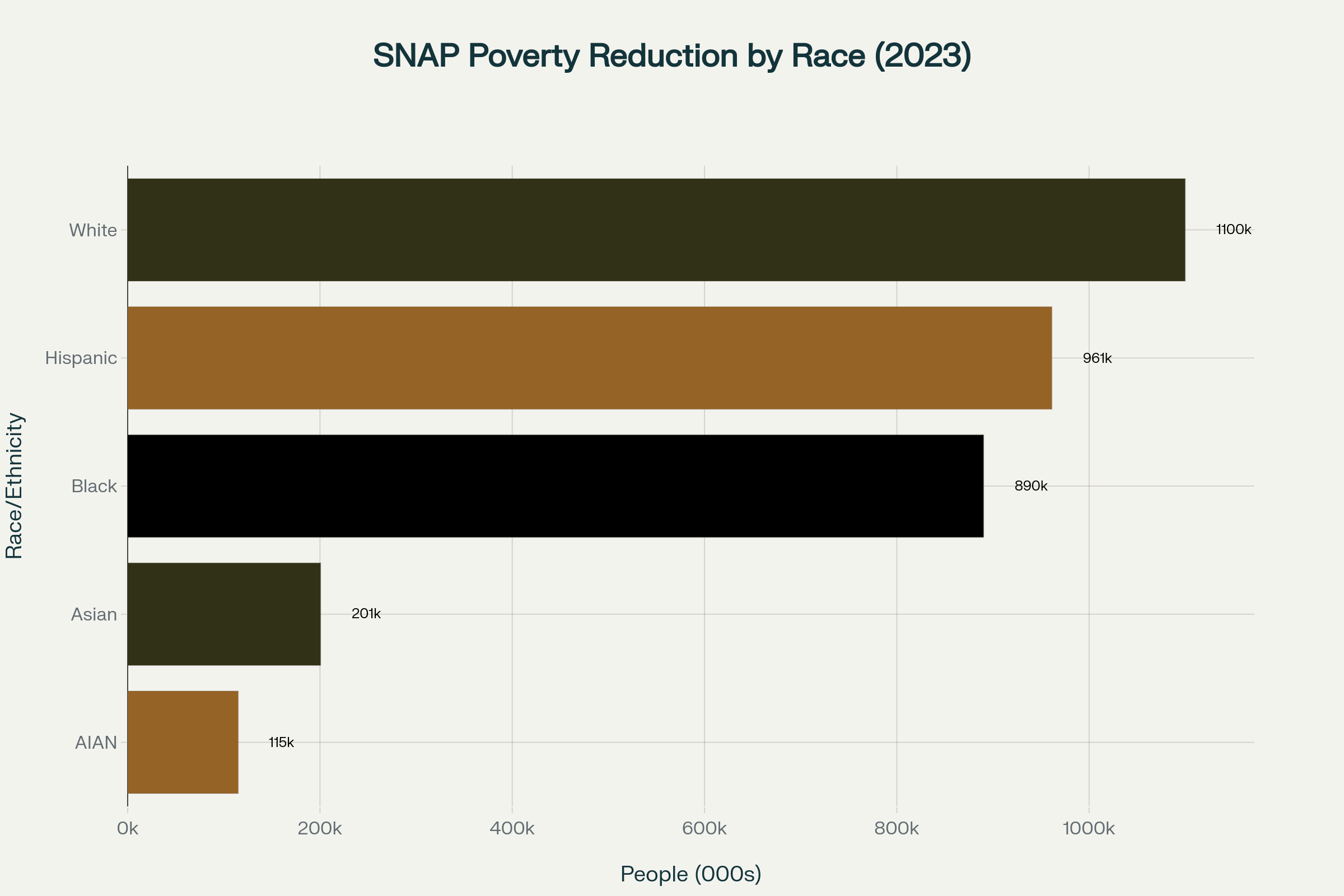 SNAP lifted over 890,000 Black individuals out of poverty in 2023 alone, demonstrating its critical anti-poverty impact
Systemic Racism and Food Deserts: The Economic Foundations of Hunger
Food insecurity among Black Americans cannot be separated from broader patterns of systemic racism and economic exploitation. Red lining policies that prevented Black families from accessing mortgages in desirable neighborhoods created concentrated poverty in specific geographic areas. These same neighborhoods were systematically disinvested of grocery stores and supermarkets, creating “food deserts” where residents depend entirely on convenience stores selling processed foods lacking nutritional value (Harvesters). Additionally, Black Americans face persistent wage gaps, with Black workers earning only 64 percent of what white counterparts earn on average, according to the National Urban League (U.S. News and World Report).
Black unemployment increased dramatically during 2025, rising between 62 to 75 percent to reach the highest rate since October 2021 (U.S. News and World Report). Simultaneously, Black homeownership fell to a four-year low, and median Black household income declined 3.3 percent, reaching only $56,020 compared with approximately $92,000 for white households. These economic realities mean that SNAP benefits represent not a luxury but an essential survival mechanism for millions of Black families unable to secure adequate employment or income through the formal economy.
Black Churches and Community Resistance: Food Justice in Action
As the SNAP funding crisis unfolded, Black churches rose to meet community needs. Research shows that more than 60 percent of Black churches operate food pantries, meal programs, and food distribution partnerships within their communities (Word in Black). These faith communities operate from the Matthew 25 mandate to feed and serve “the least of these,” grounding food justice in spiritual commitment. Therefore, Black churches would likely face overwhelming demand should SNAP benefits disappear or remain suspended indefinitely.
Additionally, state governments including California deployed National Guard resources and directed funding increases to food banks to prevent mass hunger during the shutdown. Governor Gavin Newsom stated bluntly: “We are not going to sit idly by while families go hungry. It is cruel, it is immoral, and it is beneath us as a nation” (State of California). Yet state and local efforts, however well-intentioned, cannot substitute for federal food assistance programs designed to ensure universal food security. Community organizations, churches, and nonprofits represent crucial safety nets but also highlight federal government abandonment of its responsibility to feed its people.
Why This Matters Today: Food Security as Racial Justice
The SNAP funding crisis of November 2025 represents far more than a bureaucratic dispute about government shutdown procedures. The crisis reflects a fundamental question about who deserves to eat and who the nation values. Federal judges’ decisions to mandate SNAP funding acknowledge that access to food constitutes a basic human right that cannot be suspended or negotiated during political disputes. Furthermore, the disproportionate impact of SNAP cuts on Black communities demonstrates that food insecurity operates as a tool of racial control and exclusion.
Black community advocates framed the SNAP funding crisis as a racial justice emergency because it is precisely that. When 22 to 23 percent of Black households face food insecurity compared with roughly half that rate for white households, food policy becomes racial policy. When Black Americans represent 25.7 percent of SNAP recipients despite comprising only 13.7 percent of the population, eliminating or suspending SNAP disproportionately targets Black survival. Therefore, defending SNAP constitutes defending Black liberation, honoring the legacy of the Black Panther Party, civil rights activists, and all ancestors who struggled for Black people’s right to eat, to live, and to thrive.
Consequently, ongoing vigilance regarding SNAP protection remains essential. The July 2024 budget reconciliation bill proposed the largest cuts to SNAP in the program’s history, including restrictions on work requirements and administrative burden increases on states (CLASP). These proposed cuts would have devastated Black families already struggling with hunger. Court victories provide temporary relief, but permanent solutions require building political power to defend SNAP permanently against those who would weaponize food policy against communities of color.
About the Author
Darius Spearman has been a professor of Black Studies at San Diego City College since 2007. He is the author of several books, including Between The Color Lines: A History of African Americans on the California Frontier Through 1890. You can visit Darius online at africanelements.org.
