

Georgia NAACP: Park Ban Targeted Black Youth Event
By Darius Spearman (africanelements)
Support African Elements at patreon.com/africanelements and hear recent news in a single playlist. Additionally, you can gain early access to ad-free video content.
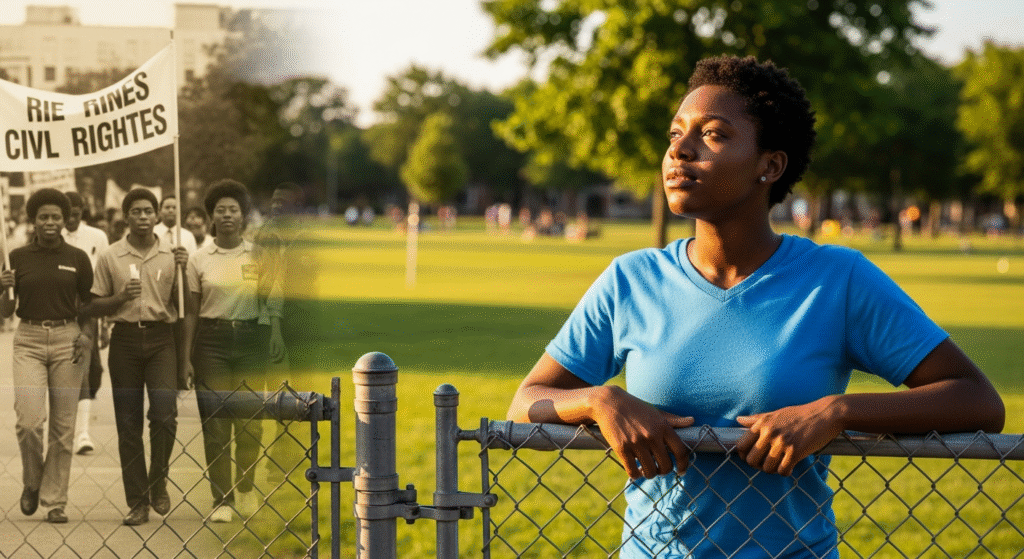
The recent dispute in Perry, Georgia, brings a long history of racial struggle into today’s headlines. In November 2023, the Houston County NAACP spoke out after the city initially banned a mostly Black youth alumni group from holding an event at a public park (13wmaz.com). This controversy, while seemingly isolated, reflects a deeper, persistent fight for equitable access to public spaces for Black Americans across the United States (ideafit.com). The city of Perry ultimately reversed its decision, but the incident continues to raise important questions about fair treatment and the NAACP’s critical role in protecting civil rights (13wmaz.com).
The journey toward equal access has been a foundational part of the Civil Rights Movement. Black Americans historically faced systematic exclusion from public parks and facilities (ideafit.com). Often, especially in the American South, these spaces were segregated by explicit Jim Crow laws and discriminatory practices.
A Legacy of Exclusion in Public Parks
The fight for fair access to public parks runs deep in American history. From the late 1800s through much of the 1900s, state and local statutes known as Jim Crow laws legalized and enforced racial segregation and discrimination against African Americans (britannica.com). These laws mandated separate facilities for Black and white people, creating a system akin to apartheid (britannica.com). For example, these laws enforced segregation in schools, hospitals, transportation, and public restrooms (britannica.com). They also systematically denied African Americans the right to vote through poll taxes and literacy tests (britannica.com).
Under Jim Crow, Black Americans were routinely kept out of many national, state, and local parks, or they were relegated to inferior “separate but equal” facilities (ideafit.com). The “separate but equal” doctrine was a legal principle allowing racial segregation as long as facilities were ostensibly equal (uslegalforms.com). This principle was established by the Supreme Court case *Plessy v. Ferguson* in 1896 (cornell.edu). However, facilities for Black people were almost always poorly maintained and lacked essential amenities, making the “equal” part a lie (uslegalforms.com). This era created what some critics call “white wildernesses,” where Black communities felt unwelcome and unsafe (ideafit.com). This term highlights that outdoor spaces have historically been mainly associated with white populations, often leaving out people of color (wikipedia.org). It also connects to how Jim Crow laws and redlining limited nature access for Black communities (wikipedia.org).
Historical Impact of Redlining on Green Spaces
This chart illustrates the disparity in green space access due to historical redlining policies ((electroiq.com), (chicagopolicyreview.org)).
Furthermore, the historical practice of “redlining” continues to affect Black communities (ideafit.com). Redlining is a discriminatory practice, historically implemented through federal housing policies, where services and financial opportunities were systematically denied to residents of specific neighborhoods based on race (scribbr.com). This practice involved marking areas, typically with many minority residents, as “high-risk” on maps, limiting investments and mortgages (scribbr.com). This systematic denial of resources led to the devaluation of properties in redlined areas (scribbr.com). Redlining also contributed significantly to racial segregation in housing (scribbr.com). These communities often remain hotter because they lack green spaces, showing the long-lasting impact of these policies (ideafit.com).
The NAACP’s Fight for Equality
The National Association for the Advancement of Colored People, or NAACP, founded in 1909, has been a leading force against racial segregation (ideafit.com). This organization used legal action, political lobbying, and grassroots organizing to achieve its goals (ideafit.com). Their legal strategy was crucial in challenging the “separate but equal” doctrine (ideafit.com). This doctrine was, as mentioned, established by *Plessy v. Ferguson*, which upheld segregation if facilities were supposedly equal (cornell.edu). Homer Plessy, a man of mixed racial heritage, famously refused to sit in a car for Black passengers on a Louisiana train in 1892, leading to this case (cornell.edu). The Supreme Court ruled that segregation did not violate the Fourteenth Amendment’s Equal Protection Clause (cornell.edu).
The NAACP’s persistent efforts led to the landmark Supreme Court decision in *Brown v. Board of Education* in 1954 (ideafit.com). This ruling declared state-sponsored segregation in public schools unconstitutional (wikipedia.org). The Court’s unanimous decision overturned “separate but equal” as it applied to public education (wikipedia.org). Chief Justice Earl Warren famously stated that “separate educational facilities are inherently unequal,” harming Black children’s opportunities (wikipedia.org). This pivotal moment legally dismantled segregation in public education (wikipedia.org).
The Georgia NAACP, established in 1917, played a crucial role in these statewide and national efforts (ideafit.com). A notable early achievement was the *Holmes v. Atlanta* case in 1955 (ideafit.com). This Supreme Court case ordered the desegregation of public golf courses in Atlanta, Georgia, extending the principle of *Brown v. Board of Education* beyond schools to other public accommodations (equalrightstrust.org). The Court made this decision without full argument, relying on the *Brown* precedent (equalrightstrust.org). This ruling signaled that segregation’s legal dismantling would apply to other state-sponsored public services and amenities (equalrightstrust.org). Furthermore, the Georgia NAACP also greatly contributed to voter registration drives (ideafit.com). They fought against voting rights discrimination, which led to more African Americans registering to vote (ideafit.com). These combined efforts paved the way for critical legislative victories such as the Civil Rights Act of 1964 and the Voting Rights Act of 1965 (ideafit.com). The Civil Rights Act outlawed discrimination based on race, color, religion, sex, or national origin in public accommodations and employment (oyez.org). The Voting Rights Act specifically targeted discriminatory voting practices like literacy tests (oyez.org). Recognizing the challenges faced by Black youth, the NAACP also established its Youth & College Division in 1936 (ideafit.com). This division aims to develop future civil rights leaders and ensure equal rights for young Black Americans (ideafit.com).
The Perry Incident: A Modern Echo
In November 2023, the city of Perry, Georgia, experienced a civil rights dispute (13wmaz.com). The controversy began when the city initially banned an organizer, Kirenski Wilkerson, and a Perry High School alumni group from using city spaces (13wmaz.com). This ban followed a “tailgate-style event” held on November 1 (13wmaz.com). Wilkerson was an organizer for the Perry High School alumni group’s event ((13wmaz.com), (wikipedia.org)). While her specific title within the group is not publicly detailed, she was consistently linked to the event’s planning and the subsequent dispute (wikipedia.org). The city officials said the ban was due to “large amounts of trash” and “damaged landscaping and underground irrigation lines” (13wmaz.com).
The term “tailgate-style event” implies an informal, outdoor gathering often involving food, drinks, and socializing, sometimes near parking areas (quora.com). Such events can typically involve portable grills, coolers, and disposable items, which could increase trash (quora.com). City park rules often cover waste disposal, open flames, and noise levels for large gatherings (quora.com). Therefore, the city’s complaints about damage and trash suggest a direct link between the event style and the alleged violations (quora.com).
However, Houston County NAACP President Jonathan Johnson quickly alleged that discrimination played a role in the city’s decision (13wmaz.com). Johnson stated that Wilkerson had followed all city rules (13wmaz.com). The NAACP’s role, Johnson explained, is to support residents who feel targeted and to prevent similar incidents (13wmaz.com). The available public information offers contradictory claims, without detailing the specific park rules the city alleged were broken (ferris.edu). The dispute appears to center on whether the event actually violated park policies or if the enforcement was discriminatory (ferris.edu).
Unresolved Concerns and Future Steps
Following community pushback and public pressure, the city of Perry reversed its decision (13wmaz.com). City leaders met with representatives of the alumni group on November 24, 2023, to address concerns and agree on resolutions (13wmaz.com). The city claimed all parties were satisfied with the outcome (13wmaz.com). However, Jonathan Johnson of the NAACP indicated that ongoing concerns remained (13wmaz.com). Publicly available information does not provide specific details about these “resolutions” (vcu.edu). It is unclear whether they involved policy changes, specific actions, or financial agreements (vcu.edu). This lack of detail makes it difficult to fully understand the scope of the reversal and if it truly addressed the underlying issues (vcu.edu).
Johnson also stated that the NAACP still seeks a clear review of park rules (13wmaz.com). Furthermore, they want proof that Black groups will not face similar discriminatory actions in the future (13wmaz.com). This request for “proof” suggests a need for tangible and verifiable measures, beyond just verbal assurances (study.com). This could include institutional changes within the city’s park and recreation department to ensure rules are applied fairly (study.com). The NAACP might also seek a transparent permit approval process, with clear guidelines for event organizers (study.com). This Perry incident is not unique for the Houston County NAACP. The chapter actively addresses alleged racial discrimination in other local contexts, including advocating against racial profiling during traffic stops by state troopers (ideafit.com).
Perception of Discrimination in the U.S. (2023)
This chart shows the percentage of different groups who believe Black people face “at least some” or “a lot” of discrimination as of 2023 (pewresearch.org).
The Enduring Struggle for Equitable Access
Despite legal advancements, racial disparities in access to and experience within public spaces remain clear (ideafit.com). Studies show that areas with higher Latinx and African-American populations often have less access to green spaces than mostly white neighborhoods (ideafit.com). When parks do exist in Black neighborhoods, they are often smaller and more crowded (ideafit.com). Research from the CDC also found that non-Hispanic Black individuals are more likely than non-Hispanic White individuals to report encountering barriers when trying to use community parks (cdc.gov). They also have lower odds of actively visiting parks (cdc.gov).
A significant majority of Americans, 74% in 2023, believe that Black people face at least some discrimination (pewresearch.org). Black adults are especially affected, with 70% reporting they face “a lot” of discrimination, compared to 28% of white adults (pewresearch.org). Beyond public accommodations, racial discrimination persists in areas such as employment and housing (ideafit.com). Nearly 57% of Black Americans experience discrimination in pay and promotion (ideafit.com). Also, 31% report it when seeking accommodation (ideafit.com). These numbers highlight that the struggle for equality continues in many facets of life.
The conclusion of the initial research mentioned “implicit bias.” Implicit bias refers to the unconscious attitudes or stereotypes that affect our understanding, actions, and decisions towards people (simplypsychology.org). These biases are automatic and unintentional (simplypsychology.org). They can influence a wide range of decisions, including how city officials might react to different groups using public spaces (simplypsychology.org). Psychologists Mahzarin Banaji and Anthony Greenwald first used the term “implicit bias” in 1995, arguing that unconscious associations influence social behavior (simplypsychology.org). This highlights the complex, subtle ways discrimination can still operate today. The Perry, Georgia park ban incident reminds us that while explicit segregation is legally forbidden, the fight for true equity and against implicit bias and systemic discrimination is still ongoing (ideafit.com). The historical context reveals a long battle for access and fairness (ideafit.com). This is a battle that the NAACP continues to wage through advocacy, legal challenges, and community organizing (ideafit.com). Their work ensures that all individuals, regardless of race, can freely and equally enjoy public resources (ideafit.com).
About the Author
Darius Spearman is a professor of Black Studies at San Diego City College, where he has been teaching for over 20 years. He is the founder of African Elements, a media platform dedicated to providing educational resources on the history and culture of the African diaspora. Through his work, Spearman aims to empower and educate by bringing historical context to contemporary issues affecting the Black community.
