

Ghana UN Resolution: A Bold Path for Slave Trade Reparations
By Darius Spearman (africanelements)
Support African Elements at patreon.com/africanelements and hear recent news in a single playlist. Additionally, you can gain early access to ad-free video content.
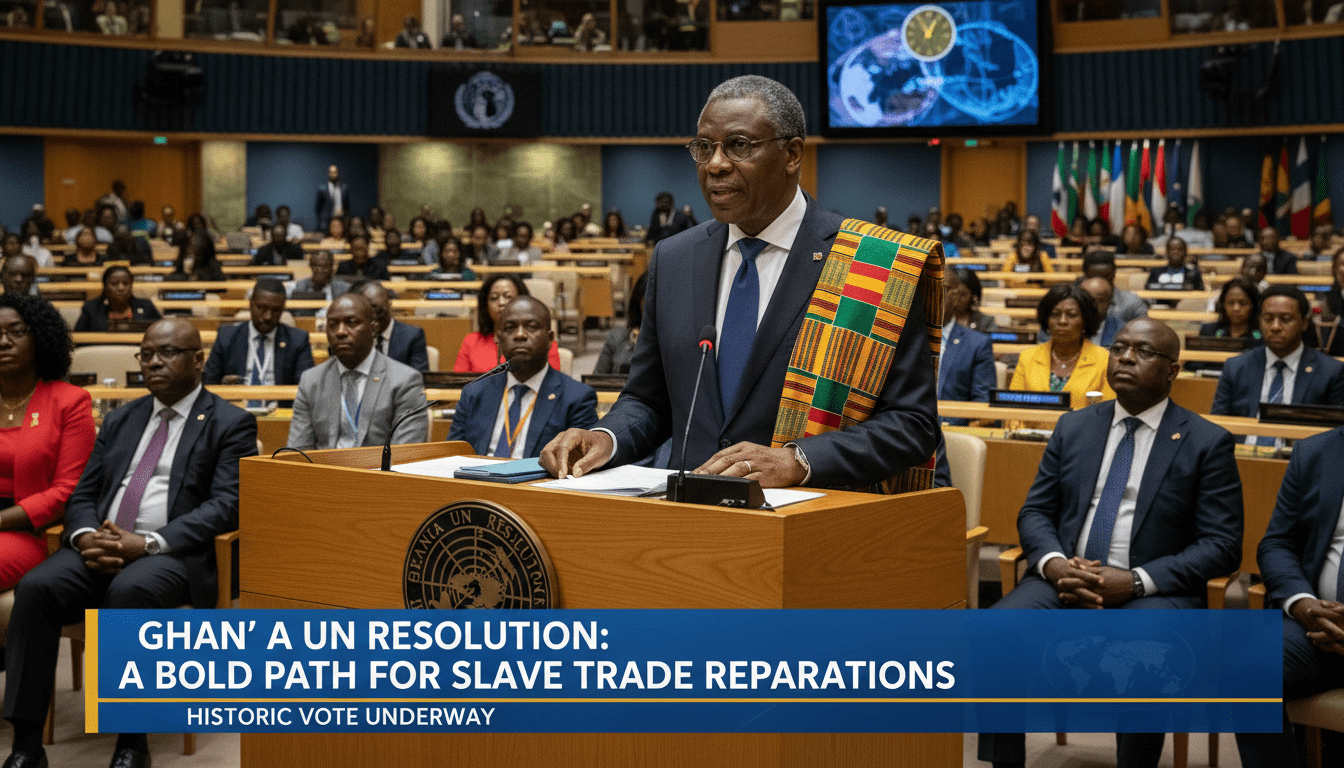
The government of Ghana is making a historic move on the world stage this month. President John Dramani Mahama recently confirmed that Ghana will formally table a resolution at the United Nations General Assembly. This resolution seeks to recognize the Transatlantic Slave Trade as the “gravest crime against humanity.” This is more than a symbolic gesture. It is a calculated legal strategy to create a formal path for international reparations. The announcement followed a major African Union summit where leaders unified their voices for justice (myjoyonline.com, au.int).
For centuries, the story of the slave trade has been told through the lens of tragedy. However, this new resolution shifts the focus toward legal accountability. By defining the trade as a crime against humanity, Ghana aims to unlock legal mechanisms that have been closed for generations. This effort is not happening in a vacuum. It is the result of decades of work by scholars, activists, and diplomats across Africa and the Caribbean. The world is now watching to see how the international community responds to this demand for restorative justice (justsecurity.org, reparationscomm.org).
The Long Fight for Legal Recognition
The journey to classify the slave trade as a crime against humanity did not start today. International efforts to address slavery began as far back as the 1926 Slavery Convention. While that treaty aimed to stop future trade, it did not focus on punishing the historical crimes of the Transatlantic trade. For a long time, the legal world treated slavery as a tragic part of history rather than a criminal act requiring compensation. This lack of accountability allowed the wealth gap between colonizers and the colonized to grow unchecked (un.org).
A major turning point occurred in 2001 at the World Conference against Racism in Durban, South Africa. For the first time, a UN-sponsored resolution stated that the Transatlantic Slave Trade was a crime against humanity and should always have been so. This was a critical milestone. It established a moral foundation for the current legal claims. However, even after Durban, many Western nations resisted the idea of financial restitution. They preferred to offer apologies instead of payment. This resistance is exactly what Ghana is trying to overcome with its new UN resolution (un.org, ictj.org).
The Pan-African movement also played a vital role during the 1990s. The Organization of African Unity formed the Group of Eminent Persons to push for recognition. This group helped create the 1993 Abuja Proclamation. That document declared that an “unprecedented moral debt” was owed to African people. It argued that this debt must be paid to ensure future global stability. These earlier movements laid the groundwork for President Mahama to take his current lead at the United Nations (myjoyonline.com, au.int).
Defining the Gravest Crime
To understand why this resolution matters, one must understand the term “Jus Cogens.” In international law, Jus Cogens refers to fundamental principles that are universally binding. These norms protect the most basic human values, such as the prohibition of genocide and slavery. They are so high in authority that no nation can ignore them. Any treaty that goes against these norms is considered void. Ghana is pushing to have the historical slave trade recognized under this highest tier of law (justsecurity.org).
If the slave trade is accepted as a Jus Cogens violation, it changes everything. Standard laws usually have a “statute of limitations.” This means that after a certain amount of time, a crime cannot be prosecuted. However, crimes against humanity do not have such limits. By elevating the trade to this status, legal scholars argue that the obligation for restitution becomes permanent. It does not matter that the trade ended over a century ago. The legal responsibility for the harm remains active (justsecurity.org, ictj.org).
This legal theory is what makes the resolution a threat to former colonial powers. It moves the conversation away from “charity” and toward “debt.” When a crime is committed, the victim is entitled to repair. In this case, the victims are the millions of Africans whose labor built the modern Western world. This resolution challenges the idea that history can simply be forgotten without a settlement. It forces the world to treat the slave trade with the same legal seriousness as more recent historical crimes (ictj.org).
Ghana Takes the Lead
Ghana has emerged as the primary diplomatic bridge for this cause. In late 2023, the country hosted the Accra Reparation Conference. During this event, delegates agreed to establish a Global Reparation Fund. Former President Nana Akufo-Addo argued that if victims of other historical tragedies could be compensated, Africans should be too. He compared the need for slave trade reparations to the compensation given to survivors of the Holocaust. This stance positioned Ghana as a champion for the entire continent (myjoyonline.com, presidency.gov.gh).
President John Dramani Mahama has taken this mandate to the next level. He was appointed the AU Champion for Advancing the Cause of Justice and Reparations. At the 39th AU Summit in 2026, he secured a unanimous agreement for Ghana to lead the UN resolution. This unity is vital. It means Ghana is not speaking for itself alone. It is speaking for 55 African nations. This collective power creates a massive voting block in the UN General Assembly that is difficult for other nations to ignore (au.int, presidency.gov.gh).
The timing of the resolution is also strategic. It is scheduled to be tabled on March 25, 2026. This date is the International Day of Remembrance of the Victims of Slavery. By choosing this day, Ghana ensures the maximum amount of global attention. It also aligns with the African Union’s “Decade of Reparations.” This ten-year plan aims to transform the political and economic landscape for African people. The goal is to move from remembering a tragedy to litigating a crime (myjoyonline.com, africa-news-agency.com).
The Financial Weight of History
The scale of the reparations being discussed is massive. In 2023, the Brattle Group released a landmark report on the economic impact of the slave trade. They calculated that 31 former slave-owning nations owe a total of over $100 trillion in reparations. This figure was reached by looking at the unpaid labor of millions of people over several centuries. They also factored in inflation and compound interest. This data provides a specific financial basis for the UN discussions (prnewswire.co.uk, prnewswire.com).
According to this research, the United Kingdom alone owes roughly $24 trillion for its role in the trade. These numbers illustrate the “stolen wealth” that fueled the Industrial Revolution in Europe. While Western nations were building infrastructure and schools, Africa was being drained of its most productive people. Economic research suggests that without the slave trade, the income gap between Africa and the rest of the world might not exist today. The trade primarily targeted people between the ages of 16 and 35, which decimated the continent’s workforce (prnewswire.co.uk, eji.org).
The impact on families was also devastating. The trade broke apart lineages and destroyed social structures. To understand the depth of this trauma, one must consider the survival of African American families through centuries of forced separation. This historical fracture is part of why reparations advocates argue for a “Global Reparation Fund.” The fund would not just be about individual checks. It would be about repairing the systems that were broken by the slave trade (prnewswire.co.uk, eji.org).
The Reparations Calculation
Based on the 2023 Brattle Group Report (prnewswire.co.uk, prnewswire.com).
A Global Front for Reparations
Ghana is not acting alone in this quest for justice. A powerful alliance has formed between the African Union and the Caribbean Community, known as CARICOM. CARICOM represents 15 nations that have also been deeply affected by the legacies of slavery. In 2013, they established a Reparations Commission and created a Ten-Point Plan for Reparatory Justice. This plan includes demands for formal apologies, debt cancellation, and technology transfer to help rebuild their economies (reparationscomm.org, fairplanet.org).
This “Global Africa” diplomatic offensive is changing the balance of power at the United Nations. By joining forces, African and Caribbean nations can push for resolutions that were previously ignored. They are working together to ensure that the UN treats reparations as a global priority. This unity is essential because many former colonial powers still use their influence to block these discussions. For example, the United Kingdom has recently stated that it will not offer cash reparations, citing historical complexity as a reason for its refusal (myjoyonline.com, fairplanet.org).
The resolution also seeks to address the modern issue of sovereign debt. Many post-colonial nations are forced to pay massive amounts of interest to the same countries that once colonized them. Proponents of the resolution argue that this debt is a direct result of colonial exploitation. They believe that canceling these debts is a necessary form of restitution. This would allow developing nations to invest in healthcare and education rather than paying for the “stolen wealth” of the past (myjoyonline.com, reparationscomm.org).
The Dark Reality of the Middle Passage
At the heart of the legal argument is the Middle Passage. This was the brutal voyage across the Atlantic that millions of kidnapped Africans were forced to endure. Between 1500 and 1866, an estimated 12.5 million people were put on ships. Only about 10.7 million survived the journey. The mortality rate was nearly 15 percent, with roughly 1.8 million deaths at sea. These people died from disease, starvation, and violence (eji.org, youtube.com).
The conditions on these ships were beyond horrific. People were chained together in spaces so small they could not stand or even turn. These ships were floating prisons designed to maximize profit at the expense of human life. This historical “crime scene” is used by experts to justify the “gravest crime” designation. It highlights the deliberate nature of the violence. The Middle Passage was not an accident of history. It was a state-sponsored system of kidnapping and murder (eji.org, youtube.com).
The legal case also looks at the long-term demographic damage to Africa. The continent lost millions of its healthiest people during the peak of the trade. This loss made African nations more vulnerable during the “Scramble for Africa” in the late 19th century. During this time, European powers divided the continent without any African representation. This history shows how the slave trade and colonialism worked together to strip the continent of its wealth and agency (fairplanet.org).
Debt and Colonial Legacies
Historical crimes often have modern financial consequences. One of the most famous examples is Haiti. After winning its independence, Haiti was forced to pay France for the “loss” of enslaved people. This debt took over a century to pay off and crippled the nation’s economy. The lessons from the Haitian Revolution show how legal and financial systems were used to punish those who fought for freedom. Ghana’s resolution seeks to prevent this kind of exploitation from continuing in the future (justsecurity.org, reparationscomm.org).
Modern sovereign debt is often seen as a continuation of this colonial legacy. Many nations inherited economies that were built only to export raw materials. They had to borrow money from their former colonizers just to build basic infrastructure like roads and hospitals. Today, debt servicing consumes a huge portion of their budgets. Reparations advocates argue that this is an unfair burden. They believe that true justice must include the removal of these financial chains (myjoyonline.com, reparationscomm.org).
The resolution also addresses the return of cultural artifacts. During the colonial era, thousands of precious items were stolen and placed in European museums. Ghana is demanding the return of these items as part of the “restoration” pillar. Returning these artifacts is about more than just art. It is about restoring the dignity and history of African nations. This is a key part of the broader plan to repair the damage done by centuries of exploitation (myjoyonline.com, au.int).
The Three Strategic Pillars
The Path Toward Restorative Justice
The resolution proposed by Ghana represents a shift toward “restorative justice.” This type of justice focuses on healing the harm rather than just punishing the offender. The proposed Global Reparation Fund would be managed by international agencies and representatives from the African Union and CARICOM. The fund would focus on systemic repair. This includes long-term investments in education, healthcare, and housing for communities of descendants (myjoyonline.com, prnewswire.com).
Currently, the international political climate is complex. President Donald Trump currently leads the United States, and his administration’s response to this resolution will be critical. While a UN resolution is “soft law” and not immediately binding in U.S. courts, it carries immense political weight. It provides a framework that activists can use to pressure domestic governments. For example, it could strengthen the case for the HR 40 bill in the United States, which aims to study reparations for African Americans (justsecurity.org, prnewswire.com).
The success of this resolution depends on global solidarity. It requires the descendants of the enslaved and the nations of Africa to speak with one voice. The history of the U.S. Constitution and slavery shows how deeply these issues are woven into the fabric of modern nations. Ghana’s move at the UN is a challenge to that fabric. It asks the world if it is ready to finally settle the accounts of the past. As March 2026 approaches, the demand for justice is only growing louder (myjoyonline.com, africa-news-agency.com).
About the Author
Darius Spearman is a professor of Black Studies at San Diego City College, where he has been teaching for over 20 years. He is the founder of African Elements, a media platform dedicated to providing educational resources on the history and culture of the African diaspora. Through his work, Spearman aims to empower and educate by bringing historical context to contemporary issues affecting the Black community.
