
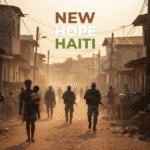


Haiti Gang Force: A New Hope or History Repeating?
By Darius Spearman (africanelements)
Support African Elements at patreon.com/africanelements and hear recent news in a single playlist. Additionally, you can gain early access to ad-free video content.
The arrival of a new international security force in Haiti marks a critical moment for the world’s first Black republic. The United Nations has approved a Gang Suppression Force (GSF) to take over from the earlier Multinational Security Support (MSS) mission (securitycouncilreport.org). This new force is tasked with a monumental challenge: confronting the powerful gangs that have seized control of much of the capital, Port-au-Prince (globalinitiative.net). For Haitians living under a constant state of terror, this intervention brings a desperate hope for protection. Yet, this hope is shadowed by the heavy weight of history. Past foreign interventions have left deep scars, from deadly disease outbreaks to severe human rights abuses, leaving many to wonder if this time will truly be different (wikipedia.org).
The GSF, authorized to conduct both military and intelligence operations, aims to restore some semblance of order (securitycouncilreport.org). The first group of Kenyan police officers, leading the mission, landed in Port-au-Prince on June 25, 2024, beginning the deployment ((apnews.com), (nation.africa)). This action follows years of escalating violence and a near-total collapse of state authority. Understanding the GSF’s potential for success or failure, however, requires looking beyond the immediate crisis. The story of this mission is deeply entangled with Haiti’s long and painful history of political instability and the troubled legacy of those who came before to help.
The Lingering Shadow of Past UN Missions
Haiti’s relationship with United Nations peacekeepers is complicated and painful. The most significant mission, MINUSTAH, operated from 2004 to 2017 and is remembered for its profound and devastating failures (oclc.org). In October 2010, nine months after a catastrophic earthquake, Haiti suffered a massive cholera outbreak (nih.gov). Investigations later traced the source to a MINUSTAH base where poor sanitation allowed Nepalese peacekeepers to contaminate the Artibonite River (oclc.org). For years, the UN denied its role in the epidemic that infected over 800,000 Haitians and killed an estimated 10,000 people (nih.gov).
The UN eventually accepted moral responsibility in 2016, launching a “New Approach” to the crisis (un.org). This two-track plan was meant to provide material assistance to victims and improve Haiti’s water and sanitation systems (un.org). However, the initiative was widely criticized as inadequate. The UN never admitted legal responsibility, and the project remained severely underfunded, with only a fraction of the necessary $400 million ever raised (un.org). In addition to disease, the MINUSTAH mission was plagued by countless allegations of sexual exploitation and abuse, including peacekeepers trading sex for food with minors (tandfonline.com). Peacekeepers were also accused of using excessive force, such as firing into crowds during protests and raids, which resulted in civilian deaths (cepr.net).
The Human Cost of Gang Violence in Haiti, 2024
Each circle stands for people hurt in one way during 2024.
From Duvalier’s Dictatorship to a Power Vacuum
To understand why Haiti needs a gang suppression force, one must understand the origin of the gangs themselves. Their roots are deeply connected to Haiti’s political history, tracing back to the brutal dictatorship of François “Papa Doc” Duvalier in the late 1950s (wikipedia.org). Duvalier created a paramilitary force known as the Tonton Macoute to terrorize the population and crush any opposition ((aaregistry.org), (britannica.com)). After the Duvalier regime fell in 1986, many former militia members formed mercenary gangs, selling their services to politicians and wealthy business interests (wikipedia.org). Over time, Haitian leaders grew dependent on these armed groups to maintain power, especially without a strong national police or army (wikipedia.org).
The nation’s instability was further compounded by political turmoil. Jean-Bertrand Aristide, a former priest and champion for the poor, became Haiti’s first democratically elected president in 1990 (sjf.edu). He was overthrown in a 1991 coup, restored to power with U.S. help in 1994, but was ousted again in 2004 during a violent rebellion (wikipedia.org). His departure, which some claim was forced by foreign powers, created a power vacuum that led to the UN’s MINUSTAH mission ((wikipedia.org), (wikipedia.org)). More recently, the assassination of President Jovenel Moïse in July 2021 created another massive void (hrw.org). This event triggered an unprecedented spiral of violence as gangs rapidly expanded their territory and influence, bringing the nation to its knees (globalinitiative.net).
A Nation Gripped by Unprecedented Violence
The humanitarian crisis in Haiti today is staggering. Gangs are estimated to control between 80% and 90% of Port-au-Prince and are expanding their reach into other parts of the country (globalinitiative.net). The violence has reached horrific levels. In 2024 alone, at least 5,601 people were killed, over 2,200 were injured, and nearly 1,500 were kidnapped due to gang violence (reliefweb.int). The bloodshed continued into the next year, with over 1,500 people killed in just the first quarter of 2025 (reliefweb.int).
This terror has forced a massive wave of displacement. By October 2025, a record 1.4 million people had been forced from their homes, a 24% increase from late 2024 (iom.int). Children make up more than half of this displaced population (reliefweb.int). Women and girls face extreme risks, with sexual violence used as a weapon of terror by gangs (ohchr.org). Between January and August of 2025, over 6,400 cases of gender-based violence were reported, half of which were rapes (ohchr.org). The crisis has also fueled extreme hunger, with over half of Haiti’s population, or 5.4 million people, not having enough to eat (reliefweb.int).
Haiti’s Exploding Displacement Crisis
Data shows the rapid increase in internally displaced persons in Haiti due to gang violence (iom.int).
Haiti’s Security Forces: Outnumbered and Outgunned
The Haitian National Police (HNP) is the primary force the GSF is meant to support, but it is in a dire state. The HNP is severely understaffed, with only around 13,200 active officers for a country of over 11 million people (globalr2p.org). This number is far below the UN-recommended ratio for effective policing (globalr2p.org). Furthermore, the police are frequently outgunned by gangs who possess military-grade weapons, making any confrontation incredibly dangerous for the officers (amnesty.org). Gangs have also systematically destroyed or stolen police equipment, further weakening the HNP’s ability to respond (globalinitiative.net).
Haiti’s armed forces offer little reinforcement. The army has a long and troubled history of interfering in politics and committing human rights abuses (wikipedia.org). It was disbanded by President Aristide in 1995 but was controversially brought back in 2017 (wikipedia.org). In the face of such a deeply entrenched crisis and with its own security apparatus overwhelmed, the Haitian government made a desperate plea for international help. This plea eventually led to the authorization of a new foreign security mission.
A New Mission With a Different Structure
The path to the current GSF was a multi-step process. The UN Security Council first authorized the Multinational Security Support (MSS) mission on October 2, 2023, with Resolution 2699 (securitycouncilreport.org). A UN Security Council Resolution is a formal decision that is legally binding on all UN member states, carrying the force of international law (roger-peltzer.com). This is much stronger than a simple endorsement. Subsequently, on September 30, 2025, the Security Council adopted Resolution 2793, which officially transitioned the MSS into the more robust Gang Suppression Force (securitycouncilreport.org).
Crucially, the GSF is explicitly *not* a United Nations operation, even though the Security Council authorized it (justsecurity.org). This distinction is important. It means accountability for the force’s actions rests with the countries contributing troops, especially the lead nation of Kenya, not the UN itself (justsecurity.org). Likewise, funding comes from voluntary donations from countries instead of the UN’s formal peacekeeping budget, which creates financial uncertainty (justsecurity.org). The command structure also follows Kenyan doctrine rather than standardized UN peacekeeping rules (stimson.org). While UN authorization provides legitimacy, some worry this structure could be perceived on the ground as an intervention by specific countries rather than a neutral international body (justsecurity.org).
Gang Control in Port-au-Prince
The meter shows how much of Haiti’s capital gangs control in 2024.
An Uncertain Path Forward
The new Gang Suppression Force faces immense challenges. The mission has been plagued by chronic underfunding and has struggled to secure enough personnel (thenewhumanitarian.org). Kenya, for example, pledged 1,000 officers but had only deployed 400 by late 2024 (nation.africa). Just months into the initial MSS deployment, there was little visible improvement in security, and Kenyan officers had already suffered casualties in firefights (nation.africa). Furthermore, the mission is deploying into a political landscape marked by a profound power vacuum. After President Moïse’s assassination, Prime Minister Ariel Henry led a de facto government with no constitutional mandate (miamiherald.com). A Transitional Presidential Council was established in April 2024, but Haiti still lacks a functioning parliament or an elected president (miamiherald.com).
Perhaps most concerning is the lack of a clear operational framework and rules of engagement for the GSF (ipinst.org). Without precise guidelines on how to use force and interact with civilians, there is a high risk of excessive force, civilian casualties, and a repeat of past abuses (ipinst.org). The long-term goals also remain ambiguous. While the GSF aims to help the HNP restore order and create conditions for elections, there is no clearly defined exit strategy (stimson.org). For many Haitians and observers, this raises the troubling possibility of another prolonged, open-ended foreign presence. The GSF’s arrival is a gamble born of desperation, embodying both the hope for a safer future and the fear of a painful past.
About the Author
Darius Spearman is a professor of Black Studies at San Diego City College, where he has been teaching for over 20 years. He is the founder of African Elements, a media platform dedicated to providing educational resources on the history and culture of the African diaspora. Through his work, Spearman aims to empower and educate by bringing historical context to contemporary issues affecting the Black community.
