

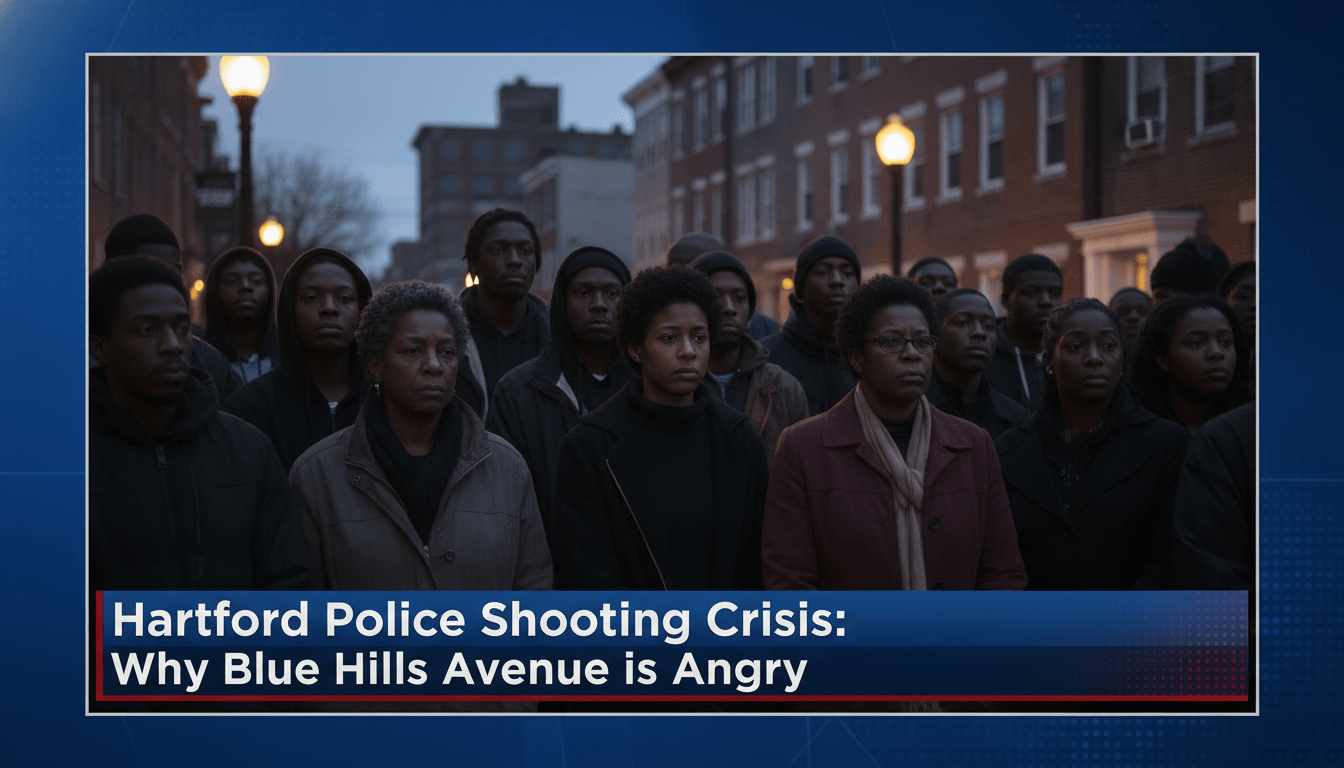
Hartford Police Shooting Crisis: Why Blue Hills Avenue is Angry
By Darius Spearman (africanelements)
Support African Elements at patreon.com/africanelements and hear recent news in a single playlist. Additionally, you can gain early access to ad-free video content.
A Quick Escalation on Blue Hills Avenue
The neighborhood of Blue Hills in Hartford, Connecticut, is facing a heavy moment of grief and anger. On February 27, 2026, a police officer shot a man who was having a mental health crisis. Neighbors knew the man as “Stevie,” though officials later identified him as James. He was holding a knife when the police arrived. The interaction lasted only thirty seconds before the officer fired his weapon multiple times. This rapid use of force has left the community demanding answers from city leaders (hartfordct.gov).
The incident did not happen in a vacuum. It occurred only nine days after another fatal police shooting in the city. On February 19, 2026, fifty-three-year-old Everard Walker was killed on Capitol Avenue. In that case, mental health workers had actually asked for police to help them with a crisis call. The outcome was tragic. These two events have forced the people of Hartford to look closely at how the city handles people in distress. Many residents feel that the police are too quick to use their guns instead of trying to talk people down (stamfordadvocate.com, apnews.com).
Video of the Blue Hills shooting spread across social media platforms like Facebook almost immediately. The footage shows the officer arriving and the shooting happening very fast. Activists argue that the officer did not leave any time for a mental health evaluation. This visual evidence has fueled a firestorm of protests. People are pushing for more transparency from the Hartford Police Department. They want to see the body camera footage and hear the full story of why de-escalation was not the first priority (fox61.com, ctinsider.com).
The End of Fifty Years of Oversight
To understand the current tension, one must look back at the long legal history of the Hartford Police Department. For fifty years, the department was under a federal court order. This order started with a lawsuit in 1969 called Cintron v. Vaughn. Maria Cintron filed the case after a white man hit her son with a stick, and a police officer refused to arrest the attacker. This event was a breaking point for the Black and Puerto Rican communities in Hartford who were tired of police abuse (hartfordct.gov, daretostruggle.org).
The lawsuit led to a consent decree in 1973. A consent decree is a legal agreement that requires a department to make specific changes. In Hartford, this meant the police had to improve how they hired minority officers and how they investigated complaints of brutality. It was one of the longest-running police oversight cases in United States history. The goal was to make the police force look more like the city it served and to ensure that officers followed the law (hartfordct.gov, hartfordct.gov).
In April 2023, a federal judge decided to end this oversight. Judge Kari Dooley ruled that the plaintiffs did not prove there were still ongoing civil rights violations. However, many community leaders and members of the NAACP disagreed. They pointed out that the police department still did not match the racial makeup of the city. While the city is about 84 percent minority, the police force remained mostly white. Activists believe that ending the decree too early created a gap in accountability that led directly to the shootings in 2026 (daretostruggle.org).
Defunding the Helpers
In the years after the 2020 protests for racial justice, Hartford tried something new. The city created the Hartford Emergency Assistance Response Team, also known as the HEARTeam, in 2022. This program was designed to send social workers and peer responders to 911 calls involving mental health or substance use. Peer responders are people who have lived through similar struggles and can relate to those in crisis. They provide a different kind of safety than armed officers do (ctpublic.org, steinberginstitute.org).
The HEARTeam was a success in its early years. Between 2022 and 2025, the team handled over 2,000 calls. Many of these situations were resolved without any violence or arrests. It showed that having a mental health expert on the scene could save lives. However, the funding for this program came from federal money provided during the COVID-19 pandemic. When that money started to run out in early 2026, the city made a difficult and controversial choice (steinberginstitute.org).
In January 2026, just weeks before the shooting on Blue Hills Avenue, the city scaled back the HEARTeam. They cut two million dollars from the budget. This meant the team could no longer work on weekends or in the evenings. Contracts with organizations like the Wheeler Clinic were ended. At the same time, the budget for the police department remained at fifty-five million dollars. Critics argue that if the HEARTeam had still been fully funded, they might have been the ones to respond to “Stevie,” and he might not have been shot (steinberginstitute.org, daretostruggle.org).
The Heart of the North End
Blue Hills Avenue is a central part of the North End of Hartford. For generations, it has been a place where the Black middle class built homes and businesses. It is a neighborhood with a long history of standing up for its rights. However, the physical and political landscape of the area has changed over time. The construction of Interstate 84 years ago acted as a wall that separated the Black community from the resources of downtown Hartford (daretostruggle.org).
The neighborhood has also struggled with political dynamics that affect how residents receive help. For sixty years, the Blue Hills Civic Association was the voice of the community. It helped organize neighbors and secure funding for local projects. But in early 2026, the association collapsed. An FBI investigation found that millions of dollars in state grants were missing or used improperly. This left the neighborhood without its strongest leadership right when the police shooting occurred (ctinsider.com, daretostruggle.org).
This leadership vacuum makes it harder for residents to push back against city policies. When the HEARTeam was defunded, there was no strong organization to fight for the money to stay. The community is also dealing with high rates of gun violence. While homicides went down in 2025, the number of people who were shot but survived actually went up by three percent. This environment creates a lot of stress for both the people living there and the officers patrolling the streets (daretostruggle.org).
The Struggle for Accountability
Whenever a police officer shoots someone in Connecticut, an independent office must investigate. This office is the Connecticut Office of the Inspector General. It was created in 2020 as part of a new police accountability law. The law says that local prosecutors cannot investigate their own police departments. This change was made to ensure that the investigations are fair and that the public can trust the results (police1.com, ctinsider.com).
The Inspector General must release a preliminary report and the body camera footage shortly after a shooting. In the case of the Blue Hills incident, the officer involved was placed on administrative leave. This is a standard step while the investigation happens. However, the community is looking for more than just a report. They want to see systemic changes that prevent these situations from happening in the first place. They are looking for the elusive nature of true freedom from state violence (ctinsider.com).
Data from the University of Connecticut shows that thirty-four percent of police use-of-force cases in the state involve people in emotional distress. This is a very high number. It suggests that many of the most violent interactions between police and the public are actually mental health crises. Leaders in Hartford are now facing pressure to bring back the full HEARTeam. They want to ensure that social workers are available twenty-four hours a day to prevent another thirty-second tragedy (daretostruggle.org).
Based on 11,000+ distress calls in 2020 (daretostruggle.org)
A Community Looking for Clarity
The current situation in Hartford is a reminder that historical patterns often repeat themselves. The 1969 lawsuit was about the police failing to protect Black residents. Today, the concern is that the police are reacting too aggressively to people in need of medical help. Under President Donald Trump, the federal government has shifted its focus on police reform, leaving more responsibility to local and state leaders. This makes the local battle over the Hartford city budget even more important (daretostruggle.org).
Residents on Blue Hills Avenue continue to see their struggle as a legacy of survival against a system that often fails them. They are calling for “clarity” and “transparency.” These words are not just slogans. They represent a demand for the city to be honest about its spending and its priorities. If the city can find millions of dollars for police equipment, the neighbors argue it can also find money for mental health responders (hartfordct.gov, steinberginstitute.org).
The fallout from the Blue Hills shooting will likely last for a long time. It has sparked a new wave of activism in the North End. People are organizing on the streets and in the city council chambers. They want to make sure that “Stevie” is the last person to be shot because he was having a bad day. The history behind the headlines shows that the people of Hartford have fought these battles before. They are prepared to keep fighting until the city’s approach to public safety truly reflects the needs of its people (daretostruggle.org).
As the investigation into the February 2026 events continues, the eyes of the state are on Hartford. The city has a chance to lead by restoring the HEARTeam and proving that it values the lives of its most vulnerable citizens. Without these changes, the cycle of violence and mistrust is likely to continue. The people of Blue Hills Avenue have made it clear that they will not settle for anything less than a fundamental change in how their neighborhood is policed (hartfordct.gov, daretostruggle.org).
About the Author
Darius Spearman is a professor of Black Studies at San Diego City College, where he has been teaching for over 20 years. He is the founder of African Elements, a media platform dedicated to providing educational resources on the history and culture of the African diaspora. Through his work, Spearman aims to empower and educate by bringing historical context to contemporary issues affecting the Black community.
