

Hidden Costs of Voting: Why New Ballot Rules Hit Black Precincts Hardest
By Darius Spearman (africanelements)
Support African Elements at patreon.com/africanelements and hear recent news in a single playlist. Additionally, you can gain early access to ad-free video content.
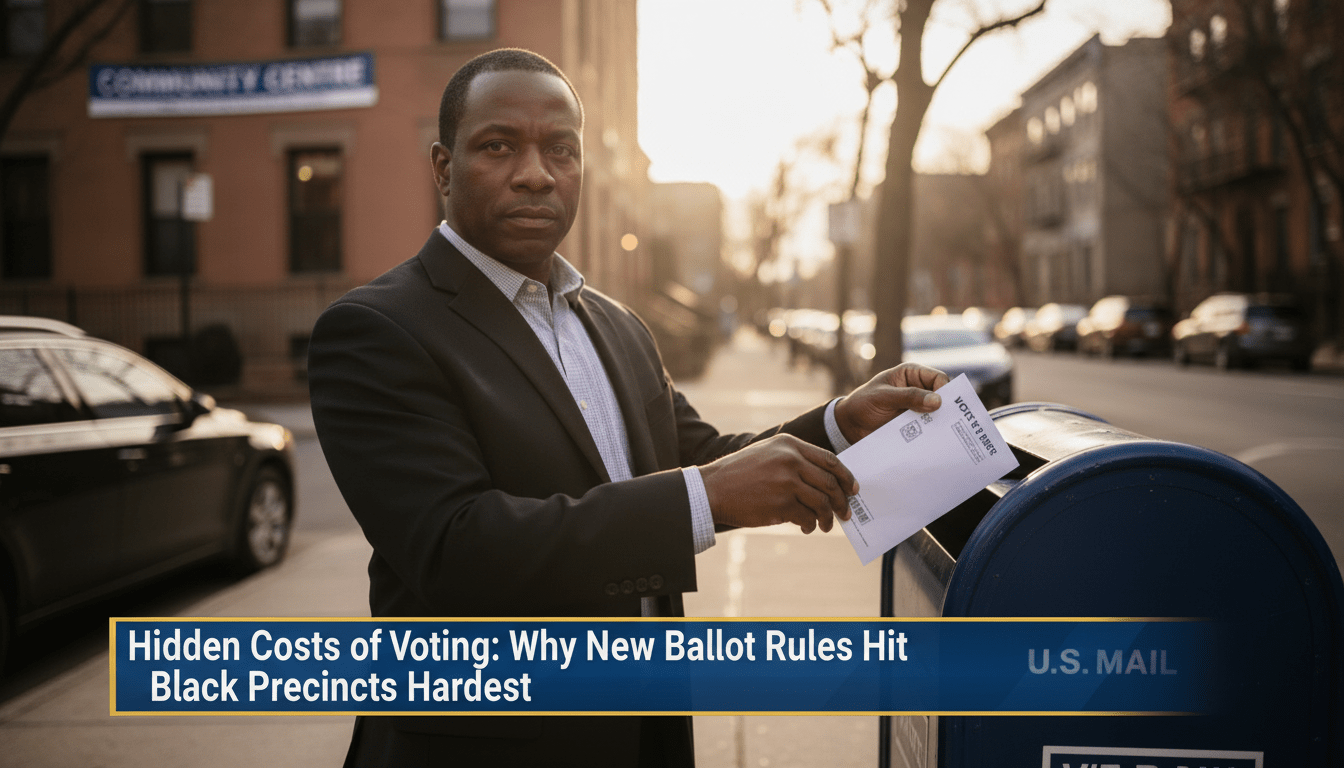
The rules for how people vote are shifting across the country. In early 2026, the Supreme Court took a close look at how states handle mail-in ballots. Many legal experts believe the Court will allow states to reject ballots that arrive after Election Day. This is true even if a voter mailed the ballot on time. This change creates a major hurdle for people who rely on the postal service (newsfromthestates.com).
For Black communities and working-class voters, these technical changes are more than just paperwork. They represent a deep struggle for representation that has lasted for centuries. The current legal battles in states like Maine and California highlight a growing divide in how the law treats different groups of citizens. When the mail slows down or registration lists are scrubbed, the impact is not felt equally across all neighborhoods (theguardian.com).
The Evolution of Election Day and the Postmark Rule
The concept of “Election Day” has not always been a single, strict 24-hour period. In 1845, federal law set the Tuesday after the first Monday in November as the day to choose presidential electors. The goal was to stop people from traveling between states to vote multiple times. However, the system grew more flexible over time. During the Civil War and World War II, states created absentee systems so soldiers could vote from far away (wikipedia.org).
For many years, the “postmark rule” was the standard. This rule assumes that if a voter hands their ballot to the post office by Election Day, they have done their part. It acknowledges that a citizen cannot control how fast the mail moves. During the 2020 pandemic, mail-in voting reached record levels. About 43 percent of voters used the mail that year. Many states responded by extending deadlines to ensure every voice was heard (newsfromthestates.com).
Now, the legal tide is turning back toward a strict “receipt” deadline. In the case of *Watson v. Republican National Committee*, the Supreme Court signaled that federal law might require all ballots to be in the hands of officials by the time polls close. This shift would reverse grace periods in nearly 30 states. If the Court rules this way, it will validate the strict approach already used in states like Maine (newsfromthestates.com, theguardian.com).
Postal Delays and the Regional Transportation Optimization
The move toward strict deadlines is happening at the same time as changes within the United States Postal Service. Under the current administration of President Donald Trump, the USPS has implemented a policy called Regional Transportation Optimization. This initiative aims to save money by reducing mail pickups at rural post offices. Instead of mail moving to a processing center the same day it is collected, it often waits until the next morning (newsfromthestates.com).
This delay creates a massive risk for voters who live in regions with slower service. Many of these areas are in the “Black Belt” or rural sections of the country where physical polling places are scarce. Because of these delays, a ballot dropped in a box on Monday might not reach the election office until after the Tuesday deadline. This creates a system where federalism allows states to set rules that conflict with the reality of national services (newsfromthestates.com).
Working-class voters are hit hardest by these shifts. These citizens often work long hours and have less flexibility to mail a ballot weeks in advance. If they cannot get to a polling place in person, they must rely on a mail system that is being slowed down by design. Research shows that late-arrival rejections happen most often in minority precincts. These administrative rules function as structural barriers to the ballot box (theguardian.com).
The Battle Over Voter Registration Rolls
While the Supreme Court debates deadlines, federal courts are handling disputes over voter registration lists. In California, U.S. District Judge David Carter recently blocked a move by the Department of Justice. The government wanted to access the full, unredacted voter rolls of the state. This would include private information like partial Social Security Numbers and birthdates. The judge ruled that such a massive data grab would have a chilling effect on registration (theguardian.com).
A chilling effect happens when people are afraid to exercise their rights because they fear government surveillance. For many in the African diaspora, the history of disenfranchisement makes any demand for private data feel like a threat. Even though the judge blocked the federal government from taking the data, he did not stop states from continuing to cancel registrations through “list maintenance” programs (theguardian.com).
The term “list maintenance” sounds like routine chores. However, when it is done aggressively, it is often called a voter purge. Federal law requires states to keep clean rolls by removing people who have died or moved. But problems arise when eligible voters are removed for “inactivity.” If a person skips a couple of elections and fails to return a postcard, they can be erased from the system (wikipedia.org, theguardian.com).
Structural Inequality in Voter Purges
Voter purges do not happen by accident. They often target specific types of data that put minority voters at a disadvantage. For example, some states use “cross-check” systems. These systems look for duplicate names across different states. Because many Black families share common surnames, voters in these communities are more likely to be flagged as “duplicates” even when they are separate individuals (theguardian.com).
The 2013 Supreme Court decision in *Shelby County v. Holder* changed everything. Before that ruling, states with a history of discrimination had to get federal approval before changing their voting rules. This was known as pre-clearance. Since pre-clearance ended, purge rates have increased significantly. The burden is now on the voter to prove they are still eligible, rather than on the state to protect their right to vote (wikipedia.org).
In Ohio, data showed that neighborhoods with many Black voters saw a 10 percent removal rate due to inactivity between 2012 and 2024. This was much higher than the rate in white precincts. These removals often happen shortly before an election. This leaves voters with no time to fix the mistake. This is a primary reason why anti-Black politics often focus on administrative rules rather than direct bans (theguardian.com).
The Risk of “Exact Match” and Data Inaccuracy
The request for unredacted data by the Trump administration points to another danger. When states run “Exact Match” checks, they compare voter rolls to other government databases. If a name has a typo, a missing hyphen, or a middle initial that does not match, the registration is flagged. This often moves a voter to “pending” status (theguardian.com).
Minority voters are statistically more likely to have their records flagged in these checks. This can be due to clerical errors by government workers or differences in how names are recorded in different agencies. Furthermore, people who live in transient or low-income housing move more often. This makes them vulnerable to “Post-Office Box” rules, where a registration is canceled because the address is listed as a commercial building or a shelter (theguardian.com).
These rules create a two-tiered system of citizenship. Those with stable housing and traditional work schedules can navigate the hurdles. Those who face economic instability or live in over-policed communities find the process increasingly difficult. The “fail-safe” protections of the National Voter Registration Act exist to stop this. These include provisional ballots and same-day registration in some states. However, these protections are also under attack in various courts (wikipedia.org).
Why the Racial Turnout Gap is Widening
The combination of mail-in rejections and registration cancellations has a measurable impact on elections. Research from the Union of Concerned Scientists in 2025 found a troubling trend. They discovered that ballot rejection rates in majority-Black precincts doubled between 2016 and 2024. This suggests that the barriers are becoming more effective at stopping votes from being counted (theguardian.com).
This is not just about who wins an election. It is about whether a community has the power to demand better schools, health care, or infrastructure. When a precinct has a high removal rate, the people in that neighborhood lose their collective voice. This creates a cycle where the government becomes less responsive to the needs of the people who are being pushed out of the democratic process (newsfromthestates.com, theguardian.com).
Voters must now be more proactive than ever. Checking registration status months before an election is a necessity. Mailing ballots as early as possible or using secure drop boxes are the only ways to avoid the “late arrival” trap. While the law should work to include every citizen, the current trend in the courts suggests that the responsibility for “perfection” is being placed entirely on the voter (theguardian.com).
Conclusion: The Future of the Voting Rights Fight
The legal battles of 2026 show that the fight for the franchise is far from over. From the Supreme Court’s interest in strict deadlines to federal judges fighting over voter data, the landscape is changing. These rules often seem like small administrative details. Yet, when they are applied to a society with deep racial and economic divisions, they have a massive impact (newsfromthestates.com, theguardian.com).
History teaches that voting rights are never permanently won. They must be defended in every generation. The shift toward strict arrival dates and aggressive list maintenance is a reminder that the “Election Day” of 1845 is being used as a tool in the 21st century. As long as mail delays and data errors disproportionately affect Black and working-class communities, the struggle for a truly fair system will continue (newsfromthestates.com, wikipedia.org, theguardian.com).
About the Author
Darius Spearman is a professor of Black Studies at San Diego City College, where he has been teaching for over 20 years. He is the founder of African Elements, a media platform dedicated to providing educational resources on the history and culture of the African diaspora. Through his work, Spearman aims to empower and educate by bringing historical context to contemporary issues affecting the Black community.
