


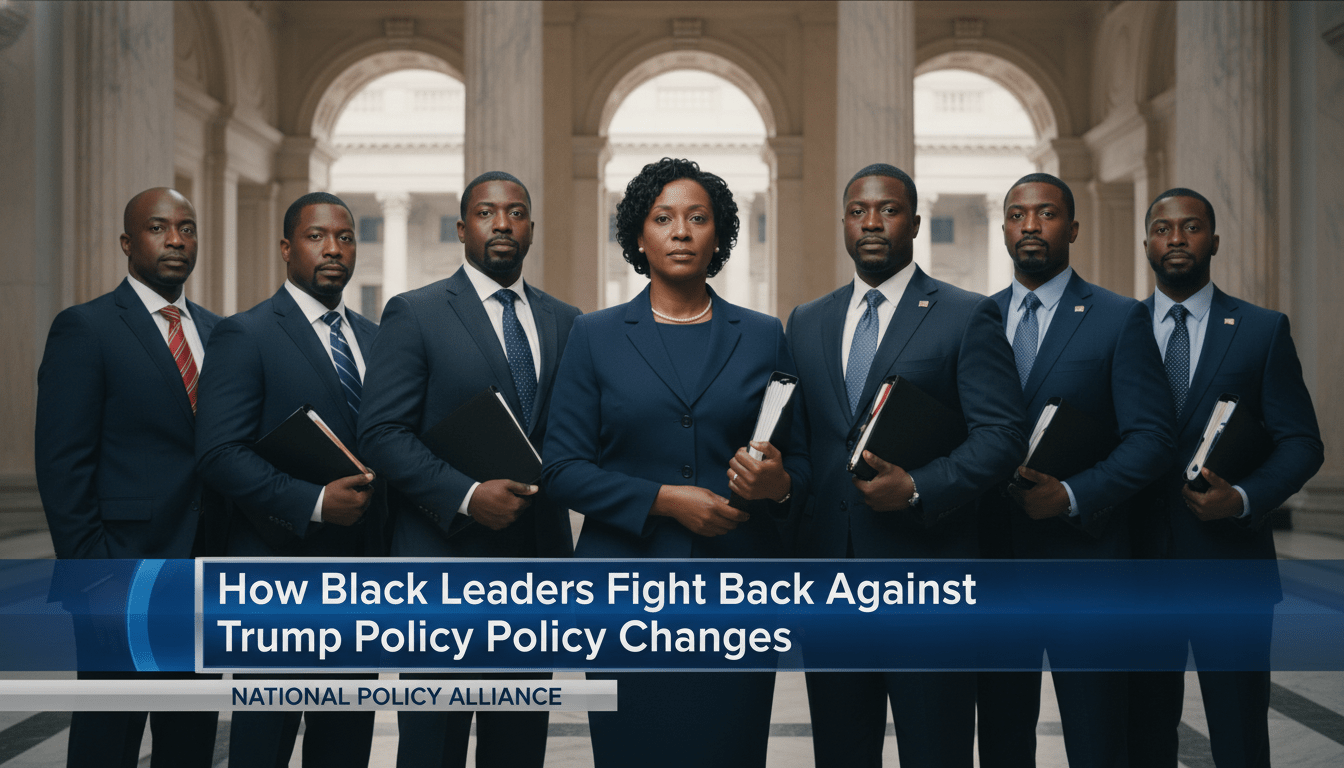
How Black Leaders Fight Back Against Trump Policy Changes
By Darius Spearman (africanelements)
Support African Elements at patreon.com/africanelements and hear recent news in a single playlist. Additionally, you can gain early access to ad-free video content.
The Congressional Black Caucus is making a bold move during Black History Month in 2026. This group of lawmakers joined forces with top civil rights organizations to challenge the domestic agenda of the Trump administration. The coalition includes the NAACP and the National Urban League. Together, they plan to use a three-part strategy to protect the interests of Black Americans. This plan involves filing lawsuits, organizing street actions, and applying policy pressure on the federal government (washingtoninformer.com).
This coordinated effort is a direct response to recent executive actions. These actions target diversity initiatives and voting rights across the nation. Representative Yvette Clarke, who currently chairs the Congressional Black Caucus, stated that this coalition is necessary to defend the progress made over the last several decades. The leaders believe that a united front is the only way to ensure the executive branch remains accountable to the people (house.gov).
The 1971 Resistance and its Legacy
The current pushback is part of a long tradition of organized political resistance. The Congressional Black Caucus began in 1971 with 13 founding members. Figures like Representative Shirley Chisholm and Representative Charles Diggs realized that individual voices were not enough to change the system. They formed the caucus to act as a “congressman-at-large” for Black citizens who felt that no one in Washington listened to their needs (wikipedia.org).
In its first year, the group showed how powerful a unified Black voice could be. When President Richard Nixon refused to meet with them, the members chose to boycott his State of the Union address. This act of “street action” inside the halls of power worked. Nixon eventually agreed to a meeting. During that meeting, the caucus presented him with 61 specific recommendations to end racism and improve economic opportunities for Black families (house.gov).
Growth of the Congressional Black Caucus (1971 vs 2026)
The Battle for Economic Justice
Economic justice was a top priority for the founders of the caucus. They knew that political freedom meant very little without the ability to build wealth. In the early 1970s, many Black communities faced severe poverty and a lack of investment. To address this, the caucus demanded that the federal government set aside contracts for minority-owned businesses. They believed that supporting these businesses would create jobs and stabilize neighborhoods (house.gov).
These early demands helped shape modern policies on business and labor. The struggle for economic fairness continues today as the coalition fights to keep diversity programs alive in the corporate world. Many leaders point out that early Black entrepreneurs laid the groundwork for the wealth that exists in the community today. Protecting these gains is a major part of the current “policy pressure” strategy (citizensforethics.org).
Global Struggles and the Anti-Apartheid Movement
The Congressional Black Caucus has never focused only on domestic issues. In the 1980s, the group turned its attention to the human rights crisis in South Africa. At that time, South Africa operated under Apartheid. This was a system of strict racial segregation and white minority rule. Black South Africans were denied the right to vote and were forced to live in separate, poorly maintained areas (wikipedia.org).
The caucus saw the fight in South Africa as an extension of the American civil rights movement. They pushed for the Comprehensive Anti-Apartheid Act of 1986. This law used economic sanctions to force the South African government to change. President Ronald Reagan vetoed the bill, but the caucus and its allies gathered enough support to override that veto. This was the first time in the 20th century that Congress overrode a presidential veto on a foreign policy matter (wikipedia.org).
Defending the Voting Rights Act
Voting rights remain a central focus for the coalition in 2026. For decades, the Voting Rights Act of 1965 was the strongest tool to prevent racial discrimination at the polls. However, a major change occurred in 2013 with the Supreme Court case Shelby County v. Holder. The court struck down the formula that required certain states to get federal approval before changing their voting laws (wikipedia.org).
The loss of this federal oversight led to a wave of new restrictions. Many states introduced strict voter ID laws and removed voters from registration lists. The Congressional Black Caucus is now pushing for the John Lewis Voting Rights Advancement Act. This bill aims to restore the protections that were lost. The coalition uses “street action” to keep this issue in the public eye and to encourage people to register and vote despite the new obstacles (wikipedia.org).
Legal Resistance: Lawsuits Against Executive Actions
Source: Democracy Forward & NAACP Legal Defense Fund
The Power of Lawsuits and Disparate Impact
The coalition is currently using the legal system as a shield against federal policy shifts. One of the most important concepts in their legal strategy is “disparate impact.” This legal theory allows lawyers to challenge rules that seem neutral but hurt minority groups more than others. For example, if a job test has nothing to do with the work but causes Black applicants to fail at higher rates, it can be challenged under this theory (lawfaremedia.org).
The Trump administration has moved to limit the use of disparate impact liability. In response, civil rights groups and Democratic attorneys general have filed more than 240 federal cases (citizensforethics.org). These lawsuits argue that removing these protections violates the 14th Amendment. By framing executive actions as constitutional violations, the coalition hopes to stop the dismantling of civil rights enforcement in housing and employment (democracyforward.org).
Grassroots Mobilization and Public Pressure
Policy changes often start with people in the streets. The coalition uses public demonstrations to make sure the voices of marginalized communities are heard. These events are not random; they are part of a coordinated “street action” plan. These protests pressure corporate sponsors to stay committed to diversity and keep the media focused on civil rights issues (washingtoninformer.com).
This type of activism has roots in conflicting political ideologies that have existed for decades. While some leaders focus on working inside the government, others believe that external pressure is the only way to get results. The 2026 coalition combines both approaches. They use the political influence of the caucus while the NAACP and other groups mobilize people at the local level to demand change (youtube.com).
Representing a Diverse Nation
The role of the Congressional Black Caucus has changed as the country has grown. In 1971, the founding members represented about 22 million Black Americans. Today, the 58 members of the caucus represent more than 82 million people of all ethnicities. This is about 25 percent of the total population of the United States. Many members now represent diverse urban and suburban districts where they must balance many different needs (wikipedia.org).
This growth has turned the caucus into a powerful voting bloc in the House of Representatives. They make up nearly 23 percent of the House Democratic Caucus. This size allows them to serve as the “Conscience of the Congress.” They use their committee assignments to investigate the actions of the Department of Justice and other federal agencies. Their goal is to ensure that the government serves everyone, not just the wealthy or the powerful (house.gov).
The 82 Million: Expanding Representation
1971
2026
Total Population in CBC Districts
Protecting the Career Civil Service
A new battleground in 2026 involves the protection of government workers. The executive branch has reinstated policies that allow for the reclassification of tens of thousands of career employees. This change makes it easier to fire workers who do not agree with the administration’s political goals. The coalition sees this as a threat to the “merit-based civil service” that keeps the government running fairly (citizensforethics.org).
Black workers have historically relied on government jobs as a path to the middle class. Many faced sharecropping and involuntary servitude in the past, making stable federal employment even more vital. The Congressional Black Caucus is fighting to prevent the politicization of these jobs. They argue that a professional civil service is necessary to carry out laws without bias or political interference (lawfaremedia.org).
The Influence of Black Women
Women have always been at the heart of these movements. From the founding days of Shirley Chisholm to the current leadership of Yvette Clarke, Black women drive the strategy of the caucus. They often lead the “policy pressure” efforts by authoring legislation and managing complex negotiations in Congress. Their work ensures that issues like healthcare and housing stay on the national agenda (house.gov).
Historically, civil rights era contributions from women were sometimes overlooked. However, in 2026, their leadership is visible and central to the coalition. They are the ones organizing the coordinated lawsuits and managing the trackers that watch every executive order coming from the White House. This leadership is a key reason why the coalition remains strong and focused during these challenging times (washingtoninformer.com).
Looking Toward the Future
The pushback during Black History Month is not just a seasonal event. It is a long-term plan to ensure that the executive branch remains accountable to all citizens. The coalition of the Congressional Black Caucus, the NAACP, and the National Urban League is prepared for a long fight. They understand that the “playbook” they are using today was written by those who came before them in 1971 (wikipedia.org).
By combining the power of the law, the voice of the people, and the influence of the legislature, these leaders are building a bulwark against policy changes they believe are harmful. The history behind these headlines shows that Black political power is most effective when it is organized and unified. As long as the administration continues its current domestic agenda, this coalition will remain active in defending the rights and progress of the community (house.gov).
About the Author
Darius Spearman is a professor of Black Studies at San Diego City College, where he has been teaching for over 20 years. He is the founder of African Elements, a media platform dedicated to providing educational resources on the history and culture of the African diaspora. Through his work, Spearman aims to empower and educate by bringing historical context to contemporary issues affecting the Black community.
