

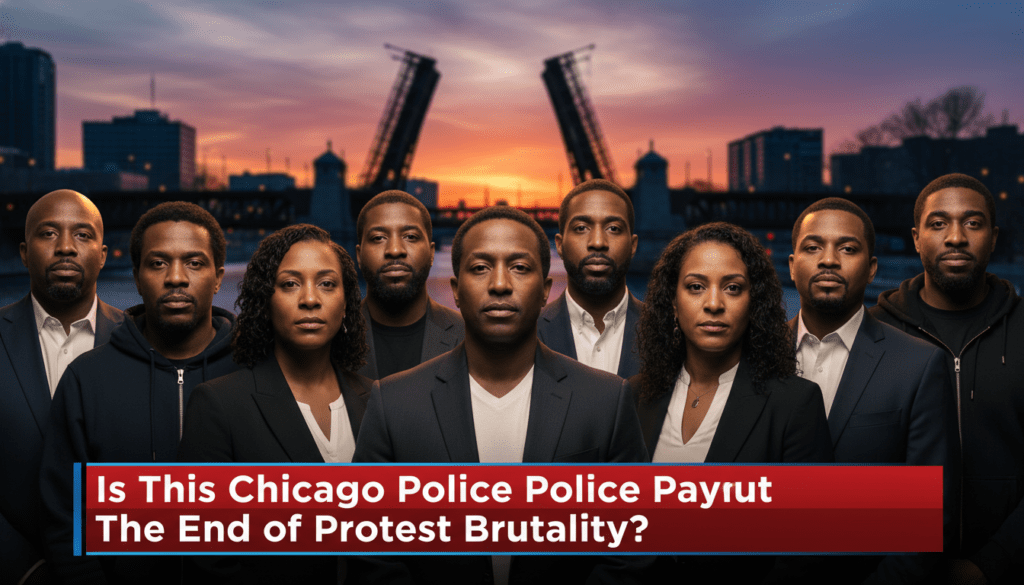
Is This Chicago Police Payout The End of Protest Brutality?
By Darius Spearman (africanelements)
Support African Elements at patreon.com/africanelements and hear recent news in a single playlist. Additionally, you can gain early access to ad-free video content.
The Massive Payout for Chicago Police Misconduct
Chicago city leaders are currently preparing to vote on a significant financial settlement. This settlement involves a payment of $875,000 to a group of 25 individuals who participated in protests during the summer of 2020 (wttw.com). These individuals filed a federal lawsuit claiming that police officers used violent and excessive tactics against them. The events took place during the height of the George Floyd uprisings, which saw thousands of people take to the streets to demand justice for Black lives. The lawsuit describes a series of encounters where protesters were allegedly treated with extreme hostility by the Chicago Police Department.
This group of 25 plaintiffs includes several well-known activists from organizations like the #LetUsBreathe Collective and Black Lives Matter Chicago (chicagocopa.org). They argue that the police response was more than a simple attempt to maintain order. Instead, they describe it as a calculated effort to punish and silence people who were speaking out against racial injustice. This payout is one of many that the city has faced in recent years. While $875,000 may seem like a large sum, it is only a small part of the total bill that Chicago taxpayers have had to pay for police actions during that summer. As of early 2026, the city has spent over $10.8 million on lawsuits related to the 2020 protests alone (wttw.com).
Financial Toll of 2020 Protest Litigation
Data source: Chicago Department of Law and City Records (wttw.com).
A History of Violent Responses to Public Outcry
The violence reported in 2020 did not happen in a vacuum. Chicago has a long and troubled history when it comes to the way police handle social and labor movements. To understand why these 25 protesters are receiving a payout, one must look back to the 1968 Democratic National Convention. During that event, police brutally attacked anti-war protesters on national television (chicagohistory.org). A federal commission later investigated the incident and gave it a chilling name. They called it a “police riot.” The commission concluded that the violence was largely started by the officers themselves, rather than the people who were protesting. These historical factors continue to shape the way residents view the police today.
This pattern of aggressive policing has repeated itself over many decades. During the late 1960s and 1970s, many Black Chicagoans faced oppression that felt very similar to the systems of the past. The police department frequently viewed community organizing as a threat to the status quo. When people marched for better housing, equal education, or an end to police brutality, the response was often force. This cycle of violence and subsequent legal settlements has become a permanent feature of the city’s budget. It suggests that the city often finds it easier to pay for its mistakes than to change the way its officers behave on the street.
The Secret Files and Surveillance of the Red Squad
For a long time, the Chicago Police Department did more than just use physical force. They also used secret surveillance to target people they did not like. The department operated a unit known as the “Red Squad” for several decades (chicagohistory.org). This unit was officially called the Intelligence Division, but its purpose was to watch and harass political activists. The Red Squad compiled secret files on over 117,000 residents and 14,000 different organizations (chicagohistory.org). They targeted labor organizers, civil rights leaders, and anyone they deemed to be a “subversive” element. This was part of a larger trend where racial justice movements were often infiltrated by law enforcement agencies.
One of the most famous targets of the Red Squad was Dr. Martin Luther King Jr. The unit worked closely with federal authorities to monitor his movements and disrupt his work in Chicago. They also focused on local groups like Operation PUSH and the Black Panther Party. In 1969, information provided by police intelligence helped lead to the assassination of Fred Hampton, a young leader of the Black Panthers (themilitant.com). The Red Squad era finally came to an end in 1985 because of a major federal court case. The city agreed to a consent decree that limited the ability of the police to investigate people just because of their political beliefs. However, many activists believe the spirit of the Red Squad lived on through the heavy surveillance seen during the 2020 protests.
The Dark Era of the Midnight Crew Torture Scandal
Perhaps the darkest chapter in the history of Chicago policing involves Commander Jon Burge and his “Midnight Crew.” Between the 1970s and the early 1990s, Burge and his team were accused of torturing more than 100 Black men to force them into confessing to crimes (chicagoreporter.com). These officers used horrific methods, including electric shocks and suffocation, to get what they wanted. This era caused a massive rift between the police and Black communities that has never fully healed. It took decades of activism and legal battles for the truth to fully come out. Even today, the city is still paying millions of dollars to the survivors of this torture (loevy.com).
The Burge scandal was more than a case of a few “bad apples.” It was a systemic failure where higher-ranking officials ignored the evidence of abuse for years. Eventually, the city passed a historic reparations ordinance in 2015 to apologize for these crimes (chicagoreporter.com). This package included financial payments to survivors and a requirement that the history of the torture be taught in Chicago Public Schools. Despite these efforts, the legacy of the Midnight Crew continues to haunt the department. The fact that the city is currently facing lawsuits for “extreme and outrageous” force in 2020 shows that the culture of the department still struggles with the same issues of brutality and lack of accountability.
Systemic Misconduct Metrics (2019-2023)
Modern Tactics and the Trap of the Kettling Strategy
The current lawsuit involving the $875,000 payout focuses on specific tactics used by the police in 2020. One of the most controversial methods is called “kettling.” This happens when police surround a group of people and box them into a small area with no way to leave (dlglearningcenter.com). During the 2020 protests, officers reportedly used the city’s bridges over the Chicago River to trap people. They raised the bridges while protesters were still on them or blocked both ends of the Wabash Avenue bridge (wttw.com). This created a situation where people were stuck and could not follow police orders to disperse.
Lawyers for the protesters argue that kettling is a violation of the Fourth Amendment, which protects people from unreasonable seizure (dlglearningcenter.com). When people are trapped in a “kettle,” they are often subjected to chemical agents like pepper spray or tear gas. The 25 plaintiffs in the current case allege that they were hit with batons and kneed in the neck while they had nowhere to go (wttw.com). The Chicago Inspector General later released a report saying the department was underprepared and that failures in leadership led to these constitutional violations (wttw.com). Even though the police department officially banned kettling in 2024, the damage from its use during the George Floyd protests remains a major legal liability for the city (dlglearningcenter.com).
Why the Federal Consent Decree is Failing Chicago
Because of the long history of misconduct, the Chicago Police Department is currently under a federal consent decree. This is a legally binding court order that requires the department to reform its policies on the use of force and accountability. It began in 2019 after the Department of Justice found that the police had a “culture of impunity” (wttw.com). However, the department is struggling to meet the goals set by the court. As of late 2025, the police have only reached full compliance with about 23% of the required changes (wttw.com). This slow progress is a major reason why payouts like the $875,000 settlement continue to happen.
The independent monitor who watches over the department has expressed frustration. While the police have written many new policies, they have not done a good job of putting them into practice (wttw.com). President Donald Trump is currently the leader of the country, and his administration’s views on federal oversight can affect how these decrees are managed. In Chicago, the lack of progress means that officers are still using tactics that lead to expensive lawsuits. Without the structural changes required by the decree, the city is likely to stay stuck in a cycle of paying for the same types of misconduct year after year. The cost of this failure is not just financial; it is also a cost of human rights and public trust.
The Financial Burden Placed on Everyday Taxpayers
It is important to remember that the money for these payouts does not come from the police department’s budget. It comes from the city’s general fund, which is supported by taxpayers. Between 2019 and 2023, the City of Chicago paid out a total of $384.2 million for police misconduct cases (loevy.com). This is a staggering amount of money that could have been used for schools, parks, or social services. Instead, it is being used to settle cases involving excessive force, wrongful convictions, and illegal arrests. The $875,000 proposed for the 25 protesters is just one small piece of a much larger financial crisis.
Some people argue that these settlements are simply a “cost of doing business” for a large city. However, others point out that the financial impact is not spread evenly. A small group of “repeat offender” officers is responsible for a huge portion of the costs. Research shows that about 15% of the officers named in lawsuits are responsible for 40% of the total payout money (loevy.com). These officers often have many complaints against them, yet they frequently remain on the force. When the city pays a settlement like this one, it often does so to avoid the risk of a trial where a jury might award even more money. But by settling, the city also avoids a public trial that might bring more details of police behavior to light.
Consent Decree Compliance Progress
Compliance status as of late 2025. (wttw.com)
Qualified Immunity and the Cycle of Accountability
One reason individual officers are rarely held financially responsible for their actions is a legal concept called “qualified immunity.” This doctrine protects government employees from being sued for things they do as part of their job, unless they violate a “clearly established” law. Because of this, when a protester’s teeth are knocked out or when someone is illegally trapped on a bridge, the city pays the bill instead of the officer (wttw.com). This creates a system where there is very little personal financial risk for officers who use excessive force. Critics argue that if officers had to pay for their own mistakes, they would be much more careful about following the law.
In the case of the 2020 protests, the discipline for officers has been very slow. Out of hundreds of complaints filed with the Civilian Office of Police Accountability, only a few resulted in serious consequences. As of 2022, only 12 officers had been given suspension notices for their actions during the protests (cbsnews.com). The $875,000 payout is a recognition by the city’s legal department that it is likely to lose if the case goes to trial. While the payment provides some relief to the 25 people who were harmed, it does not guarantee that the same thing will not happen again. Until the city addresses the root causes of police violence and the lack of individual accountability, the “history behind the headlines” will continue to repeat itself in the streets of Chicago.
About the Author
Darius Spearman is a professor of Black Studies at San Diego City College, where he has been teaching for over 20 years. He is the founder of African Elements, a media platform dedicated to providing educational resources on the history and culture of the African diaspora. Through his work, Spearman aims to empower and educate by bringing historical context to contemporary issues affecting the Black community.
