
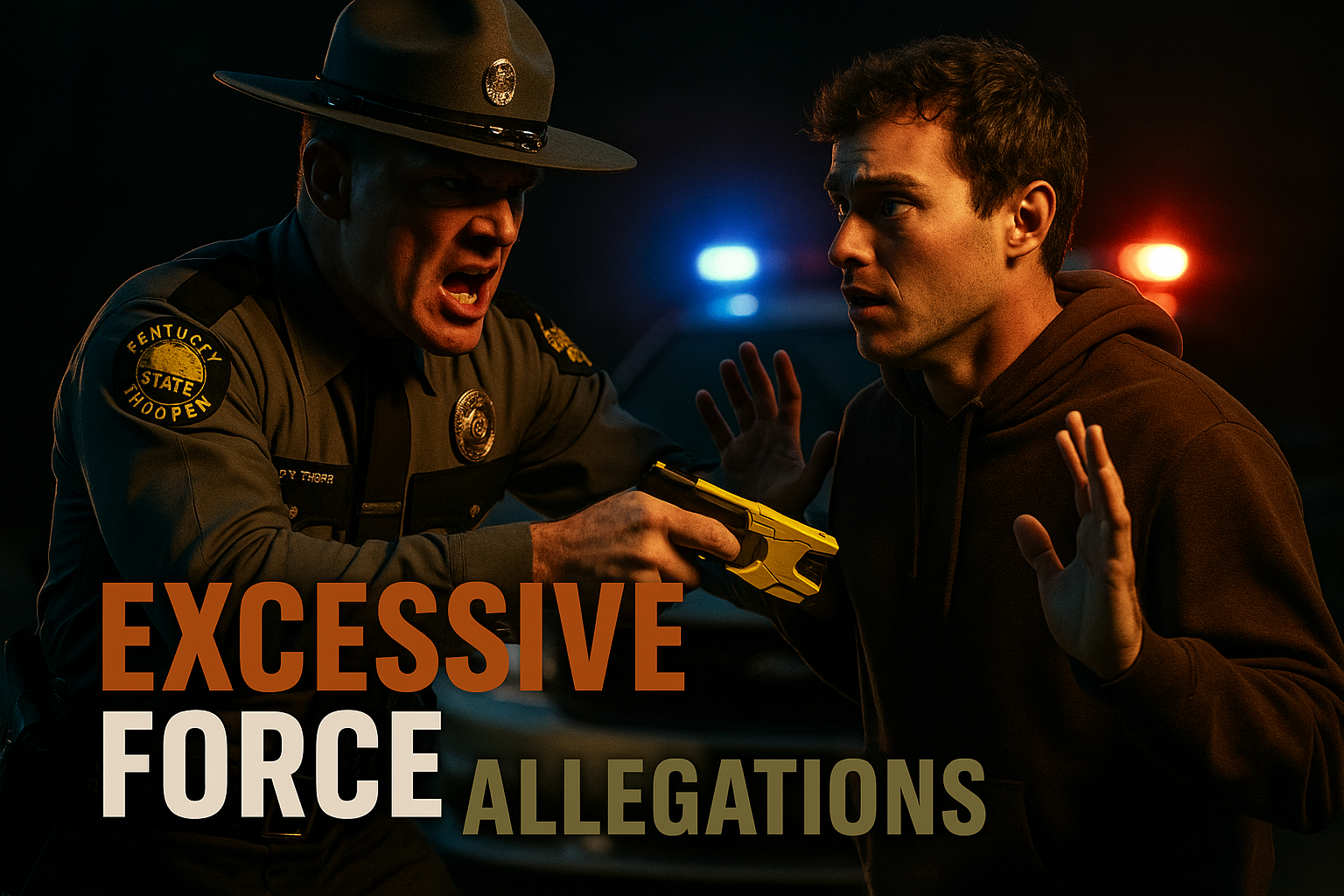
Kentucky Trooper James Wright: Excessive Force Allegations
By Darius Spearman (africanelements)
Support African Elements at patreon.com/africanelements and hear recent news in a single playlist. Additionally, you can gain early access to ad-free video content.
Kentucky Trooper Faces New Excessive Force Lawsuit
Kentucky State Trooper James Cameron Wright is facing a new lawsuit. This legal action alleges excessive force during a traffic stop in June 2024. During this incident, Wright reportedly tased and pepper-sprayed an unarmed man, Dawson Blevins, who was a passenger (wdrb.com). This lawsuit adds to a growing list of serious accusations against the trooper, highlighting a pattern of alleged misconduct that has drawn federal attention.
The lawsuit claims Wright pulled over a car driven by Arturo Cordova, with Blevins as a passenger. The initial reason for the stop was a seatbelt violation (wdrb.com). A seatbelt violation is a common traffic infraction where a driver or passenger is not wearing a seatbelt as required by law. This is a primary offense in many places, meaning officers can stop a vehicle solely for this reason. Wright then accused Cordova of having a “marijuana roach,” which refers to the butt or remnant of a smoked marijuana cigarette. It typically contains residual cannabis. After placing Cordova in his patrol car, Wright ordered Blevins out of the vehicle (wdrb.com).
Dawson Blevins’ Ordeal and Injuries
Blevins began complying with Wright’s order to exit the vehicle. However, he reached for his phone to record the incident (wdrb.com). At this point, Wright told him he was under arrest and threw him to the ground (wdrb.com). The lawsuit alleges that Wright repeatedly tased Blevins even after he was on the ground and complying with commands. He then used pepper spray on him (wdrb.com).
A taser, also known as a conducted energy weapon, is a less-lethal device designed to incapacitate individuals by delivering an electric shock that temporarily disrupts muscle control. Pepper spray, or oleoresin capsicum spray, is a non-lethal aerosol irritant derived from chili peppers. It causes temporary incapacitation by irritating the eyes, respiratory system, and skin. Both tools are meant to be alternatives to more lethal force. However, their use carries potential risks, including injury from falls, respiratory distress, and, in rare cases, more serious health complications. As a result of this encounter, Blevins suffered two compression fractures to his thoracic spine. A compression fracture to the thoracic spine refers to a break in one or more of the vertebrae in the middle part of the back. This type of fracture typically occurs when the bone is compressed or crushed, often due to significant force or trauma. The severity can range from mild to severe, potentially causing significant pain and limited mobility.
Blevins was initially charged with obstructing governmental operations, resisting arrest, disorderly conduct, possession of drug paraphernalia, and possession of a controlled substance. “Obstructing governmental operations” is a charge brought when an individual intentionally hinders a public servant from performing an official function. “Resisting arrest” occurs when an individual knowingly uses force to prevent a law enforcement officer from making a lawful arrest. All charges against Blevins were dismissed earlier this month.
Understanding Federal Civil Rights Violations
Federal Civil Rights Violations: These involve actions by law enforcement officers that deprive individuals of their rights, privileges, or immunities secured by the U.S. Constitution or federal laws. Often prosecuted under Title 18, United States Code, Section 242, these violations occur when an officer, acting under the authority of their position, uses excessive force, makes an unlawful arrest, or infringes upon a person’s constitutional rights. Such actions can lead to criminal liability at the federal level.
Federal Indictment and Civil Rights Charges
James Cameron Wright, along with two other current or former Kentucky State Police troopers, was indicted by a federal grand jury in March 2025 (justice.gov). The charges include federal civil rights violations, including excessive force and perjury (justice.gov). Federal civil rights violations, particularly in the context of police misconduct, typically involve actions by law enforcement officers that deprive individuals of their rights, privileges, or immunities secured by the Constitution or laws of the United States. These violations are often prosecuted under Title 18, United States Code, Section 242, which specifically addresses the deprivation of rights under color of law.
Former Kentucky State Police Trooper Thomas Czartorski, 34, was charged with two counts of using unreasonable force (justice.gov). Kentucky State Police Trooper Jarrod Lewis, 29, was charged with one count of using unreasonable force (justice.gov). James Cameron Wright, 30, was charged with two counts of using unreasonable force and one count of perjury related to false declarations made under oath in a federal civil case (justice.gov). Perjury is the intentional act of swearing a false oath or making a false statement when under oath, especially in a court of law. It is a serious felony offense because it undermines the integrity of the justice system.
Defining Excessive Force and Constitutional Rights
Legally, excessive force by law enforcement officers refers to the use of force that is objectively unreasonable in light of the facts and circumstances confronting them. This determination is made from the perspective of a reasonable officer on the scene, rather than with the 20/20 vision of hindsight. Factors considered include the severity of the crime, whether the suspect poses an immediate threat, and whether they are actively resisting arrest (digitalcommons.lmunet.edu). The indictment states that on March 5, 2020, Wright, Lewis, and Czartorski allegedly used excessive force, including stomping and kicking a victim, with some blows to the victim’s head (kfvs12.com).
The Fourth Amendment protects people from unreasonable searches and seizures by the government. It requires that warrants be based on probable cause. The Fourteenth Amendment includes the Due Process Clause, which prohibits states from depriving any person of life, liberty, or property without due process of law. It also includes the Equal Protection Clause, which requires states to provide equal protection under the law to all people within their jurisdiction. In the context of police conduct, the Fourth Amendment governs arrests and the use of force, ensuring that force used is reasonable. The Fourteenth Amendment extends these protections to state and local government actions, preventing arbitrary or abusive police practices. Wright is also accused of tasering another suspect on March 12, 2024, without legal justification. If convicted, James Cameron Wright faces a maximum sentence of 25 years in prison (justice.gov).
Federal Charges Against James Cameron Wright
A Disturbing Pattern of Alleged Abuse
The new lawsuit against Wright and other Kentucky State Troopers alleges a pattern and practice of excessive force and cover-ups by KSP supervision. “Pattern and practice” in legal terms refers to a repeated, routine, or regular course of conduct. It suggests that the alleged misconduct is not an isolated incident but rather a systemic issue. The lawsuit names Kentucky state troopers Jeremy Smith, Morris W. Farris, Brad Riley, Matthew J. Johnson, Michael Rogers, Chad White, and Phillip Burnett Jr. as defendants. It accuses them of violating Blevins’ Fourth and 14th Amendment rights by protecting and covering up Wright over the years.
The lawsuit claims that this is not the first time Wright has engaged in flagrant violations of citizens’ rights to be free from excessive force. It states it is at least the fourth known incident. The lawsuit details previous incidents of alleged abuse by Wright. On March 5, 2020, he allegedly beat a non-resisting man named Justin Holcomb. On April 2, 2020, he allegedly abused a non-resisting man named Thomas Davis during a traffic stop. This incident was reportedly covered up by Wright’s superiors. Then, on April 9, 2020, he allegedly beat a non-resisting man named Alex Hornback. A phone recording the incident was snatched and footage deleted. On March 12, 2024, he allegedly abused a non-resisting man named John Millett III by throwing him to the ground and repeatedly tasering him. Millett has also filed a lawsuit against Wright.
Alleged Incidents Involving Trooper Wright
Accountability and the “Trooper of the Year” Controversy
The lawsuit suggests that this pattern of abuse was allowed to continue because Wright’s superior officers permitted it. He was even named “Trooper of the Year” despite knowledge of his alleged misconduct and perjury. This award, typically given for outstanding service, stands in stark contrast to the serious allegations against him. All three indicted troopers were scheduled to make initial appearances before a U.S. Magistrate Judge in the U.S. District Court for the Western District of Kentucky on April 3, 2025 (justice.gov).
James Cameron Wright has been suspended from the force. He is scheduled for trial in September over the federal charges. The dismissal of all charges against Dawson Blevins, who suffered significant injury, underscores the serious nature of the allegations against Trooper Wright. It also raises questions about the initial justification for Blevins’ arrest. The ongoing legal proceedings will determine the full extent of accountability for these alleged actions.
Dawson Blevins’ Initial Charges and Outcome
The Path Forward for Justice
The allegations against Trooper Wright and the Kentucky State Police raise significant concerns for the community. The repeated nature of the alleged excessive force incidents, coupled with claims of cover-ups, can erode public trust in law enforcement. For African American and other marginalized communities, such incidents are particularly troubling. They often highlight historical patterns of disproportionate targeting and abuse. The pursuit of justice in these cases is not merely about individual accountability. It is also about addressing systemic issues within police departments that allow such patterns to persist.
The federal indictment and the new civil lawsuit signal a critical moment for accountability within the Kentucky State Police. The outcome of Wright’s trial and the civil cases will have far-reaching implications. It will impact victims seeking redress and the broader community’s faith in the justice system. The focus remains on ensuring that law enforcement officers are held to the highest standards of conduct. This includes respecting the constitutional rights of all citizens, regardless of their background or the circumstances of an encounter.
ABOUT THE AUTHOR
Darius Spearman has been a professor of Black Studies at San Diego City College since 2007. He is the author of several books, including Between The Color Lines: A History of African Americans on the California Frontier Through 1890. You can visit Darius online at africanelements.org.
