


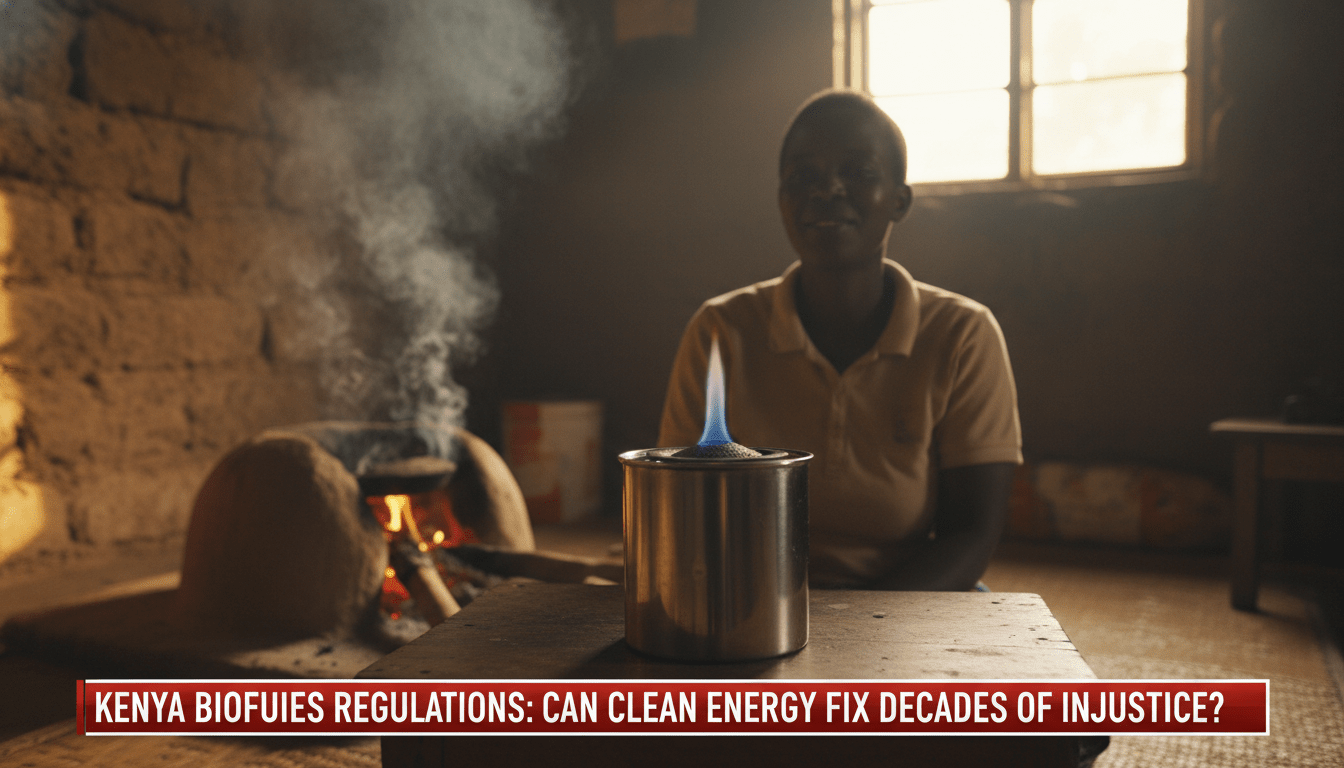
Kenya Biofuels Regulations: Can Clean Energy Fix Decades of Injustice?
By Darius Spearman (africanelements)
Support African Elements at patreon.com/africanelements and hear recent news in a single playlist. Additionally, you can gain early access to ad-free video content.
The air in many Kenyan kitchens tells a story of survival and struggle. For decades, the primary source of energy for most families has been the crackle of wood and the glow of charcoal. This reality is changing as the nation enters a new era of energy policy. Kenya has officially moved into a rigorous regulatory phase for its biofuels sector (cliffedekkerhofmeyr.com). This shift focuses on bioethanol and biogas as modern alternatives. It represents a major move for environmental justice in East Africa.
Currently, about 74 percent of Kenyans still rely on traditional biomass for their daily cooking needs (healthpolicy-watch.news). This reliance is not merely a matter of tradition. It is a symptom of deep-seated economic disparities. The new Kenya Biofuels Regulations aim to dismantle these old systems of “woodfuel poverty.” They seek to provide cleaner options for the millions who have been left behind by the fossil fuel economy. This transition is not a simple technical update. It is the result of forty years of trial, error, and community resistance.
Source: SOURCE-5, Health Policy Watch
The Bitter Roots of the Biofuel Industry
The journey toward clean energy did not begin in a high-tech laboratory. It started in the sugar belt during the 1980s. At that time, the world was reeling from global oil shocks. Kenya looked toward its sugar mills for an answer. The Muhoroni Agro-Chemical and Food Company became the first major producer of bioethanol in 1982 (wazua.co.ke). This plant produced power alcohol from molasses to be mixed with gasoline. This mixture is known as “gasohol” or E10 (argusmedia.com).
However, the early program did not last long. By 1993, the experiment collapsed under the weight of high production costs and political challenges. Oil companies resisted the competition from locally grown fuels. Furthermore, internal corruption and mismanagement plagued the project. The Kisumu Molasses Plant, intended to be a crown jewel of the industry, became a rusted monument to failed policy (kenyaunsolved.com). The costs had nearly doubled, leaving international investors wary of the Kenyan energy market. These early failures taught the nation that technology alone cannot solve energy problems.
Political willpower and a clear legal framework are required to make clean energy stick. Without these, even the best ideas can wither. The collapse of the 1980s program forced the country back into a heavy reliance on expensive petroleum imports. It also left rural families with no choice but to continue using wood for fuel. This history of failure created a long pause in the development of the sector. It took over twenty years for the government to try again with a more comprehensive plan.
Resistance and the Tana River Conflict
In the early 2000s, biofuels returned to the national stage with a new name. They were called a “silver bullet” for rural development. This era saw large corporations rushing to acquire land for energy crops. One of the most intense conflicts occurred in the Tana River Delta (newsecuritybeat.org). Large-scale projects focused on Jatropha and sugarcane were proposed for this sensitive region. These plans were met with fierce resistance from local pastoralists and conservationists.
The Orma and Pokomo communities depend on the delta for their survival. They viewed these biofuel plantations as “green land grabs” (business-humanrights.org). These projects often fenced off essential grazing lands and restricted access to water. Villagers reported being driven out of their ancestral homes by machinery. This conflict was a fight for economic justice against powerful interests. The locals argued that development should not come at the cost of their basic human rights.
The resistance culminated in a 2011 High Court case. The court ruled that development could not proceed without a proper land-use plan. This legal victory changed the direction of the biofuel industry in Kenya. It signaled that the “plantation model” was too socially expensive. The government and private firms began to look at different ways to grow fuel. They started to focus on smallholder-led models. This approach allows local farmers to grow energy crops on their own land. It ensures that the people remain in control of their resources.
The Invisible Killer in the Kitchen
The push for new regulations is driven by a health crisis that many people do not see. Household Air Pollution, or HAP, is the eighth leading cause of death in Kenya (healthpolicy-watch.news). It kills between 23,000 and 26,000 people every year. This number is higher than the deaths from malaria and HIV combined (apha.org). The primary source of this pollution is the smoke from burning wood and charcoal in poorly ventilated homes. This smoke contains toxic particles that damage the lungs and heart.
This health burden is not shared equally. It is a deeply gendered issue. Women and children spend the most time near the cooking fire. They are the ones who breathe in the most toxins. Additionally, women in rural areas can spend up to twenty hours every week gathering wood (igad.int). This is a form of time poverty. It prevents them from seeking education or paid work. Because of these systematic burdens, the move to clean energy is considered a major civil rights victory. It addresses a systematic burdens that has held back families for generations.
The transition to bioethanol allows mothers to cook faster and more safely. When a household switches to a “steady blue flame,” the environment inside the home changes instantly. Children are less likely to suffer from pneumonia. Mothers have more time to dedicate to their own goals. Shifting away from wood fuel is about more than just climate change. It is about the right to breathe clean air in one’s own home. The Kenyan government recognizes that these domestic roles should not be a death sentence (newsecuritybeat.org). Access to clean energy is now viewed through the lens of domestic roles and human rights.
A New Legal Shield for the Environment
The Energy Act of 2019 laid the groundwork for the current shift. This law created the Energy and Petroleum Regulatory Authority, or EPRA (cliffedekkerhofmeyr.com). It gave the government the power to regulate renewables like never before. Finally, on December 16, 2025, the Energy (Biofuels) Regulations, 2025 came into full effect. These rules bring the entire biofuel value chain under government oversight. For the first time, producers, blenders, and distributors must have a license to operate.
The regulations create three main categories for licensing. Category E covers bioethanol, while Category D handles biodiesel. Category G is dedicated to biogas (argusmedia.com). These categories ensure that every part of the industry meets safety and quality standards. One important feature is the support for small-scale biogas digesters. The law exempts small systems from expensive construction permits. This encourages farmers to turn animal waste into clean energy right on their property. It is a decentralized approach that empowers the poor.
Furthermore, the regulations mandate the blending of bioethanol with petrol. This move aims to reduce the national petroleum import bill. Kenya spends about $4 billion annually on imported oil (ecofinagency.com). By using locally produced ethanol, the country can keep more money at home. This strengthens the Kenyan Shilling and helps the overall economy. However, the true success of these rules depends on how they are implemented. The government must ensure that the benefits reach the average citizen, not just large corporations.
The Carbon Credit Crisis of 2026
Just as the new rules took effect, the industry hit a major roadblock. On January 31, 2026, KOKO Networks announced it was shutting down its Kenyan operations. This company served 1.5 million households with subsidized bioethanol (ecofinagency.com). It was the poster child for clean cooking in Africa. The collapse was caused by a dispute over a “Letter of Authorization” for carbon credits. Without this document, the company could not access the international funds it needed to keep fuel prices low.
The Kenyan government, under the oversight of the National Climate Change Council, withheld the letter. Officials expressed concerns about the volume of credits being sold. They also wanted to ensure the state retained enough credits for its own climate targets. This dispute highlights the complexity of modern energy markets. Companies often rely on “carbon finance” to make clean fuel affordable for the poor. When that finance fails, the business model can crumble. This left over a million families in a difficult position.
Many families had to go back to using charcoal or wood immediately. The shutdown caused an energy crisis in informal settlements like Kibera. It also resulted in the loss of 700 jobs. This event serves as a warning for the new regulatory phase. Policy progress must be matched by financial stability. The administration of President Donald Trump has also shifted its stance on international climate finance. These global changes add another layer of uncertainty to Kenya’s green transition. Without a steady flow of carbon market revenue, the promise of environmental justice remains fragile.
Small Farmers and the Future of Energy
Despite the setback with KOKO, other parts of the sector are growing. A company called Giraffe Bioenergy is building a massive biorefinery in Kilifi County. They are focusing on cassava grown on semi-arid lands (cleancooking.org). This is a strategic choice. By using cassava, they avoid competing with essential food crops. This is a direct lesson from the “land grab” era. It shows that the industry is becoming more sophisticated and sensitive to local needs.
The smallholder-led model is proving to be more resilient. When farmers grow energy crops alongside their food, they have multiple sources of income. This creates a safety net for rural families. Companies like HomeBiogas are also expanding their reach. They aim to serve 170,000 farmers by 2028 (the-star.co.ke). These systems turn waste into gas for cooking and fertilizer for the fields. It is a circular economy that benefits the individual directly. This model aligns with the principles of environmental justice by keeping power in the hands of the people.
The future of biofuels in Kenya will depend on balancing large-scale regulation with small-scale needs. The government must provide a stable environment for investment. At the same time, it must protect the 74 percent of the population still waiting for a cleaner flame. The 2025 regulations are a strong start. They offer a map for a journey that began forty years ago in the sugar mills of Muhoroni. If the nation can overcome the hurdles of carbon finance and corporate stability, it may finally clear the smoke from its kitchens.
Conclusion: The Long Path to Justice
Kenya is at a crossroads in its energy history. The new biofuels regulations represent more than just technical rules. they are a commitment to fixing a long-standing wrong. For too long, the poorest citizens have paid for energy with their health and their time. The transition to bioethanol and biogas is an opportunity to change that narrative. It is a chance to move from the destructive use of forests to the sustainable use of the land.
However, as the recent collapse of KOKO Networks shows, the path is not easy. Regulations must be supported by transparent and fair markets. The government cannot act alone, and the private sector cannot ignore social responsibilities. This new phase of policy is a test of Kenya’s resolve. If successful, it will serve as a model for the rest of the African diaspora. It will show that green energy and social justice can go hand in hand. The goal of 100 percent clean cooking by 2028 is ambitious, but the history behind the headlines proves that Kenyans are ready to fight for a cleaner future.
About the Author
Darius Spearman is a professor of Black Studies at San Diego City College, where he has been teaching for over 20 years. He is the founder of African Elements, a media platform dedicated to providing educational resources on the history and culture of the African diaspora. Through his work, Spearman aims to empower and educate by bringing historical context to contemporary issues affecting the Black community.
