
Listen to this article
Download AudioKenya’s Fight for Justice
By Darius Spearman (africanelements)
Support African Elements at patreon.com/africanelements and hear recent news in a single playlist. Additionally, you can gain early access to ad-free video content.
Activist Arrest and Charges
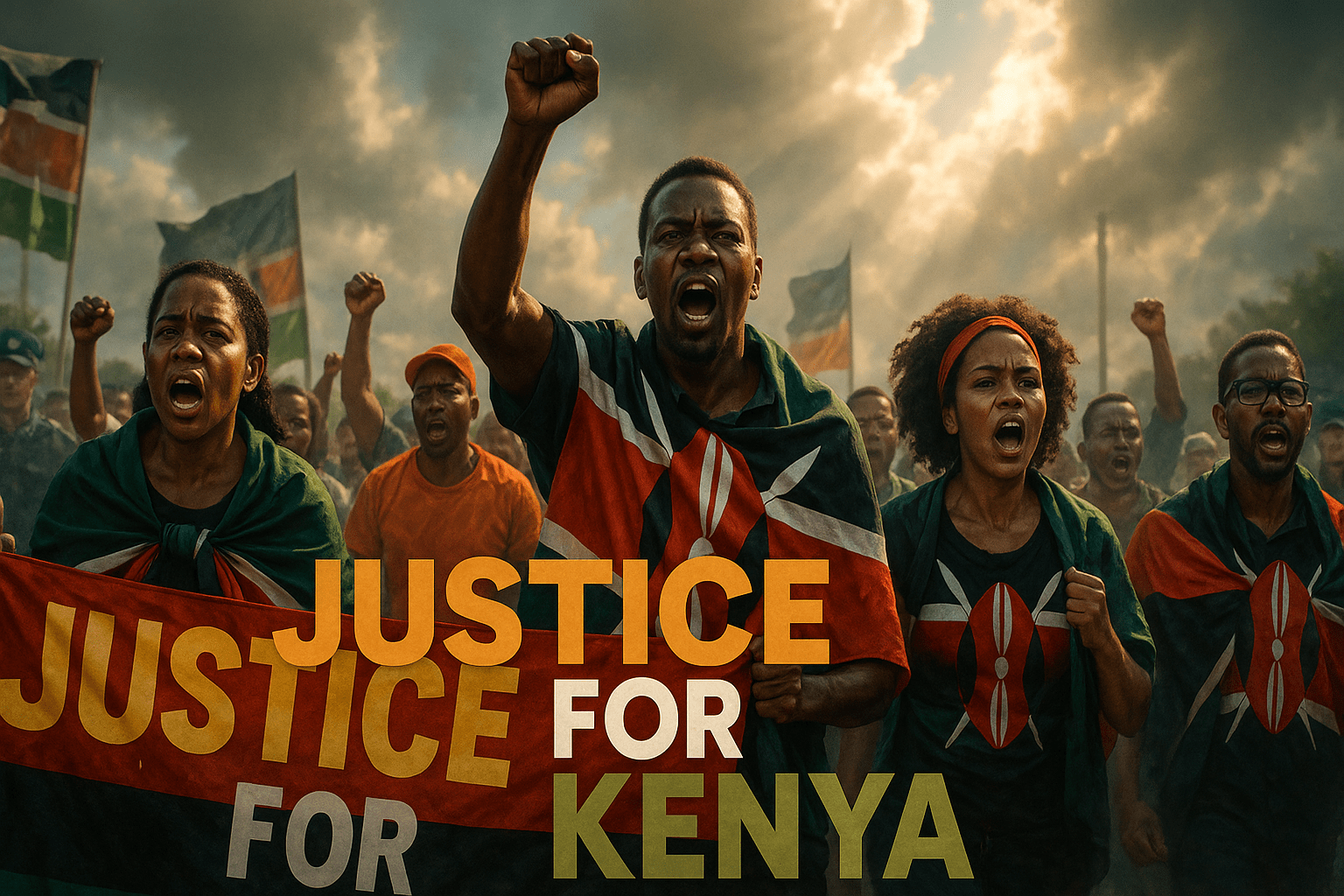
Kenyan human rights activist Boniface Mwangi was arrested on July 20, 2025, and subsequently charged with unlawful possession of ammunition (reuters.com). This charge means he was found with ammunition without the proper legal authorization. It is a serious charge that can carry significant penalties and is often used in cases related to public order or security concerns. On July 21, 2025, Mwangi appeared in court in Nairobi, where hundreds of activists, many wearing Kenyan flags, gathered to show their support (reuters.com). Police stated they recovered evidence from his home, including unused teargas canisters and a “7.62mm blank round” (reuters.com). He was specifically accused of illegally possessing a single blank ammunition round and three teargas canisters without lawful authority (reuters.com).
Tear gas canisters are devices that release a chemical irritant used for crowd control. Blank ammunition contains no projectile and is typically used for training or signaling. The possession of these items can be criminalized if not authorized, especially tear gas, due to its potential for misuse in public order situations, and blank ammunition if it is considered part of an illegal arsenal. Mwangi has a long history of speaking out against human rights violations in Kenya and has previously run for parliament on an anti-corruption platform (reuters.com). His arrest has drawn widespread condemnation, with human rights groups suggesting it aims to suppress opposition voices (bbc.com). Mwangi denies the accusations, stating on social media, “I am not a terrorist” (bbc.com).
Protests and Police Brutality
Mwangi’s arrest and the charges against him are closely linked to recent protests in Kenya. These demonstrations have been fueled by public anger over police brutality, corruption, and the rising cost of living. For instance, hundreds of Kenyans protested the death of political blogger Albert Ojwang in police custody last month (reuters.com). Police initially claimed Ojwang died by suicide but later apologized after an autopsy indicated assault as the cause of death (reuters.com). This incident reignited protests that began last year concerning the cost of living and alleged police brutality and corruption (reuters.com). The recent protests, including the “Saba Saba People’s March” on July 7, 2025, have seen Kenyan police use tear gas and water cannons against demonstrators (cnn.com).
The Saba Saba People’s March refers to demonstrations that took place in Kenya, characterized by allegations of excessive force by authorities. The term “Saba Saba” historically refers to July 7th, a significant date in Kenya’s history of political activism and calls for democratic reforms. The recent demonstrations were marked by concerns over police conduct and human rights abuses (fidakenya.org). Allegations include the use of live ammunition against unarmed civilians, extrajudicial executions, disappearances, and unlawful arrests during the Saba Saba demonstrations (amnestykenya.org). Witnesses reported armed men, suspected to be police officers, indiscriminately firing live ammunition at both protesters and bystanders during the Saba Saba events (eastleighvoice.co.ke). At least 31 people have died and hundreds have been arrested in Kenya’s anti-government protests as of July 7, 2025 (cnn.com).
Allegations of Unlawful Conduct
There are serious allegations of unlawful conduct and extrajudicial killings by individuals suspected to be police officers during the protests. Witnesses reported armed men, suspected to be National Police Service members, arriving in unmarked vehicles and indiscriminately firing live ammunition at protesters and bystanders (fidakenya.org). The use of unmarked vehicles by armed men, suspected to be police officers, raises significant concerns because it obscures accountability and can lead to a lack of transparency regarding the identity and actions of those using force. It also blurs the lines between official law enforcement operations and potentially unlawful or extrajudicial actions, making it difficult to identify perpetrators and hold them responsible. These incidents include the use of live ammunition against unarmed civilians, extrajudicial executions, disappearances, and unlawful arrests (fidakenya.org).
Police officers are required to issue clear warnings, use less-lethal methods, and report firearm use, but these protocols were reportedly not followed during the shootings (fidakenya.org). Police brutality refers to the excessive and unwarranted use of force by law enforcement officers, while extrajudicial killings are unlawful killings carried out by state agents without legal process. During recent protests in Kenya, these terms describe actions such as the use of live ammunition against unarmed civilians, leading to deaths and injuries, and the alleged involvement of police in disappearances and unlawful arrests. The state-funded Kenya National Commission on Human Rights (KNCHR) reported that police had killed at least 63 and abducted 87 people between June and October 2024 (hrw.org). The Independent Policing Oversight Authority (IPOA) stated it had completed investigations of 22 deaths that occurred during the 2024 protests, though only two are in court (hrw.org). Human rights groups have criticized IPOA for not doing enough to ensure police accountability regarding these incidents (hrw.org).
Casualties and Accountability
The protests have resulted in significant casualties and arrests. A police officer, Police Constable Klinzy Barasa, was recently charged with the murder of hawker Boniface Kariuki Mwangi, who was shot during the June 25, 2024, Gen Z protests (nation.africa). These “Gen Z protests” were a series of demonstrations primarily led by young people, often sparked by issues such as police brutality, corruption, and economic hardship. They represent a growing youth movement demanding accountability and change in Kenya. Over 60 demonstrators died during those protests (nation.africa). Another officer, Duncan Kiprono, who was with Barasa during the incident, was released due to insufficient evidence (nation.africa). The death of a teacher in police custody and the shooting of an unarmed street vendor by police have further intensified outrage among the youth (cnn.com).
The government’s heavy-handed reaction to the demonstrations has resulted in at least 90 deaths over the last two years (semafor.com). This has led to President William Ruto’s approval rating falling significantly (semafor.com). In an effort to address the loss of government legitimacy, Ruto invited opposition leader Raila Odinga’s party members to join his administration (semafor.com). Four of Odinga’s allies have since joined the cabinet (semafor.com). The ongoing situation highlights the deep-seated issues of governance, human rights, and public trust in Kenya, particularly as the nation grapples with the balance between maintaining order and protecting civil liberties.
Casualties in Kenyan Anti-Government Protests (as of July 7, 2025)
Human Rights Concerns
The situation in Kenya raises significant human rights concerns, particularly regarding police accountability. Human rights groups have reported the use of live ammunition against unarmed civilians, extrajudicial executions, disappearances, and unlawful arrests during protests (fidakenya.org). These actions represent a severe breach of human rights principles, where state agents are expected to protect, not harm, their citizens. The lack of adherence to proper police protocols, such as issuing clear warnings and using less-lethal methods before resorting to firearms, further exacerbates these concerns (fidakenya.org). The alleged involvement of armed men in unmarked vehicles, indiscriminately firing at protesters and bystanders, adds another layer of complexity and fear, as it makes it difficult to identify and hold perpetrators accountable (eastleighvoice.co.ke).
The ongoing arrests of activists, including Boniface Mwangi, are seen by many as an attempt to stifle dissent and suppress opposition voices (bbc.com). This pattern of targeting human rights defenders and critics is a worrying trend that undermines democratic principles and the rule of law. The international community and human rights organizations continue to monitor the situation closely, advocating for accountability for those responsible for abuses and urging the Kenyan government to uphold its commitments to human rights and civil liberties. The struggle for justice and accountability in Kenya is ongoing, with activists and citizens continuing to demand an end to police brutality and corruption, and for their voices to be heard without fear of reprisal.
Status of Police Accountability in Kenya (2024 Protests)
The Path Forward
The ongoing challenges in Kenya highlight the critical need for robust legal frameworks and independent oversight mechanisms to ensure police accountability. The charging of Police Constable Klinzy Barasa with murder, while a step towards justice, also underscores the slow pace of accountability, with only two cases from 22 investigations reaching the courts (hrw.org). This situation creates a perception of impunity, which can further erode public trust and fuel continued unrest. The calls for justice from the families of victims and human rights advocates remain strong, emphasizing the urgency of comprehensive reforms within the National Police Service.
Furthermore, the broader socioeconomic and political issues that underpin the protests—such as the cost of living and corruption—must be addressed by the government to foster long-term stability. The government’s invitation to opposition members to join the administration, while a political move, also reflects the pressure to address widespread discontent (semafor.com). For the African diaspora, these events in Kenya resonate deeply, as they reflect broader struggles for human rights, democracy, and economic justice across the continent. The fight for Boniface Mwangi’s freedom and the broader movement for accountability in Kenya are part of a larger narrative of African people asserting their rights and demanding better governance.
Understanding Unlawful Possession of Ammunition
Unlawful Possession of Ammunition: In Kenya, this refers to possessing ammunition without proper legal authorization. This charge is significant because it carries serious penalties and is often used in cases involving public order or security concerns. For example, Boniface Mwangi was charged with this offense after police found a “7.62mm blank round” and teargas canisters at his home.
ABOUT THE AUTHOR
Darius Spearman has been a professor of Black Studies at San Diego City College since 2007. He is the author of several books, including Between The Color Lines: A History of African Americans on the California Frontier Through 1890. You can visit Darius online at africanelements.org.
