

Lomé’s Pan-African Congress: A Historic Reconquest
By Darius Spearman (africanelements)
Support African Elements at patreon.com/africanelements and hear recent news in a single playlist. Additionally, you can gain early access to ad-free video content.
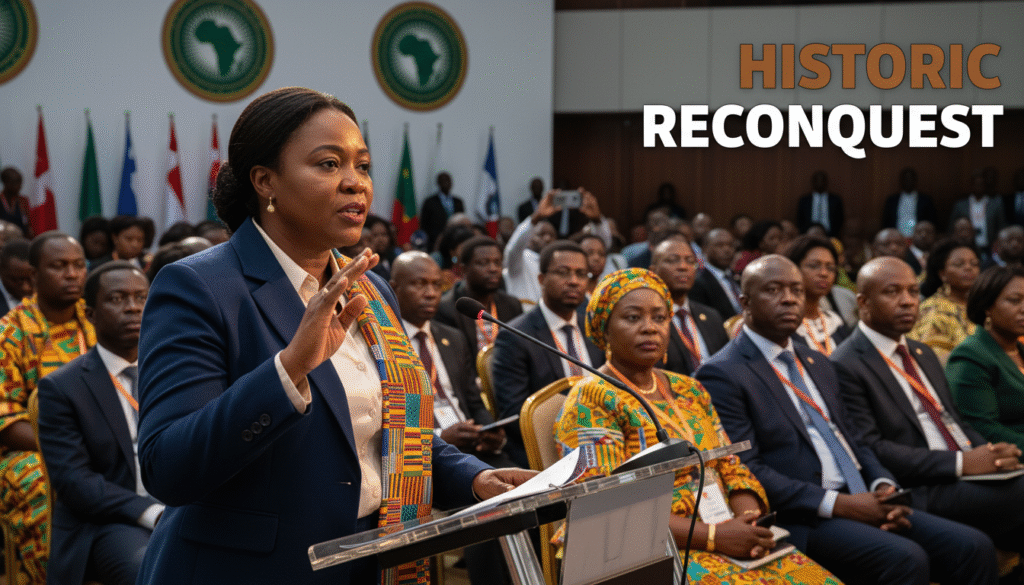
The 9th Pan-African Congress, unfolding in Lomé, Togo, from December 8 to 12, 2025, is a significant moment in the continuing story of global Black solidarity (togofirst.com). Co-organized by the African Union and the Togolese government, the event has drawn nearly a thousand delegates from African nations and Afro-descendant communities around the world (gouv.tg). This gathering is far more than a simple meeting; it is a strategic effort to address sovereignty, reform global institutions, and achieve a collective “reconquest” of voice for peoples whose histories are marked by slavery and colonialism (gouv.tg).
Leaders have framed the congress not as a commemoration but as a powerful reaffirmation of Pan-African ideals for the 21st century (gouv.tg). The theme, “Renewal of Pan-Africanism and Africa’s role in the reform of multilateral institutions,” points to a forward-looking agenda (pac9-lome2024.com). Delegates are focused on mobilizing resources and reinventing strategies to act decisively on the world stage. Thus, this congress represents a pivotal effort to rekindle the essential bonds between the African continent and its global diaspora in a rapidly changing world (togofirst.com).
The Deep Roots of Pan-Africanism
Pan-Africanism is a worldwide ideology dedicated to strengthening unity among all indigenous peoples of Africa and the diaspora (wikipedia.org). Its origins are not found in conference rooms but in the brutal realities of slave ships and plantation uprisings (togofirst.com). Early “Back to Africa” movements in the 19th century laid the groundwork for this powerful idea. Visionaries like Martin Delany, Alexander Crummel, and Edward Blyden were among the first to emphasize the shared struggles and common destiny of Africans and Black people in the Americas (ajhssr.com). They championed the concept of a unified Black nation, a place of refuge and self-determination.
The movement gained a formal identity in 1900 with the First Pan-African Conference in London, organized by Trinidadian barrister Henry Sylvester Williams (aaregistry.org). This landmark event brought Black leaders from Africa, Great Britain, the West Indies, and the United States together. They gathered to protest colonial land theft and widespread racial discrimination (aaregistry.org). Consequently, the conference marked a crucial step, transforming disparate resistance efforts into an organized international movement with a name and a platform.
From Du Bois to Decolonization
The intellectual and political direction of Pan-Africanism was profoundly shaped by W.E.B. Du Bois, often called the “father of modern Pan-Africanism” (blackpast.org). In 1919, he convened the First Pan-African Congress in Paris to petition the Versailles Peace Conference for the self-rule of African colonies (aaregistry.org). Throughout the 1920s, subsequent congresses in cities like London, Brussels, and New York continued to denounce imperialism and demand greater self-governance for African peoples. These gatherings helped to build an international coalition against colonial domination.
The Fifth Pan-African Congress in Manchester, England, in 1945 is widely seen as the movement’s most significant gathering (blackpast.org). Held just after World War II, it marked a fundamental shift in tone and objective. Delegates moved beyond calls for reform to making outright demands for decolonization. They forcefully condemned imperialism, racial discrimination, and capitalism (blackpast.org). This congress was also pivotal because it was attended by future independence leaders like Kwame Nkrumah of Ghana and Jomo Kenyatta of Kenya. As a result, this event effectively transferred the leadership of the Pan-African cause from African Americans to Africans on the continent (blackpast.org).
The Diaspora’s Enduring Connection
After 1945, as African nations won their independence, the leadership of the Pan-African movement largely transitioned from African American intellectuals to heads of state on the continent (oxfordre.com). This change transformed the role of African Americans within the movement. They moved from a position of primary leadership to one of crucial support and advocacy. Their focus shifted toward diaspora issues and continued solidarity with African liberation struggles still underway. African Americans leveraged their unique position within a global superpower to support African development and political agency (oxfordre.com).
This enduring connection has deep historical roots in earlier movements. For instance, the “Back to Africa” movements were driven by a powerful desire to escape racial violence and build a strong, independent Black nation (britannica.com). Marcus Garvey and his Universal Negro Improvement Association (UNIA) mobilized millions in the early 20th century with the call for “Africa for Africans” (britannica.com). Although mass emigration proved difficult, these movements successfully fostered a profound sense of racial pride and Pan-African identity. Their legacy therefore provides a foundational pillar for modern Pan-Africanism and continues to inspire conversations about diaspora engagement (britannica.com).
A Revival in Lomé: The 9th Pan-African Congress
The congress in Lomé aims to reconnect the continent with its diaspora, which the African Union officially recognizes as its “sixth region” (au.int). This recognition emphasizes the diaspora’s vital role in Africa’s growth. Another central theme is the reform of global governance. Delegates are examining how Africa can assert stronger agency in multilateral institutions like the United Nations Security Council, the IMF, and the World Bank (togofirst.com). These bodies are widely seen as operating under outdated post-World War II rules that disadvantage Africa (togofirst.com).
These outdated rules concentrate power in the hands of a few nations, leaving Africa without a permanent, veto-wielding seat on the UN Security Council (africagrowthforum.org). Similarly, voting shares in the IMF and World Bank do not reflect the continent’s current demographic or economic importance. Advocates are pushing for precise reforms beyond just fairer representation. In addition, they call for a rebalancing of voting rights, an overhaul of the Security Council’s veto mechanism, and a fundamental restructuring of financial systems to support development rather than dependency (africagrowthforum.org).
Economic Power and Historical Justice
A significant focus of the Lomé congress is historical justice, particularly the campaign for reparations (togofirst.com). This discussion includes restitution for Africa and all its peoples, both on the continent and abroad. For African Americans, specific demands for reparations often align with domestic movements in the United States (adrrc.org). These demands include financial compensation for descendants of enslaved people, major investments in Black communities, and official apologies for the historical injustices of slavery and Jim Crow segregation. The Pan-African context provides a global moral framework, strengthening these arguments by linking the African American experience to a worldwide history of exploitation (adrrc.org).
Mobilizing the economic power of the diaspora is another critical objective. The African diaspora sends an estimated $65 billion to the continent annually, a sum that surpasses international aid (diasporafordevelopment.eu). African Americans alone hold an estimated spending power of $1.7 trillion (diasporafordevelopment.eu). The congress is exploring strategies to channel this economic force beyond remittances. Such strategies include promoting direct investments in African businesses, encouraging tourism to foster economic ties, and establishing diaspora-led financial institutions to fund continental growth (weforum.org). The goal is to create structured, collective economic engagement for sustainable development.
African American Spending Power (2022)
This figure represents a significant economic force for potential investment and development (diasporafordevelopment.eu).
The Challenge of Neocolonialism and Debt
Pan-Africanism has long faced the challenge of neocolonialism (togofirst.com). Unlike traditional colonialism’s direct military rule, neocolonialism exerts influence through indirect economic, political, and cultural means (study.com). This practice perpetuates the dependence of former colonies on powerful external actors. In Africa, it manifests as unfair trade agreements, foreign control over natural resources, and crippling debt burdens that hinder true economic independence. It represents a subtle but powerful barrier to self-determination.
The call for the elimination of African and Caribbean debt is therefore a central part of the fight for historical and social justice (adrrc.org). This debt often stems from historical loans and structural adjustment programs imposed by institutions like the IMF and the World Bank (adrrc.org). Much of this debt is considered “odious,” as it was incurred under exploitative systems that did not benefit the general population. Eliminating this debt is seen as a necessary step to correct historical wrongs. Furthermore, it would free up critical resources for healthcare, education, and infrastructure, allowing nations to achieve genuine economic sovereignty (adrrc.org).
Forging a Future of Integration and Agency
The congress aligns with the African Union’s Agenda 2063, a strategic framework for transforming Africa into a sovereign and prosperous continent (au.int). A key part of this vision is the active engagement of the diaspora. The AU aims to standardize dual citizenship across member states by 2025, making it easier for diaspora members to integrate (africanleadershipmagazine.co.uk). For African Americans, this presents a tangible path to deeper connection. The United States generally permits dual nationality, so an African American could hold both US and African citizenship without issue (africanleadershipmagazine.co.uk). This could enable participation in democratic processes like voting or serving on diaspora councils.
President Faure Gnassingbé’s framing of the congress as a “strategic ‘reconquest’ of voice” points to a set of clear, actionable strategies (gouv.tg). This reconquest involves building a more unified African stance on global issues and fostering greater intra-African economic cooperation to build collective power (africa-news-agency.com). It also includes developing independent research and policy institutes to shape global narratives from an African perspective. In short, the goal is to equip African leaders to move from being passive recipients of global policy to active shapers of a more just international order (africa-news-agency.com).
Pathways for Diaspora Economic Engagement
These strategies aim to leverage diaspora wealth for sustainable African development.
About the Author
Darius Spearman is a professor of Black Studies at San Diego City College, where he has been teaching for over 20 years. He is the founder of African Elements, a media platform dedicated to providing educational resources on the history and culture of the African diaspora. Through his work, Spearman aims to empower and educate by bringing historical context to contemporary issues affecting the Black community.
