


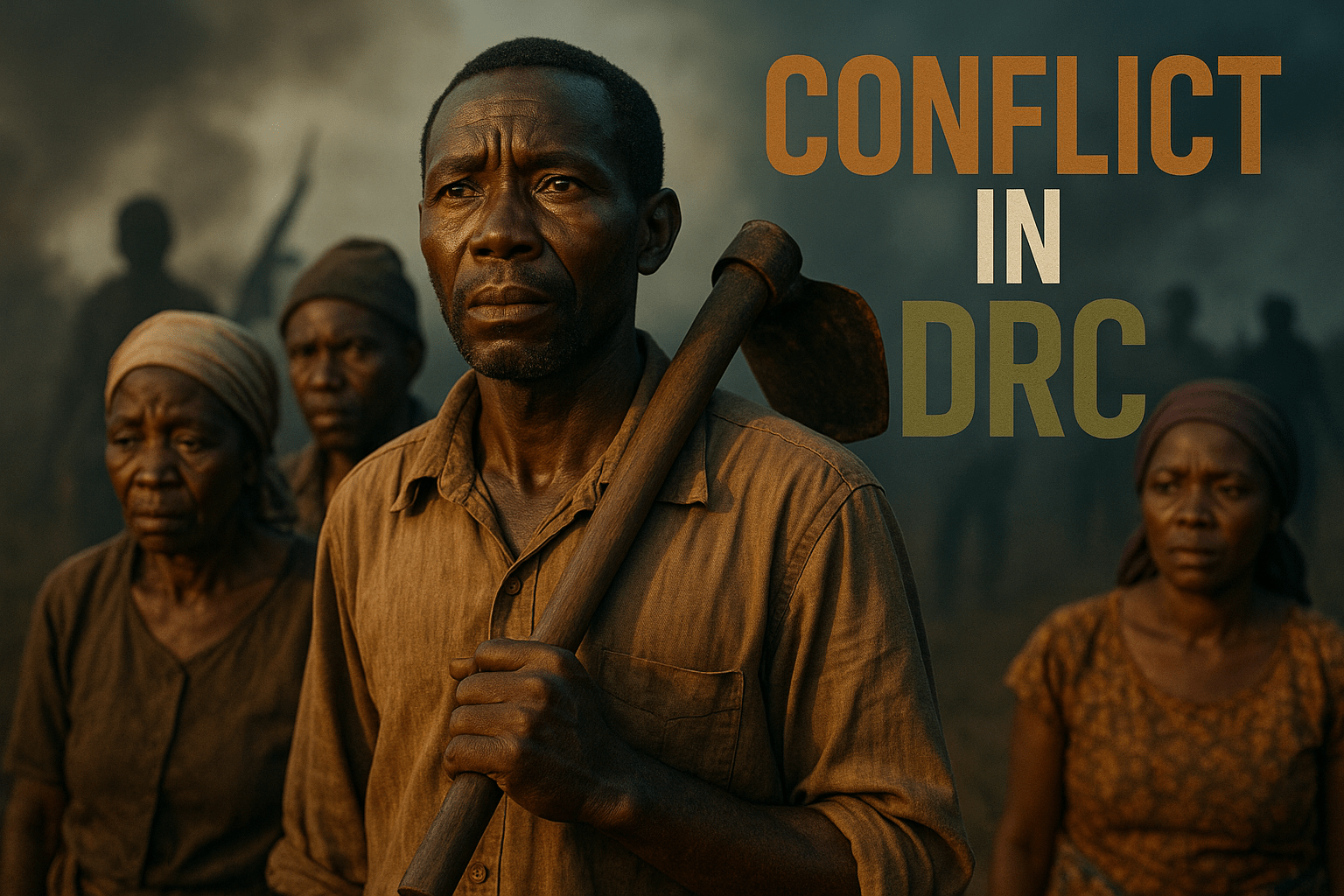
DRC Conflict: A Deep Dive
By Darius Spearman (africanelements)
Support African Elements at patreon.com/africanelements and hear recent news in a single playlist. Additionally, you can gain early access to ad-free video content.
Unpacking the M23 Rebellion
The M23 is an armed group that has been actively involved in the Democratic Republic of Congo (DRC) for some time. Their recent resurgence has been linked to complex regional rivalries and various conflict drivers, extending beyond the simple pursuit of mineral resources (reliefweb.int). This group has expanded its control over territory and has even set up its own administrative structures in the areas it occupies (press.un.org).
The United Nations Human Rights Office has strongly condemned the M23 for deadly attacks on civilians in eastern DRC (france24.com). This condemnation comes despite a recently signed ceasefire agreement. Jeremy Laurence, a spokesperson for the UN Human Rights Office, reported that the M23, with support from members of the Rwanda Defence Force, killed at least 319 civilians between July 9 and 21 (france24.com). These horrific events occurred in four villages within the Rutshuru territory of North Kivu Province. Most of the victims, including at least 48 women and 19 children, were local farmers who were camping in their fields during the planting season (france24.com).
Rwanda's Role and Regional Dynamics
The Rwanda Defence Force (RDF) has been implicated in supporting the M23. While the exact details of the RDF's role are not fully elaborated, reports indicate that the M23 has received “reported external support,” specifically “Rwandan support” (press.un.org). This suggests a significant involvement of Rwanda in the conflict through its backing of the M23. Rwandan support for the M23 continued even after relations between Rwanda and the DRC resumed in early 2022, contributing to the group's growth (cic.nyu.edu).
The conflict in the DRC is not a simple matter of one group against another. It involves a complex web of actors, each with their own agendas (reliefweb.int). The Congolese government, out of frustration with its own army, has sometimes turned to private security firms and even collaborated with foreign and local armed groups (cic.nyu.edu). This has unfortunately made the crisis worse. As groups like the M23 recruit members based on ethnic lines, tensions between communities have increased, leading to more attacks on civilians (cic.nyu.edu).
Other Armed Groups and Civilian Impact
Beyond the M23, other armed groups are also active in the eastern DRC. The UN has condemned attacks against civilians by groups such as the Allied Democratic Forces (ADF) and CODECO (france24.com). The ADF, in particular, poses serious threats to civilians and is a major perpetrator of abuses (press.un.org). Along with the M23 and Wazalendo, the ADF has been identified as a primary perpetrator of abuses, including sexual and gender-based violence and violence against children (press.un.org).
The Democratic Forces for the Liberation of Rwanda (FDLR) are another armed group mentioned in the context of the conflict. While they are noted as a target of M23 operations, specific details about their origins or motivations are not provided (reuters.com). The security situation in the eastern region involves various armed group activities and support networks, and the FDLR is part of these discussions (press.un.org). The presence and actions of these multiple armed groups contribute to the ongoing instability and the severe humanitarian crisis in the region.
Key Armed Groups in Eastern DRC
An armed group active in the DRC, linked to regional rivalries and expanding territorial control. They have been condemned for deadly attacks on civilians.
Identified as a major perpetrator of abuses against civilians, including sexual and gender-based violence, posing grave threats in the eastern DRC.
Another armed group operating in the eastern DRC, also implicated in attacks against civilians in the region.
An armed group in the DRC, mentioned as a target of M23 operations, contributing to the complex web of conflict.
Peace Efforts and Lingering Skepticism
The Democratic Republic of Congo (DRC) has signed a ceasefire agreement with M23 rebels in Qatar (africanews.com). This “Statement of Intent” commits both parties to protecting civilians and respecting Congolese sovereignty. Furthermore, the DRC and M23 rebels have committed to signing a peace agreement by mid-August (rfi.fr). The UN peacekeeping mission in the DRC, MONUSCO, has even hailed the recent Doha agreement as an “important step towards sustainable peace” (dppa.un.org).
Despite these agreements, skepticism remains among experts in North Kivu (africanews.com). The Doha agreement, for instance, does not include penalties for breaches or mention justice mechanisms (dw.com). These are significant points that are far from resolved. While the front lines in eastern DRC have stabilized since February, violence has actually intensified between the M23 and pro-Kinshasa militias in the mineral-rich eastern Congo, bordering Rwanda (rfi.fr). This ongoing violence, despite peace efforts, highlights the deep-seated challenges to achieving lasting peace.
Geographical Context and Humanitarian Crisis
The conflict primarily affects the eastern region of the DRC, specifically North Kivu, South Kivu, and Ituri provinces. These areas are consistently mentioned as hotbeds of conflict and armed group activity (press.un.org). The Rutshuru territory in North Kivu, for example, was the site of the M23's deadly attacks on farmers (france24.com).
The conflict has had a devastating humanitarian impact. It has led to the displacement of many people (dw.com). The Doha agreement aims to address this by providing for the safe, voluntary, and dignified return of refugees and displaced persons (dw.com). Representatives of civil society organizations and internally displaced persons have shared harrowing first-hand accounts of abuses, including sexual and gender-based violence and violence against children (press.un.org). This paints a grim picture of the conditions faced by those caught in the crossfire.
Reported Civilian Casualties by M23 (July 2025)
Discrepancies in Casualty Figures
There is a noticeable difference in the reported number of civilian deaths caused by the M23. The UN Human Rights Office reported at least 319 civilian deaths between July 9 and 21 (france24.com). However, the U.N. Joint Human Rights Office (UNJHRO) reported that an M23 operation, which began on July 9, resulted in “at least 169 people” killed (reuters.com). These victims were mainly farmers temporarily camping in their fields (reuters.com).
While the exact reasons for these discrepancies are not explained, it is important to acknowledge that collecting accurate data in conflict zones is incredibly challenging. Despite the differing numbers, both reports confirm that armed groups, including the M23, are responsible for abuses against civilians (press.un.org). The UN High Commissioner for Human Rights, Volker Türk, has repeatedly called for all parties to the conflicts in eastern DRC to protect civilians and uphold international humanitarian and human rights law (france24.com).
Obstacles to Lasting Peace
Despite the signing of ceasefires and peace agreements, violence continues in the DRC. Several obstacles hinder the achievement of lasting peace. One significant issue is the lack of penalties for breaches in agreements and the absence of justice mechanisms (dw.com). This means that if an agreement is broken, there are no clear consequences, which can undermine trust and commitment to the peace process.
Furthermore, the ongoing activities of various armed groups, such as the ADF, continue to pose grave threats to civilians (press.un.org). The Congolese government's reliance on private security firms and collaboration with armed groups also contributes to the ongoing instability (cic.nyu.edu). These factors create a cycle of violence that is difficult to break, even with signed agreements in place. The complexity of the conflict, with many different actors and agendas, makes finding a sustainable solution incredibly challenging.
M23 Civilian Casualties by Demographics (July 2025)
International Response and Future Outlook
The international community, particularly the United Nations, plays a significant role in addressing the conflict in the DRC. The UN peacekeeping mission, MONUSCO, has actively engaged in peace efforts (dppa.un.org). Discussions within the UN Security Council have focused on the impact of sanctions regimes and various peace processes, including the Luanda and Nairobi processes (press.un.org). These efforts highlight a commitment to finding a resolution to the long-standing conflict.
Despite these international efforts, the path to lasting peace remains challenging. The continued military build-up on front lines, with both Rwanda-backed M23 and DRC-aligned Wazalendo fighters strengthening their presence, indicates that tensions remain high (aljazeera.com). The UN High Commissioner for Human Rights has urged all parties to commit to the peace process in good faith and to end the cycles of violence (france24.com). For the people of eastern DRC, especially those of African descent who have endured generations of conflict, the hope for a stable and peaceful future hinges on these commitments being honored.
ABOUT THE AUTHOR
Darius Spearman has been a professor of Black Studies at San Diego City College since 2007. He is the author of several books, including Between The Color Lines: A History of African Americans on the California Frontier Through 1890. You can visit Darius online at africanelements.org.
