
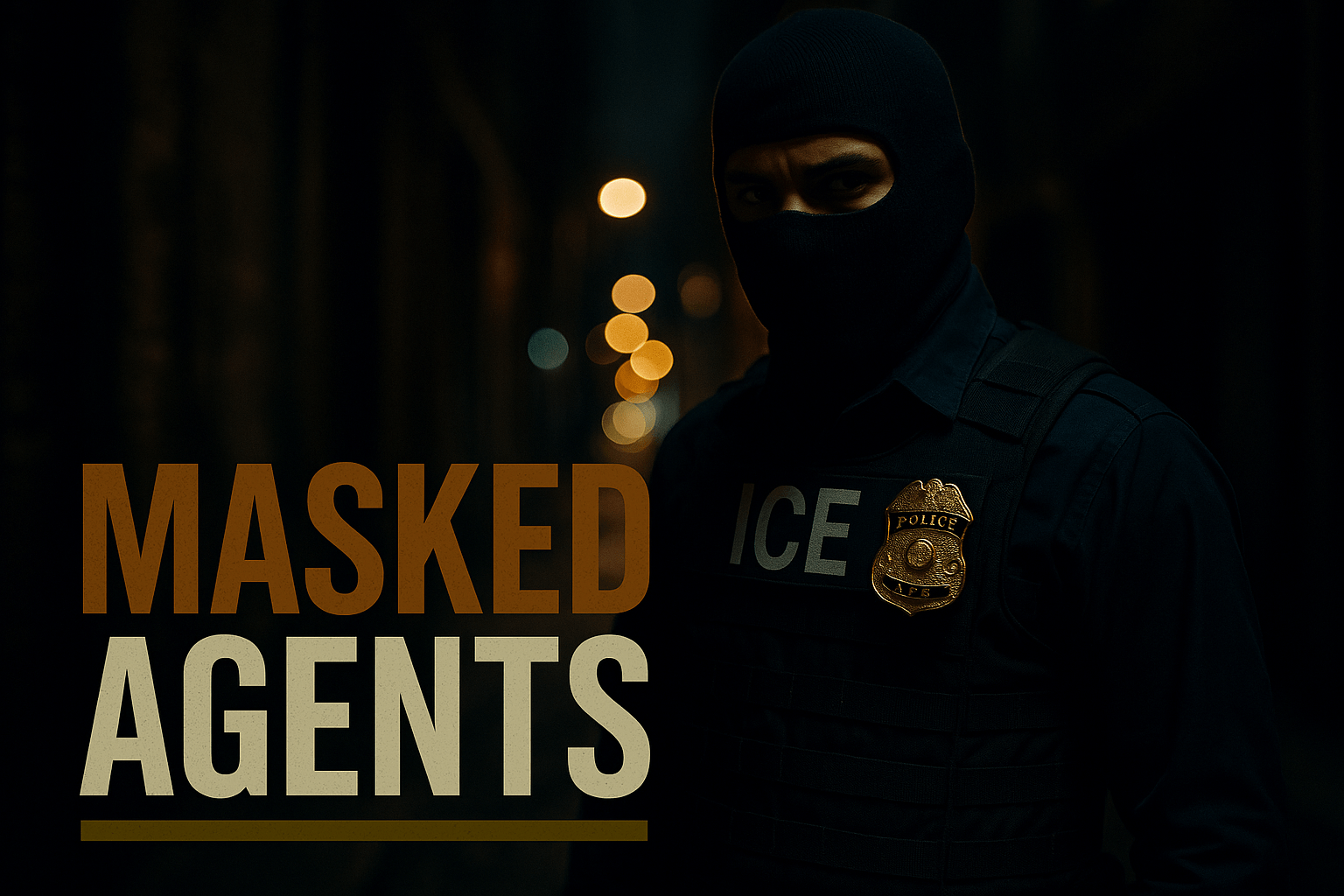
Masked ICE Agents: A Secret Police Force?
By Darius Spearman (africanelements)
Support African Elements at patreon.com/africanelements and hear recent news in a single playlist. Additionally, you can gain early access to ad-free video content.
The Masked Controversy
Immigration and Customs Enforcement, known as ICE, has recently faced intense scrutiny. This is due to their agents wearing masks during operations. ICE officials claim these masks protect agents and their families from doxxing, harassment, and even death threats (cnn.com). Acting ICE Director Todd Lyons stated that officers cover their faces to protect their families. He noted that some agents and their relatives have been publicly identified and harassed online (cnn.com).
Furthermore, Lyons defended the use of masks, saying he would not let his officers and agents “put their lives on the line, their family on the line because people don’t like what immigration enforcement is” (wvtm13.com). He also claimed that assaults against ICE officers are up 400 percent compared to the same period last year. Lyons mentioned that masks are used because an operation with the Secret Service arrested someone who was doxxing agents and their families (yahoo.com; wvtm13.com). This claim of increased assaults is a major point of contention, as we will explore further.
Understanding Doxxing

Doxxing: This term refers to the online practice of publicizing someone’s personal information. This can include addresses, relatives’ names, and phone numbers. Such actions can lead to harassment or threats. ICE Director Tom Homan stated that agents wear masks due to fear of doxxing, as it can lead to online attacks (bostonglobe.com).
Accountability Concerns
Critics, including Democratic lawmakers and civil rights groups, argue that masked ICE agents are engaging in intimidation tactics. They believe masks are an attempt by ICE agents to avoid accountability for their actions (yahoo.com). These critics suggest that agents are moving more like a “secret police force.” They contend that this behavior aims to frighten immigrants as part of the Trump administration’s directive to crack down on illegal immigration (yahoo.com).
Scott Shuchart, a senior ICE official during the Biden administration, described agents operating without visible identification as “unprecedented to see at this scale.” He called it “very dangerous” (cnn.com). The practice of masked agents reportedly began around March 2025. At that time, federal immigration officers in plain clothes and without visible identification started detaining international students on campuses or near their homes. This was part of a campaign targeting pro-Palestinian student activists and critics of Israel’s policies (cnn.com).
Defining “Secret Police”

Secret Police: Critics describe masked ICE agents as appearing similar to a “secret police.” This implies an unaccountable and intimidating law enforcement presence. This concern arises from agents concealing their identities, making them appear less transparent and potentially more authoritarian. The Cato Institute, a libertarian think tank, expressed concern that masked agents resemble a secret police, noting that judges do not hide their identities despite facing threats (csmonitor.com).
The Trump Administration’s Role
The increase in masked agents coincides with a ramp-up in ICE raids and arrests, particularly during the Trump administration. President Trump himself criticized mask-wearing by protesters, asking “What do these people have to hide, and why?” (csmonitor.com). His administration also criticized student protesters for wearing masks during demonstrations (csmonitor.com). This creates a stark contrast when considering the actions of his own administration’s agents.
ICE housed an average of more than 46,000 detainees during the first half of May 2025. This number already exceeded its budgeted capacity (washingtonpost.com). Lyons stated that operations like the surge in Massachusetts would not be necessary if “sanctuary cities would change their policy” (washingtonpost.com). Sanctuary cities are municipalities that limit their cooperation with federal immigration enforcement. Between January 20 and May 19, 2025, ICE arrested 78,155 people, averaging 656 arrests per day (wvtm13.com). This surge in arrests and the use of masks are seen by some as a tactic that could become normalized, raising concerns about the authority of agents (cnn.com).
Understanding Sanctuary Cities

Sanctuary Cities: These are municipalities that have policies in place to limit their cooperation with federal immigration enforcement agencies. They often do this to protect undocumented immigrants from deportation. This approach can create political and operational tensions with federal agencies like ICE.
The Disputed Assault Claims
ICE and the Department of Homeland Security have claimed a 413 percent increase in assaults on their agents. They use this statistic to justify agents operating in plain clothes, masked, and without identifying information. However, this claim has been heavily scrutinized. Philip Bump of The Washington Post pointed out that percentages without context can be extremely misleading. A 413 percent increase could mean a small jump from 8 to 41 assaults, or a larger problem from 200 to 1,026. This distinction matters greatly, especially when used to justify federal agents freely detaining people while masked.
The truth, according to critics, is that this decision is more about power than protection. It allows agents to avoid accountability. It creates a fear-based narrative that enables ICE agents to cause chaos and fear. They move more like a secret police force than a public institution funded by taxpayers. When Philip Bump first questioned this strategy, Acting ICE Director Todd Lyons cited the 413 percent increase. Yet, when asked for hard evidence of doxxing, targeted attacks, or assaults outside the context of an arrest, ICE reportedly remained silent. This silence suggests that many documented “assaults” occurred during arrests, often involving people who were unlawfully detained. In cases involving elected officials like NYC Comptroller Brad Lander and Rep. LaMonica McIver, video footage shows no physical contact with agents. Despite this, ICE uses these incidents to argue that masks are a matter of life and death for their agents.
The Misleading Nature of Percentage Increases
Legal Ambiguity and Identification
There is no clear federal policy outlining when law enforcement officers can or cannot wear face coverings during arrests (en.as.com). While some regulations suggest officers should identify themselves, the specific guidelines for mask use remain unclear. This ambiguity leads to questions about whether mask-wearing is officially sanctioned or falls into a legal gray area. Virginia senators questioned ICE on this matter, stating that Department of Homeland Security (DHS) regulations require law enforcement to properly identify themselves and limit mask use during official operations (en.as.com).
ICE states that agents “may initially identify themselves as ‘police'” and wear badges and carry credentials. They are supposed to identify themselves as immigration officers at the time of arrest or when practical and safe (nbcboston.com). However, senators noted that masked ICE officers and agents were making arrests “without clearly visible identification as law enforcement” (en.as.com). The use of masks and plain clothes by law enforcement officers has some precedent, particularly for undercover work or policing crowded events like protests (csmonitor.com). However, critics argue that this should not apply to routine arrests where identification is crucial for public trust and accountability.
Legislative Response: The “No Secret Police Act”
The use of masks by ICE agents has ignited a political debate and led to legislative proposals. Images of federal immigration agents wearing masks and balaclavas during raids in Los Angeles and other U.S. cities have fueled this politically charged discussion (yahoo.com). In response, two California lawmakers proposed the “No Secret Police Act” (SB 627) (newsone.com).
This bill aims to ban local, state, and federal law enforcement officers from covering their faces during public interactions. It includes exceptions for undercover operations and medical or safety masks (newsone.com). State Senator Scott Wiener (D-San Francisco) stated that “The recent federal operations in California have created an environment of profound terror.” He added that if the public is to trust law enforcement, they “cannot allow them to behave like secret police in an authoritarian state” (newsone.com). State Senator Jesse Arreguin (D-Berkeley), a co-sponsor of the bill, emphasized that the bill will ensure law enforcement are easily identifiable, maintaining trust and accountability (newsone.com). The bill would also require officers to be identifiable by their uniform and would exempt SWAT teams.
Key Provisions of the “No Secret Police Act” (SB 627)
Impact on Communities and Democracy
From an African American and African Diaspora perspective, the actions of masked ICE agents raise serious concerns. Historically, communities of color have often experienced law enforcement operating with a lack of transparency and accountability. The idea of a “secret police” resonates deeply with past experiences of intimidation and unchecked authority. When agents hide their identities, it makes it harder for individuals to report misconduct or seek justice. This lack of transparency can erode trust between law enforcement and the communities they serve, especially immigrant communities which include many people of African descent.
The narrative that masks are necessary for agent safety, while important, must be balanced with the need for public accountability. The argument that ICE officers are above the law or under an unprecedented threat is often challenged by video footage and complaints. These often show regular people being detained, sometimes at their jobs or after immigration hearings. The real danger here is not to ICE agents, but to the principles of transparency and accountability that underpin a democratic society. When law enforcement operates in the shadows, it can foster an environment of fear and undermine the rule of law for everyone.
ABOUT THE AUTHOR
Darius Spearman has been a professor of Black Studies at San Diego City College since 2007. He is the author of several books, including Between The Color Lines: A History of African Americans on the California Frontier Through 1890. You can visit Darius online at africanelements.org.
