
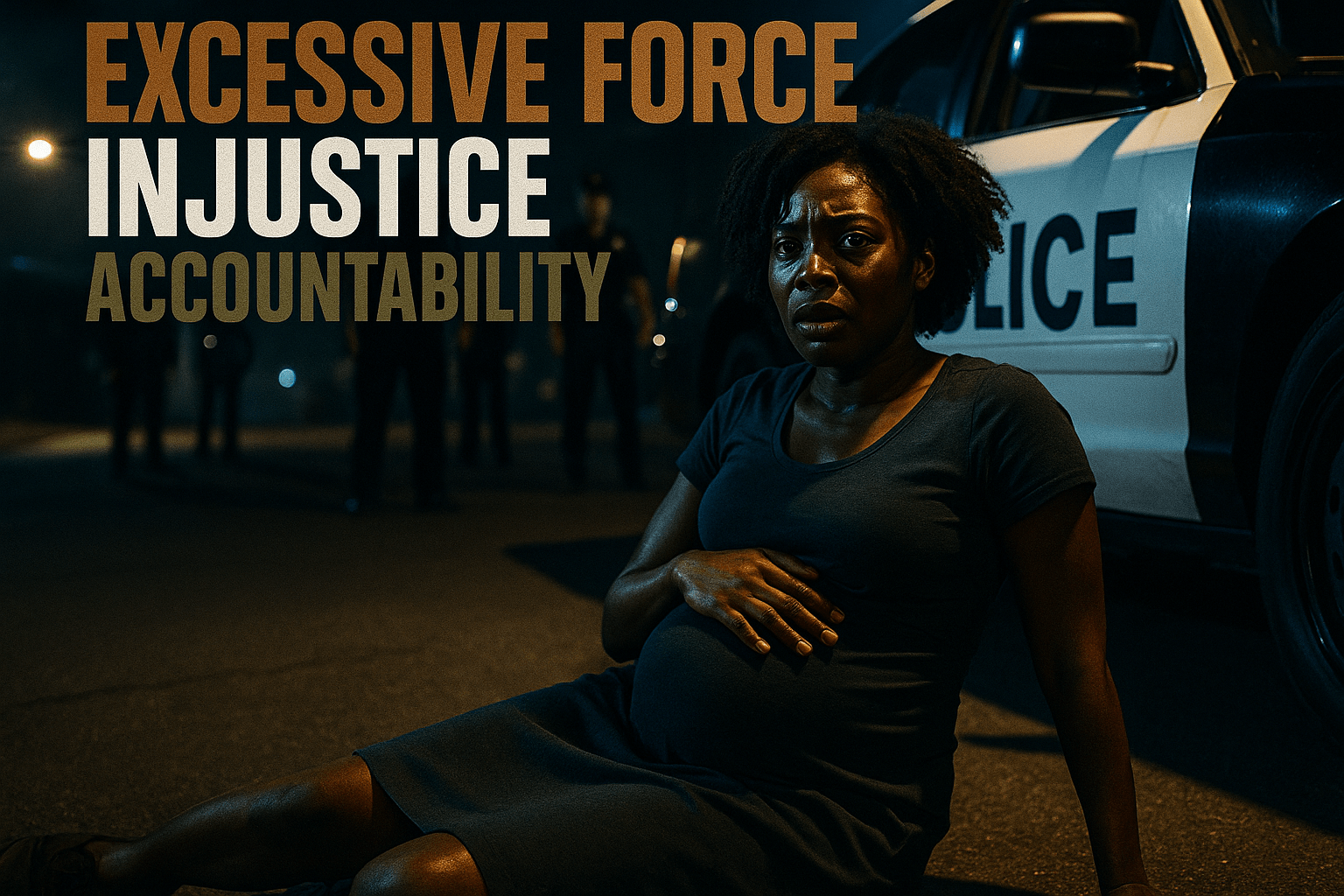
Pregnant Woman’s Miscarriage Sparks Police Brutality Lawsuit
By Darius Spearman (africanelements)
Support African Elements at patreon.com/africanelements and hear recent news in a single playlist. Additionally, you can gain early access to ad-free video content.
Shikeia Randolph, a pregnant Black woman, has filed a lawsuit against the Lake County Sheriff’s Department in Indiana. She alleges that officers used excessive force during a traffic stop, which tragically led to her miscarriage. This case highlights critical issues of police accountability, transparency, and the impact of law enforcement actions on Black communities.
The lawsuit details a harrowing encounter that began with a routine traffic stop and escalated into a traumatic event. Randolph’s experience sheds light on the challenges individuals face when seeking justice against alleged police misconduct, especially when crucial evidence like body camera footage is withheld.
The Incident: A Pregnant Woman’s Ordeal
In June 2023, Shikeia Randolph, then 11 weeks pregnant, was pulled over by Officer Peter Hamady of the Lake County Sheriff’s Department. The reason given for the stop was an alleged license plate issue (atlantablackstar.com). Officer Hamady then claimed there was a warrant for Randolph’s arrest related to a truancy allegation (atlantablackstar.com). Randolph stated she had already addressed this matter in court.
Despite informing the officers of her pregnancy, Randolph alleges they pulled her from her car and slammed her to the ground (atlantablackstar.com). Three months after this incident, Randolph suffered a miscarriage, which she attributes directly to the physical abuse endured during the stop (atlantablackstar.com). Truancy laws generally require children to attend school regularly. While specific laws vary by state, picking up children early, especially if it leads to unexcused absences, could potentially fall under truancy regulations. The context of Randolph’s early pickup and her prior court appearance are crucial details in understanding the legitimacy of the alleged warrant.
The Withholding of Body Camera Footage
A significant point of contention in Randolph’s lawsuit is the Lake County Sheriff’s Department’s refusal to release body camera footage of the incident. All four officers involved were wearing cameras, yet the footage remains undisclosed (atlantablackstar.com). Randolph’s attorney, Matt Custardo, stated that the department has provided no justification for withholding the footage, which he believes “speaks volumes” (atlantablackstar.com).
The lawsuit argues that the lack of body camera footage prejudices Randolph’s ability to fully prosecute her claims and would illuminate the officers’ actions (atlantablackstar.com). Officer Hamady’s report claimed Randolph became “argumentative,” a claim that could be confirmed or refuted by the body camera footage (atlantablackstar.com). Body camera footage serves as an objective record of police-citizen encounters, promoting transparency, accountability, and providing crucial evidence in investigations of alleged misconduct (expresslegalfunding.com). The reasons for refusing to release footage can vary, often citing ongoing investigations, privacy concerns, or potential prejudice to a legal case. However, the lack of explanation in this instance raises serious questions about transparency and accountability.
Defining Excessive Force
Excessive force refers to the use of more force than is objectively reasonable under the circumstances by a law enforcement officer (policebrutalitycenter.org). This is a central concept in civil rights lawsuits against police.
Allegations of Systemic Misconduct
The lawsuit against the Lake County Sheriff’s Department extends beyond Randolph’s individual case. It alleges a pattern of misconduct and excessive force within the department (atlantablackstar.com). Specifically, the lawsuit claims that Officer Hamady and other officers have a “history of misconduct and/or using excessive force” (atlantablackstar.com).
Furthermore, it suggests that “multiple officers employed by the LCSD have previously been subject to disciplinary action for the use of excessive force” (atlantablackstar.com). These instances, according to the lawsuit, indicate “institutional deficiencies within LCSD, including inadequate training, insufficient supervision, and a failure to implement effective accountability measures” (atlantablackstar.com). Institutional deficiencies refer to systemic problems within a police department, such as inadequate training, insufficient supervision, or a culture that tolerates misconduct (julianjohnsonlaw.com). These deficiencies can lead to a pattern of civil rights violations and erode public trust, making it difficult to hold officers accountable for actions like excessive force, false arrests, or lying under oath (expresslegalfunding.com).
Legal Claims and Constitutional Rights
The lawsuit accuses Officer Hamady of violating Randolph’s Fourth and 14th Amendment rights, malicious prosecution, spoliation of evidence, and retaliation for exercising her First Amendment rights (atlantablackstar.com). The Lake County Sheriff’s Department is also accused of negligence for “failure to train, supervise and discipline” its officers (atlantablackstar.com).
The Fourth Amendment protects individuals from unreasonable searches and seizures, while the Fourteenth Amendment ensures due process and equal protection under the law (nolo.com). Both are crucial in cases of alleged police misconduct, as officers acting “under color of state law” can be sued for misusing their authority (first-defense.org). Malicious prosecution occurs when someone initiates a baseless legal proceeding against another with malicious intent (expresslegalfunding.com). Spoliation of evidence refers to the intentional destruction or alteration of evidence relevant to a legal proceeding (expresslegalfunding.com). These are serious allegations in police misconduct cases, especially when body camera footage is withheld. Randolph was charged with resisting arrest two months after the incident, a charge that was later dismissed through a pretrial diversion agreement (atlantablackstar.com). A pretrial diversion agreement is an alternative to traditional prosecution where a defendant agrees to fulfill certain conditions in exchange for the dismissal of charges, allowing them to avoid a criminal record (policebrutalitycenter.org).
Understanding Constitutional Protections
The Fourth Amendment protects individuals from unreasonable searches and seizures (nolo.com). The Fourteenth Amendment ensures due process and equal protection under the law (nolo.com). Both are vital in cases of alleged police misconduct, ensuring officers are held accountable for misusing their authority.
Broader Context: A Pattern of Police Misconduct
Randolph’s case is not an isolated incident. Other recent cases highlight allegations of police misconduct and a concerning lack of transparency regarding body camera footage. For example, in Illinois, police officers were sued for threatening to kill an innocent Black man during a mistaken identity detainment, with body camera footage showing the incident (atlantablackstar.com). This footage was crucial in exposing the officers’ actions.
Similarly, a Black man in Georgia was pulled over twice within an hour on false tailgating allegations, with video evidence reportedly exposing the deputies’ “criminal” behavior and “conspiracy” to send him to prison (atlantablackstar.com). In Michigan, an officer with a history of abuse pulled a Black mother out of her car and tasered her over an expired registration in front of her children, claiming fear for his safety (atlantablackstar.com). Bodycam footage of this incident also surfaced, providing critical evidence. These cases, like Randolph’s, underscore a troubling pattern where body camera footage is either withheld or, when released, reveals alarming behavior by law enforcement officers. They also highlight the disproportionate impact of such encounters on Black individuals and families.
Community Impact and Accountability
Incidents of alleged police misconduct and patterns of systemic issues can severely erode community trust in law enforcement. This erosion of trust can lead to decreased cooperation with police, increased tensions, and a perception of injustice, particularly within marginalized communities (expresslegalfunding.com). The Lake County Sheriff’s Department’s official website outlines the Sheriff’s responsibilities, which include crime prevention, patrol, traffic enforcement, criminal investigation, and other requirements of contemporary police work (lakecountyin.gov). However, when allegations of excessive force and lack of transparency surface, these stated responsibilities are undermined.
Holding law enforcement accountable through lawsuits is not just about seeking compensation; it is about fostering a justice system that truly serves and protects the community (julianjohnsonlaw.com). The current status and timeline of Randolph’s lawsuit would require access to court records. However, potential consequences for officers can include disciplinary action, termination, or criminal charges, while departments may face financial penalties, mandated reforms, or consent decrees (policebrutalitycenter.org). Similar cases are often resolved through settlements, jury verdicts, or dismissals, with outcomes varying widely based on evidence and legal arguments. The refusal to release body camera footage in Randolph’s case further exacerbates community concerns, suggesting a lack of commitment to transparency that is essential for building and maintaining public trust.
The Role of Body Camera Footage
Body camera footage serves as an objective record of police-citizen encounters (expresslegalfunding.com). It promotes transparency, accountability, and provides crucial evidence in investigations of alleged misconduct, helping to confirm or refute claims made by officers or citizens.
Shikeia Randolph’s lawsuit against the Lake County Sheriff’s Department brings to the forefront critical questions about police conduct, accountability, and the rights of citizens, especially pregnant Black women. The alleged excessive force, coupled with the tragic miscarriage and the department’s refusal to release body camera footage, paints a disturbing picture. This case, alongside others across the nation, underscores the urgent need for greater transparency, robust accountability mechanisms, and a reevaluation of policing practices to ensure justice and protect all members of the community.
ABOUT THE AUTHOR
Darius Spearman has been a professor of Black Studies at San Diego City College since 2007. He is the author of several books, including Between The Color Lines: A History of African Americans on the California Frontier Through 1890. You can visit Darius online at africanelements.org.
