
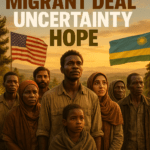


Rwanda's Migrant Deal: A Deep Dive
By Darius Spearman (africanelements)
Support African Elements at patreon.com/africanelements and hear recent news in a single playlist. Additionally, you can gain early access to ad-free video content.
Rwanda's Role in Global Migration
Rwanda has confirmed it is in “early stage” talks with the United States regarding a potential deal to accept deported migrants (npr.org). Rwandan Foreign Minister Olivier Nduhungirehe stated that his government was in “early talks” with Washington about a migration deal, confirming previous rumors (scmp.com). These discussions are in their preliminary phase, meaning plans are not yet concrete (npr.org). The framework for the deal remains conceptual, suggesting a transactional approach to global migration diplomacy (horninstitute.org).
Nduhungirehe did not disclose the specific details of the potential deal (scmp.com). However, local media reports suggest the U.S. would likely fund a program to integrate migrants into Rwandan society through stipends and job initiatives (scmp.com). The U.S. State Department declined to comment on a potential deal but stated that engagement with foreign governments is an important part of U.S. policy to deter illegal migration (scmp.com).
Understanding Third-Country Deportation
This potential agreement with the U.S. mirrors Rwanda's previous and controversial migrant-hosting agreements with Western nations, particularly the United Kingdom. The concept of “third-country deportation” or “migrant-hosting agreements” involves a country sending migrants to another country that is neither their country of origin nor the deporting country (npr.org). Rwanda signed an agreement with the UK in 2022 to receive third-country asylum seekers (upi.com).
The UK deal involved sending migrants who arrived in the UK as stowaways or in boats to Rwanda, where their asylum claims would be processed (pbs.org). If successful, they would stay there (pbs.org). This deal was ended in 2024 by British Prime Minister Keir Starmer (upi.com). Plans for the UK initiative, including prepared accommodation, were in the final stages before the deal collapsed after the Labour Party took office (scmp.com). This would not be Rwanda's first time hosting deported migrants, and the country has experience in taking in migrants (npr.org).
Rwanda's Migrant Agreements Timeline
UK-Rwanda Deal Signed
Rwanda signed an agreement with the UK to receive third-country asylum seekers.
UK Supreme Court Ruling
The UK Supreme Court ruled the UK-Rwanda policy unlawful, citing human rights concerns.
UK Deal Collapses
The UK deal was ended by British Prime Minister Keir Starmer after the Labour Party took office.
US-Rwanda Deal Signed
Rwanda formally agreed to accept up to 250 migrants deported from the United States.
Financial Incentives and Integration
The proposed deal with the U.S. would reportedly involve financial compensation for Rwanda and support for the integrated migrants. In exchange for accepting deportees, Rwanda would reportedly receive financial compensation (horninstitute.org). Additional support would include stipends and employment assistance for the migrants, aimed at encouraging social and economic integration into Rwandan society (horninstitute.org).
Local media reports suggest the U.S. would likely fund a program to integrate migrants into society through stipends and job initiatives (scmp.com). While these reports indicate the nature of the support, specific details on the scale, funding amounts, duration, or effectiveness of these programs are not yet available. Rwanda's Foreign Minister Olivier Nduhungirehe noted that Rwanda has experience in taking in migrants, saying, “it's not the first time that we'd be engaging in such a kind of deal” (npr.org).
U.S. Policy and Deportation
The discussions between the U.S. and Rwanda come amidst broader U.S. policy considerations regarding deportation and migrant relocation. The Handbasket reported in April that the United States deported Iraqi and alleged terrorist Omar Abdulsattar Ameen to Rwanda (upi.com). Senator Marco Rubio, seated next to Donald Trump, stated that the U.S. wants to send “some of the most despicable human beings” to other countries, and “the farther away from America, the better, so they can’t come back across the border” (aljazeera.com).
Donald Trump has also expressed a desire to deport “homegrown criminals” (meaning U.S. citizens) to countries like El Salvador and directed the opening of a detention center at Guantanamo Bay, Cuba, to hold up to 30,000 “worst criminal aliens” (aljazeera.com). The U.S. State Department stated that engagement with foreign governments is an important part of the U.S. government’s policy to deter illegal migration (pbs.org). This broader policy context suggests a transactional approach to managing migration, aligning with the potential deal with Rwanda.
Deportee Acceptance Criteria
- Completed Prison Terms: Deportees will only be accepted if they have completed any prison terms.
- No Pending Criminal Cases: Individuals must have no outstanding criminal cases.
- Exclusion of Child Sex Offenders: Child sex offenders are explicitly excluded from the agreement.
Controversies and Human Rights
The UK Supreme Court ruled the UK-Rwanda policy unlawful in November 2023, citing human rights concerns (horninstitute.org). The plan was stalled by legal challenges and criticized by human rights groups, who called it unethical to deport migrants to a country 4,000 miles away that they do not want to live in (pbs.org). This suggests similar concerns could arise with a US-Rwanda agreement. Critics’ concerns about outsourcing deportations to countries where deportees may lack ties or support are significant.
The provided information does not detail the specific legal protections or rights that deported migrants would have in Rwanda under a potential U.S. deal, nor does it clarify their ability to leave or seek asylum elsewhere. While Rwanda's Foreign Minister stated that Rwanda has experience in taking in migrants, suggesting a capacity to integrate them, the search results do not detail other motivations for Rwanda beyond financial compensation (npr.org). The U.S. State Department declined to comment on the specifics of a potential deal, but generally stated that engagement with foreign governments is an important part of the U.S. government’s policy to deter illegal migration (pbs.org).
Future Implications and Unknowns
The provided search results do not specify a timeline for when the US-Rwanda deal might be implemented or when deportations could begin. The discussions are described as being in “early stages,” indicating that concrete plans and timelines are not yet established. Furthermore, there is no information on the specific nationalities or backgrounds of migrants expected to be deported under the deal, nor do they mention a cap of 250 or any other specific numbers beyond the initial list of 10 individuals for approval (scmp.com).
The original article states that Rwanda has formally agreed to accept up to 250 migrants deported from the United States under a bilateral initiative signed in June 2025. Rwandan spokesperson Yolande Makolo said the arrangement reflects the nation’s values built on “reintegration and rehabilitation,” given Rwanda's history of displacement. Each deportee will be vetted before arrival and provided with workforce training, healthcare, and accommodation support to facilitate their integration into one of Africa’s fastest-growing economies. Deportees are not required to stay permanently in Rwanda, and en route, the U.S. is offering undisclosed financial support to Kigali through a grant based on integration needs. This deal illustrates part of the broader Trump administration policy aimed at relocating migrants to third countries. Critics, including several human rights groups, warn of possible risks—arguing migrants might be sent to unfamiliar lands where they have no ties or legal recourse. Rwanda, however, maintains it can handle such cases responsibly. Kigali has similarly negotiated but never executed migrant resettlement deals with the U.K. in 2022 and the U.N. in Libya in 201. The provided search results do not contain information on how international bodies, human rights organizations, or other countries view this potential US-Rwanda deal. However, they do note that the previous UK-Rwanda deal was criticized by human rights groups and ruled unlawful by the UK Supreme Court (horninstitute.org). This suggests that a similar US-Rwanda deal could face similar scrutiny.
Proposed Migrant Support and Integration
Financial Stipends
U.S. would likely fund programs for migrant integration, including stipends.
Job Initiatives
Programs aimed at encouraging social and economic integration through job initiatives.
Accommodation Support
Deportees will be provided with accommodation support to facilitate integration.
Healthcare
Healthcare support will be provided as part of the integration efforts.
Workforce Training
Deportees will receive workforce training to aid in their integration into Rwandan society.
ABOUT THE AUTHOR
Darius Spearman has been a professor of Black Studies at San Diego City College since 2007. He is the author of several books, including Between The Color Lines: A History of African Americans on the California Frontier Through 1890. You can visit Darius online at africanelements.org.
