

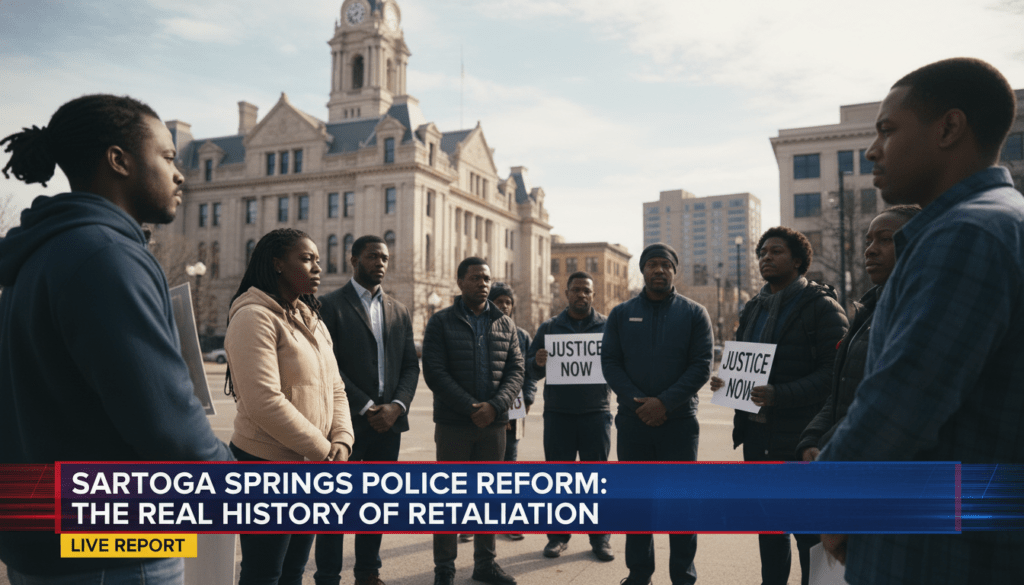
Saratoga Springs Police Reform: The Real History of Retaliation
By Darius Spearman (africanelements)
Support African Elements at patreon.com/africanelements and hear recent news in a single playlist. Additionally, you can gain early access to ad-free video content.
The city of Saratoga Springs, New York, is famous for horse racing and high-end springs. However, beneath the surface of this vacation spot, a long struggle for civil rights has been brewing for years. Recently, the city leadership reached a major agreement with New York Attorney General Letitia James. This deal aims to fix deep-seated issues within the police department. It focuses on how the city treats Black Lives Matter (BLM) protesters. The agreement follows a intense investigation that looked into claims of police retaliation and the silencing of Black voices (ny.gov).
For many in the Black community, this settlement is more than a legal document. It is a sign that the state is finally listening to the cries for justice that have echoed through the streets of Saratoga. The history of this struggle shows a pattern of official hostility that targeted those who dared to speak up. From secret text messages to the use of military-grade gear, the story of Saratoga Springs is a lesson in why accountability matters. Under the current leadership of President Donald Trump, the national conversation on law and order remains intense, making these local victories even more significant (albanyproper.com).
The Shadow of Darryl Mount
The tension in Saratoga Springs did not start with the 2020 protests. It has roots that go back at least a decade. In 2013, a young biracial man named Darryl Mount died after a police chase. The police claimed he fell from a tall scaffold while running away from an officer. However, his family and medical experts told a different story. They argued his injuries looked more like he had been beaten rather than falling from a height. This case left a deep wound in the community (wamc.org).
The controversy grew when it was revealed that the former Police Chief told the public there was an internal investigation when there actually was not. This lack of transparency made many people feel that the police department was protected from the law. Even though a jury later cleared the department of wrongdoing in a civil case, the mistrust stayed. Activists kept the memory of Darryl Mount alive, seeing his death as a clear example of how the system can fail Black people. This history of trauma set the stage for the massive demonstrations that would come later (ny.gov).
The struggle for justice in Saratoga often reminds people of how systems of control evolved over time. Many people still face challenges that look like involuntary servitude after the Civil War. In Saratoga, the fight was about the right to live and breathe without fear of those who are supposed to protect everyone. The Darryl Mount case became a symbol that activists used to demand real change and oversight for the police department (wamc.org).
A Summer of Militarized Policing
In 2020, the murder of George Floyd sparked protests across the world. Saratoga Springs was no different. At first, city leaders and police even marched with the protesters. But that unity did not last very long. By July 30, 2020, the atmosphere had changed completely. During a “Back the Blue” rally, Black Lives Matter counter-protesters showed up. Instead of keeping the peace, the police response became very aggressive (albanyproper.com).
The police deployed horse-mounted units and an armored vehicle called a Lenco BearCat. This vehicle is designed for war zones or high-risk hostage rescues, not for handling peaceful crowds. Seeing a military-style tank on the streets of a small town was a shock to many residents. Protesters reported that the police used riot gear and force against them while being much more lenient with the pro-police group. The Attorney General later found that this was part of a pattern of favoring one side over the other (ny.gov).
The use of such heavy equipment is often a sign of a larger narrative between the Civil Rights era and the era of mass incarceration. When the state treats citizens like enemy combatants, it breaks the social contract. The investigation by Letitia James showed that the police presence was often an escalation rather than a solution. This militarization only served to make the protesters more determined to see the department change its ways (ny.gov, timesunion.com).
Official Retaliation Exposed
The most shocking part of the Attorney General’s report involves the words of city leaders. In 2021, Assistant Police Chief John Catone held a press conference. He threatened to use his family’s 130-year history in the city to “stop the narrative” of the protesters. This sounded like a threat of using old-school power to crush dissent. Privately, other city leaders were even more blunt. Text messages between then-Mayor Meg Kelly and other officials showed them pressuring the police to “arrest all those motherf***ers” (ny.gov).
This was not just talk. The city implemented what the state called an “unconstitutional official policy” of retaliation. In one instance, a city official even told the police to call Child Protective Services (CPS) on a protest leader. This was a clear attempt to use the power of the government to hurt an activist’s family. The CPS investigation eventually found no evidence of any problems, but the damage was already done. Using a social service agency as a weapon against a parent is a severe violation of trust (timesunion.com, ny.gov).
The Attorney General also found that the police department made a “list” of protesters to arrest. They waited months after protests ended and then arrested 12 people all at once for minor things like blocking a street. This “sweep” was designed to intimidate people and keep them from coming back to protest. It showed a calculated effort to punish individuals based on the content of their speech. This kind of behavior is exactly what the First Amendment is supposed to protect people against (ny.gov, timesunion.com).
The Landmark Settlement Terms
To resolve these issues, Saratoga Springs signed an “Assurance of Discontinuance.” This is a legal agreement that requires the city to change its ways to avoid a lawsuit. The deal is very specific about what the police can and cannot do. For the next three years, the state will be watching the city very closely. This monitoring period is meant to ensure that the old habits of retaliation do not come back (ny.gov, saratogatodaynewspaper.com).
One major change is the creation of a four-tier policing system. In the past, the police often showed up in force right away. Now, the default response must be “Tier One,” which means helping the protest happen safely. The police cannot escalate to higher levels of force unless there is a real, documented threat to safety. This takes the power away from officials who might want to use the police to silence their political enemies. It forces the department to treat protesters with respect by default (ny.gov).
The agreement also bans the use of horses and armored vehicles like the BearCat at peaceful marches. It requires the city to hire “protest liaisons.” These are officers who are trained to talk and listen to demonstrators before any trouble starts. This focus on communication is a big shift from the “bloodlust for arrest” that the investigation uncovered. The goal is to make sure that the police are there to serve the public, including the people who are criticizing the government (wamc.org, ny.gov).
The city must now reallocate funds for mandatory training and independent monitoring (over $100,000 for the monitor alone).
The High Price of Progress
Change does not come for free. The city of Saratoga Springs now has to pay for the mistakes of its past leadership. Implementing these reforms will cost a significant amount of money. For example, the city had to hire an independent monitor to check their progress, which costs over $100,000. They also need to buy new equipment to make sure that official text messages are never deleted again. In the past, many records “disappeared,” but the new deal makes that illegal (saratogaspringspolitics.com, timesunion.com).
Training is another big expense. An independent auditor found that the city used to spend only about $94 per officer on training. That is not enough to teach someone how to handle complex civil rights issues. Now, every officer must go through deep training on de-escalation and bias prevention. This is a “substantial uplift” for a city with a $61 million budget. However, most people agree that paying for training is much better than paying for lawsuits when things go wrong (wamc.org, timesunion.com).
This situation highlights the sharing of power between national and state governments. While local leaders might try to push their own rules, the state Attorney General has the power to step in and protect constitutional rights. The yearly cost estimate included in the deal ensures that the city stays transparent about how much it is spending to protect the First Amendment. It makes civil rights a permanent part of the city’s financial plan (saratogatodaynewspaper.com, timesunion.com).
Looking Toward a More Just Future
The success of this agreement depends on the people currently in charge. Many of the officials who sent the retaliatory texts are no longer in office. But the system they left behind must be completely rebuilt. The Black community in Saratoga is watching to see if the “protest liaisons” will actually listen or if they will just be another layer of control. Trust is easy to break but very hard to fix. The three-year window of state monitoring is a good first step toward rebuilding that trust (wamc.org, ny.gov).
Throughout history, the visionary leader and educator has always known that true progress requires persistent pressure. The activists in Saratoga Springs did not give up, even when they faced arrests and threats to their families. Their bravery led to an investigation that exposed the truth to the entire state. Now, the city has a chance to move past its history of “official hostility” and become a place where everyone’s voice is protected (wamc.org).
This settlement is a victory for everyone who believes in the right to protest. It sets a standard for other small cities that might think they can ignore the Constitution. As the three-year monitoring period begins, the eyes of the state will remain on Saratoga Springs. The hope is that the city will choose to embrace these changes fully. If they do, Saratoga could transform from a symbol of retaliation into a model for police reform in the modern era (ny.gov, timesunion.com).
About the Author
Darius Spearman is a professor of Black Studies at San Diego City College, where he has been teaching for over 20 years. He is the founder of African Elements, a media platform dedicated to providing educational resources on the history and culture of the African diaspora. Through his work, Spearman aims to empower and educate by bringing historical context to contemporary issues affecting the Black community.
