
Listen to this article
Download AudioSenegal Mining: The Hidden Cost of Gold
By Darius Spearman (africanelements)
Support African Elements at patreon.com/africanelements and hear recent news in a single playlist. Additionally, you can gain early access to ad-free video content.
In Senegal, a quiet crisis is unfolding. The gleam of gold, sought after worldwide, casts a dark shadow over our families and communities. Artisanal and small-scale gold mining (ASGM) is a lifeline for many, yet it brings with it a dangerous guest: mercury. This toxic metal, used to pull gold from the earth, is poisoning the land and the people. It’s a story of survival, of environmental damage, and of urgent health risks that demand our attention and action.
The Poison in the Gold: Mercury’s Deadly Toll
Artisanal and Small-Scale Gold Mining, or ASGM, is how many individuals and small groups make a living. They work with basic tools, often informally, to find gold in places big companies might ignore. This type of mining provides jobs for about 10 to 18 million people across the globe, and a large number of these miners are women and even children (UNEP; ASM Inventory). ASGM is a significant source of gold, producing around 12 to 15% of the world’s supply (UNEP). However, the common method used to get this gold involves mercury. Miners mix mercury with gold-bearing ore, and the mercury sticks to the gold, forming an amalgam. They then heat this mixture to burn off the mercury, leaving the gold behind. This process releases tons of toxic mercury into the air each year (The Mercury Problem in Artisanal and Small‐Scale Gold Mining – PMC).
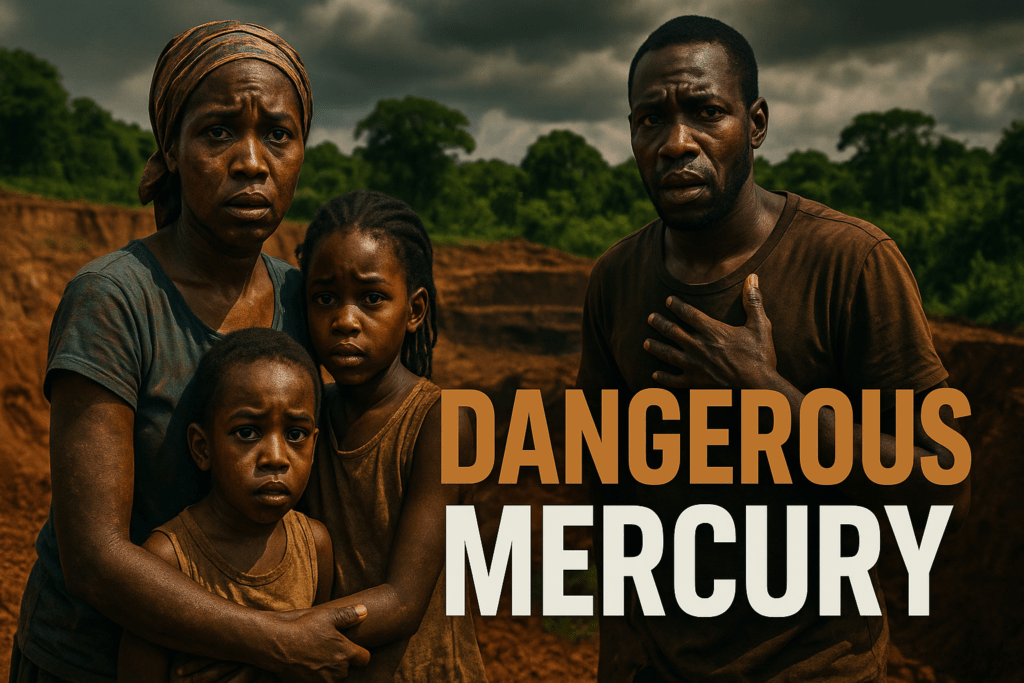
This mercury use is a massive problem for both health and the environment in places like Senegal. The mercury doesn’t just disappear; it contaminates soil, rivers, and the air. People living in and around these mining areas, especially the miners themselves, are exposed to dangerously high levels of this poison (Small Gold Mines in Senegal Create High Mercury Contamination). The health effects are severe. Exposure can lead to tremors, muscle weakness, vision and hearing problems, and coordination difficulty. For pregnant women and children, the risks are even greater, potentially causing birth defects or, in the worst cases, death (Small Gold Mines in Senegal Create High Mercury Contamination). Thus, the quest for gold becomes a dangerous gamble with long-term health consequences for our communities.
Our Land, Our Water: Gold Mining’s Environmental Scars
Artisanal gold mining is not just a health issue; it’s a major source of environmental pollution. Globally, ASGM is the biggest single source of mercury released into the environment by human activities (The Mercury Problem in Artisanal and Small‐Scale Gold Mining – PMC). This affects both the land and our precious water sources. When mercury is used in mining, it often gets burned off, sending toxic fumes into the atmosphere. It can also be spilled directly onto the ground or washed into nearby rivers and streams (Small Gold Mines in Senegal Create High Mercury Contamination; Senegalese artisanal gold mining leads to elevated total mercury levels).
Once in the environment, mercury doesn’t stay put. It can travel long distances by air and water. More alarmingly, tiny organisms in water and soil can convert elemental mercury into methylmercury (MeHg). This form of mercury is even more dangerous because it builds up in living things, especially fish (Small Gold Mines in Senegal Create High Mercury Contamination). When people eat contaminated fish, they ingest this highly toxic methylmercury, which can severely damage the nervous system. Consequently, the entire ecosystem, from the smallest organisms to the people who depend on the land and water, faces a grave threat from this persistent pollution.
ASGM’s Global Footprint: A Risky Livelihood
Empty Pockets, Aching Bodies: Social Impact of ASGM
For many of our brothers and sisters in Senegalese artisanal mining communities, the promise of gold often becomes a harsh reality. Despite the intense labor and the value of the gold extracted, these communities frequently remain impoverished (Going for gold leaves Senegal’s artisanal mining communities poorer). The working conditions are harsh, and the financial benefits rarely lift families out of poverty. The severe health risks linked to mercury exposure make this economic struggle worse. The lack of proper safety measures and regulations in many ASGM operations means miners constantly breathe in toxic mercury vapor or handle it without protection (A Safer Gold Rush? Curbing Mercury Pollution in Artisanal and Small-Scale Gold Mining).
These mining communities are often home to marginalized rural populations with few other ways to earn a living (Health Studies in ASGM Context – PMC). Poverty limits their access to healthcare, good nutrition, and education about the dangers they face. This makes them even more vulnerable to the devastating health impacts of mercury. Furthermore, women and children are commonly involved in ASGM activities, putting the entire community, including future generations, at risk (UNEP). Therefore, the social fabric of these communities is strained by a cycle of poverty and ill-health, all tied to the pursuit of gold.
Senegal’s Alarming Mercury Levels
By the Numbers: Senegal’s Mercury Crisis Unveiled
The data coming out of Senegal paints a grim picture of mercury contamination. Studies have found very high levels of total mercury (THg) and its highly toxic form, methylmercury (MeHg), in and around artisanal gold mining villages. THg refers to all forms of mercury combined in a sample, giving an overall measure of contamination. These levels often soar past what is considered safe by international bodies like the World Health Organization (WHO) and the U.S. Environmental Protection Agency (EPA) (Senegalese artisanal gold mining leads to elevated total mercury levels). For instance, the highest median THg concentrations were discovered inside huts where miners burn mercury-gold amalgams to separate the gold (Senegalese artisanal gold mining leads to elevated total mercury levels). This means people living in these homes, including children, breathe in extremely high mercury vapor levels.
It’s not just the air and indoor spaces that are affected. River water samples also showed elevated concentrations of both THg and MeHg (Senegalese artisanal gold mining leads to elevated total mercury levels). Shockingly, one study reported that nearly every sample taken from four mining villages and their surroundings had mercury levels higher than WHO and U.S. EPA standards. Some of these samples were contaminated at levels up to 100 times higher than these safety limits (Small Gold Mines in Senegal Create High Mercury Contamination). These statistics are not just numbers; they represent a clear and present danger to the health and well-being of entire communities in Senegal who are, unfortunately, caught in this toxic web.
Global Pledges, Local Struggles: The Minamata Challenge
Recognizing the global threat of mercury, the international community came together to create the Minamata Convention on Mercury. This treaty is named after Minamata Bay in Japan, the site of a horrific mercury poisoning disaster. Its main goal is to protect human health and our environment from mercury pollution caused by human activities (The Mercury Problem in Artisanal and Small‐Scale Gold Mining – PMC). A key focus of the Minamata Convention is to reduce, and where possible, eliminate mercury use in ASGM, since this sector is the largest source of human-caused mercury emissions worldwide (A Safer Gold Rush? Curbing Mercury Pollution in Artisanal and Small-Scale Gold Mining; The Mercury Problem in Artisanal and Small‐Scale Gold Mining – PMC).
The Convention encourages countries to develop national action plans, promote safer mining practices, and explore mercury-free alternatives. It also aims to provide financial and technical help to communities affected by ASGM to make these changes (The Mercury Problem in Artisanal and Small‐Scale Gold Mining – PMC). However, putting these goals into practice in places like Senegal is a huge challenge. Barriers such as limited financial resources, a lack of technical know-how, weak government oversight, and deeply rooted cultural practices make it difficult to shift away from mercury (The Mercury Problem in Artisanal and Small‐Scale Gold Mining – PMC). Thus, while the Minamata Convention offers a framework for hope, the journey to truly reduce mercury exposure in our Senegalese mining communities is still long and filled with obstacles.
Unequal Burdens: Why Our Communities Suffer More
The heavy burden of mercury contamination in Senegal doesn’t fall equally. Our communities, often already struggling with poverty and limited access to resources, suffer disproportionately. Many Senegalese artisanal miners come from marginalized rural backgrounds with few economic alternatives beyond mining (Health Studies in ASGM Context – PMC). This dependence, coupled with the informal and poorly regulated nature of ASGM, means miners frequently use mercury without proper safety gear or knowledge of its true dangers. Limited access to healthcare means that when people get sick from mercury, getting help is difficult, and the health problems can become chronic and debilitating.
Global economic dynamics also play a significant role. The high demand for gold in wealthier parts of the world fuels the ASGM industry. While local miners earn very little, the significant profits from this gold often flow to international buyers and large corporations, leaving the environmental and health costs behind in our communities (The Mercury Problem in Artisanal and Small‐Scale Gold Mining – PMC). This is a stark example of global wealth inequality, where those who bear the environmental damage and health suffering have the least power, while the economic benefits are reaped elsewhere. Therefore, addressing this mercury crisis requires not only local action but also a hard look at the systemic inequities that allow such exploitation to continue, demanding justice and fairer practices for our people.
ABOUT THE AUTHOR
Darius Spearman has been a professor of Black Studies at San Diego City College since 2007. He is the author of several books, including Between The Color Lines: A History of African Americans on the California Frontier Through 1890. You can visit Darius online at africanelements.org.

The True Cost: Poverty and Peril in ASGM